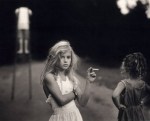
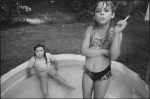

[↖] Sally Mann – The Last Time Emmett Modeled Nude (1987); [↑] Mary Ellen MarkAmanda and her cousin Amy, Valdese, North Carolina (1990); [↗] Sally MannCandy Cigarette from Immediate Family series (1989); [↓] Jen ErvinUntitled (2015)

Follow* the thread.

* There’s a photo that featured on a poster in my undergrad dark room–by an American woman circa the mid-to-late 1990s; it’s a B&W photo (a platinum print?) of a girl–perhaps 9 or 10–standing in dripping wet one-piece swimsuit next to a split rail fence (I think?). Maybe one of her siblings is climbing on the fence, I think there are two other people in the photo. The girl is making eye contact with the camera and is mugging a bit. The surroundings scream American suburbs. Also, I think the title of the image possibly has something to do with summer in Connecticut and it was on a poster from either a gallery or advertising a book (I can’t remember which). I am more than a little irritated with myself for being unable to remember it. (I swear it was Corinne Day but I’ve been unable to find the same photo in anything of hers online.) If anyone has a clue what I’m referring to–please for the love of all that is holy, drop me a line. The point of this post was supposed to be how young photographers don’t even necessarily have to be familiar with the full history of fine art photography because frequently the work that influences them draws influences from folks that are even more prototypically working within the same conceptual realm/with a startling overlap in their creative concerns.

Sally MannGoosebumps (1990)

I’ve introduced roughly a half-dozen folks to Mann. And I’ve had the pleasure to sit with at least three of them while they perused Immediate Family for the first time.

This image almost always solicits some sort of visceral response. Whether it’s a gasp or an unsettled comment about how the photograph maybe takes things a little farther than they should have been taken.

I’ll defend Mann to the ends of the earth and back. Her work–all of it, no matter how sentimental, overwrought or printed inexplicably pitch dark–will always render me impossibly spellbound.

And I know she’d respond to the people I’ve watched shifted uncomfortably looking this image. She’d likely offer the following anecdote:

Once,
Jessie, who was 9 or 10 at the time, was trying on dresses to wear to a
gallery opening of the family pictures in New York. It was spring, and
one dress was sleeveless. When Jessie raised her arms, she realized that
her chest was visible through the oversize armholes. She tossed that
dress aside, and a friend remarked with some perplexity: “Jessie, I
don’t get it. Why on earth would you care if someone can see your chest
through the armholes when you are going to be in a room with a bunch of
pictures that show that same bare chest?”

Jessie was equally perplexed at the friend’s reaction: “Yes, but that is not my chest. Those are photographs.”

I don’t think she’s being disingenuous–I’d go so far as to say knowing what I do about her: she’s incapable of that.

But I do think part of what she’s skillfully avoided addressing in all the controversy surrounding her work is her own voyeurism. Her images–to a one–show us things that implicate the viewer by pulling aside the curtain to reveal things we would–if we were polite–avert our gaze. We don’t though.

And what I think is so vital about her work is what shines through in this work so clearly–everything about this image feels like a private moment (and if I recall correctly, it was until Mann caught a glimpse of it and asked I think it’s Jessie here to hold still while she got her camera).

I feel what upsets people is that we judge Mann as a woman and a mother on top of being a photographer. The photographers duty is to be unflinching–but many people suggest Mann was a bad mother.

But frankly, I don’t really understand the controversy surrounding her work. Although, looking at this photograph, I do find myself wondering how much richer her work would’ve been had she not had to navigate such a puritanical society which associates so automatically nudity as categorically interchangeable with sexuality.

Sally MannThe Last Time Emmett Modeled Nude (1987)

In my admittedly short lived travels in fine art photographic circles, Sally Mann tends to be merely tolerated in public while she is derided and/or dismissed for her ‘excessive sentimentality’ behind closed doors.

So it’s not surprising to witness her wondering aloud in HBO’s excellent documentary What Remains: The Life and Work of Sally Mann whether or not she’ll be ‘pilloried’ by the critics when she exhibits her new project.

It’s a telling scene. Mann’s observation demonstrates a keen understanding of the disparity in her reputation between consumers of culture and the cultural gatekeepers/overlords.

The accusation of ‘excessive sentimentality’ is a palpable hit. The sentimental lies at the foundation of virtually everything she’s ever made. (Except maybe the cibochromes–which if you haven’t witnessed, you are truly missing out on some of the most staggering color work since Eggleston.) 

The cultural gatekeepers/overlords aren’t so patient with sentimentality given their unquestioning adherence to the syllogism dictating that the sentimental is to art as Kryptonite is to Superman.

It all strikes me as too convenient. Yes, Mann’s chosen medium is photography. But that doesn’t mean her lineage can only be traced back through Gowin to Callahan and the Bauhaus movement. Mann belongs equally to the tradition of Walt Whitman and Henry David Thoreau both of whom are comparable sentimental and adored for the fact.

A better criticism might be to draw attention to her blemished, unnecessarily dark printmaking.

Or better yet, acknowledge that–as the aforementioned scene illustrates-even when anxiously doubting herself and her work, she plays the conceptual art shell game masterfully.

What makes her work great is she always predicts criticisms that will arise from the work and uses the work to refute them in advance.

What makes Immediate Family the greatest work she’s ever likely to produce, is its naive, unblinking curiosity that didn’t manage to see the snake until it had already stepped on it and still somehow avoided getting bitten.

It’s impossible for me to narrow that work down to a single favorite image. But this image of Emmett is easily one of the top five.

kalkibodhi:

Feet

KalkiBodhi Archives

Normal
0

false
false
false

EN-US
X-NONE
X-NONE

/* Style Definitions */
table.MsoNormalTable
{mso-style-name:”Table Normal”;
mso-tstyle-rowband-size:0;
mso-tstyle-colband-size:0;
mso-style-noshow:yes;
mso-style-priority:99;
mso-style-parent:””;
mso-padding-alt:0in 5.4pt 0in 5.4pt;
mso-para-margin-top:0in;
mso-para-margin-right:0in;
mso-para-margin-bottom:10.0pt;
mso-para-margin-left:0in;
line-height:115%;
mso-pagination:widow-orphan;
font-size:12.0pt;
mso-bidi-font-size:11.0pt;
font-family:”Garamond”,”serif”;}

Sans attribution, there are two directions guesses at credit for any photograph featuring young nudist women can go: David Hamilton or Jock Sturges.

And despite being in color this bears none of Hamilton’s idyllic, dreamy soft focus.

The large-format aspect ratio points to Sturges despite the fact that he works almost exclusively in B&W.

Also, I am pretty familiar with his work and I cannot recall an instance where the subject whose eyes were wide open was this close to the camera without staring directly into the lens.

Further, although Sturges favors vertical compositions to echo the people standing within his frames, this vertical orientation is skillfully contrapuntal, delicately diminishing the horizontal force of the pose by balancing the negative space in the doorway against the blue wooden slats.

All in all, this contains altogether more calculation than I expect from Sturges’ knee-jerk fine art-photographer-as-gilded-voyeur routine.

But it’s the un-self-conscious mien of the model—who, although nude, appears not as a sexualized object so much as a spectrum of being that includes the possibility of sexuality. Such presence in both one’s own skin and a moment has a definite parallel with Sally Mann’s wonderful Immediate Family.