At first glance, the choice for this photo to be vertically oriented seems clever–the use of space so that the woman’s body is counter balanced in the frame by the negative space of the room around her creates a definite sense of downward movement. In other words, everything works together to imply that she’s taking her knickers off.
Stop and think for a minute tho: if you’re taking your underwear off, how often do you bend all the way down to do so? I don’t–I pull my panties down below my knees and then step out of them, the last leg out hooks the leg hole and then I kick it up to myself so I don’t have to bend over. I feel like that’s fairly common behavior.
You could also say that maybe she doesn’t want to let her undergarments touch the ostensibly funky love hotel duvet–which to me is all the more reason to push them down below your knees and step out of them.
I would wager $5 that she’s actually putting her underwear back on. The photo has just be presented in such a way where there’s an illusion that she’s taking them off.
But it’s a little off-putting to me that if she is–in fact–putting them on, instead of taking them off. There’s a sense that this image has happened post intercourse. The composition and framing tho–misrepresents the truth of the moment and in doing so renders her body permanently in a stage of readying to be sexually available for the (male) viewer.
Also, the scene is alarmingly predictive of Mary Ellen Mark’s Falkland Road project–about sex workers in Mumbai in the late 1970s.
When I think of Mark, I don’t think color; I think of her B&W photos and the way the seamlessly
blurred the line between street photography and social documentary all maximizing the impact of Kodak’s legendary Tri-X emulsion.
For example:
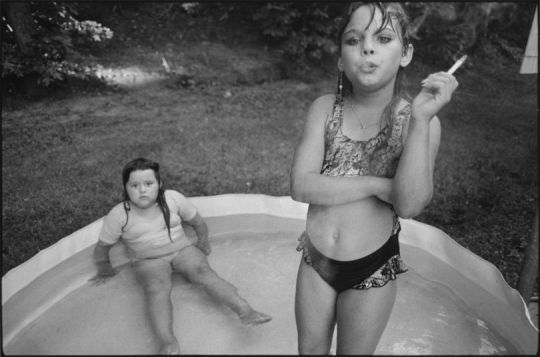
Amanda and her cousin Amy, Valdese, North Carolina (1990)
Unlike Arbus, Mark was less interested in playing up
her subjects station as outliers and instead emphatically orchestrated
her work to underscore the deep humanity of her subjects.
Or so I thought until I dug into her work—with more attention than my usual, casual I-need-to-know-who-this-person-is-so-I-can-talk-knowledgeably-about-her-work-in-a-very-general-survey-101-fashion but I-also-don’t-100%-vibe-with-the-work-on-a-personal-level-so-let’s-keep-it-superficial.
Honestly, there are some pretty significant issues that either I’ve gotten too sensitive to or folks have just been to willing to overlook.
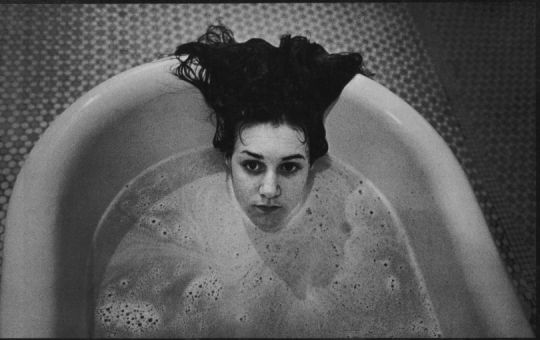
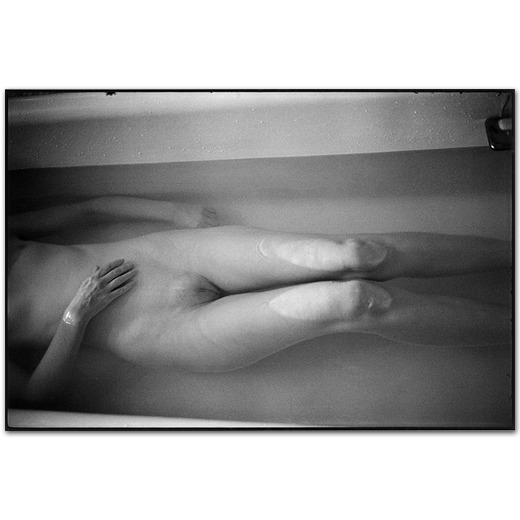
Consider the photo of Laurie in Ward 81 Tub—it’s modern and wouldn’t be out of place posted on social media as if it was made yesterday.
At the time Ward 81 was the only locked women’s mental health institution in Oregon.
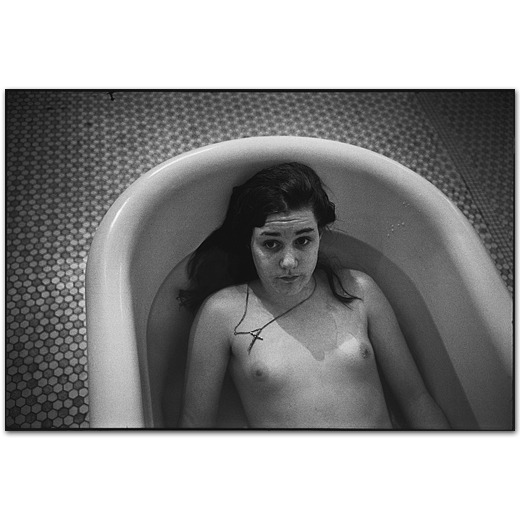
Here are a couple of other photos from that project:
On the one hand: as with all of Mark’s work, the quality and cultural
relevance are unassailable. Conceptually. however, I cannot help but
inquire regarding the informed consent of the women in these
photographs. Were they given a choice in whether they were photographed
or not? And given that they were institutionalized to what degree where
they considered to have some agency over their photographic
representation.
That’s baseline. Then there’s the nudity in the
two images and it makes me uncomfortable—and not in a way that is
in-line with the way the project is conceptually framed.
Falkland Road is problematic in the same fashion, except those problematics are significantly exacerbated.
Let’s
start with the photo alone. It’s obviously show on slide film with a
flash. In and of itself, that is a small technical wonder. Add to that
the simultaneously sumptuous and grungy colors—I have little doubt that
Nan Goldin was hugely influenced by this project.
Backing out a
bit further consider the photo in the context of the attributional
information: a white, cisgender, heterosexual American woman documenting
sex workers in Mumbai in the late 70s. (For me, this sets off a good
number of alarms. Not enough to dismiss it outright—the exceptionally
high quality of the work does counter these alarms reasonably well,
however.)
The story of how this project came to be is worth considering.Mark
travelled to India for the first time in 1968. (The same year as The
Beatles—my suspicion is that this isn’t coincidental and should probably
be examined with a similar lens w/r/t cultural appropriation.)
Curious
about Kamathipura, Mumbai’s red light district, she toured the area and
found herself increasingly curious about the lives of sex workers along
Falkland Road—a low-rent lane with rock bottom rates.
She was
not immediately accepted. In fact, she was initially run off by the sex
workers. However, she kept returning on that trip and on subsequent trips.
After a decade, she and her camera were finally allowed access to
several brothels on Falkland Road.
More alarm bells: a woman from
a colonizing country visiting a former colony to create a project
documenting the lives of indigent sex workers? What could possibly go
wrong… (The path of FOSTA/SESTA from ill-conceived do-good notion to
misguided legislation to free speech chilling modesty fiat provides a
great example of why issue surrounding sex work insist upon a lot of
nuanced, thankless labor to not eff up.)
By now I’m less straddling the fence and more deeply concerned about this project. Let’s take a look at the artist’s statement…
And…
wait? Most of the young women in this project are between the ages of
11 and 15?!?!!! (And just to preempt any shitty neckbeard protestations:
the age of consent in India was 15 from 1949 to 1982—in other words,
most of the women in this project were likely unable to consent to sex.)
That’s
already seriously WTF? territory but it gets worse—Mark describes
seeing the young woman beaten by house madams, pimps and boyfriends. She
points out that the situation tottered over into outright slavery
often.
Alarm bells have transformed into barrage cacophonously complicated
ethical chorus of protestation. On the one hand there’s the dictum that a
photojournalist ceases to be objective when she transitions from
observer to participant. At what point do ethics demand the sacrifice of
objectivity? And if she had interfered what would she have done? I mean
it’s not like she could single handedly rescue all these girls… (I
don’t have an answer to this query, actually; the best I can do is to
suggest that the rash of stories several years back about the stigma
surrounding menstruation on the Indian subcontinent and western NGOs
trying to address and educate Indian women and the subsequent backlash
about the heavy handed approaches that reeked of cultural superiority,
reiterating the same dynamics of colonial power structures; and then the
subsequent response to the backlash that stated the goal shouldn’t be
forcing pads or tampons or western menstruation products on Indian women
so much as working to empower them to address these issues in their own
preferred way within their own cultural reality.)
Conversely,
you really can’t dodge the argument for long that this project is
extremely effective at using the photographer’s rendering of the
incisive humanity of her subjects almost certainly brought awareness to
the plight of low caste sex workers in India.
The flip-side of that is that this raised awareness was paid for in straight up voyeurism.
(Additionally:
Kamathipura became a red light district under British colonial
occupation. And it’s a bit fucked up that the restraint of objectivity
indirectly supports the racist ass notion that this is just how things
are on the Indian subcontinent, contrary to the fact that this wasn’t a
thing until British rule. The British created it and then blamed the
creation–from which they benefited–on the victims.)
There’s
also the fact that Mark included photos of trans women living and
working on Falkland Road. She refers to them using the term transv——
(not a word cis people should ever utter and a word that I—a trans
girl—refuse to use).
And here again I find evidence of an ingrained
attitude of cultural supremacy. To the best of my knowledge, the term hijra was in
broad use in India during the time Mark was there. (Unfortunately, like most folks who received their
primary and secondary education in the 80s and 90s, I’m not super well
versed in Indian culture/history; the way it was explained to me was
that hijra indicates a broader category of gender
questioning/non-conformity that includes trans women but should not be
understood as exclusive to trans women.
If I’m wrong about that
then it would be just as easy to update the titles to read ‘trans
woman’, or, to preempt those who want to argue that this masks the true
face of history: why not render the titles so they ‘transv—— ‘and
then add ‘trans woman’ in brackets?
All this to say: despite the
quality and deep humanity of the work, I do think there are some very
serious ethical shortcomings. I don’t think those shortcomings
necessarily do the project any favors. From the perspective that one of
the bastions of capital-A Art is that it de-emphasizes the wrong
questions and contemplatively shepherds the viewer away from
unproductive questions and instead toward better, more fruitful queries, Falkland Road is a goddamn train wreck.
I mean I’ve spewed text
for 4 pages and feel like I’ve only just scratched the surface.
Although it is interesting that a lot of the conceptual missteps of this
project are still very much active in a lot of the present political
discourse.
Lastly, it’s fascinating that Arbus, Mark and Goldin
all suffer in one way, shape or form from an intrinsic chauvinism. And
all three are saved to the exact extent that they evince a human
solidarity with their subjects—something I think should serve as a
prescient reminder that artist’s are not necessarily bad people but that
artist’s are more likely to make short work of dismissing substantive
ethical quandaries due to viewing them less an end in and of themselves
and more more an obstacle to both the means and the end. (This is
probably the most verbiage anyone has ever used to convey the need to–as the saying goes: check your self [privilege] before you wreck yourself.)
What does it mean to use the problematic aspects of BDSM as a way to explore real power and real pain? Can images be recontextualized through words? What does self-exposure really entail? How are sex positive and sex negative feminists allied against certain kinds of sex and certain kinds of work?
[Trigger warning: see tags]
PART ONE: Fists
[A nude black and white photo of Lori taken from behind. She is seated on a stool, and her arms are pulled straight behind her by a leather bondage device. It has multiple straps and runs up her back and around her neck. Her face isn’t visible and her hands are clenched into fists. She is tilted at a noticeable angle.]
This device sent chills down my arms. I’ve owned a pair of leather restraints for years. I use them on a regular basis at work and occasionally for play. Usually I find restraints unremarkable. There was something about this particular device, though, something about its shape: halfway between the full arm binding of a straitjacket and the piecemeal straps of modern medical restraints, what the girls on my first psych ward called ‘the four points.’
You will only see straitjackets in museums and BDSM parlors these days. It’s not that straitjackets weren’t effective; on the contrary, hardly anything is more effective. It’s that they are horribly painful to wear for long periods of time. Wikipedia explains the physiological reasons with the standard detachment: “Blood tends to pool in the elbows, where swelling may then occur. The hands may become numb from lack of proper circulation, and due to bone and muscle stiffness the upper arms and shoulders may experience excruciating pain.” We’re more civilized than inflicting that sort of pain now.
We’re so civilized we speak in code. When the call came down the hallway for a Code… Code Orange, I think (or Yellow? Not Blue, that was death), we all knew to scatter. Calling codes is one of the many amusing ways psych wards are like commercial BDSM parlors, where the scatter-and-hide code is always ‘Clear’ If one didn’t hide, if one stayed and peeked around the corner, she’d see a man in a business suit being led into a room with a black bondage bed and black leather cuffs. Or, she would see a girl being held down on a white cot, straining against white canvas cuffs.
I made it a point to be as disobedient as I could without incurring consequences. I needed to prove to myself that I was still in control even though I was not able to leave. This tendency faded quickly enough in the BDSM parlor, where we were forbidden to come and go as we pleased to avoid drawing the attention of police to the fact that we fucked men in the ass with dildos and fists. In other words, our restriction was for the safety of the management, and for our safety, too. At ten days, my stay in the psych ward was too brief for my obstinance disappear. When the code was yelled, the orderlies shooed us down the hallway, but I ambled so slowly I fell behind the other girls, stopping right next to the doorway from which the yelling was emanating. I peered in, largely to see if I could, but also because I thought that someone should.



 Acetylene Eyes
