Source unknown – Title unknown (19XX)

There’s a very fine line between simplicity and knee-jerkiness.

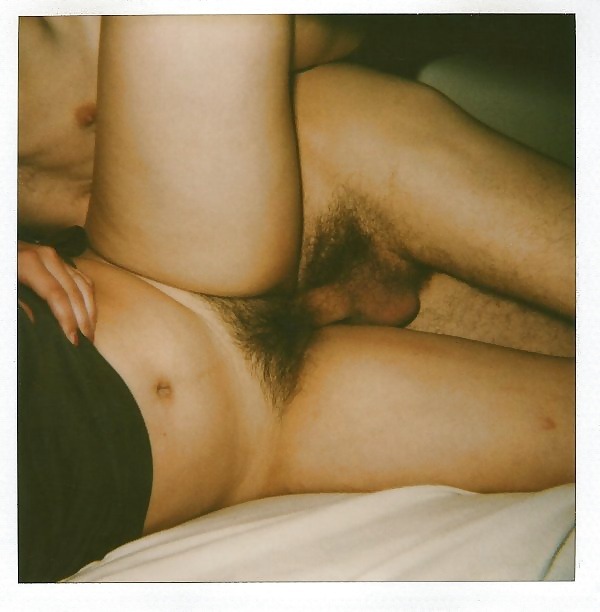
This is a square frame. (Judging by the color and insinuation of texture in the border, I’d wager it’s Polaroid 600.)

The act of penetration is just ever so slightly above and right of center. And given most Polaroid cameras are technically TLRs.

It’s a good bet that whomever framed the image, intended to have the explicit action dead center. The discrepancy between the viewfinder and the taking lens due to parallax saves it.

Er… perhaps it doesn’t.

See: initially, I thought I liked the way that the frame is divided into implicit quarters by the L form of her legs. With more careful consideration, I’m not sure it’s such a great idea.

HOWEVER, it does work here–although it is less about the implicit parsing of the frame and more to do with the way the parsing flattens the frame.

Normally, I’m not someone for flattening the frame. But it’s interesting to note that the fellow here is almost entirely parallel to the focal plane. She’s actually every so slightly foreshortened. (It’s not obvious when you look at her abdomen but consider how her leg is straddling the crook of his hip and then trailing back away from the camera.

There are a couple of reasons this ambiguity aides the photograph. First, it draws in more context. There’s not a lot to take in and while I’m not all that big a fan of close-ups, this has the feel of a hotel room to it. But not in a way that makes you think… oh, hotel room. It’s not something you’d necessarily think of unless someone asked you directly where this scene was shot.

Also, while the subject is pornographic, there’s enough of an auspice of formality that renders the whole thing somewhat understated and demure even. (I’m thinking here of how you cannot photograph water. But you can make images of water when it is contained–in a cup, or a stream bed; or in motion, rain and you don’t show the essence of water so much as you can draw attention to certain characteristic attributes.)

The foreshortening also suggests overlap with the paintings of Caravaggio–in color and mood. But I’d be remiss if I didn’t point out how much the remind of Gauguin’s work from Tahiti. (I can’t explain why…just look at it and I think it’ll be plain as day… I just don’t know how to say it.)


Source unknown – Title Unknown (2009) 

Any halfway decent Philosophy 101 course is going to touch on the notion of an ontological argument.

The premise goes like this: God must exist because a God is perfect and that which exists is more perfect than that which does not exist.

I feel as if a lot of modern images suffer from an ontological raison d’etre–namely, the image you capture is better than the image you don’t because the former exists and the latter does not.

All sorts of justifications are employed to shore up this rationale: if I don’t take a photo I won’t remember or it seemed to suggest something that would make a pretty picture.

I call bullshit on both. On the one hand the notion that folks need to Instagram every prettily plated meal and a trendy eatery cheapens the notion of persistence of memory. I’m sure it was good and all but are the huevos rancheros you had a brunch really something you want to remember ten years from now? (It’s like they teach you early on in film making–there’s no need to shoot coverage of a scene with closeup inserts that show the protagonists movements. He grabs something off the counter and picks up something else on vanity in the vestibule. It’s unnecessary to show a close-up of his wallet and his keys, respectively; unless either figure prominently later in the plot.*)

But the second impetus–it seemed like it would make a pretty picture–is, at least, more fundamentally honest in that it assumes that someone else seeing the image will through seeing it gain something.

The proliferation of ready-at-hand imaging devices has not materially improved image making. This is due to the fact that the vast majority of the impetus to create images is grounded in the capitalist act of conspicuous consumption. It’s not enough that I eat and remember what I ate, it’s necessary to show that one is eating here there or having this or that unmediated experience.

It gets even worse with porn. Consumers of erotic content are spoon fed a stylized and highly unrealistic version of sexuality. What I always find so completely bonkers about that is that–by and large–when folks set out to produce DIY porn, instead of asking themselves how do I convey what my experience of sex is like (or perhaps better: inquiring as to why they have the urge to produce such content and then exploring how to place what they want to show in line with what they create), porn provides an easily replicable template for making you the porn star or starlet of your own triple X scene.)

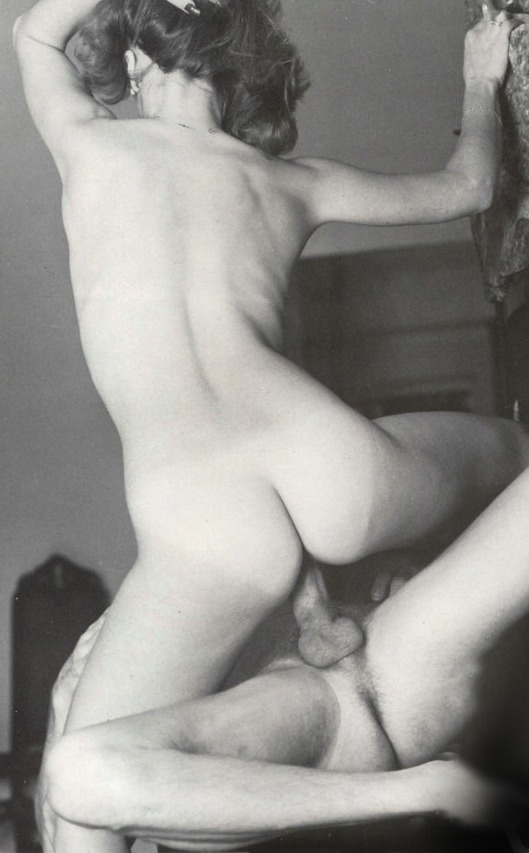
The above is–to my eye–quite different. It’s clear that the audience is seeing something pornographic in nature but the focus is on the expression of an intense, in-the-moment experience of physical pleasure. Yeah, it’s goes way too dark in areas and the shadow cast by the tripod in the upper left corner is detrimental to the immersive effect the image seems to be seeking; but, the way she’s looking back over her shoulder isn’t something that could be easily staged.

Will McBrideRocky & Julia (1972)

One of the most amazing teachers of my life taught Sociology 101 in community college. (She was breathtakingly brilliant and could’ve taught anywhere but as a committed Marxist, she viewed it as her duty to provide the same degree of academic rigor to students who might not necessarily have the resources to attend an Ivy League institution.)

I still refer back to notes from her class a handful of times every year. This time it was to remember the term cultural lag.

The gist of the concept is technological innovation moves at a much faster speed than cultural evolution. As a result it can take a really fucking long time for society to come to terms with advances in technology.

If you are unfamiliar with McBride, he’s notable for his collaboration with Helga Fleischhauer-Hardt, a psychiatrist, on a picture book designed as a resource to help parents educate their children about sex.

The book was called Zeig Mal! (or, Show Me!) and it included frank discussions about sex accompanying age appropriate images of nude children and graphic depictions of teens and adults engaging in sexual activity.

It was well received in Germany–and received a second printing. But it’s publication in the U.S. was more troubled. It was quickly libeled as ‘child pornography’–and despite the fact that it exonerate in court on four different occasions as not obscene.

However, there was a convoluted back and forth about whether or not distributing non-obscene depictions of nude children was protected by the first amendment. To be on the safe side, the publisher opted not to continue to publish the title in the U.S.

The notion of cultural lag doesn’t strictly apply to McBride–if anything the culture was fine until puritanical prudery arrived on the scene.

There is something potentially valuable to consider here; namely: that as long as we remain unclear on what constitutes pornography and what does not, we’re going to continue to have problems like this.

If you disagree think about teens who are getting added to sex offender registries for consensually sexting nudes to other teens.

The pervasive attitude of puritanical prudes is that education/preparation is implicit acceptance of the activity. (The reason so many idiots are against contraception is truly less out of any well-meaning desire to keep kids and teens safe and more born of the fact that “if we provide free condoms, then they’re certainly going to use them.” It’s entirely about control–no more, no less. Fear and coercion only work so long as they keep you from eating of the fruit of the tree of the knowledge of good and evil; once you’ve eaten, you want to continue to eat–you just have the associated guilt over eating in the first place to work through before you can truly enjoy the feast. (Sadly some people never make it.)

Consider another analogy: of the kids I went to a parochial high school with, only one never struggled with the sudden freedom of self-determination upon going off to college. All of them struggled with binge drinking and addiction except the class salutatorian–whose parents wisely allowed her to have a glass of wine with dinner and an occasional beer here and there from the age of twelve onward.

Similarly, the people I know with the healthiest attitudes towards sex are those whose parents refused to teach their children that some sort of shame surrounded their bodies/nudity and who modeled sexual attraction/behaviors in an open but appropriate fashion.

Or, to put it another way: in my experience if a child can formulate a question on a particular topic they are generally more than ready for an honest answer.

We–as a culture–really need to do better about this kind of thing.

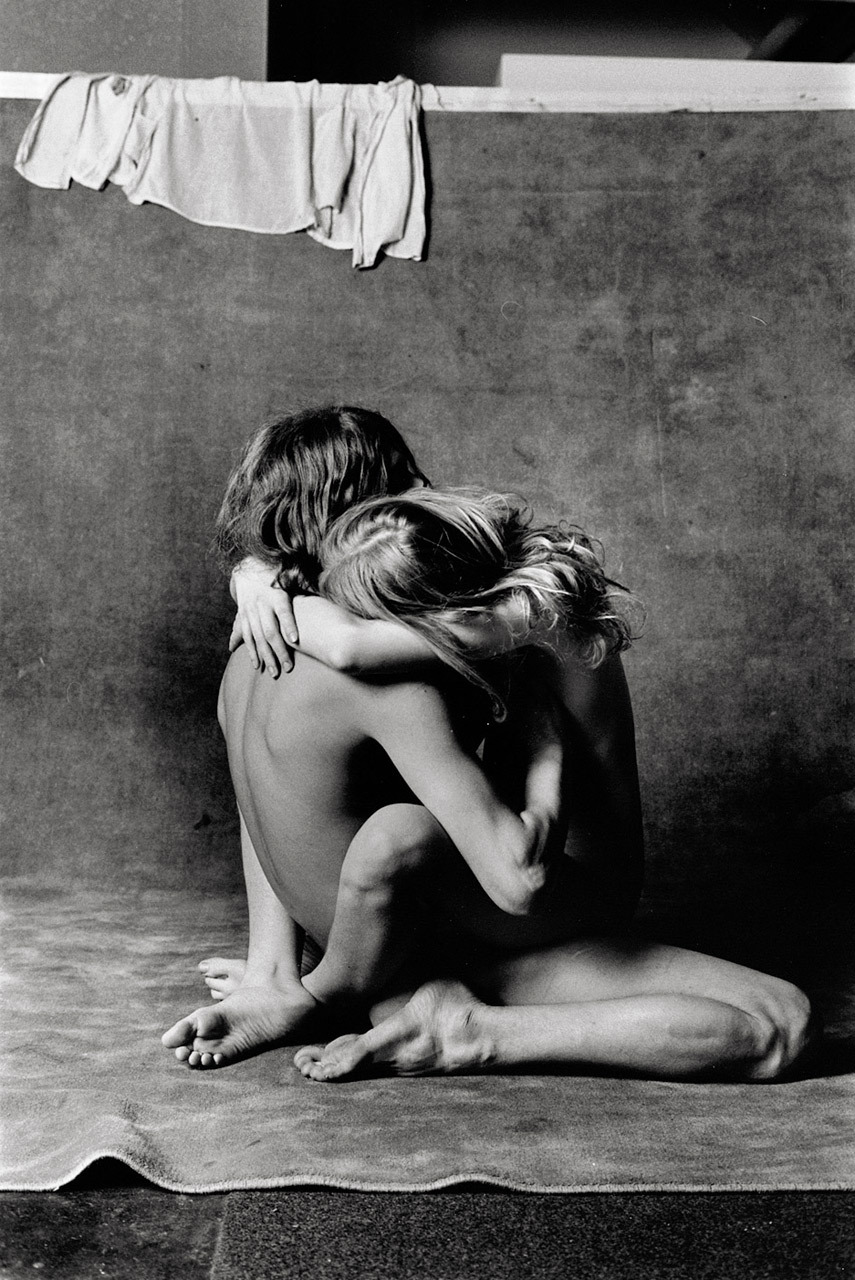
Anyway, I have no idea from what body of work the above image emerged. It would’ve preceded Show Me! by half a decade. But you do have to appreciate the seemingly post-coital intimacy that manages somehow to avoid both sentimentality and salaciousness.