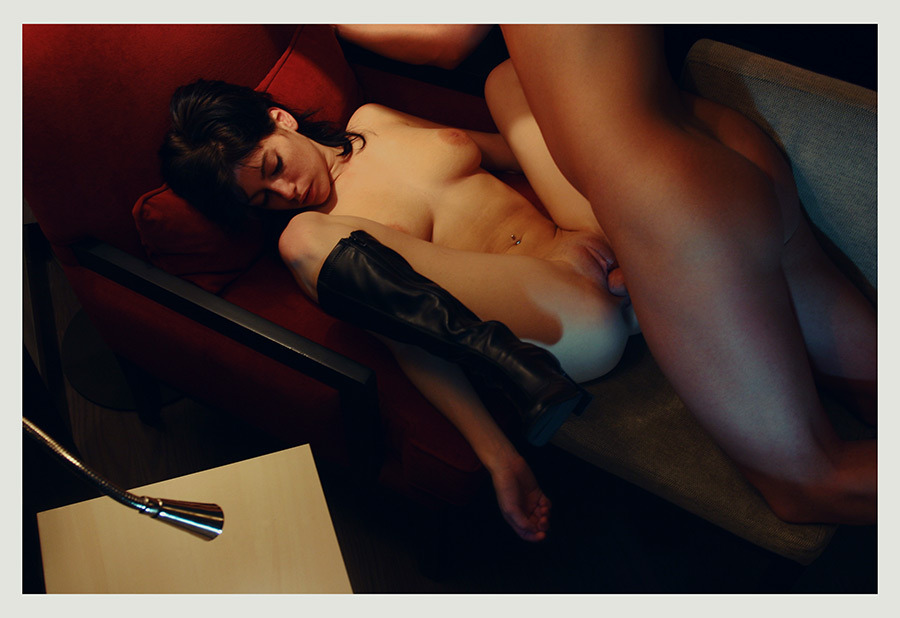
Source unknown – Title unknown (188X)

One thing you learn very quickly studying visual art in academia is the liability that is sentimentality.

The two exceptions I can think of are Nan Goldin–who, while her work is unsentimental, the raison d’etre for her work is fundamentally sentimental; and Sally Mann, whose work frequently borders on inexcusable sentimentality but always manages to maintain a rigorously formal foundation w/r/t to conceptual complexity and masterful execution.

I’m not arguing that the above image is sentimental. It is, however, very earnest and I think all too often that disqualifies certain work from being considered as art.

There are certainly compositional flaws that detract from this. The entire frame is left heavy. As all the elements either shift the eye left or are gathered at the left half of the frame. The “24.” along the right frame edge is placed as if to counter-act some of that off kilterness–but it hardly makes up for it.

Additionally, the lower frame edge cutting at the knee is just inelegant and jarring.

Yet, there is a lot to praise here. The skin tone is lovely–the subtle gradation between the curve of his body and the backdrop, the way her skin is so much lighter than his.

The backdrop borders on ridiculous; however, with the careful drape of the rug and the position of the bodies with the aforementioned gradation, it all suggests a familiarity with classical modes of visual representation.

I also adore the way her arm is bent back and she’s looking directly into the camera. There’s something calculated about it–part defiance, part fascination. Also, the dirty soles of her feet splayed in the air is inspired.

It feels to me like the photographer wanted to make images of people fucking but didn’t want it to read as frivolous. Thus, there’s an attention to detail that although it doesn’t entirely work, it adds a ring of truth to the scene.

I have no idea about the origins of this image. But there does appear to be a scratch on it–bifurcating it more or less horizontally at the center as well as a dogeared corner. It may not be accurate but it’s possible to imagine someone keeping this photo secreted away in a coat pocket.
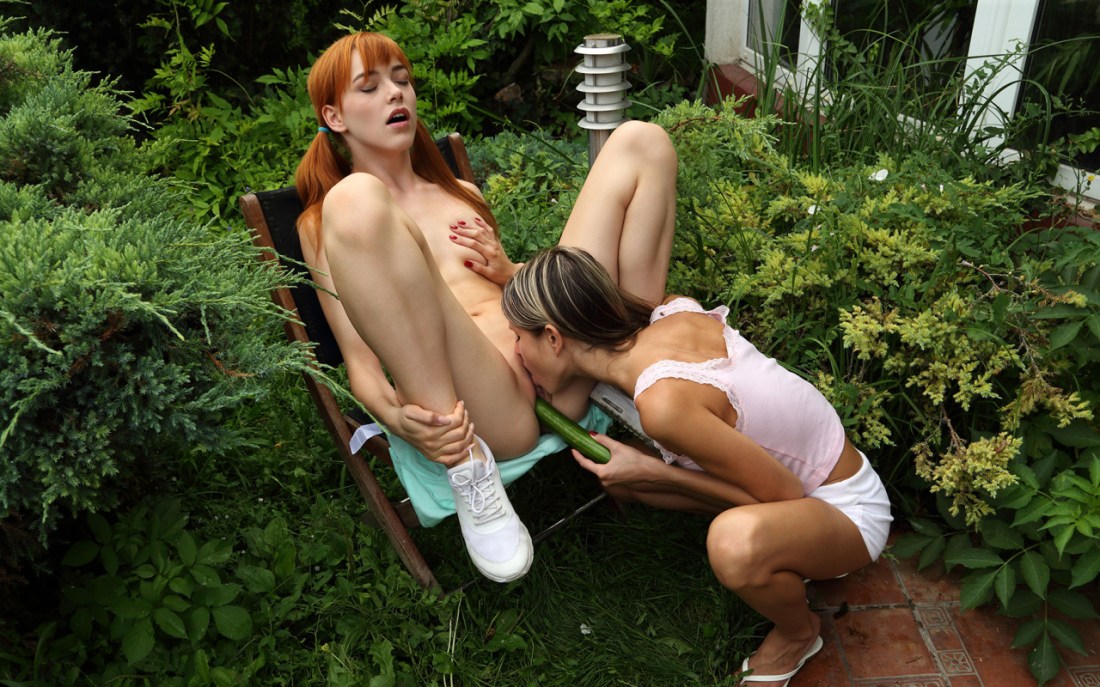
Source unknown – Title unknown (201X)

Unlike most of the porn I post–which tend to be images with a certain audacity I appreciate, honest immediacy I crave or a libidinous savoir faire that resonates strongly with my own weird desires–I think this image ticks all the right boxes but also suggests something about the nature of the question of pornography vs art.

This image is constructed to convey context. I love that with the exception of the woman in the pink blouse’s left flip-flopped foot, both women are presented in their bodily entirety within the frame.

It’s not just my own personal preference here. Pornography–and especially pornographic moving images–there is this tendency of embodying the laziest and worst short cuts offered up by cinema. Establishing shots that suggest the scene is in a famous city that then later cuts to environs built up in sterile soundstage; or, worse, the excessive use of close-up inserts (a tact which only works when kept to a bare minimum since each instance is intended to cause the viewer to take special notice of the object or action depicted, porn tends to gravitate towards something on the order of 65% inserts–pun intended, sorrynotsorry.)

From the standpoint of form, it’s sloppy technique. But, since the advent of DVD players–if not before–a viewer has been able to zoom in on a portion of the frame at will. With the telescoping of increasingly absurd resolutions, there’s really no reason to have a scene play out in extreme close-up. With moderate thought given to composition and blocking, a wide shot could be filmed in such a way that it could subsequently be parsed by the viewer to focus on what interests them.

Back to the question of pornography vs art. I think a better dichotomy might be questioning whether the image is a document or a product. Let’s use the above as an example to show how such an analysis might go.

This is clearly someone’s back yard. And that invites questions of public vs private–in this case a private space that verges on public. The down tilt of the camera emphasizes this. It’s not quite high enough to be the view of a neighbor looking over their fence–but it’s still not entirely possible to shake that feeling that the camera is a stand-in for a voyeur. (In and of itself, the camera functioning as a voyeur does not exclude the the image from being a document. However, in this case, the fact that the woman in the pink top has carefully pulled her hair over her right shoulder so as not to block the camera’s field of view.

Given the absence of body hair, my gut is that this is intended as less a document than a product. Yet, I’m not completely willing to disqualify it from being a document. The use of color is mad on-point. The spectrum of reds–hair, lips, respective skin tone, bricks; greens–bushes, grass, cucumber; the pastel magenta shirt and the aquamarine cushion. There’s also that super-saturated, contrast-y color you get when it’s overcast.

Also, the composition doesn’t quite work–the brushed nickle lighting pylon and the windows and bricks, skew the balance so that frame right is almost twice as heavy as frame left. Still, it’s a solid idea with better than average execution.

Given the opportunity this is exactly the sort of scene I’d like to use as inspiration for a fine art image.

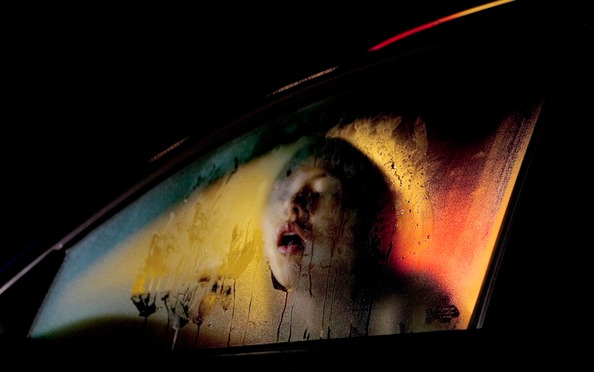
Malerie MarderUntitled from Carnal Knowledge series (1998)

When I first stumbled onto Marder’s work a little more than a year ago, I had mixed feelings about it.

As I’ve subsequently encountered the work and reengaged with it, my estimation has shifted dramatically. The work has grown and I’ve discovered nuance and sensitivities I had previously overlooked.

Yes, I would still very much like to see her make something that is simultaneously capital-A Art and pornography. However, I’m not much less inclined to believe that not making that sort of thing the focus of her work is any sort of detriment or side-step of intrinsic potential and more I suspect if she did make art porn it would immediately clarify a number of stubborn questions I have about how to approach such an endeavor.

Really though, what I’ve learned by spending more time with the work is there’s actually less in the work that relates to pornography or Art. As the title of the series from which these images emanate suggests, these are more documentations of sexual arousal. They are less concerned with any sort of fantasy or sensuality; all but completely disregard any pretense of eroticism and focus simply on the space between tension and distension in physical desire.

The images are about sex. But in being about sex they aren’t intentionally arousing or explicit, that’s merely a natural outcropping of their laser-like focus on presenting the material with honesty, immediacy and intensity of feeling.

Another way to put it might be like this: how do you describe the taste of coffee to someone who has never tasted it? It’s a trick question: you don’t/can’t. You pass them a mug and say here this is hot and strong, try it.

The corollary here is that in a similar fashion, you cannot explain to someone who hasn’t had sex with another person, what it’s like. You can say it’s different than masturbating; but as to how it’s different… yeah, good luck with that. Because there’s the way the sensation is fundamentally different.

To be crass: being so horny you need to get yourself off to alleviate the tension is not unlike hunger but desire to share a connection with someone is much closer to thirst.

I believe Marder’s work is seeking to address something of the mechanism of such thirst. And the extraordinariness of that cannot be overstated.

Kerstin DrechselUntitled from if you close the door series (2009)

With the exception of The Cabinet of Dr. Caligari, I’m not all that fond of expressionism.

In fairness, I can’t imagine Drechsel fancies herself an expressionist. But I think there’s an argument to be made that while if you close the door starts off more classically photo-realistic as it becomes more enmeshed in the private experiences of loves, it begins to disintegrate into something that shares elements of expressionism.

I love how the work is at once both graphic and implicit. The sometimes fumbling awkwardness of the exchanges.

Take this image: I can’t get over the matching knickers. The way each partner is stimulating the other and holding the other at a distance. (The one on the left in an effort to watch her lovers body and the one on the right because she is approaching orgasm–note the way the partner on the right has her lips parted but at the same time this expression is partly elided by the clumsy shadow her partner is casting across her face.

I also really like the vaginal shape of the composition. It’s not at all subtle but in the context of the work it’s a powerful statement about whom and for what purpose the work was created (i.e. it wasn’t made for white cishet dudes to objectify).

Anna CladoniaVarious Portraits* (2010-2015)

I’ve been thinking about Emily Dickinson a lot lately.

Not due to any connection between It Sifts From Leaden Sieves and the fact it’s snowing balls outside right now. (Although I am hardly oblivious to the synchronicity.)

But, on that note, why do we teach Dickinson to middle schoolers by introducing them to the myriad complexities and nearly infinite scope of her work via the aforementioned poem and A Narrow Fellow in the Grass? It’s no wonder I hated her work until I revisited it in my twenties and immediately fell in love with the work and the incredible woman who made it. (Seriously: the think-question you tend to get asked on first dates about what person living or dead you’d most want to have dinner with, yeah… Emily Dickinson all the way. Even if I have grown to strongly prefer Bishop’s body of work.)

I promise… this seemingly self-indulgent ramble does relate to Cladonia’s devastating photographs–bear with me a bit longer.

My objection to the way Dickinson tends to be taught is that it tends to emphasize the allegorical (nature imagery) over the more metaphorical work. You’d do much better to start with the exquisite, goth-before-goth-was-a-scene I Felt a Funeral in my Brain… Couple that with the fact that the window to Dickinson’s bedroom overlooked a cemetery and even twelve year-old’s can easily grasp the incisive eye which uses words to describe the landscape of a morbid imagination.

However, once you dig into Dickinson–I mean really dig in–one line of hers takes on profound resonance: “my business is circumference.”

It’s an odd claim–especially from a woman who never traveled further than a day away from the house in which she was born. Yet, the acuity of her perception and her openness to the world and experiences in her immediate surroundings taught her in a fashion not unlike that of a storied traveler.

Cladonia exhibits a similarly circumscribed scope. Her photos are ostensibly portraits–largely shot in ramshackle Moscow apartments. But within those narrow parameters there’s evidence of an encyclopedic familiarity with the history of photography.

Beyond the essential Russian-ness of her work, the astute viewer can easily recognize winking references to virtually every Russian image maker I’ve ever posted on this blog–but especially to Igor Mukhin and Evgeny Mokhorev.

But there’s also grace notes from David Hamilton and Duane Michals.

Having and wearing your influences on your shirt sleeve doesn’t necessarily make for good work, unfortunately. But what Cladonia manages is less homage than a point of loving departure–she takes a great idea that resonates strongly with her and makes it her own.

In and of itself–that’s the mark of a truly great photographer. But there’s also the way she embraces and eschews obtrusive image grain, her spare and gorgeous use of autochrome-esque color (I + II). And that’s not even getting into her revelatorily explicit handling of masturbation and sexual expression.

Marielle Heller + Brandon Trost – Still from Diary of a Teenage Girl (2015)

If you haven’t already, you really, really, really, really, really (that’s 5 reallys) should see Diary of a Teenage Girl.

The premise of the film is a fifteen year-old named Minnie (an excellent Bel Powley) carries on a relationship with her mother’s boyfriend Monroe (Alexander Skarsgård).

If you’re thinking isn’t that crossing some kind of uncrossable line? Well, Powley was twenty-one during production. Yes, she’s playing younger but the film is carefully structure to introduce us to Minnie as a precocious teenager. We’re given a glimpse of who she is and how she thinks, responds & interacts with the world around her before anything carnal unfolds.

Minnie’s response to her initial sexual explorations is a natural extension of her personality. And it’s frankly fascinating how the movie uses the fleeting–and yes explicit (but tastefully so) sex scenes–as depth charges to test and more thoroughly define her character.

That there was no outrage over this is likely due to the fact that the makers carefully avoid any sort of obvious or easy imposition of moral prudery–in fact there’s a feeling that it was intended as a sort of quasi-fairy tale as to what the world might be like if the world weren’t so sexually repressed. But, it’s also notable as the film was directed by a woman.

Also, Marielle Heller was one of the few women to direct a film with studio backing. That it’s one of the five best movies of the year, should speak volumes about why we need more women filmmakers.

Edward YsaisUntitled (2013)

I’ve had this image saved as a draft for almost a year. There’s no arguing that it’s chiaroscuro is executed with skillful aplomb. It’s memorable, quality work and I like it… but I’m conflicted about it.

At first, I thought that the both women were the same person. That’s largely because I am absolutely awful when it comes to facial recognition. For example: If I’m meeting someone I don’t know all that well, when I scan a crowd I’m noting things like height, hair color, build and body language.

I don’t think these are the same women (it’s not entirely clear but the woman entwined with the man appears to have longer hair than the one in the mirror). So my initial impression of this as a critique of the male gaze–wherein the male surrenders to sexual bliss while the woman is condemned to a duality of experience wherein she not only experiences sensation but also stands detached monitoring and critiquing her the relationship between her experience and the male consumption of her experience.

Without that anchor, I’m not really sure what to make of the image. Is this a threesome? There’s a sheen on the woman in the mirror’s skin that could be suggestive of such a scenario. But it fears more like a nightmare–a woman dreaming about her lover cheating on her.

And that’s kind of where things start to unravel for me. In my experience as a dreamer, mirrors straight up DO NOT work like they are represented here. In other words, my experience is that the mirror only reflects a part of me–i.e. my head or I don’t have a reflection.

This dissonance opens a door to some critical considerations about the work. Yes, it’s pretty. Yes, the lighting is sumptuous. Yes, it’s almost certainly riffing on Velázquez‘s Las Meninas.

However, note the way Velázquez uses available light as the primary motivation for his composition. In other words, the perspective the viewer is presented is one which given the light renders a composition built around a masterful understanding of space–especially distance and depth.

Ysais’ image is alarmingly flat. The light functions to render the scene legible and in no way informs the composition. And once you follow that rabbit trail, you realize that due to the slight down tilt of the camera–presumably to compliment the mirror–the vertical slat of the partition at the extreme left of the frame is put askew. Further, the horizontal and vertical slats, transitioning to the bas relief to the damask pattern to the drape and the echoing drape in the reflection–the artifice of the frame becomes hard to suspend in favor of disbelief.

It’s something I’m discovering in my own work of late: the distance between a bad image and a good one is exponentially less than what separates good from great.

Mihály ZichyNaughty Satyr (18XX)

I’m not sure I can think of another artist as gleefully transgressive as Zichy.

Erections, cunnilingus and masturbation all feature prominently in his drawings.

There are two things I find especially fascinating about his work. Zichy essentially had two styles–his sexually explicit tableaux are always equal parts humorous/playful and presented in a distinctly Renaissance style while his more exploratory sketches appear rigorously formal, reminiscent of little more than an Anatomy text. (Interestingly, if you split the difference between these two styles you stumble upon something not altogether different than the sketches of Klimt and Picasso–both who would almost certainly have been familiar with Zichy’s oeuvre.  Secondly, although his fixation on male sexual response can come across as a bit grating to modern sensibilities–he acknowledges rather less than implicitly that women are not only able but should be allowed to derive pleasure from sex.

I’m not 100% certain that this image is actually called Naughty Satyr. It’s a good title though. If you remember your mythology, Satyrs were demigod drunkards. As such, Naughty Satyr is a bit rendundant. And I like to think that the reason the Satyr here is deemed naughty is not the fact that he’s sexing up this nymph, it’s that he’s enjoying her flesh and abdicating both his pleasure as well as hers up to her alone.

I would think (drunk or not) a less selfish satyr would have braced the palm of his hand on the inside of her thigh in such a way that his thumb could shuttle back and forth over her clitoris.