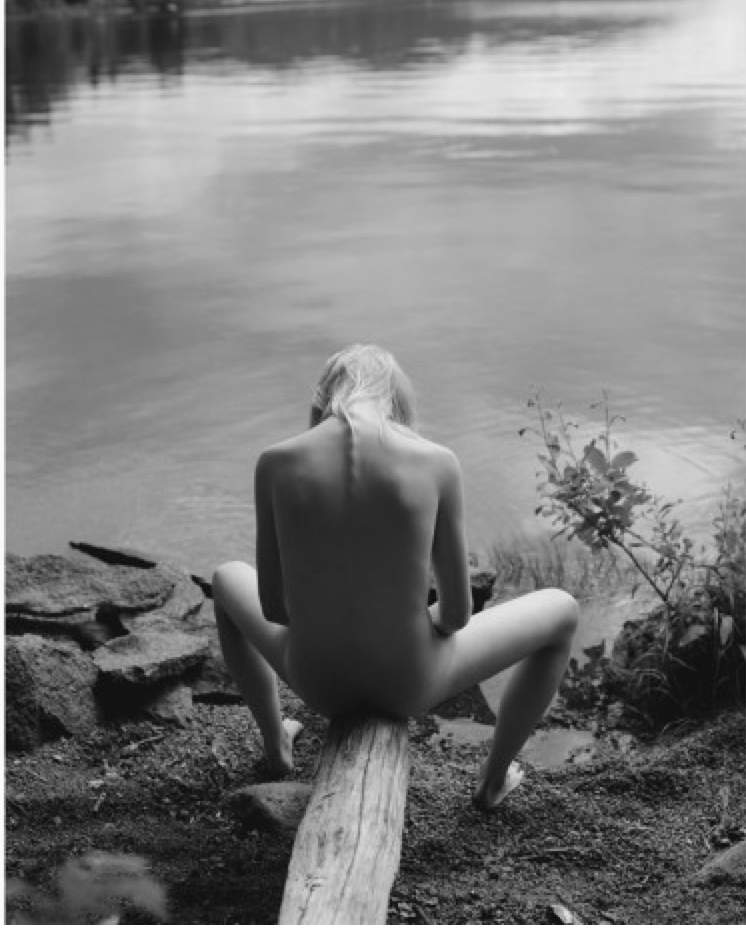
Massimo LeardiniUntitled from Scandinavian Girls (2013)

This wears its influences on its sleeve–Jock Sturges and Arno Rafael Minkkinen.

One out of two isn’t bad.

But it also shares common ground with Taiwanese genius Yung Cheng Lin insofar as it chooses implicit insinuation over explicit denotation, i.e. this could be nothing more than a simple image of a sprite nude young woman in nature, yet the pose here can just as easily be read as a sort of adolescent body curiosity which is perhaps even masturbatory; also the positioning of the log could reference Freudian misogyny or–I’ll pretend I’m an optimist today: an underdeveloped theme of genderfuckery. (I don’t really think that last suggestion fits because in this case the vertical composition is logically consistent with the image; yeah, it’s phallic as fuck but at least the skinny frame is logically consistent.)

In other words, I’m into this image on a conceptual level and not so much w/r/t technique–there’s almost no highlight detail which limits contrast and tonal separation by hazing out the middle greys. (Imagine what this would’ve looked like with the 3D pop that you can get when you effing nail the exposure with an appropriately contrasty film stock.)

Source unknown – Title Unknown (20XX)

Artfully depicting masturbation is not an easy feat.

The act is private, sequestered. Thus, the question of how one witnesses such goings on becomes central—is it voyeurism, exhibitionism or a bit of both?

The more voyeuristic the image, the less intentional it appears, the more it relies upon the reputation of the image maker to supplement its ‘artistic’ merit.

The more exhibitionist the image, the less artful it appears–exhibitionism being rooted in self-consciousness and the efficacy of art being so commonly measured on its ability to annihilate notions of self and other.

This scene suggest an altogether brilliant fucking with this dichotomy: subvert the distinction between subject and object. What’s one of the oldest means of doing that? Reflections.

Now, I will not argue the young woman is unaware of the camera. (She definitely is… at least initially but she’s watching herself trigger and experience her bodies sexual response.

This discursive nesting of contexts–for me at least–continually refocus my attention on her increasing arousal and accompanying pleasure.

That to me is such a fucking turn-on that I really can’t even…

(NOTE: I had previously published .gif excerpts from this clip. I’ve elaborated somewhat on the comments accompanying those .gifs in an effort to tidy things up a bit.)

Lina Scheyniusamanda (2014)

If you do any reading on Scheynius, after the model turned photographer angle, you’ll invariable hear folks opine ever so elegantly about how her work focuses on intimacy or is preoccupied with the so-called female gaze.

I won’t object to either suggestion but I do find the tendency towards reducing a complicated, nuanced work to one or two of it’s representative elements almost always does a disservice to the artist and the work.

To my eye there is always something related to an effort to externalize and give voice to a primal, gnawing physical desire.

I don’t remember where I read it–perhaps in Scheynius’ recent interview with Zeit–where she recalls how one of her first modeling contracts stipulated that she could not gain more than a cm in any of her measurements over the course of a year.

And in much of her self-portraiture there is an element of violence in the way she documents her body that is always in dialogue with a ferociously unapologetic presentation of sexuality and a flirtatious ambivalence towards coyly implicit and outre explicit.

However, this approach to depicting herself doesn’t extend to others. The unflinching eye she turns on herself, becomes tender, seeks the wonder in light on skin, the line of the body in space–a fierce awe that acknowledges the connection between physicality and sexuality while refusing to sexualize the subject against the parameters of how they wish to be seen in any given moment.

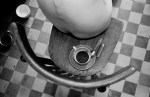
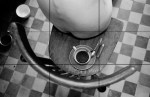
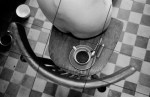
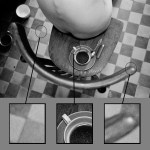
[↑] Igor MukhinUntitled (2010); [←] rule of thirds (overlay); [→] rule of thirds + 18° (overlay); [↓] grain density & depth of field (magnification sampling)

I talk to much and say too little. I decided to show as opposed to telling you the genius-tier visual math shit going on here.

Igor Mukhin has forgotten more about the photographic craft than most of us will ever hope to know.

Petra DolezovaUntitled (2011)

Have you ever come awake too soon from a beautiful dream? I’m talking one where you immediately roll over, screw your eyes shut and focus every bit of energy on descending bacl into it again?

If you can recover it, it’s never quite as vivid as it was the first time around. like a dream seen through gauze, in a mirror.

It’s a feeling not unlike the thread that runs through Slovakian-born, Dutch educated Petra Dolezova’s stunning work.

I’d very much like to share some of my impressions but her work truly deserves at least initial contemplation. So please, do the internet equivalent of closing the text around your finger and go through her entire Flickr photostream. Treat each image the way you would a savory mouthful of food, chew slowly, twenty times, before swallow. (I’ll still be here when you get back.

Oh and may I suggest a sonic pairing, this 1997 vintage Labradford enhances the oneiric grace notes rather well.

I keep fighting a strong urge to term Dolezova’s work ‘minimalist’; except as much as I’ve studied both art history and critical theory, my understanding of minimalism is a bit like those words that are their own opposites.

On the one hand–and I think this constitutes more of the general denotation: minimalism suggests a diminution of ornaments (necessarily entails additional, implicit emphasis of form). One declare Philip Glass and architecture with clean lines to be ‘minimal’.

On the other hand, there’s a tendency to think of minimalism as something additive. I add this line or that curve to negative space–the relationship of the line or curve to such space is minimal. However, if you invert it and consider empty space as the locus of meaning, the what appears maximal is actual razor sharp in its subtly and nuance. (Silence is a sound; melody is sometimes what is excluded.)

And that’s glossing over questions of conceptualization, concerns over execution.

I think my instinct to label them minimalist has to do with the way the presence of each image all but extends to the viewer the key to its own undoing. As if the image is less witnessing document and more kataphasis/apophasis perpetual motion machine.

As if there is no author [praxis] in which theory and practice are fused; as if there is no sayer to impose two words when one will do–all that is unnecessary or extraneous has been removed; there is only the image.

P.S. PH Magazine did an interview with Dolezova a few years back. The questions are underwhelming but it’s difficult not to admire her straightforward and meticulous responses.
kindnessinyoureyes:

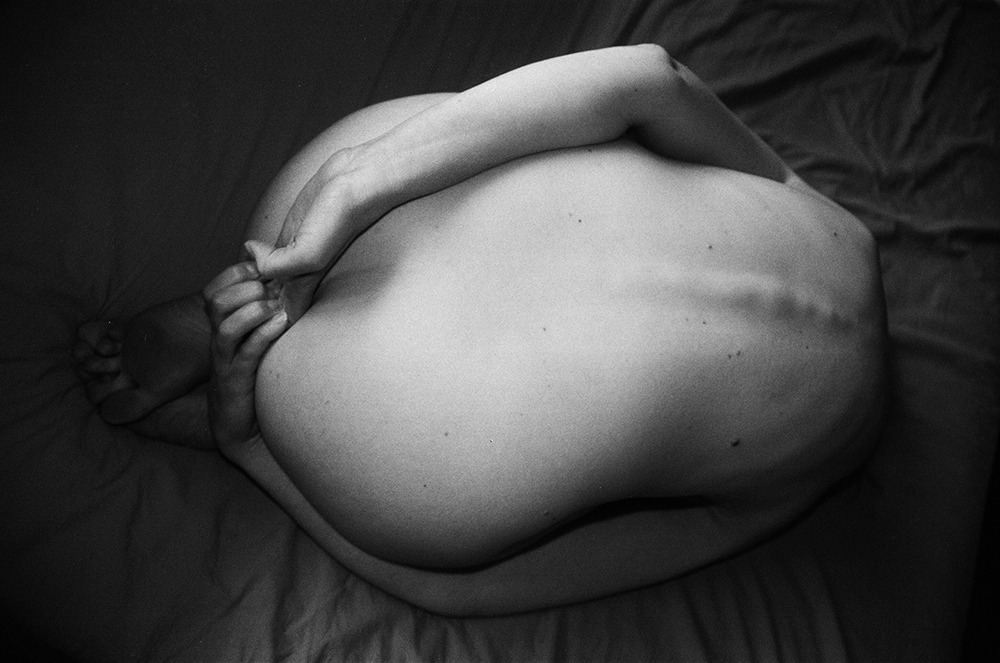
Adam
London, June 2013

This is a thoughtful way to present a male-bodied nude: soles of both feet exposed, clenched ass, the arching line of the spine and the his right arm covers his face; except for the heavily dangling scrotum and cut definition of trapezius and deltoid musculature, it is an androgynous-to-effeminate depiction– explicit, vulnerable and mysterious.

It reminds me of one of my favorite images from last year. (That post is worth re-reading as it covers ground I’ll be skipping this time around.)

Comparing these two images does Leonidas’ work a disservice. And although I will give him credit for shooting film (Fuji’s Superia color negative, in this case), most of the faults are a result of sloppy craft.

This is the most egregious example of #skinnyframebullshit, I’ve posted. Whereas most people deploy portrait orientation to the end of reifying the verticality of the composition–lame at best as far as justification goes, lazy at worst–the subject here is not vertical.

You can feeling it just looking at the image but to see it visualize the center vertical as a fulcrum balancing the rear leg of the chair (frame left) and the top of the boy’s head (frame right). Notice the rightward thrust. Add this to the light pooling in overexposed puddles on the floor and back wall, the lack of space between the chair and wall and the flow of the composition is decidedly right leaning. The angle of the shot is an effort to use the line where the floor meets the wall as a means of adding dimensionality but this only exacerbates the existing problems with the slant.

Landscape orientation would have made a much more dynamic composition. And while this lacks the audacity of the image of which it reminds me, it might have done a better job standing on its own.

Criticisms notwithstanding, the scarcity of images depicting male-bodied persons in a simultaneously ‘formal’ and sexually charged imagery is such a rarity, that efforts, however flawed, deserve acknowledgement.

rawpix:

May21s†♥mirror/†he…mind(Daniel Schaefer)★

Roulé

Normal
0

false
false
false

EN-US
X-NONE
X-NONE

/* Style Definitions */
table.MsoNormalTable
{mso-style-name:”Table Normal”;
mso-tstyle-rowband-size:0;
mso-tstyle-colband-size:0;
mso-style-noshow:yes;
mso-style-priority:99;
mso-style-parent:””;
mso-padding-alt:0in 5.4pt 0in 5.4pt;
mso-para-margin-top:0in;
mso-para-margin-right:0in;
mso-para-margin-bottom:10.0pt;
mso-para-margin-left:0in;
line-height:115%;
mso-pagination:widow-orphan;
font-size:12.0pt;
mso-bidi-font-size:11.0pt;
font-family:”Garamond”,”serif”;}

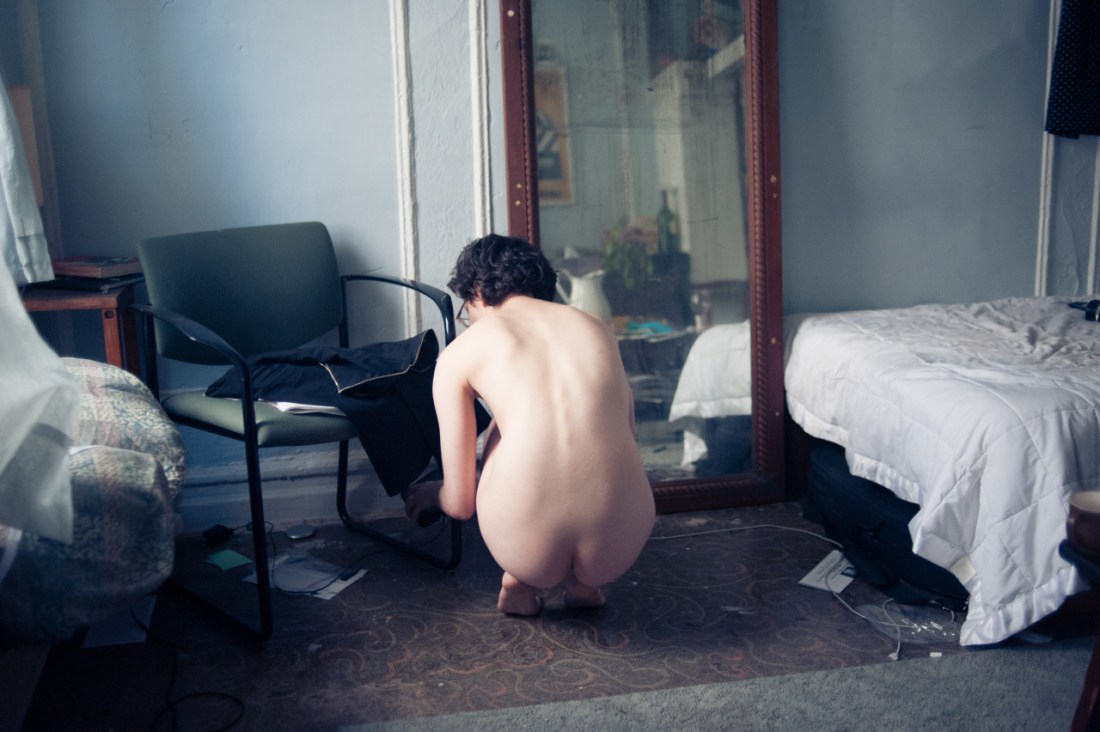
This interior—with its Spartan-with-Bohemian-pretenses—is reminiscent of my shitty, first-post college apartment in NYC.

What’s more startling is the resemblance of the young woman to the lover with whom I shared much of my time in that apartment. She, who in the pauses between our lovemaking, would crawl kneel o check the message on her phone she’d leave charging on the floor just like this.

The composition has an imprecise, snapshot immediacy which would almost certainly have appeared stale and uninspired were it not for the mirror’s reflection adding some much needed depth. Yet, what this image nails is presenting an ideal scale for everything the image contains.

Although she is kneeling, the frame is only slightly taller than she would be if she were standing. If she stood, the frame would have to move in order to contain her. In other words, she is the frame’s anchor—not vice versa; she agency in inhabit a space with implicit instead of merely appearing as an ancillary decoration.

This post is guest curated by azura09:

nevver:

How to bend light

And in the dark we will take off our clothes
And they’ll be placing fingers through the notches in your spine

When I first looked at you in the almost-dark, scared that you would not like my breasts. That I would see disappointment on your face. But you still pushed me to touch you, my fingers climbing your back as I held you and kissed you near your mouth. 

Years pass and I’m used to your hatred of overhead lighting. I expect it when you reach over to turn on the desk lamp or light a candle I don’t like the smell of, wax and apple cinnamon. I’m grateful for the way you now know my body so well it’s not necessary for you to see me, but yet you still want to look.

youarecordiallyinvitedtopissoff:

Annamaria Kowalsky

I dig this image. Part of it is definitely due to the latent pyro in me. Plus it captures all the best of what Kowalsky—no, not Kowalski—brings to the table as a violist-by-day/photographer-by-night.

Yet, I feel my response has to address the indebtedness of Kowalsky’s work to Brooke Shaden—whose work I loathe.

What makes Kowalsky’s work attractive—besides the violist bit (I am a love fool for musicians, dontcha know?)—is the manner whereby she dodges Shaden’s derivative interpretations with sincere photographic inquiry. Her images tell the story of how she sees herself as well as how she wishes she was seen.

In other words, photo manipulation is not an end in and of itself to Kowalsky—and make no mistake this and much of her work are composites (to which I normally object but if I’ll give Jeff Wall a pass…); instead, the implausibility of her contrived images recall in-between-ness of the moment after you glimpse something you are certain is impossible and the moment before you looking again to discover it was just the play of the light sparking your eyes’ imagination.