
Tono Stano – Untitled (2001)

Rimantas Dichavičius – Untitled from Žiedai tarp žiedų (1965-1989)
When my absence doesn’t alter your life, my presence has no meaning in it.
–Unknown
If I say of myself that it is only from my own case that I know what the word “pain” means—must I not say the same of other people too? And how can I generalize the one case so irresponsibly?
Now someone tells me that he knows what pain is only from his own case!–Suppose everyone had a box with something in it: we call it a “beetle”. No one can look into anyone else’s box, and everyone says he knows what a beetle is only by looking at his beetle.—Here it would be quite possible for everyone to have something different in his box. One might even imagine such a thing constantly changing.—But suppose the word “beetle” had a use in these people’s language?—If so it would not be used as the name of a thing. The thing in the box has no place in the language-game at all; not even as a something: for the box might even be empty.—No, one can ‘divide through’ by the thing in the box; it cancels out, whatever it is.
That is to say: if we construe the grammar of the expression of sensation on the model of ‘object and designation’ the object drops out of consideration as irrelevant.
–Ludwig Wittgenstein, Philosophical Investigations §293
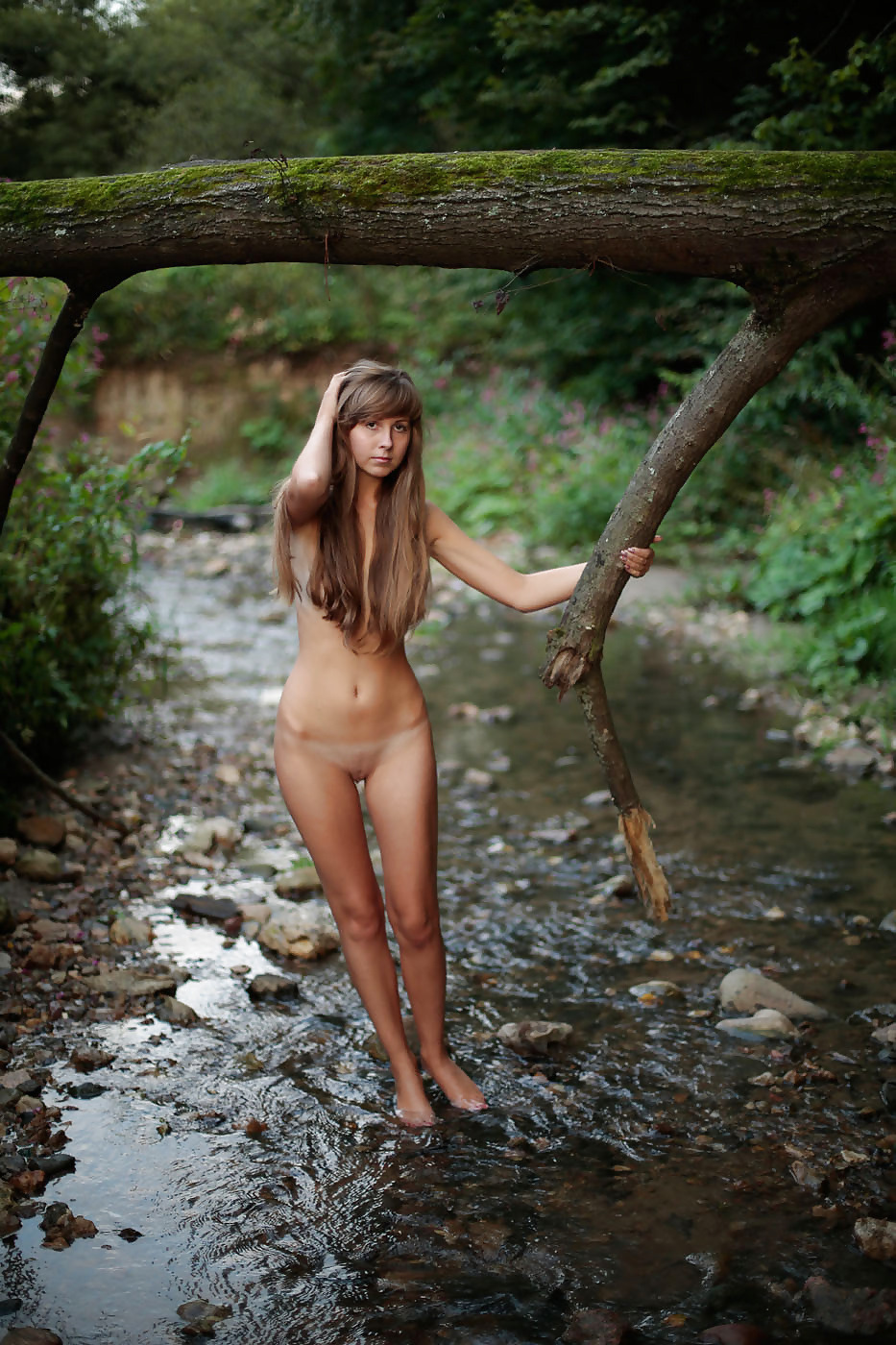
Author unknown – Catherine from Summer Stream series (2013)
This features a solid concept. Like I’m fairly certain anyone who has spent any kind of time behind a camera, would’ve absolutely seen this as a shot if the tableau were unfolding before them in the moment.
And I don’t actually have any of my usual #skinnyframebullshit qualms with the vertical orientation here–you want to emphasize the way her pose is echoing the shape of the branch onto which she’s holding. (A horizontal frame would necessarily privilege the fallen tree.)
The extremely shallow depth of field recalls Mona Kuhn–except she’s working analog (which features an automatically shallower DoF, with much better lenses, and you know uses bokeh to dimensional effect).
The bokeh in the above is super digital artifact-y and not especially flattering; I’d also argue given the frame that it’s a mistake as the lighting being as it is, the eye would naturally bestow a much larger DoF on the scene since Catherine is clearly aware of being seen and the expression on her face makes it clear that even if she is a wood nymph, she’s being witnessed by a human watcher).
So while I don’t think this is exactly well-executed, it still fundamentally works based on the premise it conveys.
That feeling that causes a photographer or image maker to raise the viewfinder to their eye and try to feel what they did when they saw something that captivated them is something I’ve been thinking a lot about–usually while high as fuck on extremely potent marijuana edibles.
I’m not a linguist–not even close. But it occurred to me that ‘optical’ and ‘option’ feature the same root: opt-.
Optic is from the Greek by way of Medieval Latin; Opt would’ve been emerged in Latin about 50 years after optic.
I’m not sure how to rigorously go about it, but it seems to be that there is likely some conceptual underpinning of language that understands seeing and choosing as related and frequently overlapping processes.
So yeah, those are my cursory notes for a future first day as a beginning photography teacher lecture.
 Acetylene Eyes