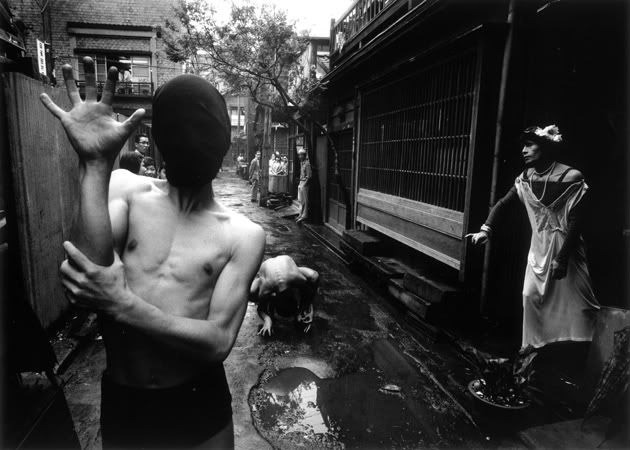
William Klein – Danseurs Crabes (Kazuo Ono) (1961)
Apparently, Klein was known in Japan as a Leica shooter. And although I am extremely dubious that the above image was made with a Leica–with a gun to my head I’d say the bokeh in the background trees screams Nikkor lens–I’m going to run with the notion as it allows perhaps the smoothest segue I’ll manage to a tangential topic.
During my time in Berlin, I was able to see the C|O Berlin Eyes Wide Open!: 100 Years of Leica exhibit. (It’s up for another 45 days or thereabouts–so if you are anywhere close, you really should go to the trouble of dropping it; it’s quite extraordinary.)
Honestly, I have mixed feelings about Leica. The craftsmanship that goes into making them is unparalleled. However, my tendency is to choke whenever things get down to check out; I’m always asking myself: is it really worth paying $10K for a camera with one lens. (Plus, in side-by-side comparisons, I tend to prefer the sharpness of a Zeiss lens to the characteristic Leica lens moody contrast.)
Recently, this opinion has shifted. Largely because Trixie, my Fuji TX-1, is a rangefinder–and truthfully although there’s an ultra-steep learning curve when you come from SLRs, I’m actually finding myself more engaged with what I’m shooting.
So it really was the perfect moment for me to encounter this show as it tipped me over from being morally opposed to Leica to starting to think about how one day maybe I’ll be able to afford an MP…
Anyway, the thing I wanted to mention about the show is that the curation was mad on fleek. Seriously impressive. In a nutshell, the exhibit was laid out chronologically so you could see how the compact portability of the camera evolved from it’s inception through roll out, to the golden age of photojournalism.
Yet, the most fascinating thing was the either penultimate or final (I can’t remember which) descriptive plaque that contextualized the entire history of photography within the microcosm of work made with Leica cameras. I’m going to reproduce it here verbatim:
At a time in which none of the remaining magazines can or wants to afford a permanently employed photographer, yet on the other hand museums are showing photographs, galleries are dealing with photos and corporate collections feed very much on photographic images, the author with an interest in art–nolens volens–has become a model of our postmodernist photo culture. Any overview of the terrain shows six different types of photographers as authors, though the boundaries are of course fluid.
Young photographers still stay true to the genre “Reportage”, even though they now travel with self-assigned commissions, often pursue themes over a long period of time and determinedly rely on their own signature, in order to set themselves apart from the fast food of the electronic media (Paolo Pellegrin, Kai Wiedenhöfer). The “Photographic essay”–traditionally the “Travel report”–as a henceforth critical, formally ambitious exploration of a world in upheaval (Bertrand Meuiner, Klavdij Sluban) has remained just as topical as examination of social themes in the sense of approach that has been defined as “Personal documentary” (Jane Evelyn Atwood, Michael von Graffenried, Gaël Turine) of late. Photographers uses their camera to overcome personal trauma or to simply explore their private environment, creating a kind of “Visual diary” (Paula Luttringer, Alberto García-Alix, Tom Wood). They purposely operate their camera in defiance of the dictates of the instruction manual, and in the spirit of Classical Moderism (keyword: “Visualism”) to formally and aesthetically explore the boundaries of their medium (Andreas Müller-Pohle). Or they pose–while photographing–fundamental questions. For example: What do we do with pictures? What do they do with us? How do they influence our way of thinking, our knowledge? In light of this, existing material is lifted, sorted, reactivated. “Approriation art” is the term of the moment, although a line can be traced from anonymous snapshot to the photographic icons through cinema film (François Fontaine).
I feel like the little of Klein’s work I’ve encountered overlaps in many ways with all six proposed categories. It’s also especially odd in a world where street photography–whatever my thoughts of it might be–is increasingly less formal or even active genre, that Klein chose to focus on the unnerving and nightmarish instead of the synchronous, surreal or strange.
Which I guess is the point I’m quite dancing around: no matter how brilliant categories/genres are, they only ever remain truly useful as long as they serve as a point of departure instead of criteria determining arrival.
 Acetylene Eyes