E. E. SpurrierUntitled (2015)

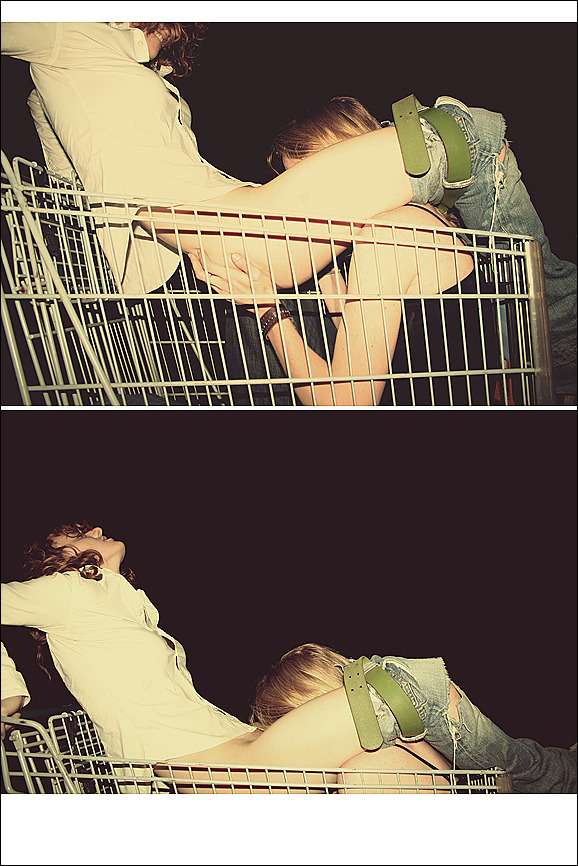
This reminds me of something I witnessed in college.

There were two grocery stores within walking distance from campus. One was an off-shoot of a big chain but featured a better selection; the other was one of those football field sized containers for endless aisles stocked with crap food and the whole affair sick with dead light and saccharine pop music over the PA.

Everyone on campus went to the second place.

It wasn’t necessarily the draw of the place but one of the advantages was the store hadn’t yet discovered those wheel locks that rendered the carts immobile beyond a certain distance from the store. It was a pretty common occurrence to see classmates pushing a cart overflowing with groceries down the side of the road back to campus.

The carts that wound up back on campus were usually returned (eventually) to the store by campus security. However, during their time away from their usual service, they were drafted into all kinds of absurd shenanigans: grocery cart jousting, the hauling of care packages from home between the post office and dorm room and use sometimes even illicit prop in a drunken visual joke.

In my case, the young woman in whom I was interested–but stupidly didn’t realize for another three years didn’t feel mutually–would get extremely drunk off of vodka and would assume an atrocious Russian accent. She would insist that she was Svetlana and Svetlana was crazy and down for just about anything.

So this image reminds me of Svetlana and one of her friends (both straight and cis), climbing into a cart and miming lesbian hi-jinks for the boys looking on.

And I guess that’s what appeals to me with this–it certainly isn’t the image makers aesthetic which is pretty much hideous even if despite it he does seem to manage to frequently capture what appear to be earnest expressions of sexuality among close friends: this does not appear to be a coy, ostentatious mime for an audience.

I mean sure it starts off with that–the appreciative but toothily self-conscious grin is quickly replaced by the focus of surrendering to someone who you trust and who knows you as well as if not better than you know yourself.

Colby KernMore from table manners (2015)

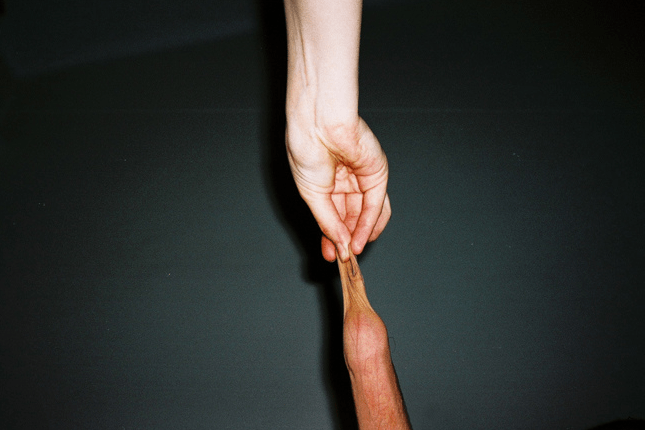
Kern telegraphs his familiarity with Nan Goldin and Araki too much for my taste. (There’s some Ryan McGinley in there as well, which would at least be more in keeping with the work.)

It’s unfortunate because there are a couple of things his work does that turns out to be more interesting–at least to me–than the work he’s referencing.

For example: he has no qualms depicting graphic nudity. Yet, when sexual overtones emerge in the images, he always either partially or completely obscures his subjects genitals. Frequently, the frame edges or someone else provide assistance in such obscuring. It comes across as very nearly playful–which is why I think McGinley is perhaps the better reference to pursue given only the three aforementioned photographers.

I think this image is especially interesting because of the triangulation. The image maker is a participant in the image–he may not be casting that dark shadow on the lower table but with the guy looking at his hand covering the boys groin and the boy making eyes at the camera, the circular table cycles the eye continually around the frame. (I do think there should have been a third cup or no cups, however.)

Lastly, although I can’t figure out exactly how to explain it–I feel like there’s some genderfuckery at play in this. The boy stretched out on the table is both clearly masculine but the pose and the way he’s flirting with the camera are something one would typically see in fashion editorials target straight white cismen. Yet the placement of the blocking hand does more than anything to activate a sort of suggestion of androgyny. (Yes, if you follow the implication far enough–I’m pretty sure it turns out to be a problematic depiction. But it’s a sentimental image and when fine art folks eschew sentiment it’s not so much that sentiment in itself is bad; more the tendency to respond out of habit instead of thoughtfully. (It’s the same reason poets are told to avoid cliches, really.)

Source redacted – Title Unknown (2010)

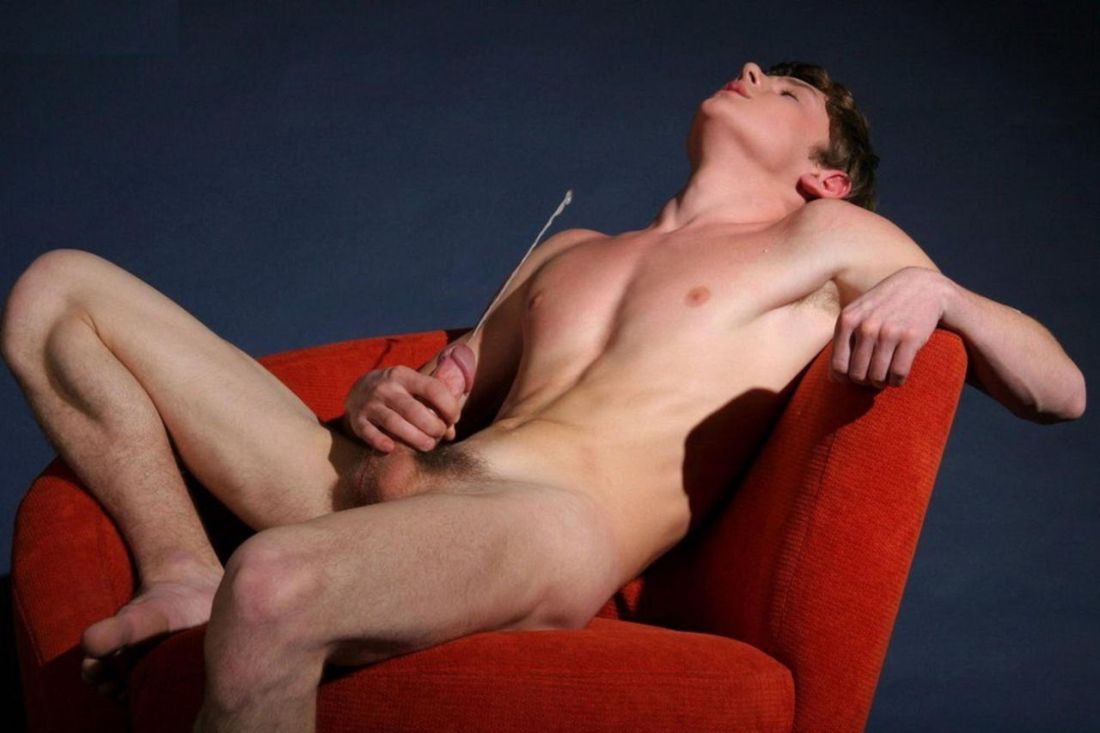
I’m into this for reasons.

It is far from perfect. The key light is set to accentuate his skin tone. The magenta and red in his face and chest, respectively are nice and all but the end up getting diminished by the bristling red of the chair. Also, while from the standpoint of color theory blue recedes and red approaches, without balanced dimensional lighting design the effect won’t read in the frame. And that’s not even getting into how the two black voids from the strobe enhanced cast shadow of the chair arm and his left knee are extremely distracting from a compositional standpoint.

This set up could have theoretically worked if only the chair had been rotated three degrees clockwise and the camera retreated two feet.

I lean towards thinking the cum shot freeze frame is Shopped–his pose/muscle tension aren’t in keeping with orgasm. Further, I’m reasonably certain that it should appear more globular and dispersed, not to mention have more of at least a slight arc to the trajectory.

Still the inclusion of a cast shadow from the stream at least demonstrates some thought.concern for continuity.

Unfortunately, the site from which this image emerges creeps me out. (I’ve chosen not to reference it her–but a Google reverse image search will turn it up easily.)

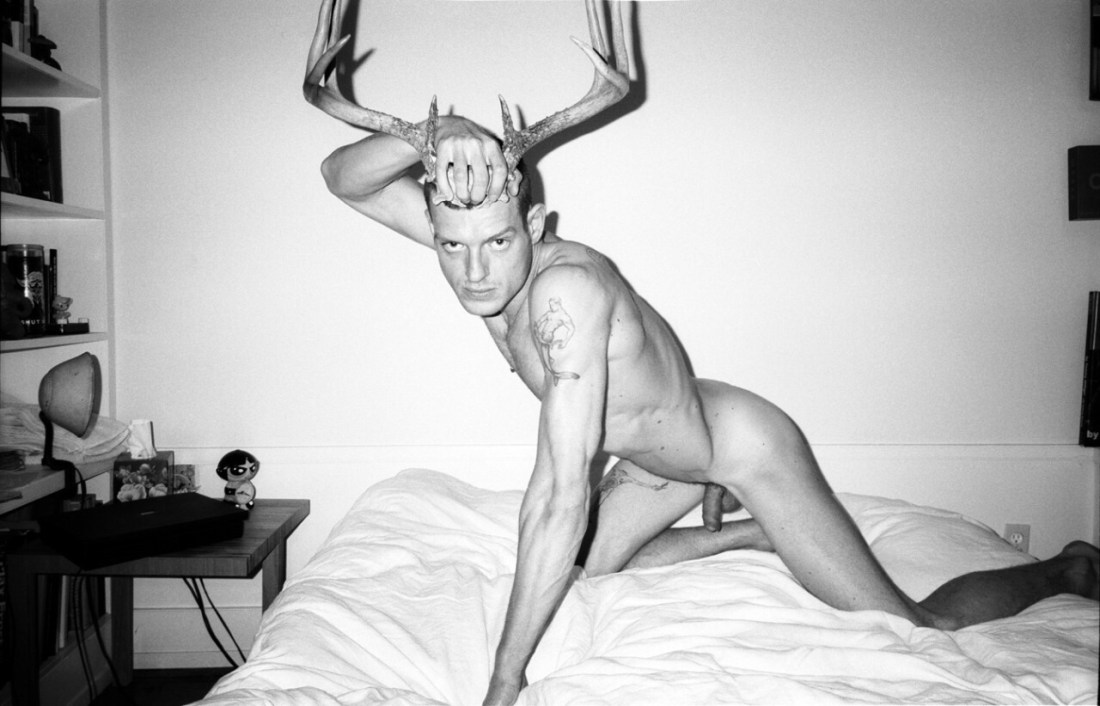
Miguel VillalobosDeer Slava (2008)

Like anything else photography has loosely defined genres, i.e. street photography, fashion photography, landscape photography, etc., etc.

There’s Ansel Adams–a stollid landscape photographer; your street photographers–Cartier-Bresson or Winogrand; and portraitists a la Arbus.

Additionally there are those artists who migrate between genres over the course of their career–probably the best example being Emmet Gowin, who started out as a portraitist who subsequently took up aerial landscapes of the American west as area of focus. Similarly–and ultimately unsurprisingly given her noted affinity for Gowin, Sally Mann has sort of been all over the place.

What’s interesting about these authors whose work shifts over time is that although the approach and overall aesthetic remain more or less constant, there’s always a lot going on between how they see and how they represent what the see. In other words, we recognize them by their creative trajectory rather than their constancy of vision.

What I find stunning about Villalobos–besides his bold use of dynamic black and white with a downright confrontational use of flash, is that although he favors edgy portraiture… there’s a consistency of seeing across his work regardless of genre.

His work seems to exist as if perpetually experiencing the trough between crests on a slightly sinister acid trip.

CAH – Cam Damage (2015)

camdamage is an artist. Full fucking stop.

I mean she’s disarmingly pretty and if she’s taken a bad picture, I either missed it or have lost track amidst her steady stream of effing stellar work.

Still, I feel like commenting on her appearance misses more than half the point. It’s like Jon Stewart’s on fleek insight into the media response to Caitlyn Jenner’s transition: Caitlyn when you were a man we could talk about your athleticism, your business acumen…now you’re a woman and your looks are the only thing we care about.

What makes her beautiful is more than just her appearance. If you follow her–which if you don’t then real talk you are abso-fucking-lutely doing Tumblr wrong–you know she is a wickedly intelligent and kind individual, with a sarcasm setting that isn’t just a louder 10 but goes all the way to 11.

At risk of using a meaningless cliche, she’s down-to-earth. Not in that she makes an effort to be some with whom everyone can relate– but that she presents herself as someone who tries really hard but fails what feels like far too many times to justify the investment of time and painstaking effort. She stumbles, admits them, gets back up and tries to roll that giant fucking rock up ye olde hill of impossible climbing once again.

Her work to grow and evolve as an individual, her courage and uncompromising determination shine through in her work in a way for which I know of no precedent with which to compare it.

The saying goes: talent hits the target no one else can; genius hits a target no one else can see.

By that token, Cam’s work signals her as a genius.

(Oh, and this picture is stunning: the vague vignetting effect of the strobe and the way it casts just enough of a shadow to cause her to pop from the background. The skin tone is both natural and gorgeously accentuates muscle tone. The unraveling braids, armband tattoo and perfectly executed eye light are all artifacts of high-end glossy fashion editorial methods in service of presenting something closer to a candid portrait. Just goddamn fucking killer!)

Jean-Luc VertutApparition (2015)

If you browse Vertut’s portfolio with any attention, you’ll notice that beyond his preoccupation with the nudes-in-landscape motif this image feels different than his previous work.

Were I a betting man, I’d wager he’s been gorging on benoitp‘s work. Certainly, not a bad thing–and although I appreciate the straightfowardness of this image over Paile’s endless barrage of hallucinogenic visual fugue-states–I’m just not sure that the flash here is strategic enough or appropriately in harmony with the scene to serve. I love the idea and I think sans the strobe it might’ve worked; with it, however, what was clearly intended as a grace note, cacophonously muddles things.

Chris LowellUntitled from N. America series (20XX)

If you have any investment in entertainment that passes the Bechdel test then you likely know who Chris Lowell is already. Remember Veronica Mars? Remember how amazing the first season was? Even the second season–despite its flaws–was a cut above most serial dramas. Then came the inexcusably awful third season.

Well, Lowell–who played Veronica’s college boyfriend Piz–was among a clot of reasons the show suddenly started sucking shit through a tube.

All this is relevant only insofar as it suggested a way of responding to a raft of questions I have about his images.

On a certain level, I want to like his work. His compositions are logical, exploiting the inherent dynamism of strictly observing the rule of thirds. I see some of my own compositional tendencies mirrored back at me.

What sets me off is the framing of the work as ‘fine art photography’. Yes, it’s a term that I am ambivalent about at best but its inclusion here catalyzes my various impressions into something unflattering.

In the absence of titles and any sort of framing statement, there is only the skeletal suggestion of the respective continent on which the images were made. This seems to imply the images are clear and self-contained enough to carry their own weight.

They are all pretty; some even alluring even but they do not stand on their own as-is.

Consider the above image: the strobe blown foreground contrasting with the carbon black night is compelling. And I get that the image maker is riffing on Yves Klein’s Leap into the Void.

Beyond that nothing is clear: the void in the latter has been transformed from a French street into a literal void.

Is this–as Leap into the Void was–preoccupied with questions of photomontage? (If so, the stakes are lower here; it’s child’s play to composite a figure over a single, seamless solid color.)

Is the figure going to land on a trampoline or a pool? What’s with the screened in tree house/porch?

Whatever fine art photography entails–and really who the fucking hell even knows what that is–a fine art photographic image MUST demonstrate an unambiguous bearing toward its audience. (And that bearing may be ambiguity.)

In most cases the photographer get’s their ass out of the goddamn way. Yes, the Cartier-Bresson’s style is as singular as a fingerprint. Ultimately though, he’s less concerned the polemics of his own style as he is in seeing the world as a stage waiting to be wondrously set through the lens of his camera.

Stephen Shore takes things a step further by de-emphasizing any stage setting in favor of images that seem like in a accidental and miraculous moment the world offered you (the viewer) and you alone a magical glimpse of its underlying symmetry/meaning and purpose. Alternately, Eggleston gives zero fucks about his audience. He was a terrorist who wanted to profane gallery walls with an extravagantly unrestrained profusion of colors that served no other purpose than to slavish ornament mundane existence.

Meanwhile, the relationship of Lowell’s work seams to at best position him–as it were–beside the viewer. He watches them watching, hoping against hope that they’ll tell him they like it. Waiting for the proper moment to interrupt them and inquire: what do you think? Is it okay? Do you get it?

I don’t mean abandon such harsh criticism at Lowell’s doorstep like flaming bag filled with dog shit. I point this criticism in my own direction. I think what original drove me to pick up a camera was the belief that since I was terminally unrequited and undesirable that maybe it might be possible for people to love me through my work.

Such isn’t at all a bad initial impetus–but as long as the artist’s drive is governed by it–’art’ if it happens will be more a happy accident than a summation of any progress or growth.

Sasha KurmazUntitled (2010)

Folks are fond of reminding me of Helen Levitt’s notion that the only substantive difference between making work and thinking about making work is whether or not you’re running film through the camera.

I used to object; splitting hairs on the grounds that Levitt was a street photographer and I’m a landscape photographer.

Then I saw this photograph and chugged a big ol’ tallboy of Shutting the Hell Up™.

Great work has this way of transcending the specific confines that contributed to its creation

I’m reasonably sure Levitt would object to mention of her or her work in the context of the image above.

And I’m not sure I’d take issue with her quibble. Kurmaz’s work is largely derivative–borrowing wholesale, in turns from Ren Hang, Maurycy Gomulicki and Igor Mukhin.

As a result, his body of work is distinguished more by its high-gloss, fashion/lifestyle than a distinctive photographic voice.

Still, browsing his Flickr proves Levitt’s point: as long as you are shooting there’s liable to be some perfect storm of mitigating circumstances where good work stumbles through in spite of everything.

This is one such image. (Also, to his credit, Kurmaz seems very aware of this image’s ability both to read as homage and to accomplish something distinct from the work it clearly references–something that functions similarly only using music instead of images consider the Beastie Boys’ monumental Paul’s Boutique.)

Misattributed source; proper attribution sought (The furthest I can trace it is TinEye’s entry–dated January 11, 2011 on a now defunct Tumblr.)

Sometime before the October Revolution, filmmaker Lem Kuleshov made a short film. The film consisted of the same shot of Ivan Mousjoukine wearing a blank look interspersed with footage of a bowl of soup, a child in a coffin and a woman splayed on a couch.

Despite there being no difference in the footage of Mousjoukine, the audience was extremely impressed with the depth of his craft–feeling that he was hungry when he saw the soup, grief stricken upon seeing the dead child and highly desirous of the reclining woman.

Today, film studies peeps refer to this projection of the audiences feelings in response to an image onto an actor/surrogate as the Kuleshov Effect.

(I argue this interpretation stops short: that which precedes informs with regard to the nature of the seeing, what follows contextualizes what has preceded.)

In other words: my experiences/prejudices not only color but dictate to a great extent what I see.

For example: one person may read the above as a trite riff on fashion photography voyeurism, giving the finger to prevailing tendencies for female-bodied folk to be openly arranged and displayed.

Someone else could claim it has D/s overtones.

Still another might be triggered due to similarities between the depiction and memories of past abuse.

What I see ties into the emerging trend of referring to physical intimacy as ‘sharing’ your body. To the extent that this phrase functions as sharing something neither party can own, I find it conceptually fulfilling. When it comes across as this is my toy and I am only letting you use out of my heart’s boundless kindness, I begin to have problems.

To me, this toes the line from the side I endorse.

What do you see?