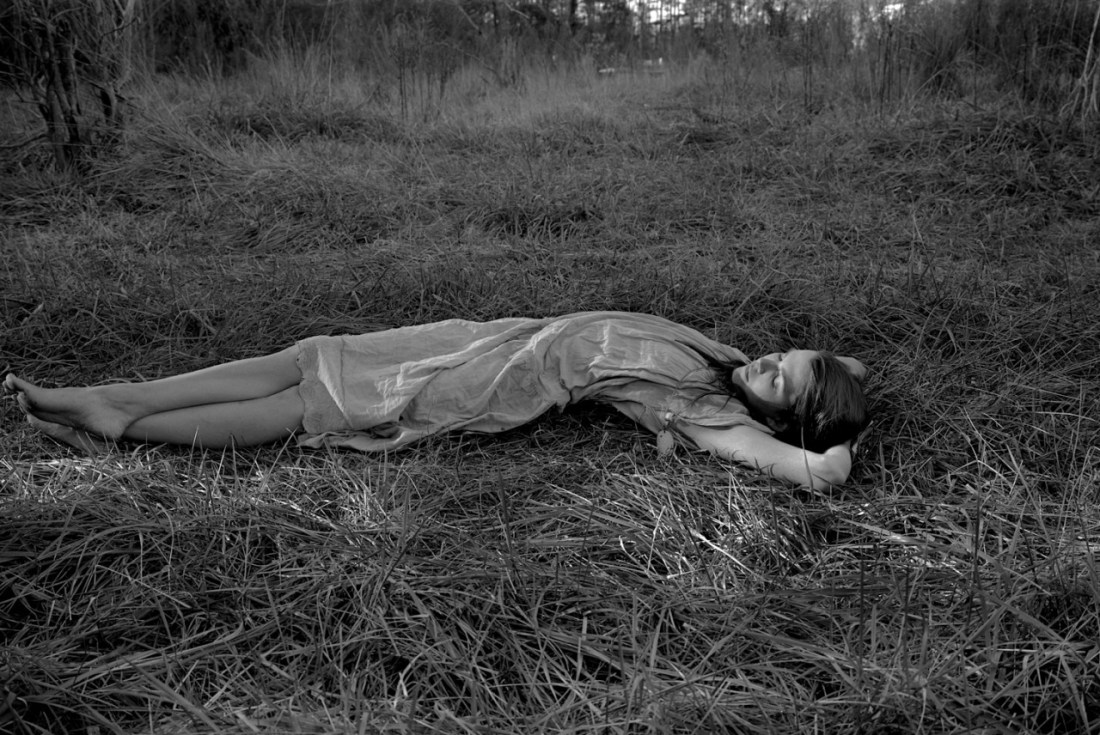
九口走召 9mouthUntitled from Menstrual series (2014)

From one vantage: this image is a little too perfect of an addendum to the previous .gif. From another: I’m not entirely comfortable posting it.

9mouth is an exceedingly problematic image maker. I’ve posted about him before and my argument each time seems to boil down to even misogynist men can sometimes make an objectively good sexy picture.

However, engaging with his work this time around has prompted me to modify my opinion of him and his work.

The first thing that’s worth mentioning is that I’m bringing a better working familiarity with Nobuyoshi Araki and Daidō Moriyama to the table this time around–9mouth’s aesthetic being influenced heavily by them both.

The problem with this is that that the younger photographer cleaves to these sources in a blunt and non-contemplative fashion. To speak in broadest of generalities Araki’s work implicates its own voyeuristic raison d’etre through various conceptual stratagems; Moriyama tends to seek out the foreign in the familiar–in the instances of his more voyeuristic work, there’s a decontextualization of the mundane in an effort to draw attention and focus to how the juxtaposition between the erotic and the mundane infroms our notions of the limits of either category.

It feels like 9mouth looks at Araki and Moriyama as photographers who like make photos of nude women–without understanding that there is a lot more going on in their work than just gratifying a knee-jerk cishet male gaze.

9mouths work hinges not on any conceptual framework–and he very much attempts to lead with that but it’s disingenuous, self-justification at best–instead, his work is fixated on either women’s bodies as the locus of all sexual fetishization and women’s bodies presented to the viewer as if their bodies are sexually available to anyone approaching the work.

I am disappointed in myself for taking so long to see this fact. (Even by my own persnickety quibbling with compositional considerations–it’s taken me a minute to apply my own frequent criticism regarding the frame edge as a amputative tool. (For example: in the image above the woman–who is unnamed and due to the nature of the Menstrual series, inherently carrying an expiration date and therefore also disposable–has her feet amputated meaning that not only is she presented as sexually available to anyone who sees her, she also is rendered immobile through the symbolic amputation of both her feet.

RuddTitle unknown (2017)

I love this even if the composition is somewhat funky. (Yes: the ottomon and her arm draw the eye at a diagonal up and right toward her sternum, the equal yet opposite angle of the couch pushes the eye past her face to the hand thrown behind her head; the mass of negative space is like the tension of a bowstring when the arrow is loosed and the gaze spans back to where he’s feasting upon her desire–this subsequently then causes the eye to shuttle back and forth between him and her.)

It works but the layout is just strange and if I had to guess I’d say that this is a drawing made from some sort of image reference. (This would explain the strange layout because when you’re drawing you can put a camera anywhere but in the real world their are limitations on where a camera will fit.)

Still: I really do like the fact that the way the illustration scan preferences her pleasure above its catalyst. And when you subsequently realize the cause of the pleasure, the connection sharpens her experience somehow.

There’s also the little things–like I don’t exactly understand if it’s a stylistic contrivance but both of them appear to have their nails painted black. It’s small but it’s not a bad tact to remind you that her extended right arm is still part of the composition despite the way the viewer’s gaze is encouraged to loop between her face and his.

Lastly, it’s great that below his left armpit and her right inner thigh you can see a puddle of vaginal mucous and presumably saliva spreading on the couch. Good times.

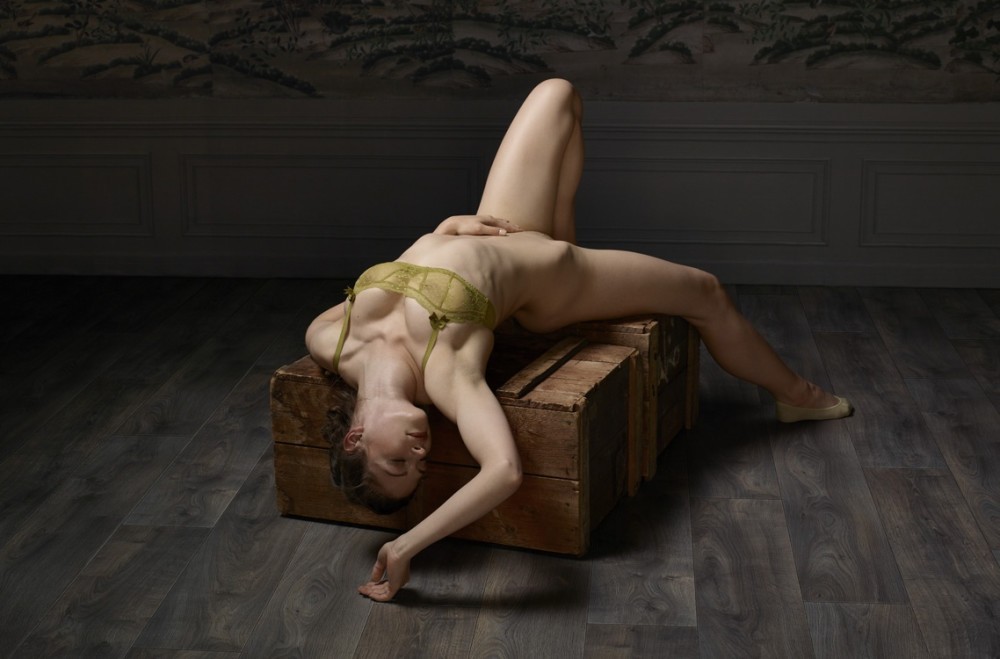
Erwin OlafReclining Nude No. 6 from Skin Deep series (2015)

By all accounts, Olaf shouldn’t be someone I dig as much as I do. He works primarily in fashion & commercial photography–not typically my thing.

His sense of lighting, however, is always so damn inspired and well-executed.

But the Skin Deep series appeals to me more than his other work. First off, because I’ve found that there is something deeply satisfying about any work of art that is so pared down to its most essential elements, that you look at it and think: this is simple enough that this really could’ve been made by an especially studious begging photography student–which is not the same thing as saying it looks like student work. (For example: I’ll watch anything Kelly Reichardt puts her name on. And while I certainly can’t say I’m in love with all of her films, I do adore Wendy and Lucy and of her film it is absolutely one that any student with access to equipment could have made themselves.)

Yes, with Skin Deep, Olaf most likely had a crew of designers and set decorators and assistants. People to do the heavy lifting for him so he can focus on the nitty gritty details of getting the shot.

But this shot in particular is something just about anyone could have made. Yes, Olaf likely hand picked the floor, the paneling and the wall paper. But if you break it down to it’s component parts, it’s an interestingly textured floor, two boxes, crates and a single over head light up and over (giving the sense of a circular pool of light) but angled slightly to provide separation between the left edge of the model’s body at the darking background. (There’s almost certainly a flag blocking spill to her immediate left, too.)

The exposure is perfectly suited to accentuating even skin tone and to make the bra pop.

But there’s something else about Skin Deep that is v. very on-point: Olaf is gay. The project includes both male nudes and female nudes–in equal measure. And it’s clear from not only the rest of his body of work but these works that he’s more enticed by the physical embodiment by his male models. But fucking-A, he’s the only one I can think of who makes an effort to provide a cross section of variously gendered attractive bodies in his work.

And really, I can only think of a few photographers that routinely make work that is this sexy about folks they aren’t attracted to personally.

Mark SteinmetzAthens, GA [Carey] (1996)

I’ve seen this photograph a dozen times but haven’t fully engaged with it. At first glance, it’s lovely enough.

The forested dappled light falling on the grass is reminisicent of Kurosawa’s magnificent Rashomon.

The camera is low to the ground–giving it an almost Russian feel–except for the fact that near the top of the frame you can see just the hint of the top of some sort of structure. (I first thought it was the upper rear door of a van parked at the curb on a suburban street but on closer view, I’m pretty sure it’s the top of a house you’d expect to see a conversion van parked at the curb in front of in the Suburban south of the United States.)

It all feels a bit slapdash for Steinmetz. But then Carey’s position is so purposefully arranged–and given the way he necklace has slipped against her armpit, it’s not unreasonable to assume that at one point she was laying on her side before rolling onto her back.

This sort pose recurs at intervals in Steinmetz work. Consider: this from Summertime, Athens, GA [Jessica] (1997) & Athens, GA 1996. The pose–which you might term recumbent–is usually reserved for kids and young adults.

(E.D. Note: Here the author thought of the word ‘supine’ as a result of listening to Swans pretty much constantly for the last three weeks but had to use google to verify it meant laying face up as opposed to face down.)

I remember in a presentation Steinmetz referred to why he is interested in photographing teens that are no longer children but not yet adults is a result of what he terms a “ramshackle elegance”. (I know, it’s a dreamy turn of phrase; heart eyes emoji.) For illustration he showed pretty much my favorite photo he’s ever made.

There’s another thing he does assiduously in his work–subvert anything that might push things towards any sort of objectification. Take the previous photo of the young woman standing at the screen door. She’s clearly post-pubescent, but the aluminum cross section on the door is framed to block her chest. The viewer is left with both a profound sense of the subjects physical presence but the only means of connecting with that in any sort of way is through a confrontation where she’s ‘safe’ behind the door looking out; in other words, the visual grammar indicates a confrontation as opposed to any sort of clandestine, subtle or even outright voyeurism.

It’s always as if Steinmetz is diverting any sort of sexual objectification but leaving room for sexual potentiality. (I may be projecting a bit here and if so I apologize both to Mr. Steinmetz and you, dear reader.)

I think the best way to put it is to compare two other artists I find very similar: Ren Hang and Yung Cheng Lin. Hang is raw, gritty and in your face. His perversity is loud and clear, front and center.

Alternately, Lin inverts Hang’s lo-fi aesthetic and shoots the obverse of what Hang shoots. As I’ve noted previously, if you want to really grasp the degree to which Lin is the equal to Hang in terms of pervsity just consider everything the camera strategically doesn’t reveal in his frames and then you’ll start to understand how truly audacious his work is.

I wouldn’t necessarily say Steinmetz conceptualizes his work in a fashion where he distinguishes between sexual objectification and sexual potentiality. I think it’s just that his interest is ostensibly people and their stories in relationship to the stories that construe reality in the world around them.

But, to come back full circle, I don’t think my initial notion of comparing this to Rashomon is off-base. I mean Steinmetz, although an expert on the history of photography, like myself, is almost more likely to reference filmmakers than photographers.

I think it’s interesting that the story in Rashomon centers on four incompatible/irreconcilable testimonies detailing the events of an encounter in the woods. In turn that reminds me of the best advice I’ve ever received on writing: do not write about anything for at least three years because what seems important to remember in the immediate aftermath and what you remember down the road are two completely different things. The latter will have the most universal resonance to those who read what you write.

Terry SmithCory on the rooftop of LeStat’s here in San Diego, California (2006)

This isn’t an image you’d ever claim was ‘good’; the focus is soft, the pose is awkward given the composition (or the composition is awkward given the pose–flip a coin) and although it’s less frequently imposed in creating male nudes, this orientation is inherently tied up in an art historical tendency of the body as object, i.e. the dominant eye standing above a supine figure.

All that being said, it is interesting because everything I just finished criticizing is what ultimately makes the image interesting–the soft focus causes the the boy’s skin to stand out against the filthy rooftop, the pose is neither full passive nor entirely active (due to the right leg being elevated off the ground and the objectification is clearly a primary impetus for the picture’s creation.

Also, I’m taken with this because while I’ve never been to LeStat’s, several of my friends do frequent it and speak fondly of the place.

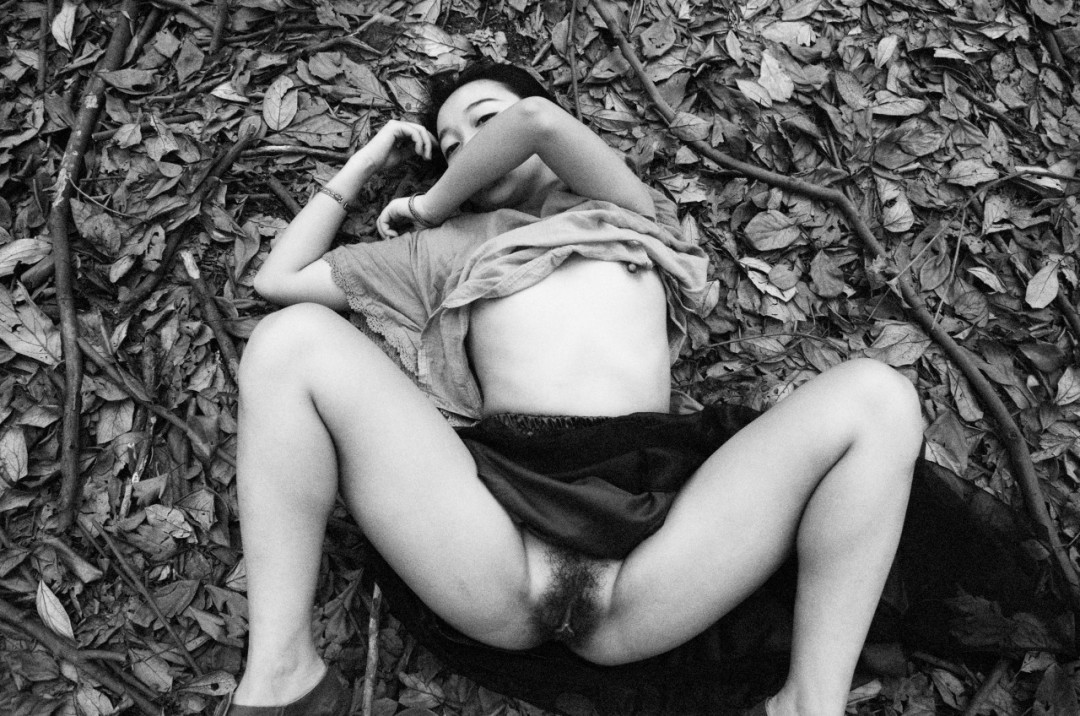
Jesús Llaríano head (2014)

As in tune as I can be with logging my own process of reading images, this short circuits everything.

I’m not sure I can explain it without getting a little TMI but it reminds me of being fifteen. (Not that I saw anything like this in the flesh until almost a decade later…)

It reminds me of random, mundane things that would inexplicably trigger arousal so extreme it was actually painful.

I had already been chasing the same oxytocin/prolactin buzz for seven years as a way of smoothing out the jagged edges of my abusive adolescent existence and suddenly it was also effecting some sort of vaguely imagined autonomy over my own body.

As a friend puts it: it’s a real wonder all the masturbation didn’t inflict permanent nerve damage.

So yes: initially seeing this image resulted in me having to release some sexual tension.

Afterwards, I found myself enchanted by the way the image works. Although I’m not sure it’s ever justifiable to employ a frame as a means of dismembering a woman’s body, I can’t technically refute the decision as Llaría observes the dictum of amputating between joints instead of at them.

And there is a notable compositional logic supporting his choice. Note the repeated angle of the elbow which is not the model’s, the line of the lower half of the dresses’ buttons, the way the seam to the left of the lower button line softens the angel to echo that of the model’s right thigh only to have the same angle emerge again in the cocked angle of her right leg.

There’s also the matter of palate: excluding her bush, the image consists of three hues. The rust colored earth figures at the darker end of a spectrum that would include the more magenta tones in her skin; while the white in her slipper and dress are virtually identical. The blue of the dress makes everything else pop.

Let’s not forget texture, either–something about which I am often preoccupied. The skin doesn’t really have texture in this image; except juxtaposed between the dirt and the fabric of the dress the absence of texture becomes a null field. Unlike the ground or the dress you can’t imagine touching the model’s legs but you can recall what it was like to have touched such legs. The visual synesthesia suggests an insistent anti-objectification that subtly reminds that this is no less or no more than what you have always known.

I would be dreadfully remiss for also not mentioning that even though I am not female bodied and if I were I would not be comfortable wearing a dress, I’m more than a little obsessed with the dress.