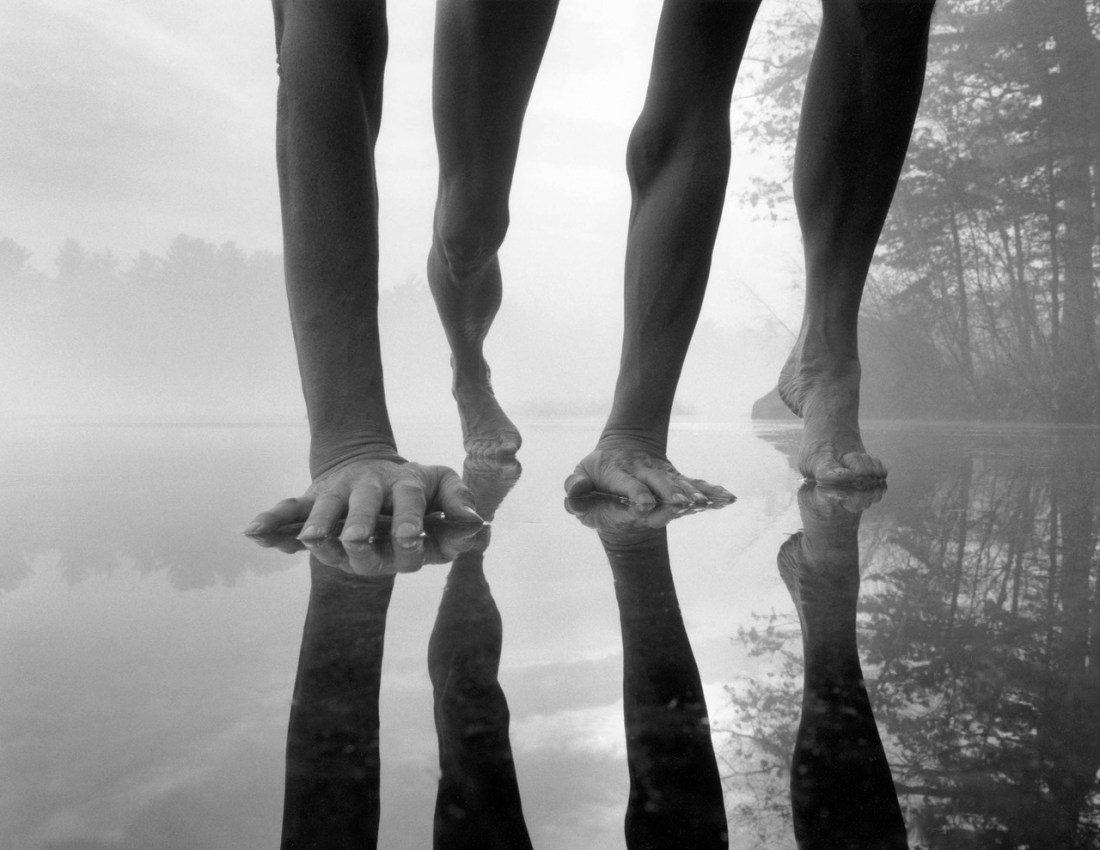
Arno Rafael Minkkinen – Self-portrait, Millennium, Foster’s Pond (2000)
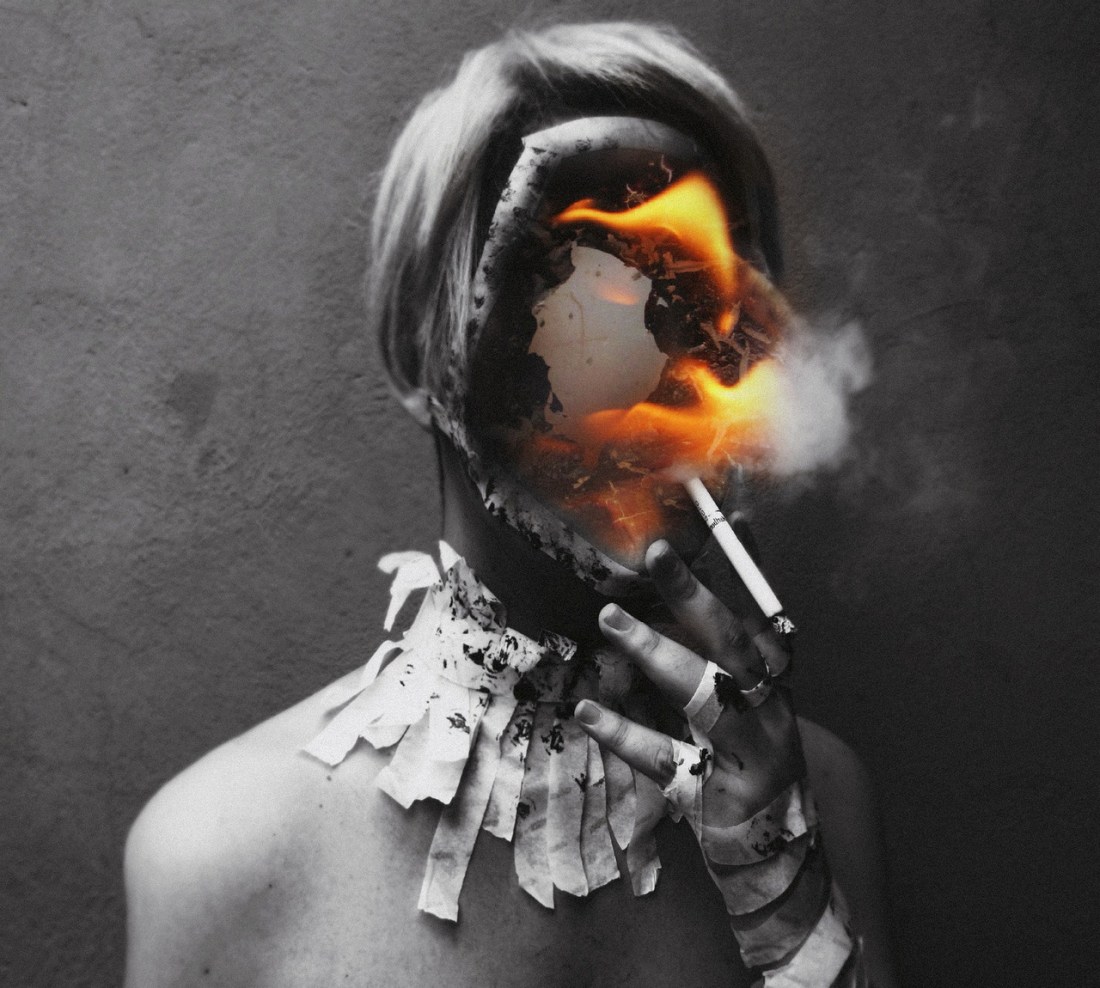
Heitor Magno – Untitled (2013)
There’s no question: this piece owes a debt to David Lynch.
I know that portraits of someone’s head and shoulders presented in front of a textured wall in contrast-y B&W or monochrome is so ubiquitous as to be cliché but consider the preponderance of this motif in portraits of Lynch himself–it’s almost as if this manner of presentation is an extension of his brilliant white button ups, under shadow dark sports coats.
I’ve talked a fair amount of piss about Lynch in the past. I am a huge fan of most of his work–in fact, if you disregard Dune and Inland Empire, his oeuvre situates him as among one of the most consistently masterful, active, contemporary artists.
I watched the Twin Peaks revival in it’s entirety this spring. I am of a mind that it’s the best work he’s ever done–by quantum margins. There is honestly no way whatsoever I can oversell it; it’s an ingenious tour de force that is utterly exquisite to experience. (Also: some of the criticisms that I’ve lobbed Lynch’s way previous about the demarcation between the surreal and the oneiric–and how Lynch tends to play fast and loose with that boundary–well, Twin Peaks: The Return demonstrates that even if such a criticism was valid previously, it is certainly no longer the case.
I’ve not seen all the original run of Twin Peaks. (I was a about three years to young to catch Twin Peaks fever and subsequent efforts to re-watch it have been sabotaged by a constellation of factors. At this point: it is unlikely that I’ll ever see it.)
I am curious if the trope of facial voids and flames feature in the original run–because while the notion of a facial void is very Lynchian, I’m not sure I can recall that specific image in the rest of his work.
Lynch is one of those influences from whom artists would do well to exercise caution in riffing on without careful consideration. Someone much smarter than me pointed out how many ‘artists’ use Lynch as an excuse, i.e. going light on plotting so as to focus on compelling visuals and a sinister surrealism to pull things together. There is always an underlying logic to Lynch’s work–to the extent that even inconsistencies will be consistently applied.
Anyway, I would be curious if the facial void image occurs in the original Twin Peaks because if it doesn’t then I feel like Magno’s image is actually even better than I understand it to be–and I’m basing that of the premise that it ceases to be theft if you take an idea and in the process of making it your own, improve upon it.
This is fantastic for the way it constantly turns in on itself. The lit B&W cigarette resonates with the flame burning through a print. (This appears to be a collage effect, where the picture of a burning print has been digitally imposed over the B&W portrait–creating a mask that is in turn a void with dimension deeper than the image on which it has been overlaid; like one of those haunted houses that is bigger on the inside than the outside.)
Also, the trope of burning photos possesses a sinister value. Typically, when we see this in a piece it indicates someone surrendering something that costs them too much to keep. Think of unrequited lovers burning pictures of the one who has abandoned them or of a criminal destroying evidence.
In a lot of ways I feel like this takes ideas that almost certain were sparked by Lynch and internalizes not only the symbolism but the logic underlying the symbols; then: applies both to personal expression. That would already be impressive. But what I adore about this is that this goes even deeper by then taking the concept and then applying the same system of logic and symbols that codified the conceptual trappings and then applying that awareness to questions of how the presentation of the work will be seen and interpreted by the viewer.
It’s a level of commitment to consistency that is damn impressive. Even more so if it intuited this underlying theme in Lynch’s work and then extrapolated it into something that pushes things a great bit further than Lynch manages to in the Twin Peaks revival.

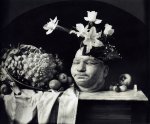

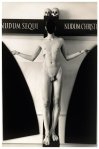

Joel-Peter Witkin – [↑] Poussin in Hell (1999); [←] Anna Akmatova (1998); [+] Nude with a Mask, LA (1988); [→] Still Life, Marseilles (1992) [↙] Glassman (1994); [↘] Naked Follow the Naked Christ, NYC (2006); [↓] Arm Fuck, NYC (1982)
I was in my final year as an undergraduate in an advanced philosophy course when I made a terrible mistake. I used the word ‘tautology’ in the context of something that was axiomatic instead of something that was redundant. Folks looked at me strangely and finally another classmate asked rhetorically whether or not I was aware that I had clearly no idea what a tautology was.
Joel-Peter Witkin is similar. For whatever reason: I’ve always associated him with Jerry Uelsmann’s seamless multiple negative fantasy landscapes.
But Witkin doesn’t really have anything in common with Uelsmann. He works with a single frame–frequently scratching the emulsion, obscuring his negatives with tissue paper when printing, defacing the film and smearing chemicals and lord knows what all else everywhere. He’s a bit like Bosch with a camera. He has a ridiculous familiarity with art history. (The proper way to introduce his work to me would’ve been to say: you know how much you love Mark Romanek’s work on // | /’s Closer video? Well, Romanek stole whole cloth, half of the visuals in that video from Witkin.)
Once I realized my mistake I dug into his work. There’s a lot of fine lines in his work–not just scratched into the negatives but conceptually. He’s a devout Catholic; also: a left-of-center Democrat. There’s a lot going on in the majority of his frames. Personally, I think that 65% of his stuff is overwrought to the point of sensory overload. When it works it’s unrivaled–a la Poussin in Hell. Mostly I prefer his less busy, more balanced compositions.
35% of his work is either too masterful or too audacious to ignore. (I’m not exactly on board with his politics and he’s not done a very good job of being sensitive to the marginalized communities he likes to depict.) And really there’s a lot of shit with his work that is not easily defensible. He’s borrowed Rhesus monkeys from animal testing labs to feature in questionable contexts within his work. (One of his most notorious photos straight up implies bestiality.)
Feeling stifled by the rules in the US against such thing, he spent time in Mexico during the early 90s photographing corpses. His exquisite Glassman was the pinnacle of that work. (I read this story before I ever say the photo, so I was never even a little put off by the work. I just think it’s brilliant.)
He’s certainly not the first artist to fixate upon cadavers. da Vinci gained a great deal of his anatomical acumen by dissecting human corpses. Then there’s Stan Brakhage’s The Act of Seeing with One’s Own Eyes–which has always struck me as antipathic through and through. As well as the work Sally Mann did on her Body Farm series.
There are oodles of problematics and objections that can be pointed at Witkin’s work. I think a lot of that has been overlooked because the work has been seen as too irrevocably unpleasant. (A lot of the criticism of his work during the late 80s and early 90s involved objections along the lines that Art is meant to instruct and edify, whereas Witkin’s work vacillates between fomenting revulsion and focusing on visions of disquiet, alienation and brutality.
Perhaps he was merely 25 years ahead of the curve because this stuff feels of a piece with a lot of edgy, emerging internet art. I’m really sort of hoping this post will take off–in spite of my heavy handed prose.
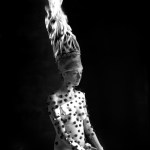
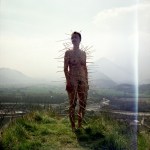
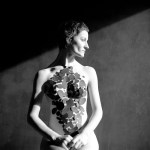


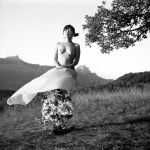
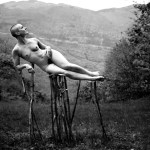
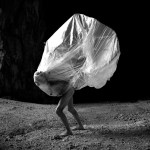

Stéphane Fugier – [↖] Kashka from Studio series (20XX); [↗] Ludivine from Couleurs series (20XX); [<] Anne Laure from Studio series (20XX); [+] Sang Mee from Couleurs series (20XX); [>] Jean Marcel from Extérieur series (20XX); [←] Thierry from Couleurs series (20XX); [→] Sang Mee from Extérieur series (20XX); [↙] Delphine from Extérieur series (20XX); [↓] Jean Marcel 2 from Extérieur series (20XX); [↘] Hélène from Studio series (20XX)
I’ve been giving thought to the re-emergence of surrealism–particularly in photography/image making; I am less interested in distinguishing between ‘oneiric’ and ‘surrealist’–this may have been a utilitarian distinction at some point; however, it now seems to be a feature more of photographers/image makers vanity than anything which actually contributes to greater depth of understanding.
It’s possible that my familiarity with photo history a decade ago was of such limited scope that it might be realistic to think that I was just unfamiliar with examples of surrealist photography. While I’m sure there are scads of folks who have forgotten more about the history of photography than I’ve ever known, it seems that Joel-Peter Witkin and Jerry Uelsmann were the only game in town when I first test the waters of photography with an extended toe.
And surrealism is exactly the right distinction in both cases–since as Wikipedia astutely observes: surrealism was fixated upon creating illogical scenes borne out by photo-realistic depictions as well as a preoccupation with “creat[ing] strange creatures from everyday objects[.]”*
The above definition pretty much encapsulates Fugier’s work. Sticks, plastic bags, apples, fire and apples all employed in an exceedingly unconventional manner. I’ve not be able to find much on Fugier–even his website takes a bit of digging to uncover. However, apparently NY Arts magazine said of his work:
The viewer sees what [they] wants to see, the context contracting and
orienting the possibilities. There is no correct interpretation and
nothing that must been seen or understood. The photographic experience
(experiment) is first and foremost an encounter with a person.
This seems to be pushing back against the notion that the work can or should be deemed surrealist. I see it another way: as a shift from an object focus and a movement towards a consideration of subject. Another good question: what context informed ‘strange’ and ‘everyday’ as far as the original instance of surrealism. How have those contexts shifted in the intervening century. But I digress…
I opened this post by saying that I’ve been thinking a lot about the increasing preponderance of surrealism. It’s basically a crap shoot these days w/r/t whether or not photographers/image makers are surrealist or not–red or black, place your bets and spin wheel.
Why is that?
It strikes me that Dada was a response to the horror of WWI; and: surrealism emerged from the Dadaist milieu. There’s a tendency to see these movements as steps forward in advancement of culture. (I mean they were also EXTREMELY problematic and should be criticized, but again: I digress…)
Loosely, one might argue that dadaism and and surrealism were an effort at a binary response to The Great War–a resounding: no! Keep in mind that Dada emerged almost as if it were twinned with the emergence of fascism–a term few people understand as evidenced by folks who insisted Obama’s regime was both simultaneously fascist and socialist.
Fascism basically said liberalism and democracies are bad, social is bad and totalitarian dictatorships are good. (You’ll already see where I’m headed with this but one personal point first: one thing which never ceases to incense me is the way generally the same folks who critiqued Obama’s regime as simultaneously fascist and socialist are the same people who accuse those of disagreeing with them as being fascists. And slightly more intelligent–and therefore more offensive are the folks who use the term SJW or refer to things as PC. Yes, there are some overzealous progressives–I interact with a half dozen every week. It’s not fascist to denounce someone who is displaying bigotry as a bigot. Especially given that if you do not want to be termed a bigot, you know: stop being a bigot, perhaps? But the thing that folks who throw around the word SJW don’t like is that there perspective is not tolerated, lauded and accepted by others in direct proportion to their own estimation of their intelligence.
Which brings us back to fascism as a the opposite response to WWI from the Dadaist and subsquently surrealist–a sort of this is the way the world works, suck it up and learn to live with it.
Militarism was nearly universal during WWI–there were those horrified by it and those who in what I can only think to term and egregious nihilist sentiment believe that something of human potential was unearthed by wholesale carnage and living (or feeling more fully alive) when faced with death.
Dada and surrealism didn’t stop WWII any more than conceptual art or postmodernism prevented the global war on terror. But were’s still enacting the same cycles over and over. And I’m not sure if that’s a good thing or a bad thing. And while I think Fugier’s work could be more contemplatively realized, his shifting from considering of object to a presentation of humans as subject is at least conceptually satisfying.
P.S. My deepest and most sincere apologies for how things have been on autopilot with this project for the last couple of weeks. My final MFA application was a goddamn doozy–and while I was able to get it in just under the wire, the way those things forcibly constrict your vision is not something I care for and I’ve been struggling to get my head back into the game with this. Not sure I’m totally there yet–but my hope is to extend things out to having a queue again over the next two weeks. That should help. Thank you for your patience and for those of you who wrote in with encouragement–whether or not I responded: your words were greatly appreciated.
*Given an opportunity, I would quibble with the insistence on ‘creatures’ as it contributes undue preference on folks like Ernst; alternately, I do at least understand why the insistence is there–given that once you make it about using everyday objects in unusual ways, you’re practically demanding that someone insist that Dada and Surrealism are not separate movements.
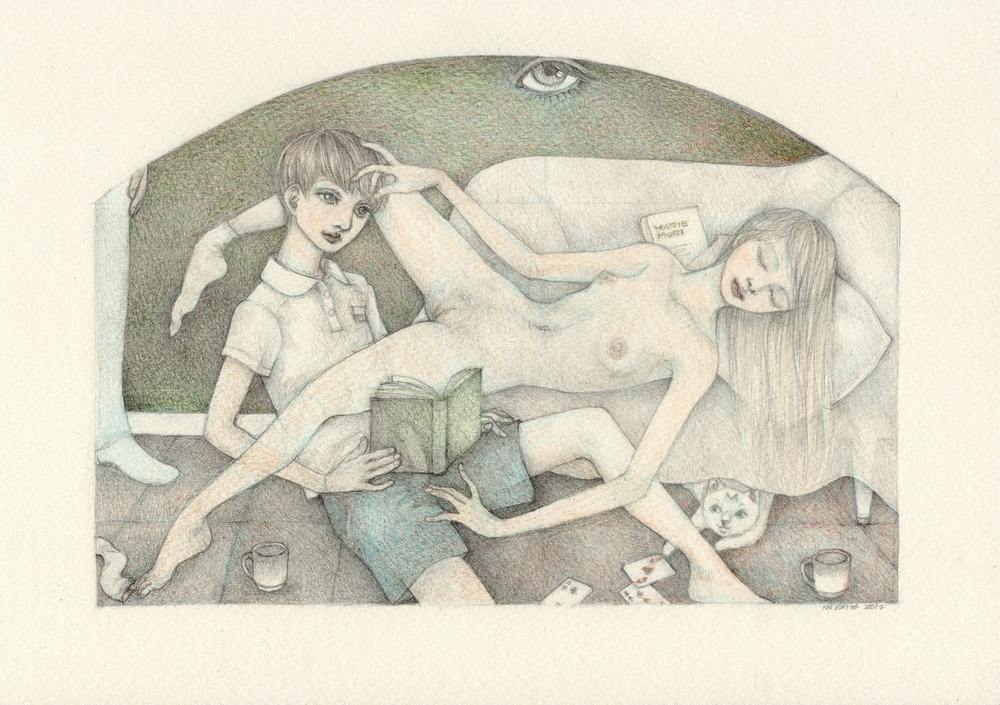
Musubu Nakai – Untitled (2012)
I really like this guy’s style. His compositions tend to be too busy but he has an interesting way of parsing things so that although his stuff is frequently overwhelming, it does surrender to a sort of implicit ordering structure after the initially dismaying over-stimulation.
Consider the variegated pointillism of the color here, the green red and blue of the wall, the complementary cover of the book from which the boy is reading. The subdued pink and blue of her skin; the blue of his shorts and the bluw in the pants of the person standing at the edge of frame. The red, blue and hints of green in the floor tiles.
I am, however, not 100% on-board with some of his content. The cat–which seems to be the way he inserts himself into his paintings and the young woman with her eyes closed are almost certainly a veiled reference to Balthus. (Which is very much in line with the work he’s done… notable projects include illustrating The Story of O and a lot of stuff that looks more or less like a cross between Sailor Moon and Alice in Wonderland.)
I don’t have a problem with artists depicting age appropriate sexual curiosity. Some of the aspects of this strike me as unsettlingly suggestive. The way she is naked and he isn’t suggested a sexual freedom, whereas he’s forced to hide his erection behind the book. It’s presented as a sort of seduction. I don’t think I need to explain why that’s problematic.
But what I find unnerving is the orderly type figure standing off to the side. As if this exchange is being monitored somehow? Which given what is shown–there’s no way to spin that in a slap on the wrist sort of way. I’m not going to say that this crosses a line but it’s definitely toeing it in a way that feels irresponsible to me, somehow.
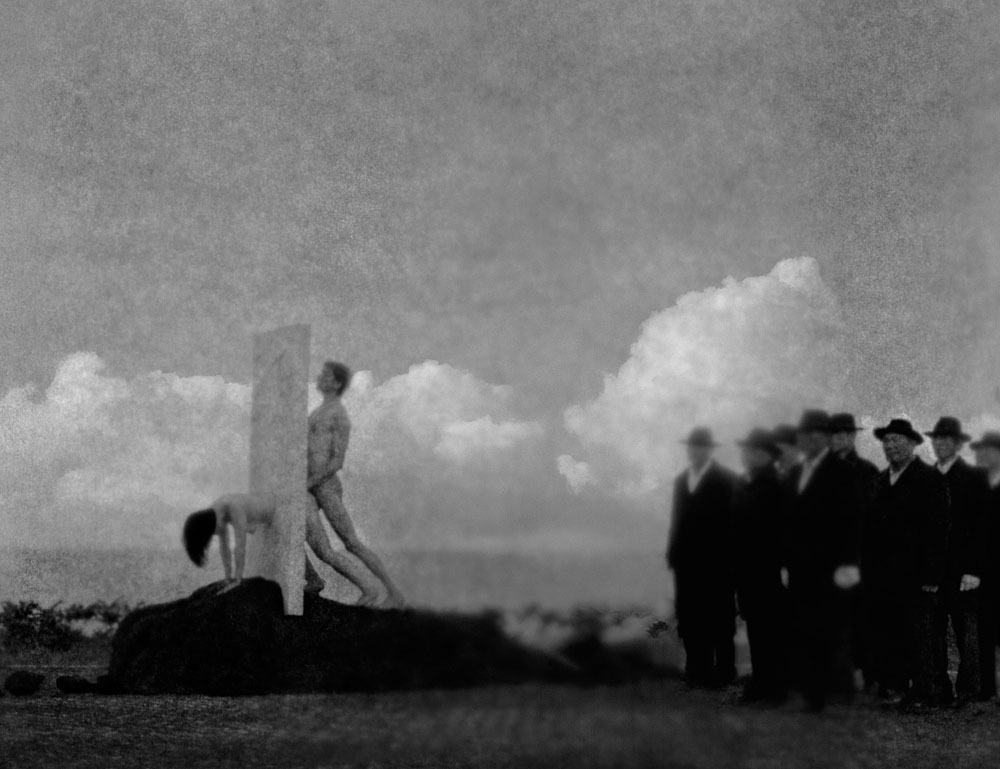
Hsieh Chun-Te – The Romance on the Stele from Raw series (1987-2011)
The images in the Raw series are intended to be narrative–yet what the narrative entails remains muddled due to how little is available on the artist in English.
For example: an image titled Bitches was, according to Chun-Te inspired as a result of: “overhear[ing] a journalist
friend of mine who got beaten up during an investigation of human
trafficking of a prostitution ring. Girls were captured then sold, some
of them tried to escape.”
I was not able to find the creative impetus underlying the above image. In fact, I discovered very little of merit beyond this blurb from the 2011 Venice Biennale. I agree that themes of desire, eroticism and death permeate his work. But, he’s clearly working within the Surrealist tradition. (I feel as if this is so apparent as to not need comment but to put to fine a point on it, he makes a point of telegraphing this affectation via his inclusion of bowler hats–a reference to Margritte’s seminal painting The Son of Man.
I’m inclined to disagree with the aforementioned blurb w/r/t what the above image depicts. It takes the easy route of correlating death and eroticism and suggests the image depicts a scene of capital punishment by means of being fucked to death. (The pose of the woman in the image suggests she’s still very much alive.)
And that is definitely an interpretation in keeping with the tone. Except, I read this as a far more nuanced examination of punishment in society. The relationship between the person receiving punishment and the remove at which the person who inflicts the punishment must be placed in to avoid sullying polite society by association.
I look at this and see it point to an irony. We’re not okay with this because of the context–restraint as a means to facilitating punishment and punishment as a means of retaining social control.
But this can also be read as an allegory of the relationship between pornographic performance and consumption within a capitalist, hetero-patriarchal system.
And really one of the reasons this works so well is that the author is clearly far more interested in pointing to a slippery corollary than passing any sort of judgment on it.

Set fire to nests of best ideas;
Let plagues spill from your lips,
When deserts choke on wetness and wanting,
Firebirds feast on ash.
 Acetylene Eyes