
Victoria Baraga – [←] Self-portrait (2012); [→] Self-portrait II (2012)

I could’ve sworn I posted the Self-portrait II previously–but I’ve spent the last half-hour trying to find it and I see no trace, so…

It’s possible I had it saved as a draft and subsequently opted not to post it.

There’s not one but two layers of ubiquity working against these images. The TLR, waist level finder in the mirror trope deserves every bit of shit the bathroom mirror selfie gets. (Folks who pursue the former tend to get a pass they shouldn’t because they’re doing it the old-fashioned way and it’s not as straight forward was aiming the camera and pushing a button–but both tend to be devoid of any vivacity.)

There are exceptions of course. Laura Kampman does some exquisite things within very narrowly circumscribed margins–i.e. there’s a ridiculous degree of technical mastery at work in her better photos. Baraga, on the other hand, tends to fixate on capturing herself in the act of watching herself.

The result is conceptual satisfying–the viewer watches her watch herself, while she watches herself experience intimacy. It’s a clever deconstruction of the triad where the photography use the camera in an effort to parse time and space in such a way that the viewer of the resulting photo see much in the same way the photographer did in the moment of making the image. In this case, the mirror is an impartial arbiter allowing her to focus on one relationship in the triad–photographer to subject and subject to photographer in a fashion that presumes an empathetic response from the viewer.

There’s life an artfulness to these images that far exceeds 98% of comparable work out there.
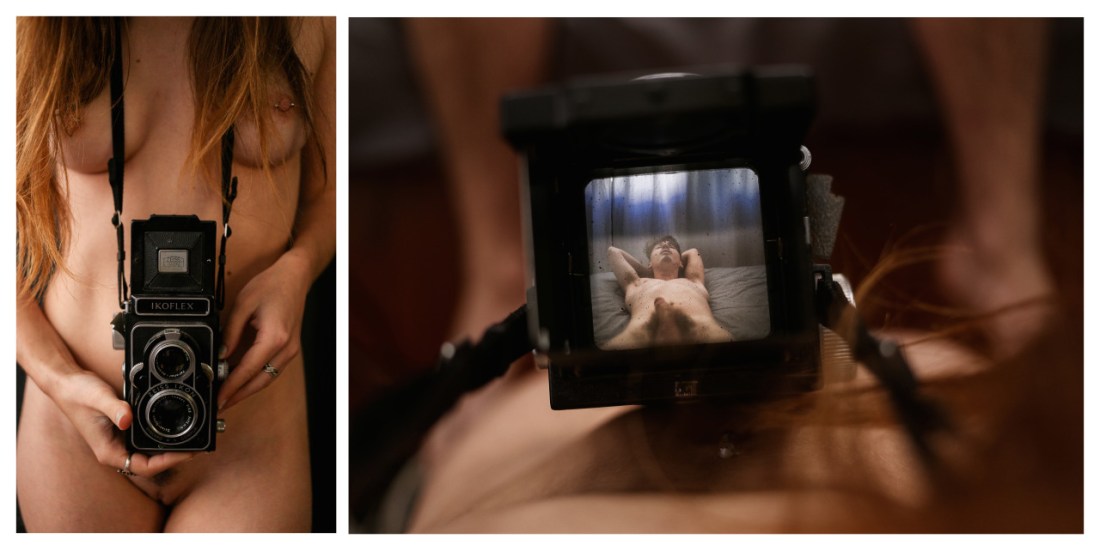
A & N – Nympho Ninjas Submission (2014)

Diptych ought to be read seamlessly.

The trouble–which in the end isn’t really trouble at all since it allows a far more benevolent interpretation–is that I initially see these images discontinuously.

There’s the obvious discrepancy in visual langague. The first frame being one of the most infuriatingly egregious examples of #skinnyframebullshit I’ve posted.

Plus, it is oblivious to the politics of frame edge dismemberment. (To anticipate the counterargument: preserving anonymity is a downright lazy justification. There are literally a thousand ways to obscure identifying features that don’t require decapitation. Yes, it just takes a bit more effort on the part of the image maker…

Pairing the first image with the second presents an interesting dichotomy. (It maybe even alleviates the tiniest fraction of the goddamn piss poor decision to opt for portrait orientation in the first image since it allows both images to fit together more intimately within the viewer’s visual field.)

The second image is very nearly perfect. Yes, I have a bias to frame-within-frames and viewfinder peaks but although the second image is great on its own, I think the interplay between it and the previous image are fascinating.

This interplay–as I read it–is a studied subversion of the male gaze.

The leftmost image presents a sample of said gaze; the right explicitly presents the viewer with a female POV.

All sorts of tangents and rabbit trails emerge. But what’s most important is to note that the male gaze is in-built, assumed. It sees the female bodied subject regardless of whether or not she sees–here she literally cannot see as she has no eyes.

Because the initial image informs the following image the female gaze sees but it is seen in its seeing.

(Whether intended or not, the fact that the male bodied subject does not acknowledge the camera is a sophisticated bit of conceptual reflexivity.)

The first frame contextualizes the second. Were one to draw a parallel with art historical tradition and subsequent influence in practice, one would go straight to the head of the class.

In the context of the first frame, the second frame’s richness diminishes the first; underscoring the glaring impoverishment–not to mention bias–of the male gaze..

This is as thoroughly subversive. And it occurs to me that unlike most -isms that take on definition by prioritizing this above that; feminism is a rare ideology wherein the criticism is also a performance of a suggested solution. The act of saying: voice like mine have been silence for centuries, what I have to say is as important as any thing anyone else has to say: therefore I will speak.