
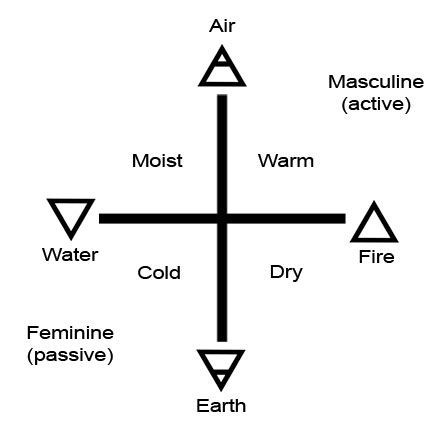
Tono Stano – Untitled (2001)

Tono Stano – Right-angle Flight (1985-6)
If I had to guess I’d say this frame has been inverted from its original orientation.
In other words: whereas the image appears as if the model’s legs are hanging off of something, more likely she’s laying on her back on the edge of a table with her legs in the air.
Not how the little dark edge of the table you can see in silhouette in the top left corner echoes the angle of the seem betwen the wall and the ceiling in the background behind her right foot.
Also: smart money would theorize that this filtered through a jugendstil funhouse mirror served as the impetus for the frankly ridiculous scenes from LvT’s Nymphomaniac where Seligman imagines Joe’s sexual education.
Stano would’ve been 25 when he made this. LvT was in his late 50s when making Nymphomaniac. (And that’s why everyone believes Bjork and no one believes LvT–plus if you’ve seen his films you’re automatically predisposed to believing Bjork.)
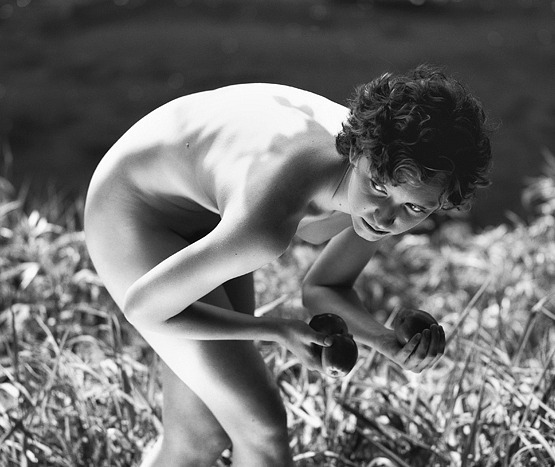
Tono Stano – Gift (1999)
Like much of Stano’s work, I am, at first, not certain how to engage with this photograph: it’s stunning–both in the sense of the reflection of sunlight off a moving vehicle that unexpectedly blinds you as well as incurring a coup de grace.
That’s probably not such a bad starting point, actually. (First idea, best idea–and all that.) There is something impossible about the light in the above: the over exposure along the ridge of your back, the flattering dynamic range of gradients on her face. (There’s almost certainly some sort of wizard-like chicanery with bounce boards going on just beyond the frame edge.)
After the initial wow-ness of seeing it, I naturally think woman with apples and start running with the biblical Eve mythos. On the surface, I feel that’s a super hackneyed premise. I’m inclined to accuse the artist of a lack of subtlety, when I should probably equally blame myself for the ease with which I trot down that well-worn path.
However, I don’t think it’s the wrong path. Here the woman is looking at something on the ground with both gravity and curiosity. The viewer might very much be intended to make this sort of subconscious connection. The three apples (instead of the usual one associated with the trope), suggests a fascination with the potential of knowing of good and evil (and from a theological standpoint: embracing of sin).
The more I look at this the more I’ve convinced that the allusions to Eve actually serve a recursive purpose, to present the surrender to temptation with nothing more than an implicit tempter.
Everything else points to a rapturous celebration of the sensuous pleasure of being human, alive and therefore physically embodied. (Also, from the standpoint of compositional form: not how the parabola of her rounded back opposes the inverse parabola of the grass behind her and how her shape and order contrast with the blurry chaos of vegetation; and how the dark background in the upper 40% of the frame makes her stand out more–conceptually suggesting that between chaos and nothing, there is humanity and it’s potential of sensuous experience.)
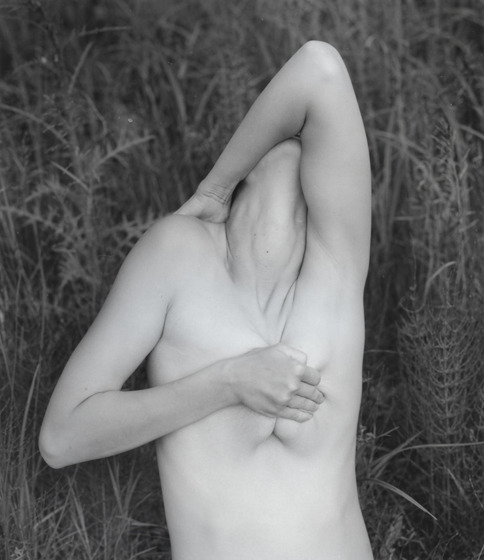
Tono Stano – Unidentifiable (2000)
Photography is not–as it were–my first visual ‘language’. I studied cinema for almost a decade before pursuing film making specifically.
Yet, similar to any first language–when I’m having difficulty expressing a thought in my second visual language, my tendency is to fall back on the first.
I had the opportunity to see the forthcoming Terrence Malick project Knight of Cups earlier this week.
It‘s a work by Malick–so all the things you typically associate with his style (multiple characters thoughts illustrated through stream of consciousness voice-over, so gorgeous they’re painful scenes and just a general profusion of beauty). It’s also so inexcusably vacuous, it’s vapid.
The mix of cinematography and digital cinematography is incredible. (Chivo is one of a teeny tiny group of indisputable ‘young’ masters.)
But what’s truly ground breaking about the proceedings are the way the roving camera approximates a dream. Chivo frequently fluidly transitions from one moving shot into another by trailing out of the first and then swinging into the second. By this I mean that you could say that the camera keeps moving without the actor and the motion becomes subjective, almost a POV and then it cuts to another subjective perspect that the actor then enters. It’s exceedingly well done and pulls together compellingly what would otherwise have been unwatchable.
But it’s frustrating: Chivo so frequently works with auteurs who’ve grown intractable in their approach to how and what the cinematic experience should convey (Malick) or godawful hacks who are only celebrated because of abject arrogant public masturbation sold to idiots as audacity married with technical precociousness (Iñárritu, who can kiss my whole asshole).
Sadly, Alfonso Cuarón is the closest Chiva routinely gets to a great artist and even that isn’t enough to push him to greater heights.
Really, I feel like Stano has quite a bit in common with Chivo. His work is consumately well made and presented but it lacks a conceptual clarity that it’s sorely missing.
For example: there are two image makers producing similar work–Dara Scully and Beatrix Mira. Scully is clearer in concept and execution than she is in presentation. Mira lacks Stano’s dynamic compositions but here’s seem motivated by a unifying personal obsession.
Stano’s work just looks cool as fcuk. But when you ask yourself what it’s about or what purpose it serves, the work reduces rapidly to an exercise in style over any sort of discernible content.
Ideally, the work I love most features both style and content but I’ll always taken the latter over the former. And that’s why I think ultimately, Scully and Mira are better artists.
Oh and here’s another example of how not cutting your head out of the frame is possible but still allows for anonymity and makes an infinitely better picture.
 Acetylene Eyes