

[↑] Francesca Woodman – Untitled (1980); [↓] Anna Malina – Untitled (2014)
Juxtaposition as commentary
[↑] Francesca Woodman – Untitled (1980); [↓] Anna Malina – Untitled (2014)
Juxtaposition as commentary



Peter Hujar – Bruce de Sainte Croix Triptych (1976)
The central image here served as my introduction to Hujar’s work. (I posted about it 2.5 years ago–misattributing the subject and excerpting just the one image from the grouping.) But, I recently discovered that I was familiar with another of his photos well ahead of that–probably the photo most commonly associated with Susan Sontag was made by him.)
I keep coming back to his work, though. I guess the reason I do is due to his patently even handed approach to all subjects. From portraiture, to landscapes to erotica, he invariably affords his subjects a calm dignity which more often than not edges over into a flash of stubborn pride.
As if in the mid-to-late 70s and big bad eighties in Manhattan with the specter of HIV and AIDS stalking the gay community, there was a camaraderie and joie de vivre that you just don’t really ever see. (And to be clear, I have no intention of romanticizing. It just strikes me that the romanticization of much of the work emanating from the downtown scene possesses an openness an candor that was bred as a result of surviving, the creation of which was clear eyed and unpretentious and for those who didn’t live through those years in that climate read as charmed in a way that was never intended by the creators.)
His tone and frank presentation of ‘high’ and ‘low’ subject matter with the same, quietly incisive approach are things I would very much like to achieve in my own work.
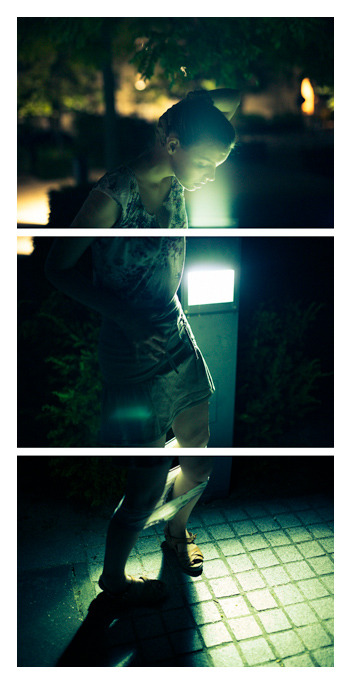
Tom Spianti – Eve, Night Light Triptych (2008)
The above leaves me a thousand times more turned on than something like this.
It’s less to do with the going commando. (That’s certainly hot, though.)
It’s more the way it risks transgressing the boundaries between public
and private.
For example: if a woman is naked under her dress,
when I knows it, the knowing is usually limited to myself and her.
Whereas, in the situation depicted here, although it is highly likely
the situation will remain a secret shared between only two individuals,
there’s still the possibility that it’s not: that a third party
witnessed the transgression.
A conspiracy of two where it’s
impossible to know with certainty whether it was limited to two or open
to three is something that will always reduce me to a flustered,
twitterpatedly aroused mess.
(And just to be clear, a good bit of
Spianti’s triptych work is similarly fixated and both intriguing and
sterling as far as craft is concerned.)
 Acetylene Eyes