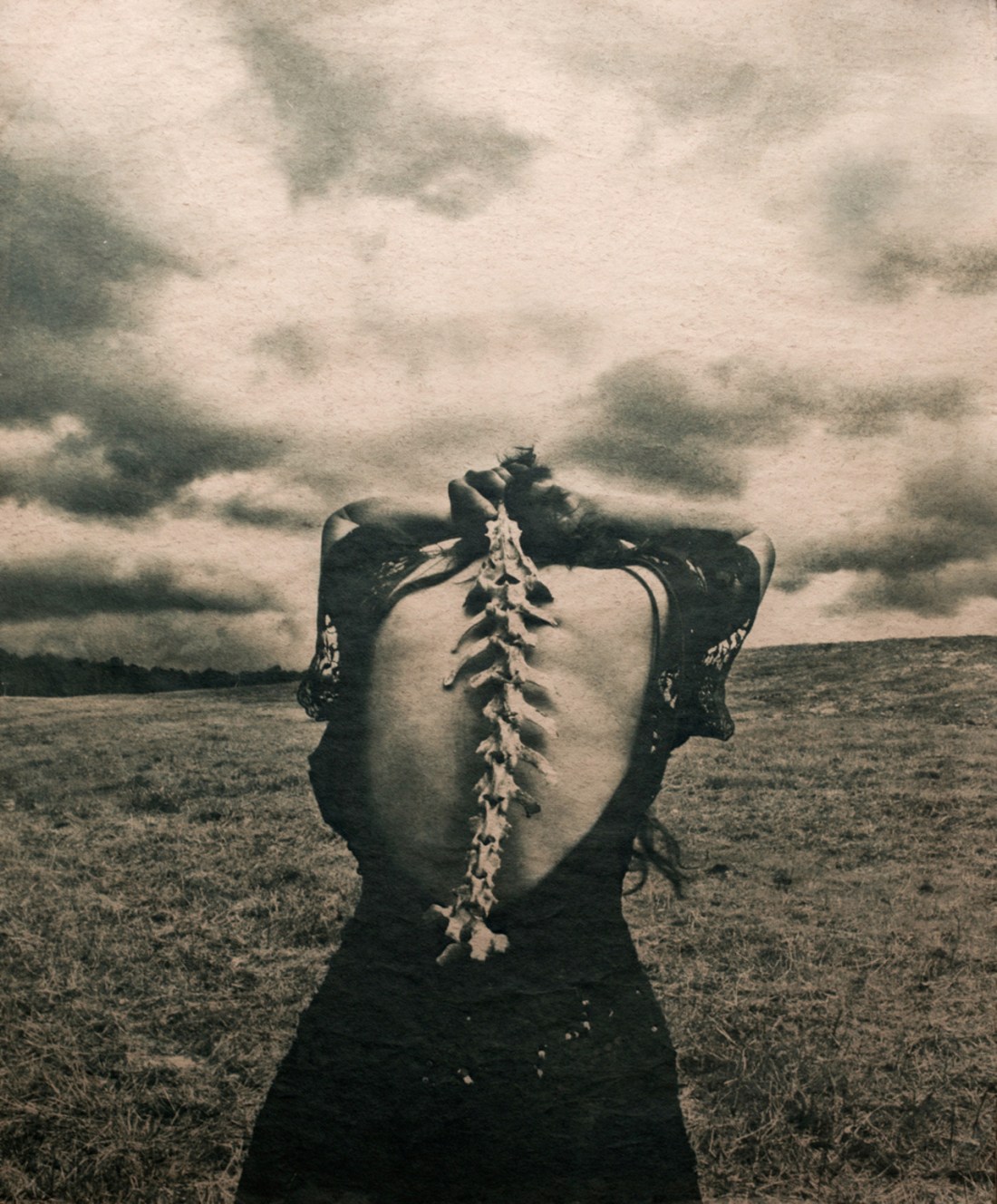
Jaime Erin JohnsonSpine (201X)

Everyone is familiar with the experience of seeing something and swearing they’ve seen it before even though they have never seen it–the experience of déjà vu.

Somewhere exactly halfway between the inverse and opposite of that is what’s called jamais vu–seeing something known as if for the first time.

For me, this photo sits somewhere between déjà vu and jamais vu: I am reasonable certain I’ve never seen it.

..yet I’ve had a notion of making a stunningly similar scene for a while now…

The great photography as fine art curator John Szarkowski maintained that all photos functioned as either windows or mirrors–respectively: showing the viewer the world around them or showing them something about themselves.

I tend to get tetchy about either/or dichotomies. (Or, as the joke goes: there are two types of people in this world; hard working decent folks and assholes who go around sorting everyone around them based on arbitrary bifurcative criteria.) However, I think for the epoch in which Szarkowski worked, windows and mirrors were arguably better criteria than might’ve otherwise be employed.

The thing I wonder is if maybe they no longer apply. I mean photography as a discipline has been predominantly focused on The World As It Is ™ for much of its formative years. (Arguments about the potential for a photograph or image to be subjective, notwithstanding, of course.)

Something I do that I’m not sure whether actually trained art historians do is the tendency to extrapolate based on trends that have already run their course.

There’s the interpenetrative history of dadaism and surrealism–and I’d argue that dadaism arguably better earns the surrealist designation, while surrealism was something more interested in toeing the line of what these days gets termed: oneiric.

As I’ve pointed out David Lynch has made a career out of sometimes skillfully, other times clumsily conflated surreality and oneirism. (In fact it occurs to me that his best work occurs when he actually distinguishes between the two with some sort of logical system–that no matter how difficult it is to parse, keeps these differing impulses in their own respective lanes. And, here I am thinking explicitly of Mulholland Dr. Although if you’d prefer me to restrict things to the realm of photography, I’ll see you Josef Koudelka and raise you Arno Rafael Minkkinen.)

Also, photography doesn’t really have a surrealist branch of practice. I mean you’ve got Joel-Peter Witkin and Jerry Uelsmann–and I’d place both closer to say whatever the hell it was H. R. Giger was on about than of a piece with Salvador Dali.

My point is merely that I don’t think Szarkowski’s windows/mirrors bifurcation works any more–except maybe in oneiric deviations of photography/image making.

It seems like surrealism is invested in showing us a world that is enough like our waking world that were it possible we could step into it and ‘inhabit’ it. Oneirism reintroduces us to a world we already know–but may have forgotten upon waking.

In effect: surrealism is a window, whereas oneirism is a mirror.

And what I adore about Jaime Erin Johnson’s image here is that the experience I have looking at it is virtually identical to encountering a word in The Dictionary of Obscure Sorrows that describes something I’ve felt is an experience only I have ever had–only to discover that a language I don’t speak or know found that feeling important enough to name.

It really doesn’t matter whether I’ve ever seen this image before–it works because it taps into a sort of archetypal symbology to convey the reality of an emotion that has been if not fully inhabited, then at least methodically studied.

w-y-s-f:

I’m going to be out of town, but I wanted to post a reminder that today’s theme is scars! I have eight symmetrical scars on my spine from an injury I suffered in 2010. While it was one of the most traumatic things I’ve ever experienced, and I deal with pain everyday, I think about how often artists transform pain. Brooke Eva looked at my scars and saw something else. Scars are healing. They’re the place where the cut was. They’re the place where the skin is growing over the hurt. They are your Earth’s earnings. Your transaction with time. A sign that you survived something that might have killed others.

Hanna

Brooke EvaHanna Grace (2015)

I don’t–for once–have a raft of commentary about this image. It’s entirely too dark and the placement of the subject in the frame is governed less by any pervasive aesthetic logic and more presenting an overhead-ish view without including the camera operators feet.

That’s not really intended as a slight against the image. In being entirely too dark and given the prominence of the vertebral column, there’s a clear parallel with Sally Mann’s work.

However, I talk about Mann entirely too much and it’s seems especially pointless given that when you perform a Google Image Search on this image, the top result is actually a Sally Mann image. No one reads what I post in order to discover something an algorithm could teach them.

What interests me about this is the subject herself: Hanna Grace.

I noticed her work about six months ago and was so impressed with the inherent potential in one of her photosets that I featured it in a post.

Subsequently, her work as well as her commentary/writing keep commanding my attention–there’s something devastatingly insightful in the way she articulates her thoughts. And there’s a certain rawness to her presentation that applies whether she’s modeling, making self-portraits or explaining her singular perspective.

I’ve struggled in the writing of this post–deleting everything multiple times and starting over. I can’t seem to get the tone right. The laudatory aspects is easy enough. Since I legitimately enjoy her work. But there’s also something else I want to address but I’m hesitant…

In several earlier drafts, I’ve tried to suggest a correlation between Hanna and Francesca Woodman. That’s a little too easy and pat, though. What I see as relateable between the two is Woodman’s asymptotic approach to something not unlike malediction in the later work.

However, Woodman’s later work tends to toe the line separating curious exploration and experimentation from outright narcissism. In other words, the precociously astute interrogation of visual representation and gender identity grow that defined her work as a teenager growsincreasingly redundant and struggles to find a solid contextual footing.

Now I’ve read a great deal on Woodman but I’m unfamiliar with critical commentary that has taken issue with her ostensible white, cishet privilege.

That–in turn–propelled me to consider similarities between Woodman’s work and Ana Mendieta’s. Again, that’s probably to pat and easy a corollary but they were both wunderkinds, who were celebrated during their lifetime and who both died under similar circumstances–falling from tall buildings. (Although, it is worth noting that unlike Woodman, Mendieta was probably pushed.)

On top of those similarities, there’s an overlap in their respective tones–a similar maledictory thrust. (In fact, several of Mendieta’s performances invoke violence in ways I consider objectionable.)

Despite that, I find it interesting the degree to which Woodman receives adulation and Mendieta remains lesser known. I’d argue both are equally important. But Mendieta does–at the least–contextualize her work in a broader, historical sense addressing a more primal, magical sense of gender as construct. (By that account, she’s objectively more mature than Woodman.)

Grace’s work strikes me as adjoining these two women. The malediction is subverted into a means of exorcism and the context is intersectional feminist discourse. In that regard, she’s closer to Mendieta than Woodman. However, I do have to point out that in the quote with which Grace introduces the above image, I do think the final sentence is telling: A sign that you survived something that might have killed others. [Emphasis mine]

It doesn’t quite read as an explicit notion of personal exceptionalism. But it does beg the question how surviving something that might have killed others is somehow more noteworthy than surviving something that might have killed you.

Rendering death as an alterity is rather an odd maneuver given the intensity and rawness of the work. Especially given the momento mori of the above image. And I mention it not so much as criticism; more from the realizations that its often the seemingly irreconcilable contradictions between how we think of a thing and how we articulate our thinking about that thing which provide the most staggering growth in our work–creative or otherwise.