Source unknown – Title unknown (188X)

One thing you learn very quickly studying visual art in academia is the liability that is sentimentality.

The two exceptions I can think of are Nan Goldin–who, while her work is unsentimental, the raison d’etre for her work is fundamentally sentimental; and Sally Mann, whose work frequently borders on inexcusable sentimentality but always manages to maintain a rigorously formal foundation w/r/t to conceptual complexity and masterful execution.

I’m not arguing that the above image is sentimental. It is, however, very earnest and I think all too often that disqualifies certain work from being considered as art.

There are certainly compositional flaws that detract from this. The entire frame is left heavy. As all the elements either shift the eye left or are gathered at the left half of the frame. The “24.” along the right frame edge is placed as if to counter-act some of that off kilterness–but it hardly makes up for it.

Additionally, the lower frame edge cutting at the knee is just inelegant and jarring.

Yet, there is a lot to praise here. The skin tone is lovely–the subtle gradation between the curve of his body and the backdrop, the way her skin is so much lighter than his.

The backdrop borders on ridiculous; however, with the careful drape of the rug and the position of the bodies with the aforementioned gradation, it all suggests a familiarity with classical modes of visual representation.

I also adore the way her arm is bent back and she’s looking directly into the camera. There’s something calculated about it–part defiance, part fascination. Also, the dirty soles of her feet splayed in the air is inspired.

It feels to me like the photographer wanted to make images of people fucking but didn’t want it to read as frivolous. Thus, there’s an attention to detail that although it doesn’t entirely work, it adds a ring of truth to the scene.

I have no idea about the origins of this image. But there does appear to be a scratch on it–bifurcating it more or less horizontally at the center as well as a dogeared corner. It may not be accurate but it’s possible to imagine someone keeping this photo secreted away in a coat pocket.
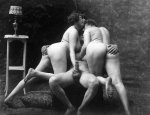
Source unknown – Title unknown (19XX)

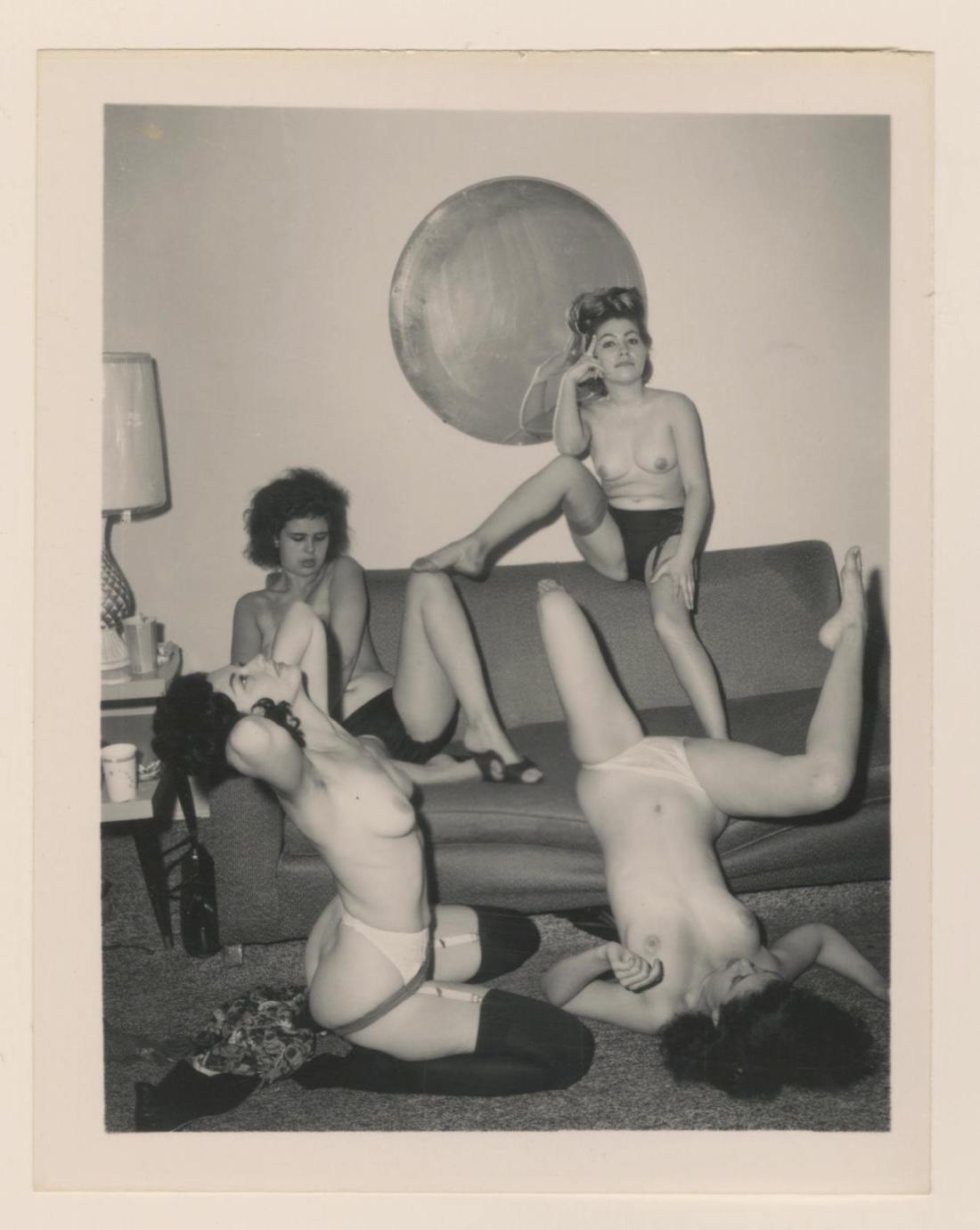
It’s one thing to direct one person to stand here or there, glance through the viewfinder, weave and bob for a bit in order to find an acceptable frame before clicking the shutter.

It’s another altogether to make a frame work with multiple people.

And to be fair: the above only works halfway. Here I think its more productive to approach what doesn’t work first.

For a photograph to demand a modicum of detective work of the viewer is not necessarily a bad thing insofar as the image provides enough context for a diligent viewer to at least attempt to ‘solve’ the mystery given only the presented visual evidence.

Here I think arguably the best starting point is to ask: what in blazes are the women at 5 o’clock and 9:30 doing?

An answer is implied–if only winkingly; note at frame left: the cups on the end table and the bottle between the table leg and the base of the couch.

Thus, I don’t think it’s really that much of a stretch to presume everyone is a bit soused.

(And with that context, the woman at 9:30′s mien becomes much easier to ‘read’–she’s so intoxicated she’s on the threshold of blacking out.)

My experience suggests the binge drinking explanation is correct. For example: Among my friends it’s a well established fact that given a fifth of vodka, my ability to navigate the finer points of sitting on a couch grows progressively jumbled. I’m certain I’ve ended up in a position mirroring the woman at 5 o’clock on more occasions than I should admit publicly. (Ed. Note: this is why the author’s friends no longer allow them to consume vodka under any circumstances whatsoever.)

So although the poses are at best odd (and more likely awkward), the information offered suggests a clear explanation.

Compounding the oddity and or awkwardness of the poses is the flash. Note: the way Ms-Stretching-Her-Back-And-Staring-Up-At-The-Ceiling casts a ugly shadow Ms Approaching-Black-Out-Drunk.

However, although this aspect of the flash doesn’t work, it was a great choice in other regards. It de-emphasizes the reflective qualities of the mirror and renders a super flattering even light on the woman sitting on the couch back. (Who, I have to add looks uncannily like a dear friend–it’s partly her facial features and partly the foot on the other woman’s knee, which is exactly the sort of thing my friend would do while mugging for the camera. Also, I’m probably the only one here but the position of the mirror and the vertical frame remind me of my third favorite painting of all time–Van Eyck’s The Arnolfini Wedding Party.)

Okay, so there’s some clumsy shit here: the ambiguity about what’s happening and the cast shadow. The ambiguity is–to my mind–clearly ameliorated given the broader context of the photograph. The cast shadow is a definitely detracts but since its a result of the flash and the flash adds an undeniably immediacy to the moment, what is one to do?

It’s likely the photographer already had their back–quite literally–against the wall. Given the couch and the mirror on the wall, the vertical frame is both logically appropriate and aesthetically wise. (A horizontal frame could’ve probably allowed for positioning the women within the frame better/having their relative positions in the frame relate to one another more organically; but it would almost certainly have compromised the intimate feeling that the vertical frame conveys here.)

Perhaps, it would’ve been possible to shift Ms-Stretching-Her-Back-And-Staring-Up-At-The-Ceiling ever so slightly left and then cheating Ms Approaching-Black-Out-Drunk right by a hair.

But a better way would’ve been to only include three people. (Whenever possible it’s always better to work with odd numbers of people. As anyone with a lot of freckles and a tendency to tune out when people drone on about boring shit knows: any three non-linear dots form a triangle, so odd numbered groupings, with a little thought and organization can be arranged into to triangular configurations.)

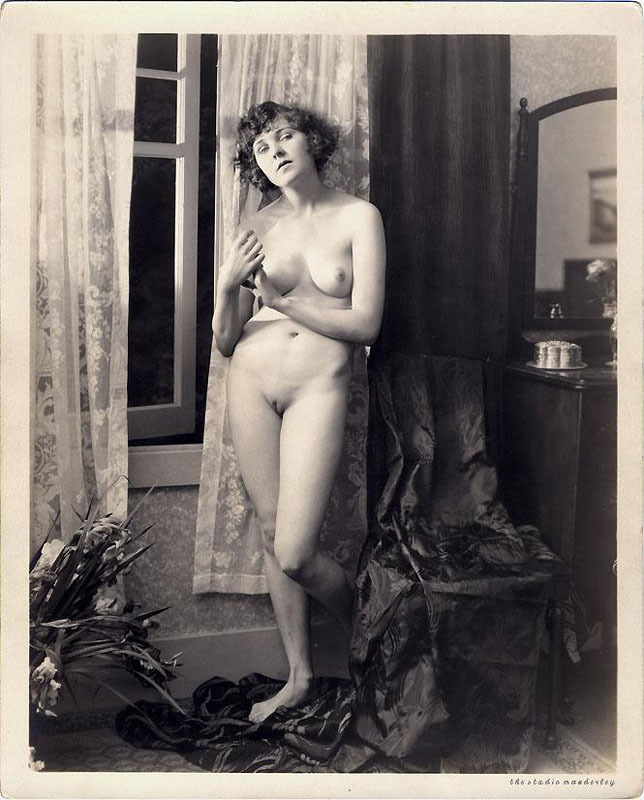
Albert Arthur Allen – Untitled (192X)

Excluding the border, sepia tinge and interior design, this could from a modern image maker who took this last year and only got around to uploading it to Tumblr last week.

But this was made sometime during the 1920s by a man born in Massachusetts, who moved to the Bay Area and started shooting nudes.

In this way he was singular in focus and profligate in output.

The work is a bit of a chimera; words like ‘camp’ and ‘contrived’ pop up whenever Allen’s work is discussed–sadly the former obscures a more important feature, the latter perhaps misses a pertinent point.

Take the above, for example. At first, it strikes one as charmingly intimate and unselfconscious. Upon further examination: the composition mostly works. The relationship of the lens to the mise en scene is studied, carefully composed–the half of the plant in the lower left corner is great as is the reflection of the room in the mirror.

Yet, as one gazes, inconsistencies take on a sharper focus: why in the hell is her ankle hooked behind the leg of the chair; did the shutter fire mid-blink or is she half asleep? That’s entirely too much fabric to be a robe and why is it draped on the chair like that–is it an effort to rubber stamp Classical Ideal ™ bonafides?

And now, almost a century after the images were made–despite their sometimes clumsy habituation, they are still better than 95% of the stuff made by so-called Tumblr famous image makers who shoot nudes and nothing by nudes.

In fact: I think there’s an argument to be made that Allen is perhaps a better photographer than someone like David Hamilton–if for no other reason than at least Allen is honest and straight-forward and owns (for better or worse) his rote repetitions and foibles.

But the interesting question here is: by seeking to document a subject which has been tested–tried and true across the ages–as perennially of interest as a subject addressed by art, to what extent does surviving 100 years render a photograph less document and more art?

I’d argue that the continued interest in Allen’s work has less to do with the work itself and more to do with what the viewer might interpolate about the longevity of fine art nudes as a photographic genre based upon the work.

We want the work to be Capital-A Art because it suggests a degree of merit to the undertaking and in so doing we subtly fixate upon the charm to the diminution of the awkward.

And really, Allen’s work is better than 95% of the work by this or that Tumblr famous image maker–I mean at least he is compellingly conversant in art history and its considerations.

But I’m not sure that which makes his work enduring is something that should in any way be seen as a voice from beyond the grave legitimating these our most earnest of efforts.

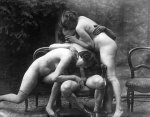
Source unknown – Title Unknown (19XX)

Narrative this image is not. In fact it’s pretty goddamn contrived–a cishet male photographer appropriating lesbianism for erotic effect.

But that realization serves as a narrative spark and I can’t help but think that as these two women were leaving post-session and one of them–probably the one on top (the woman on the bottom with the protruding tongue is a little too lipstick lesbian for me to believe she has any personal experience with cunnilingus) works as a prostitute but is a lesbian. She accepts these photo gigs because they pay the same as sex work and she doesn’t have to deal with men.

Yet the sessions themselves are the closest she gets to tracing the outline of her true desire and as such she frequently jokes with other woman with whom she is photographed about how ridiculous the way heterosexual men think about lesbian sex is and hoping that the other model will just once nod a little too knowingly and one thing will lead to another.

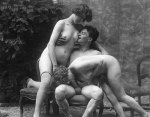
Source unknown – Title unknown (19XX)

I tried to draw attention to this series a few posts back but on the grounds of quality of craft, i.e. adept handling of a diverse tonal range and unimpeachable attention to skin tone/texture.

Yes, some of the framing is awkward but I feel that’s more than counter balanced by the fact that the camera remains at enough of a remove that it remains voyeur instead of becoming an ersatz participant in the liaison.

(And my Wittgensteinian side thrills in the fact that the action–haphazardly framed or not–is firmly grounded in the context of a background equal parts Ostra Studios and anticipating Saudek.

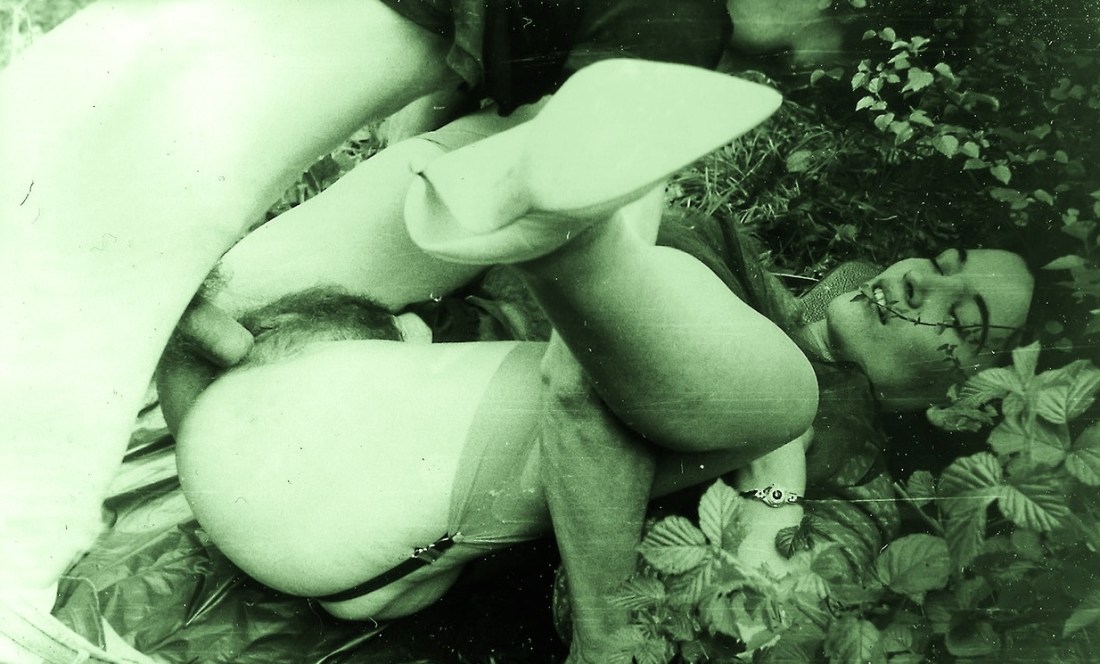
Source: Unknown

There are several dozen reasons this is a really lovely image but I would like to focus specifically on its careful use of tonality.

It is meant to be scanned left to right. The skin of the male bodied partner is exposed a hair below complete overexposure and loss of highlight detail. (Making a traditional darkroom wet print, you would probably have to split grade and burn the edge in with a 4 or 4.5 filter.)

The male bodied participant is rendered an ethereal specter; his body only begins gaining form and dimension in relation to his proximity to his partner.

The right half of the frame is heavy with a mid-to-dark range of tones. The female-bodied partner’s teeth represent the only tone in from the highlight range. This balances against the dark tones of the pubic hair in the left half of the frame–in a way the skin and high heel encircle the penetrative sex act, highlighting it.

The darkest areas of the frame are in the armpits of his t-shirt, the area shadowed by her left thigh and his right forearm and her hair.

Thus the tonal composition reduces to a figure not unlike: 0>.

What is interesting to me is the discrepancies from the figure and how they actually enhance the image. If you follow the highlight of her blown out high heels suspended in midair–a porno trope I loathe but that serves here–your eye is led in the direction of his face (where his eyes are locked on his erection as it is consumed by her body); whereas, if you are following the mid-to-dark tones, your eye descends to note the way her knees hook into his elbows.

All that definitely appeals to my aesthetic sensibilities. But it’s the way that despite the emphasis on the graphic depiction of intercourse, that I am entirely preoccupied with her calm and beautifully meditative expression.