that each quarter-second decision to exclude, to define a boundary, to say what will not be in the photograph
is as explicit as a thumbprint.
–Traci Matlock
I find this metaphor appealing for dozens of reasons.
From police commish to your average Jane on the street, the police procedural and its popularity have instilled a near universal awareness of the distinctive singularity of the human finger print.
Recently, I learned a bit about the methodology underlying dermatoglyphics; namely, a fingerprint consist of one of three patterns: whorls, loops or arch.
5% of all fingerprints are arches.
Every fingerprint is–in theory unique–but arched prints are, in effect, doubly unique.
I feel this contributes a certain added elegance to the metaphor. Yes, image composition is as explicit as a thumbprint; but, there are certain image makers whose composition is so distinctively singular, that they stand out at forty yards under bad light as belong to a particular artist.
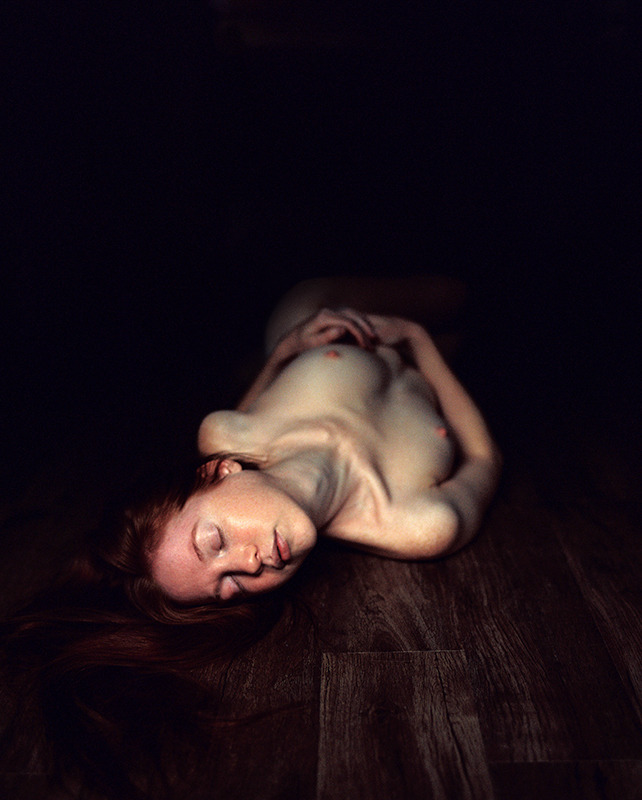
Ryan Muirhead work is a good exemplar.
He prefers vertical frame orientation. And not to disappoint long time followers but I am not at all inclined to dive for my customary #skinnyframebullshit accusation.
Why? Well, there may be grounds for questioning where stylistic affectation ends and compositional logic begins—Muirhead’s wide framed images are more compelling (at least to my eye). ultimately though I can’t fault his skinny frames–they routinely contribute a preternatural dynamism, cleverly accentuate shape and form (rightmost image), ground portraits in a specific context, all while exploring a diverse range of technical nuance to precocious effect.
Given all that, I’m not entirely sure vertical orientation adds anything to this image. Don’t get me wrong–it’s one of the best conceived and executed nudes I’ve encountered in months, completely unlike anything I’ve ever seen. I am enamored by the way it finds a way for stillness and restlessness to coexist in the same space in time. The only word I can attribute to nature of the gaze is respectful.
Unlike many photographers whose work impresses me at first blush, researching Muirhead further did little to diminish my interest. In fact, this beyond on point interview over at This Is Imperfect honestly impressed the shit out of me.
But it reminds me of two curatorial comments I encountered in Madrid’s Museo del Prado. One referred to altar pieces’ heavily favoring a vertical compositional orientation. Another underscored the horizontal orientation of Venetian narrative painting (istorie).
It’s almost as if the mechanics of a vertical composition draw the eye heavenward while the eye scans across that which is horizontal–sacred vs. profane.
I am certain a great many humanist artists knew this and purposely executed profane work in a secular style as a subtle subversion.
I think there’s a bit of that at play here. And while I almost want to criticize Švabinský for his ambivalence towards a definitive context, I feel the work was a little too slippery for even him to completely control in much the same way the customary atheist proverb isn’t wonder enough? conveniently misses the truth that the experience of wonder is the experience of being in the presence of God. Just not the god as placeholder for transcendent experience that bear names like Allah, praise be upon him, Yahweh, Krishna, Buddha, etc; names and obtuse back stories that facilitate parallel reciprocity at the expense of relationship.
I’ve wanted to comment on his work in some way; however, the overall quality demanded much more than an OMFG, lookie at the pretty colors!
Since Chill follows this blog, I figured it couldn’t hurt to reach out to him in an effort to learn more about his process.
To my surprise, he not only responded but expressed excitement at the prospect of addressing a handful of questions.
AE: Right off: I am en-goddamn-thralled by the interplay between color and depth of field in your work. It’s almost as if the dominate hue permeates the frame so completely it becomes sort of liquid—not unlike amber encasing an object. Short of Uta Barth, I’ve never seen anything that conveys 3D space in a 2D medium quite like your images. Could you talk a little bit about your technique?
Chill:Your amber metaphor is fabulous (and unusual). I really like [it]. I’m very [sensitive] to the way [things are seen]. This picture of a liquid enveloping everything is pretty and poetic. I’ve always been attracted by vivid colors and natural light. There is a particular energy and a pleasant atmosphere in it. I love close frames, it reinforce details you want to highlight and naturally goes hand in hand with intimacy.
I always [meet] the person before the session. In a nice place, [getting to know] each other, talking about what we like, what we don’t, exchanging some ideas, answering questions, etc… I think it’s normal and human « step » before making pictures. It also helps me ([and] the model) to feel more comfortable.
I work as much as possible in natural light, which makes me dependent on it. Scene colors, clothes that the model will wear, skin tones… influence substantially the result of my photo sessions. Every meeting is unique, and that pushes me to adapt regularly. Anyway, it’s never pleasant to cancelling a session when the weather is really bad. I [applied] myself seriously in photography when I bought my Canon EOS 40D. It was my first DSLR and I really enjoyed [using] it for 6 years with [the] 50mm lens I still have. I have [had] a full frame camera (Canon EOS 5D) for a little over a year. My shallow depths of field, my highlights and my frames are natural. I don’t post-process [my pictures much], my motto is to keep my pictures as natural as possible.
AE:I am going to be a bad interviewer and digress into personal biography. Similar to you, I am a self-taught image maker. I’ve also taken photography courses at an MFA level and in my experience there is a near total disconnect between traditional so-called fine art photography and autodidact practitioners—the form and content of the respective works are different + the conversations surrounding them couldn’t be more opposed. (The DeviantArt/Flickr/Tumblr crowd raves about Traci Matlock and Lina Scheynius whereas the MFA kids seemingly can’t shut the fuck up about Eugene Atget and Robert Frank.) Beyond your manipulation of color with depth of field what interests me about your work is that it feels like it’s standing in the middle of that bridge of impossible crossing dividing non-traditional and traditional fine art practice. In form and content your work is pointedly non-traditional; however, my own response to it skews much more towards engaging critical and conceptual concerns instead of pondering why the work interests me and/or whether or not I like it. I am curious as to how you arrived upon such a rare middle ground.
Chill: Your analysis is very interesting, I hadn’t seen the things like that and I’m truly touched by it. I discovered photography during my studies, far away from the artistic environment. A sideline which quickly captivate me and became my main passion. I grew up in a family where there wasn’t any particular interests to photography or visual arts. The fact that I fell in it by simple curiosity still surprises me now, so much [that] I…feel like…it [now] forms integral part of me.
Being…very curious, I quickly realized that everything was possible in photography and it was necessary for me to control my equipment to succeed in doing what I wanted to. …[M]y technique became a kind of personal signature. I developed my skills in a rather naive way…according [with] my tastes and my desires. I try again and again, different things, randomly or with a precise idea. I correct. I start again. I think it’s in this way I developed a certain rigor in my photographs over time.
AE:What artists do you consider to be indispensable influences?
Chill: I’m an admirer of Helmut Newton (Newton’s glamour and erotic style is unique), Richard Kern (for the natural and living side), Larry Clark (I like the way he has sometimes to disturb through his works, and his manner of filming. Rough and true.), Ryan McGinley (for the timelessness, unique ambiances and dreamy pictures) and many others…
AE:While she was a terrible fucking person—not to mention the unsavory whiff of implied slut-shaming—there’s this Margaret Thatcher quip: Power is like being a lady…if you have to tell people you are, you aren’t. I mention it because I feel it is apropos to straight, cisgendered men who shoot erotic/nude work and waste a lot of breath pontificating on how much they respect women; meanwhile their work suggests a patently sexist agenda. In other words: if you respect women, no need to pat yourself on the back, it’ll show in your work—end of fucking story. Your work comes across as at the minimum cognizant of feminist concerns w/r/t the politics of representation/depiction. And that makes me wonder to what extent—if any—you are consciously trying to subvert the art historical trend of privileged straight men objectifying the female body? Do you identify as a feminist ally?
Chill: I’m into body photography in [intimate] environments. Of course, I’m conscious that many pictures I make are glamour and sensual, and can be, unfortunately, …interpreted or quickly…catalogued as being a part of the art historical objectification of women by privileged straight men.
I would…identif[y] myself… as a a feminist ally, because I’m completely against [such] objectification of…woman and it’s always very unpleasant to receive those typical male comments about my photographs. I find that disrespectful for the persons I photograph and…my work.
AE:In an interview appearing in issue 6 of Koch Magazine you mention that nudity presents the opportunity to capture a certain ‘timelessness’. I am curious as to how that is perhaps counter balanced by your expressed interest in shooting in the model’s environment whenever possible. Grounding the shoots in modern, personal spaces seems to contradict such ‘timelessness’. Could you talk a little about how these two features of your process connect?
Chill: The fact of photographing the model in his place, when it’s possible, reinforces the intimacy, and that’s what I try to show firstly. The environment is significant to the intimacy of the person photographed, and nudity becomes a means of enriching this intimacy.
To make timeless nudity possible, the environment has to be neutral and minimalist. Thus emphasizing only the body and not the body being a part of the place.
AE:You are stranded on a desert island. A desert island that counter-intuitively (and conveniently) has electricity, a phonograph and a DVD player. You can bring only 3 albums and 3 DVDs. What can’t you live without?
Chill: Albums
PJ Harvey’s – To Bring You My Love(1995) – Her voice has so much power. I can listen to this album over and over, tirelessly.
Leftfield’s – Rhythm and Stealth(1999) – Because it’s one of the first electro albums I’ve listened to and I’ve been immediately hypnotized by Leftfield’s cadencies
Dr.Dre’s – The Chronic (1992) – I used to listen to a lot of hip-hop when I was a teenager, and this classic album is definitely one of my favorites. You can even feel the heat of L.A. summer.
Sean Ellis’ Cashback (2006) – I love pretty pictures, I’m attracted and embroiled by them. And every scene of this movie is one.
Guy Ricthie’s Revolver (2005) – Because of the actors, the strange story, the soundtrack, the photography, the humor and the style.
AE:What was the last book that really blew your mind?
Sandcastle (Chateau de sable) by Frederik Peeters and Pierre Oscar Levy (comic book) – A closed session between 13 persons on a beach, who will face an inconceivable event which will [raise] many questions about themselves. I can’t tell more.
I’m having one of those aha moments where the incandescent bulb over my head flickers, falters and then begins to glow bright.
Unless you’ve been living under a rock, if you participate in the Tumblr art nude/erotic image community, then you know who the fuck Chip Willis is. The list of model with whom he has collaborated might as well be the Tumblr model A-list.
Honestly though, I’ve always felt meh-ish at best about his work. I mean, don’t get me wrong: it’s quality; it just hasn’t ever really moved me.
This image connects somehow. And I think it has to do with the fact that it features Kelsey Dylan.
The first image I ever saw of hers was the incredible Polaroid diptych by rabbits. This is one of those times where my thoughts don’t align all that well with language. But the aforementioned photos resonate with an unnerving curation of representational identity–looking at them my body has this strange psuedo-synesthetic response where I physically itch in a way that is half mosquito bite, half throbbing erogenous arousal. It’s an experience that bypasses critical/conceptual academnification via an impossible, coup de grace killshot, the bullet lodging in the liminal space between the thinking mind and the feeling brain.
It’s not just the Polaroid diptych, the majority of Dylan’s work seems to have a similar effect on me.
Therein lays the bait. But by the time I’ve realized it, the hook is set–or more accurate Willis’ image becomes something of a labyrinth I must now learn to navigate because I have found myself unexpectedly at its center.
If you know you’re in a maze, you just pick either the wall to your left or right and you as long as you follow that wall without deviation, you will eventually find your way out.
This image provides two clues as to how it is to be interpreted–and looking back over Willis’ work, these seem to hold true throughout:
The image maker is aware of the voyeuristic slant the content contributes to the image,
The image represents an effort to sublimate tropes and tableaux customarily relegated to the realm of pornography by employing methods associated with Art practice.
I suspect Mr. Willis would probably object to the second point. He might contend that he’s interested in presenting a narrative. But as with every image maker who uses an image’s potential to convey a story, the truth is: indubitably narrative images tend to be the exception not the rule.
What possible narrative could this image entail? What reason is there for such a pose? Is Dylan being fucked by the light pouring in through the open window? Hardly.
The futon is positioned with more a mind to mise en scene than interior design and the framing of the doorway imposes a sense of voyeurism on the proceedings. That it is a wide shot–presenting a more or less complete context–shifts it away from its pornographic trappings and towards a mediation on representation of physical identity, sexuality and objectification.
Everyone tells me I apologize too much. I know it’s true; but I just assume everyone judges me on a comparable scale of harshness as the one I deploy in self-criticism and that compels me to seek absolution for persistent failures everyone around me seems to only vaguely notices as afterthoughts…
I don’t have a good excuse for not posting any-fucking-thing in course of the last month. There have been extenuating circumstances; but honestly, none so severe as to justify being so remiss in my duties. I apologize profusely for my dereliction.
Things are kind of weird right now and while I can’t promise a return to the post-a-day golden days of February and March, I will try my damnedest to eke out 3 to 4 posts a week until things settle into a more sympathetic routine.
Two other small bits of news.
Keep your eyes peeled. Something big has been in the works for a few weeks and I am hoping it’ll be ready to post by late this week or the beginning of next. (Hint: Acetylene Eyes pursued and was inexplicably granted the opportunity to interview an increasingly popular Tumblr photographer!)
For those who have followed my shitty soap opera script life, I am no longer unemployed. I started a few weeks ago. It’s just about as far from being my dream job as you could imagine but it looks like it’ll mostly pay the bills and depends on me being my own boss more than reporting to any sort of codified authority structure even if I am in way over my head as far as what they think I am qualified to do as opposed to what I am actually qualified to do. Cross your fingers for me, I guess…
There’s this essay that’s been bouncing around in my head for more than a year. It has to do with the junctions, disjunctions and ruptures in the terms ‘erotica’, ‘sexual explicit imagery’, ‘pornography’ and ‘Art’.
I have some 30 pages of notes but sitting down to write in earnest is a real struggle for me.
It’s a shame, really–being able to call on such an essay in the analysis of this image would pay rich dividends in the case of this image, especially given that I’d be inclined to label this as both ‘erotica’ and ‘pornography’ but less willing to attribute any strong artistic merit or suggest that depicting and erect penis precludes sexual explicitness.
What’s sexual here is the position of the female body in relationship to the male. The image clearly captures a moment prior to the commencement of sexual congress; in other words, the image titillates through implication.
There is a sense of artistic pretense–high contrast, black and white, shot with a strobe there’s also the feeling that what is presented is a crop from a larger image; or, what should have been a composition centering on a wider angle of view.
Artistic shortcomings aside I do find this image to be highly erotic as it includes a number of things that dampen my undies: the fact that although not wearing a stitch, the female bodied participant is presented in such a way that her nakedness is hidden at the same time the male bodied participant is visible for all the world to see. (In this case I also really dig the acute angle of his erection and way the flash draws attention to the texture and tone of his foreskin.)
There’s also something intangible about the image that conveys for me a sense of craving a lover’s body so much it causes physical pain. And with that aching transforms the carnal union into not only an approaching of ecstatic bliss but a drowning of pain in pleasure.











 Acetylene Eyes