A note on criticism

As much as I don’t miss MFA crits, I sort of do.

Visual culture matters to me immensely. I’m not sure if anything I do here is necessarily good or even coherent and although it’s not easy to sit down and write I manage it with some regularity. (That’s a big deal for me.)

Rest assured that if I post an image of yours, even if I don’t exactly agree with certain decisions you made, the fact that I posted it means that I believe some facet of your effort is meritorious.

I am a highly critical person, yes. But I do not see my role as a critic. I’m here and I do what I do because–well, I hate to admit it but I am kind of not exactly lazy but prone to inertia.

Unfortunately, I’ve found that progress requires momentum and I am shit at building it. I don’t always have things figured out and honestly I’d say ¾ of the time, by writing the posts I do, I am trying to work through some question I have about an image or a technique/process. It doesn’t always get me anywhere. But sometimes it does.

If it helps you work through something to, then all the better.

Masha DemianovaUntitled from Badlands series (201X)

By her own admission, Demianova is preoccupied with establishing a female gaze countering Berger vis-a-vis Benjamin’s art historical male gaze.

I won’t argue that her assertion is unfounded–the work does supports it. I just think that perhaps the notion might be more effective applied in analysis of Rita Lino’s work. Further, when she’s asked about the female gaze she trots out flippant non-answers a la I am a female so is my gaze.

In fairness, that half-assed quip comes from a painfully bad interview with DAZED in which they compare Demianova’s images to Petra Collins’. (As an aside: it seems if you want to talk about Collins you’d really be better suited using Arvida Byström or laurencephilomene-photo.)

Demianova’s work–preoccupation with the female gaze, notwithstanding–has far more in common with Igor Mukhin (a fellow Russian who also shoots both B&W and color) or, in an inversion of style, Noah Kalina (who is similarly caught up in fashion/editorial work and who favors skin tone just beyond the edge of overexposure, an equal but opposite effect to the way Demianova often lets her backgrounds edge dark and muddled to render a somewhat sinister Floria Sigismondi/Kubuki effect.)

But I’m not really especially critical of Demianova’s work. It doesn’t all appeal to me but like so many other artists of Russian and/or Eastern European extraction, there is an edge that draws me like a moth to a flame.

I think it has something to do with–and I may be off base her because I know little about Catholicism and even less about Eastern Orthodoxy–but there seems to be a different perspective on physicality. In the West, the body must by brought under rigid control, but I always feel very much as if in Russian and Eastern European work (at least modern work) there is a way in which physical sensuality is a spiritual realm.

So that is the bias which makes me without hesitation think the boy above is posed to recall the Blessed Virgin. The genderfucking undertone is satisfying. But what sells the photo–and (at least in my mind) suggests that even if Demianova hasn’t quite learned how to express it in interviews, she is not being even slightly pretentious when she mentions her aesthetic of a female gaze–is the fact that the way it’s shot with the photographer ostensibly standing over the subject and using a strobe, this feels like it’s also trying to re-appropriate an aesthetic now very nearly ruined by its association with predatory scum bags like Terry Richardson.

Andrés Castañeda – Untitled (2014)

I see a lot of Castañeda’s work featured on a lot of the blogs I follow.

Until the set of images from which the above image emerges (and is the best), I’ve liked a handful of his images but have remained mostly ambivalent about his work.

Encountering this made me realize that what makes one image and breaks another is Castañeda seemingly pathological obsession with capturing raucous colors.

The difficulty–at least for me–is given the more explicit focus of the majority of these images, the lush profusion of color for the sake of color, or colorlust, if you prefer is inconsistently (at best) and haphazardly (at worst) applied.

In the case of the above, the riot of colors cause the orange stockings to pop. However, in popping they compliment the diminished range of skin tone which actually shifts attention to the unspoken focal point of the  the image: the suffused, milk-white light.

In other words, the fixation on color in this image is less raison d’etre and more conceptually unifying than most of the work.

Also, I was reading something on typography a few days ago and it observed that the best typeface choice is the one you don’t notice. I haven’t quite worked out the corollary but I have a feeling this suggestion also works when considering notions of composition. Too often, Castañeda is (Stephen) Shoring when he should be (Jeff) Walling.

Digital changed the landscape. Before the pixel, craft was still an elemental component of the narrative. A process that involved trusting strips of cellulose in a mysterious dark box was replaced by instant, impeccable rendering, in situ on vast monitors. The photographer’s role as sorcerer and custodian of the vision was diminished: The question ‘have we got it?’ became redundant. Now it was the photographer asking the art director asking the client. Which is a big deal. Because the previous dialectic was that you engaged people who brought something to the party you couldn’t provide yourself. Like Magi, the ‘creatives’ brought creativity; photographers, vision. By abdicating those responsibilities to the guy who’s paying, you’re undergoing a sort of self-inflicted castration. A culture of fear and sycophancy develops. Self-worth diminishes, because nobody really likes being a eunuch, even a well-paid one. There’s less currency in having a viewpoint. The answer to the question ‘What have you got to say?’ drifts towards ‘What do you want me to say?’ There’s reward in being generic, keeping one’s vision in one’s pocket. Trouble is, when your vision has spent too long in your pocket, sometimes you reach for it and it’s not there any more.

Photographers’ Rep Julian Richards on Why He Abruptly Quit the Business  (via photographsonthebrain)

See also:

[W]hen a film-maker says he will produce a pot-boiler in order to give himself the strength and means to make the film of his dreams—that is so much deception, or worse, self-deception. He will never make his film.

                     -Andrei Tarkovsky

Year: Three

Acetylene Eyes was born two years ago today.

I have thoughts and things I would like to be able to articulate but I think it’s better if I limit myself to offering my completely and unqualified thanks to my followers. Thank each and every one of you for bothering with this weird little experiment.

I hope we keep getting better together.

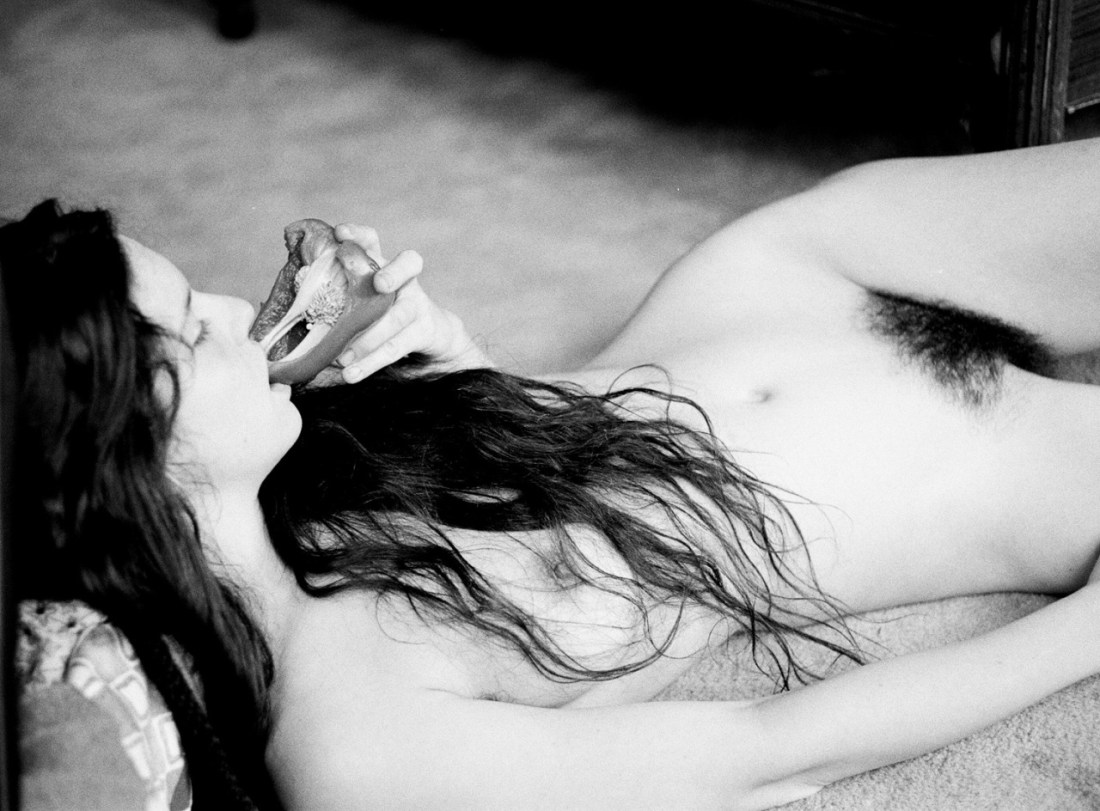
Henry Gaudier-GreeneEdward Weston and the Origin of the World (iii) featuring Kelsey Dylan (2014)

Early this year Gaudier-Greene was asked whether he had any New Year’s resolutions; he announced his desire [t]o develop a better working relationship with midtones.

It struck me as an odd self-deprecating joke–coming from someone virtually unrivaled in the using color photographically to claim controlling B&W midtones to present a challenge after he’s used them to stunning effect (thinking specifically of his collaboration with Tanya Dakin: The Beginning of Mod, emphasis on this gem).

I suspect it is largely just that but it’s also an interesting and probably entirely unconscious framing device. Let me see if I can show my work for that assertion.

Looking at this gorgeous photo oblivious to the title recalls Goya’s La maja desnuda and Modigliani’s Reclining Nude.

Now, when I look at the title I dart in the opposite direction–away from painting as a means of transcending the ephemeral one-to-one nature of sensuality and towards the physicality of father shot/son printed green peppers and graphic nudity, i.e. the visual documentation of explicit bodies as a means of exploring the erotics of metonymy.

I don’t think such misdirection is misplaced. But I also don’t think it’s accidental. I’m not quite sure how to ground a further explanation of what I mean in Gaudier-Greene’s work, so let me take the half-assed route of the intellectually disingenuous: I see a number of parallels between Gaudier-Greene and Edgar Degas. But for the purposes of this explanation, I’ll limit myself to one. Degas set out to be a historical painter, he is now lumped in with the Impressionists–despite wide variance and in some cases outright antagonism to their practices.

In truth he was both a historical painter and an Impressionist; at the same time, he was never truly either. He was more radical and subversive than any category. It seems to me that in an effort to fit within the photographic tradition, Gaudier-Greene tends to point to the less obviously discernible influences he’s pinned to his sleeve while the audience fawns in awe over the calm and stubborn purity of beauty in the work.

Gaudier green is a photographer par excellence and a capital A artist. He has on at least three occasions made me swear to give up photography and on half a dozen others caused me to swear eternal fealty to it.

Source unknown – Title Unknown (201X)

I have objections to this–namely, the camera’s proximity to the action implicates it as a participant/not strictly an observer. The image would’ve been improved dramatically by moving backward say two feet. (Further, you know, DoF could’ve been a little more thoughtfully implemented and a series of unfortunate Photoshop decisions might’ve been avoided.)

Still, the image is super hot and not just because of the graphic penetration. (Also, it bears mention that I am super supportive of this as a depiction of safe sex that doesn’t come off as perfunctory, forced or trite.) I think it appeals to me because there’s enough context to suggest that this is a public environment. But something I’m realizing more and more about myself is depictions of sex that are salaciously focused on reproductive organs just do not do it for me. I want to see an effort to communicate physically the unsayable intensity of passion. Her the kiss is what sells the image and it in no small part reminds me of another equally arousing (though non-pornographic) photograph by Lina Scheynius.

Yesterday’s PornTitle unknown (2014)

Puritanical responses to nudity and/or sexuality are an enormous pet peeve of mine.

But I have a very special hatred setting reserved for failing to inquiring as to whether the pic was requested or consent was sought and received before it was sent and instead applying the default, knee-jerk response: no one wants to see that.

Um… saying no one wants to see peen is completely fucking untrue. What no one wants is seeing shitty picks that involved little thought beyond having a hard on and a camera nearby.

(Also, while we’re on the topic bear in mind saying no one wants to see that not only implicitly dictates (pun semi intended) an insanely narrow view of sexual propriety but is also hugely problematic as this is entirely disproportionate to the typical response when women who post nudes or have their nudes leaked face a staggering gambit of slut shaming, body shaming and myriads of other forms of harassment, not to mention threats and the long term consequences of losing employment or narrowing future options.)

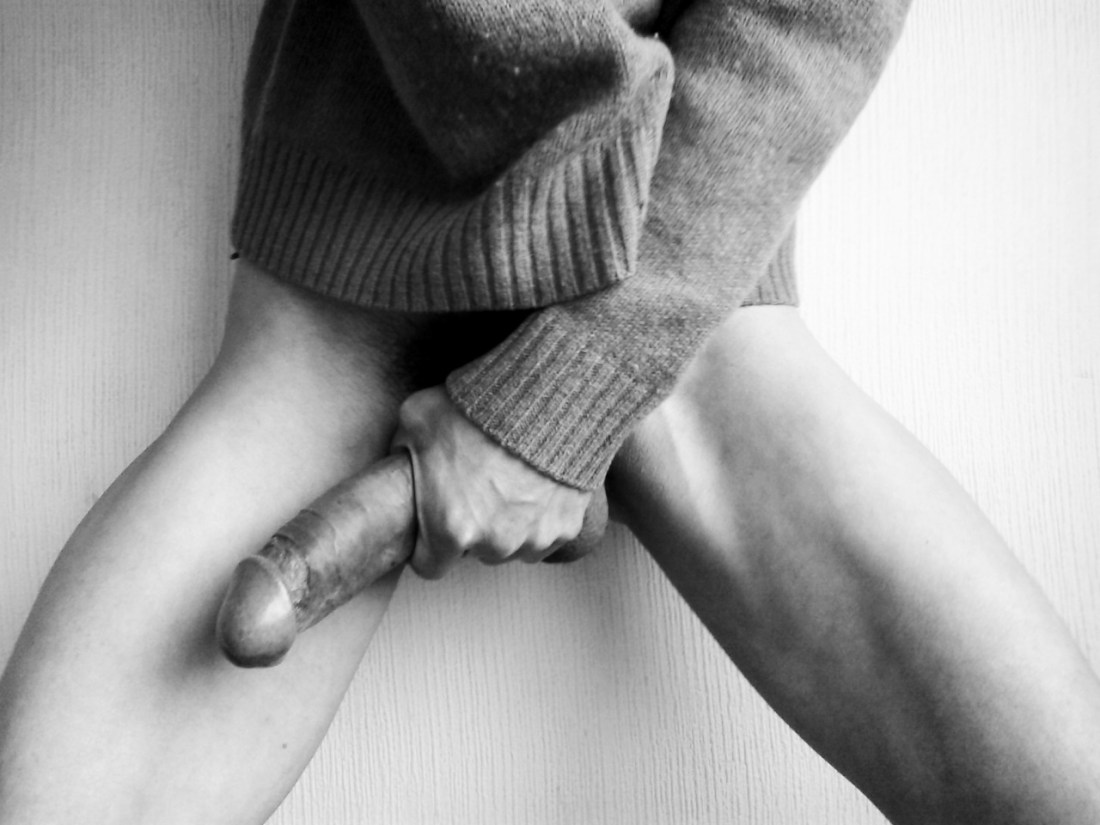
With that in mind I present this as a sort of gold standard template of what a classy cock shot entail:

  1. A dick pic doesn’t have to be fine art but quality never hurts–this image is effective because it presents a decent tonal range between shadow and highlight while also featuring three distinct, effectively rendered textures, i.e. wall paper, sweater and skin. (Plus, the sweater adds a somewhat feminine note which juxtaposes well with the more phallological content.)
  2. Anytime a frame includes genitalia, the inclusion is already charged. Placing the genitals at the center of your frame isn’t just preaching to the choir, it’s screaming in their face while beating them around the head and shoulders. Here: the left hand directs the cock out of the center of the frame. This dodges the common trap of thinking images magically become 3D when others view them or worse the tendency of treating the aperture as little more than another fuckable orifice.
  3. Avoid the oh my god! look at how huge I am trope. This image is preoccupied with that but I am willing to overlook that due to the sublimation and also because the small triangular sheen of reflected light his corona makes my molars feel all itchy.
  4. Another great strategy is decontextualizing the dick or finding a way to present it in a more mundane and natural setting. This image isn’t concerned with that but this does both interestingly.

Thus before you send/post that shot ask yourself how does it compare to the above. If it pales in comparison, maybe think about hitting delete. If it’s on the same level or better, go forth and conquer.

[←] Source unknown – Maximiliano Patane (2013); [→] Source unknown – Title unknown (2014)

The original post features these two images (without attribution) and this accompanying quote:

“The vulgar man is always the most distinguished, for the very desire to be distinguished is vulgar.”

Gilbert K. Chesterton

Before I spent this two hours searching for the sources, I thought these were a breathtakingly fucking gorgeous (and I don’t mind admitting: arousing) photographic diptych.

Alas… although it demonstrates an image sommelier’s sense of pairing, it’s little more than an admittedly most adept effort at accomplishing the same end as a horny teenage boy ‘Photoshopping’ Emma Watson’s head onto Stoya’s body.

I’m hardly saying there’s no place for image mash-ups, adapto’s #comparative tag–for example–frequently spills over into staggering, full-in-the-face brilliance.

The difference is that adapto painstakingly cites his source material. The above can’t be bothered with such concerns, implying a rather disconcerting lack of respect.

A shame really, for–as the saying goes–what shall it profit a man, if he shall gain the whole world, and lose his own soul?

Source unknown – Title unknown (XXXX)

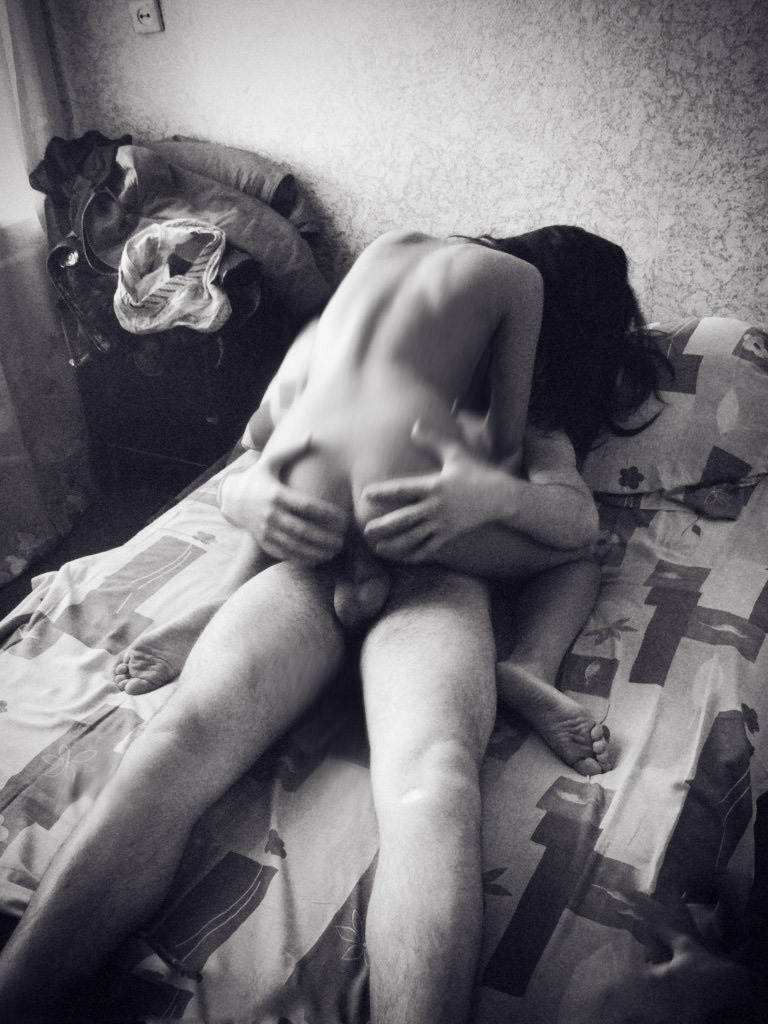
Here’s an example of a vertical frame that isn’t #skinnyframebullshit.

Why? You ask, Isn’t it just echoing form of the subjects?

Well, it is doing that but in this case a landscape orientation contributes little additional context to the image. As it is we can tell it’s a small bedroom, demonstrating exactly how small it is–if anything–belabors an already clear representation.

The trick that makes a skinny frame work here is the narrow triangular form of the overexposed motion blur adorning his hands and her left side would–in a wider frame–be subject to de-emphasis. Further, the vertical framing draws attention to the discarded clothes piled on the bedside table and likely Russian electrical outlet.