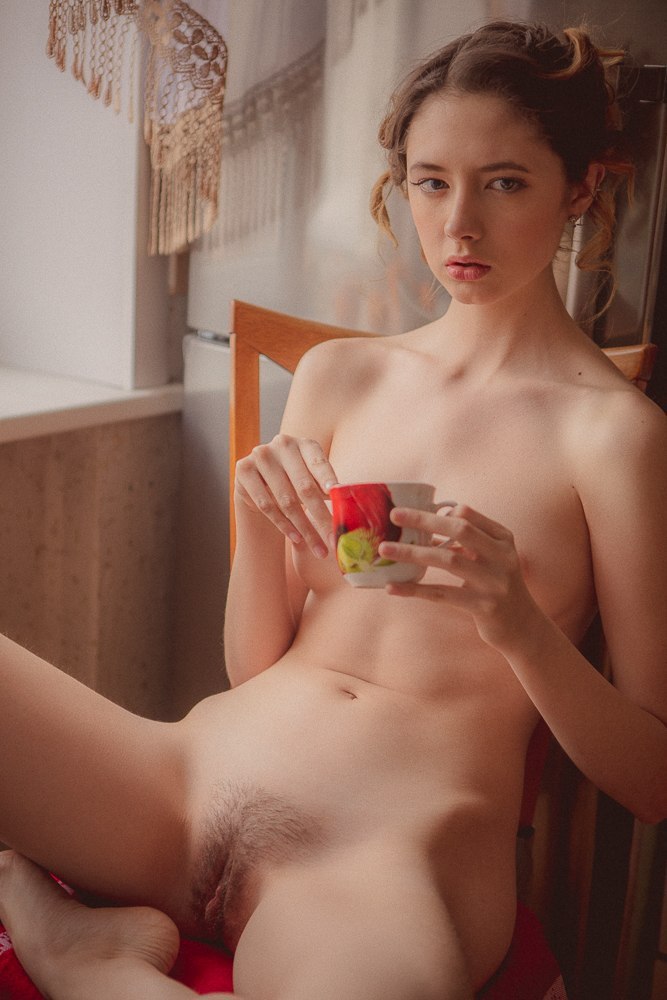
Alexander Prischepov – Untitled (201X)
I have A LOT to say about this image but I want to admit upfront that I am several steps over the burnt out line and as a result I am extremely brain fogged, so bear with me.
I wasn’t certain of the attribution on this for a while–it just doesn’t really look like much else Prischepov has made; but if you look here, you can match the model and the curtains.
I feel like a broken record every time I say this but–le sigh–this is not a good image: the angles are such that the slight variance between the frame edge and the inner window jamb are not squared and with this wawkerjawed-ness becomes more exaggerated as the your eyes scan the frame. (For example: left-to-right you have the left frame edge (0°), the inside window jamb (2°) back of the refrigerator (5°), edge of the refrigerator door to the right of the line of her neck (7°) and then the door handle (9°).
From the standpoint of composition this does push your eye left to right across the frame–but by doing so it doesn’t really encourage prolonged examination. And with the slowly increasing cant, the eye is drawn left to right and then down. The clear focus of the image is absolutely intended to be the well manicured fur on mons pubis.
Don’t get me wrong all vulvas are beautiful and deserving of considered appreciation. But the way this is set up compositionally is entirely ubiquitous as far as the art historical male gaze and it’s essentialized, objectifying orientation.
What I find fascinating and commendable about the image is the way that despite how it’s organized, it–to my eye at least–subtly subverts such a mentality.
I don’t think it’s intentional on the part of the image maker. But there’s a contrast between the super styled and fully made up production design against the casual way she’s sitting. (I mean she looks super comfy. And it occurs to me as I sit her writing this that I am sitting in a similar position and am just as naked and comfortable. The only difference is I’m drinking coffee not tea. And she’s prettier than I’ll ever be…)
She’s also not making eye contact with the camera. She’s staring at something the viewer can’t see–intently lost in thought. (It’s very difficult to objectify someone when you acknowledge that they have an inner life which you cannot access unless they choose to share it with you.)
Further–as I tell folks who are interested in avoiding objectifying imagery–think of the labia as eye lids and the vagina as if it had an eyeball, if that eyeball is staring directly into the camera, then, yeah, it’s highly likely that the image is objectifying. (This is a general rule. There are exceptions. Steph Wilson comes to mind but her approach is more one of re-appropriation of the trope. Same with this one by Becky Flanders–which probably was a predecessor to Wilson. )
I’m also looking at this and recalling the question that @suspendedinlight made during her guest curatorial stint a bit over a week ago. She wondered allowed whether “[It’s] possible
to desire someone without objectifying them?”
I’m gonna steal a line from Bjork’s Immature:
How could I be so immature ?
To think he could replace,
The missing elements in me,
How extremely lazy of me.
To employ an analogy desire is to objectification as joy is to happiness. Joy is something that happens in a moment. It’s something experienced not controlled. Happiness is the effort to transform joy into something continuously uninterrupted.
It’s the same with desire. There are a myriad of flavors but insofar as your understanding of desire involves gaining something from someone else as opposed to sharing your self with them and reveling in their sharing of themselves with you, then yes desire is inherently objectifying.
I, for my part, reject that kind of desire.
As far as depictions of desire go, yes it’s complicated. An image is permanent and unwavering. In effect, by trying to depict desire visual with non-moving images, you are fundamentally objectifying. But although largely true such a perspective egregiously fails to acknowledge that just as the meaning of a word evolves as its use shifts, the interplay between visual grammar and concept and execution provides ample opportunity to interrogate such considerations–whether or not the image maker intended those responses.

 Acetylene Eyes