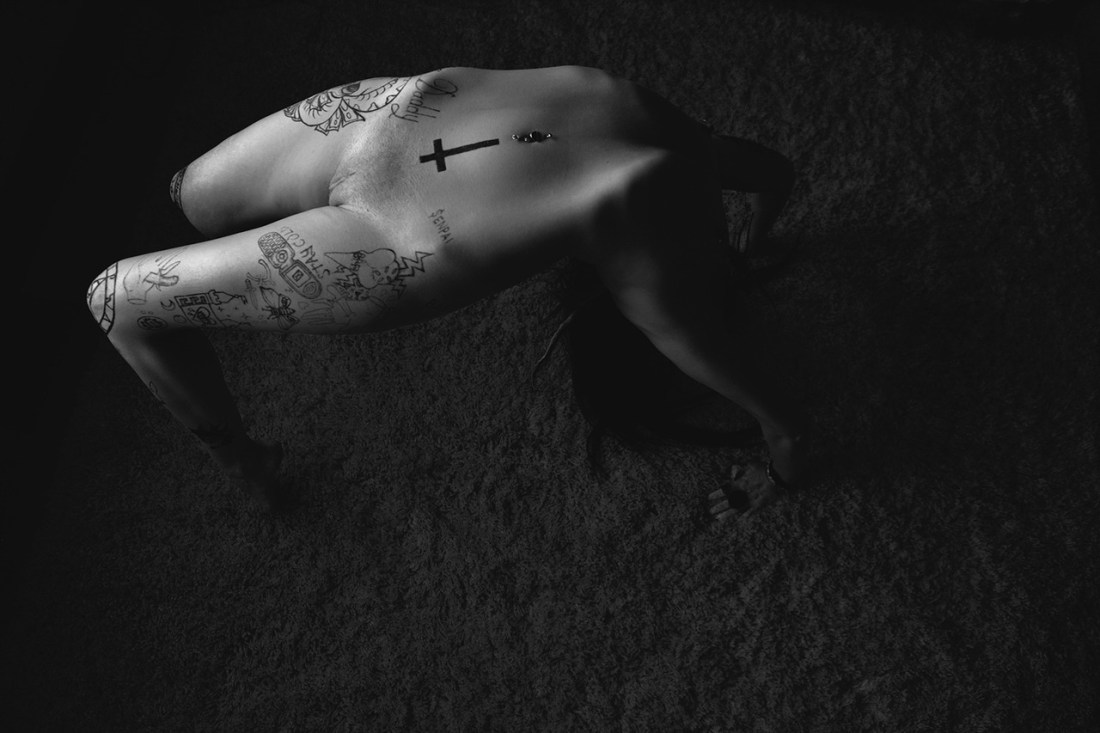
Helena Darling AKA The Woods Witch – Title unknown (201X)
I love everything about this–and Darling’s images are 120% worth digging into–however, I’m less interested in talking about the tenebrism in this or the compositional acumen (reading from left to right, you see the backbending body first and then the framing negative space balances the positive space in a way that insists upon the viewer considering both what is visible and what is occluded within the context of the frame in its entirety).
Instead what I’m interested in is the inverted cross tattoo.
First off, it’s a fraught symbol. There’s all the goth scene appropriations and witchy applications and it’s become an over-the-top cliché in black metal–and unfortuantely, through black metal the image has been appropriated by some less than savory ideologies.
The reason the symbol appears to me is that way back in the day when I was dabbling in staunch atheism (a viewpoint I have only slightly more sympathy for these days than Evangelicalism) is because, I don’t think anyone who identified as an atheist in the late 90s and was really into the fringes of the metal and progressive rock scenes, didn’t go through a phase of confrontationally pointing out to Xtians that were it not for sheer luck they’d be Mithrians (after the Mithras fertility cult).
All I really knew about the cult was that many of their rituals bore more than a passing similarity to Xtian observances. I remember being told by several of my acquaintances who were self-proclaimed occultists that the symbol of the inverted cross was originally associated with the Mithras cult.
Further, the Roman crucifix was an inversion and perversion of the Mithrian symbology framing the ‘rightside up’ iteration as a symbol of death by linking it with the prominent mode of capital punishment.
Subsequently, the Roman Catholic Church appropriated the symbol as a means of claiming dominion over the realm of death through Christ’s death and resurrection.
However, most sources cite the origination of the inverted cross as the Crucifixtion of St. Peter–who insisted on being crucified upside so that no one would associate his death with Christ’s. (Given my understanding of the image, I find this complication utterly fascinating.)
I was less than critical with a lot of stuff I was consuming in my early 20s. So I went back to check the validity of this and although I can’t find any definitive proof I did discover the apparently initiates to the Mithras cult went through an induction ceremony that unfolded a-whole-fucking lot like a baptism and ended with the inductee having a cross scarified onto their forehead.
If you consider this in the context of the fact that Rome was already a full-blown empire before the Mithras cult came up and it appears that crucifixion would’ve risen to predominance around the same time as the cult. And given the disparity between a fertility cult and the death cult of state sanctioned executions, I don’t think my understanding is entirely implausible here.
Either way: I am increasingly preoccupied with the panoply of often contradictory significations folks impose on simulacra. To me: such signs are more resistent to the ascription of extant meaning and instead require both constant personal re-evaluation as well as contextual exegesis. In other words: it’s difficult to make an idol of that which will always and forever remain ambiguous.

 Acetylene Eyes