Source unknown – Title Unknown (201X)

People speak to me about boundaries.
This is work. That is play. This is public. That is private.
This is for friends. That is for lovers.
I don’t understand imaginary lines in the sand.

I want to know the ones like me. Daughters whose mothers
Left them to wolves, trusting the tutelage would
Lead–one day–to understanding the words
tattooed over their shivering hearts:

There are no lines. There are no boundaries.
A horse will run until it dies.
And death, death is better than dreaming about
what it might’ve been to run free
.

can pornography be good for you?

vextape:

– this was my opening statement as part of the discussion can pornography be good for you at edinburgh science festival, april 2016.

I’m Vex. I’m an independent porn, performer, producer, director, editor, everything really. I’m able to talk about my experience with porn not just a viewer, although I’ve done a fair bit of that too, but mostly as a maker and performer.

My story in porn isn’t maybe what you’d think, but it’s not that uncommon. I didn’t sit on a casting couch in LA or answer a vague ad for models from craigslist. I decided to start performing on webcam and making my own clips at university, as a test to see if it would be interesting and maybe, profitable. It really was, I’d make more in a few hours on cam than I did in an 8 hour shift at my 0 hour contract retail job and I loved it. Like so much of the modern, online adult industry it’s completely self directed and determined. You work for yourself, do what you’re comfortable with, work when and where you want. Camming gave me the freedom and the time and the capital to begin learn and to fall in love with film making.

My porn project, Four Chambers began as an experiment, to see if I could put sex on film in a way that was creative and interesting for me, something I didn’t see represented in the majority of readily available porn. We started making our own and putting it out on social media. The response was incredible, I never imagined I could be in the position I’m in now where it’s basically my full time job.

I think this is maybe where I’m now expected to stand here and tell you how “empowered” I am, how I love my job and how I’m sexually liberated. And really I’m happy to say that, for me, that’s true – I mean – I’m my own boss, I have totally flexible working hours, I don’t answer to anyone. I put my own sexuality on film without compromise in a way that I’m truly proud of. I get to fuck my friends and travel and make my living in a creative way that I couldn’t have ever dreamed of. I have a better sex life, I’m a more open and honest person and a better partner because of the communication and honesty that making porn requires from a committed relationship. I have confidence, ownership and pride in my body and my sexuality that I never did growing up. It’s been the best, most challenging and interesting thing I’ve done with my life.

And now I’m going to say that that doesn’t really matter. 

Keep reading

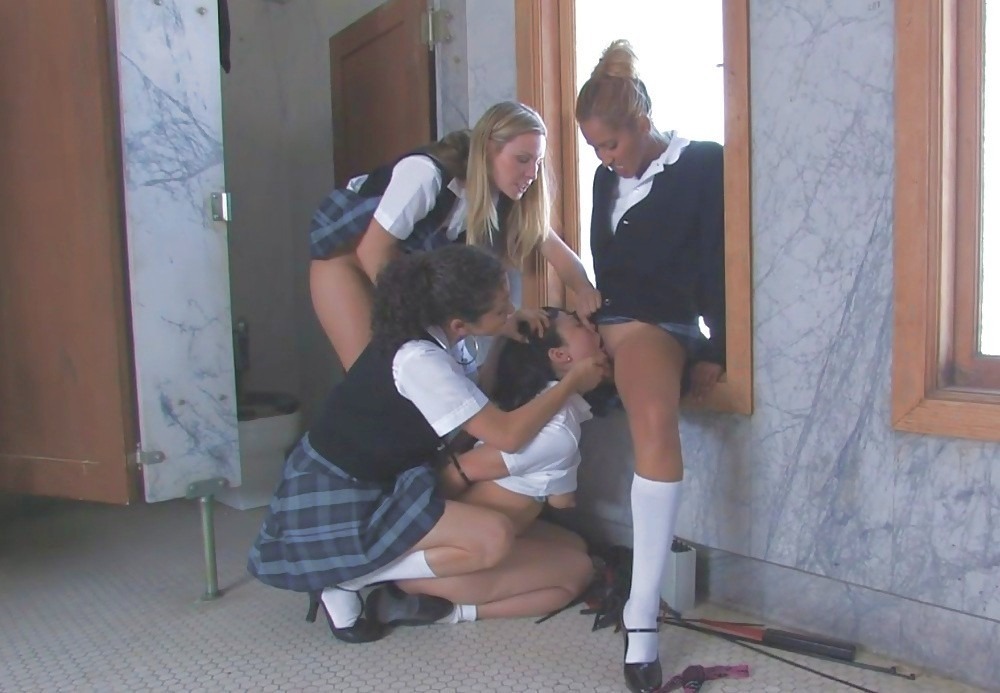
Source unknown – Title unknown (19XX)

It’s one thing to direct one person to stand here or there, glance through the viewfinder, weave and bob for a bit in order to find an acceptable frame before clicking the shutter.

It’s another altogether to make a frame work with multiple people.

And to be fair: the above only works halfway. Here I think its more productive to approach what doesn’t work first.

For a photograph to demand a modicum of detective work of the viewer is not necessarily a bad thing insofar as the image provides enough context for a diligent viewer to at least attempt to ‘solve’ the mystery given only the presented visual evidence.

Here I think arguably the best starting point is to ask: what in blazes are the women at 5 o’clock and 9:30 doing?

An answer is implied–if only winkingly; note at frame left: the cups on the end table and the bottle between the table leg and the base of the couch.

Thus, I don’t think it’s really that much of a stretch to presume everyone is a bit soused.

(And with that context, the woman at 9:30′s mien becomes much easier to ‘read’–she’s so intoxicated she’s on the threshold of blacking out.)

My experience suggests the binge drinking explanation is correct. For example: Among my friends it’s a well established fact that given a fifth of vodka, my ability to navigate the finer points of sitting on a couch grows progressively jumbled. I’m certain I’ve ended up in a position mirroring the woman at 5 o’clock on more occasions than I should admit publicly. (Ed. Note: this is why the author’s friends no longer allow them to consume vodka under any circumstances whatsoever.)

So although the poses are at best odd (and more likely awkward), the information offered suggests a clear explanation.

Compounding the oddity and or awkwardness of the poses is the flash. Note: the way Ms-Stretching-Her-Back-And-Staring-Up-At-The-Ceiling casts a ugly shadow Ms Approaching-Black-Out-Drunk.

However, although this aspect of the flash doesn’t work, it was a great choice in other regards. It de-emphasizes the reflective qualities of the mirror and renders a super flattering even light on the woman sitting on the couch back. (Who, I have to add looks uncannily like a dear friend–it’s partly her facial features and partly the foot on the other woman’s knee, which is exactly the sort of thing my friend would do while mugging for the camera. Also, I’m probably the only one here but the position of the mirror and the vertical frame remind me of my third favorite painting of all time–Van Eyck’s The Arnolfini Wedding Party.)

Okay, so there’s some clumsy shit here: the ambiguity about what’s happening and the cast shadow. The ambiguity is–to my mind–clearly ameliorated given the broader context of the photograph. The cast shadow is a definitely detracts but since its a result of the flash and the flash adds an undeniably immediacy to the moment, what is one to do?

It’s likely the photographer already had their back–quite literally–against the wall. Given the couch and the mirror on the wall, the vertical frame is both logically appropriate and aesthetically wise. (A horizontal frame could’ve probably allowed for positioning the women within the frame better/having their relative positions in the frame relate to one another more organically; but it would almost certainly have compromised the intimate feeling that the vertical frame conveys here.)

Perhaps, it would’ve been possible to shift Ms-Stretching-Her-Back-And-Staring-Up-At-The-Ceiling ever so slightly left and then cheating Ms Approaching-Black-Out-Drunk right by a hair.

But a better way would’ve been to only include three people. (Whenever possible it’s always better to work with odd numbers of people. As anyone with a lot of freckles and a tendency to tune out when people drone on about boring shit knows: any three non-linear dots form a triangle, so odd numbered groupings, with a little thought and organization can be arranged into to triangular configurations.)

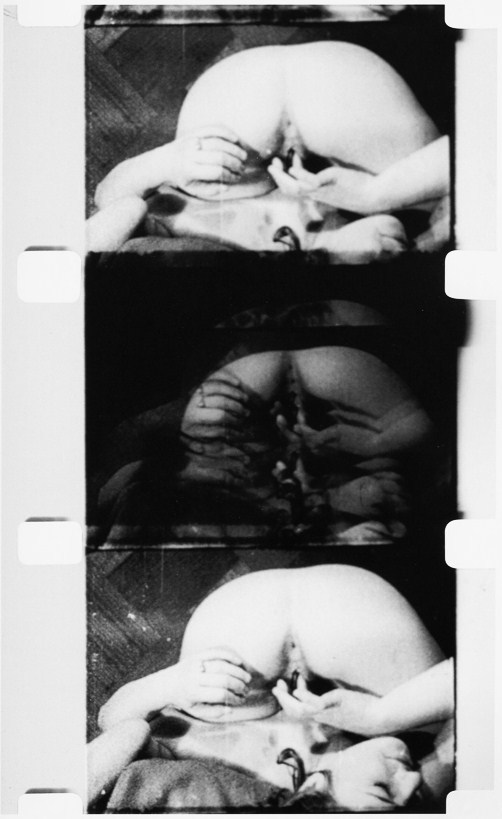
kink.com – Title Unknown (2007)

I’m cagey when it comes to posting this.

First of all: the above is so technically inept that the light of baseline proficiency won’t reach it for a million years.

Second: it’s a property of kink.com; on a good day I’m–shall we say– unenthused about their products (which tend to be a bit extreme for my taste). 

Third: kink.com has an established prerogative of turning a blind eye to coercion–a fact that rankles me.

Fourth, there’s the issue of consent. While, I haven’t viewed the video from which the above still ensues, given the image presented–devoid of any sort of grounding context–I have fundamental concerns about the responsible presentation of verbal affirmation, safe words, etc.

Given those extensive reservations, then why the hell am I going ahead and posting it? Simply put: despite my reservations, I find it really, really hot.

The reason why I feel this way has to do with several situations not unlike the above which I have experienced. I’ve written about one previously, the other involved a junior high class mate quite literally beating the piss out of me and subsequently squatting over my face and grinding her ladybug undies against my mouth several times before spitting on me and leaving me crying on the floor of an empty classroom.

The first time was different. I repressed it for quite a while but it surfaced a little more than two years ago. I still can’t remember all the specifics but I do have an idea what transpired.

I have mixed feelings about it. I had no personal agency and further was unable to consent to the proceedings but I was also extremely aroused by what I was asked/made to do–a fact that ended up figuring into the proceedings.

It’s probably a mark of privilege but even though I feel extremely weird about what happened, it doesn’t even break into the top ten of childhood trauma.

And I am not at all sure what to make of the realization that this event ended up changing my wiring. I make that observation based upon the fact that I spend a great deal of time craving the opportunity to re-experience a situation like the one depicted above. Except in this iteration, to be able to consent and have the option of withdrawing consent at any point during the exchange.

It’s as if the original experience itself was neither good nor bad but the way it was approached and handled was intensely problematic. And I guess I feel that while I definitely got something out of the encounter, I feel that re-staging it allows me the opportunity to exert control and agency in a situation where previously I was powerless.

It’s like the option of choosing it renders it just another part of who I am instead of something that happened to me.

That distinction somehow feels vital to me.

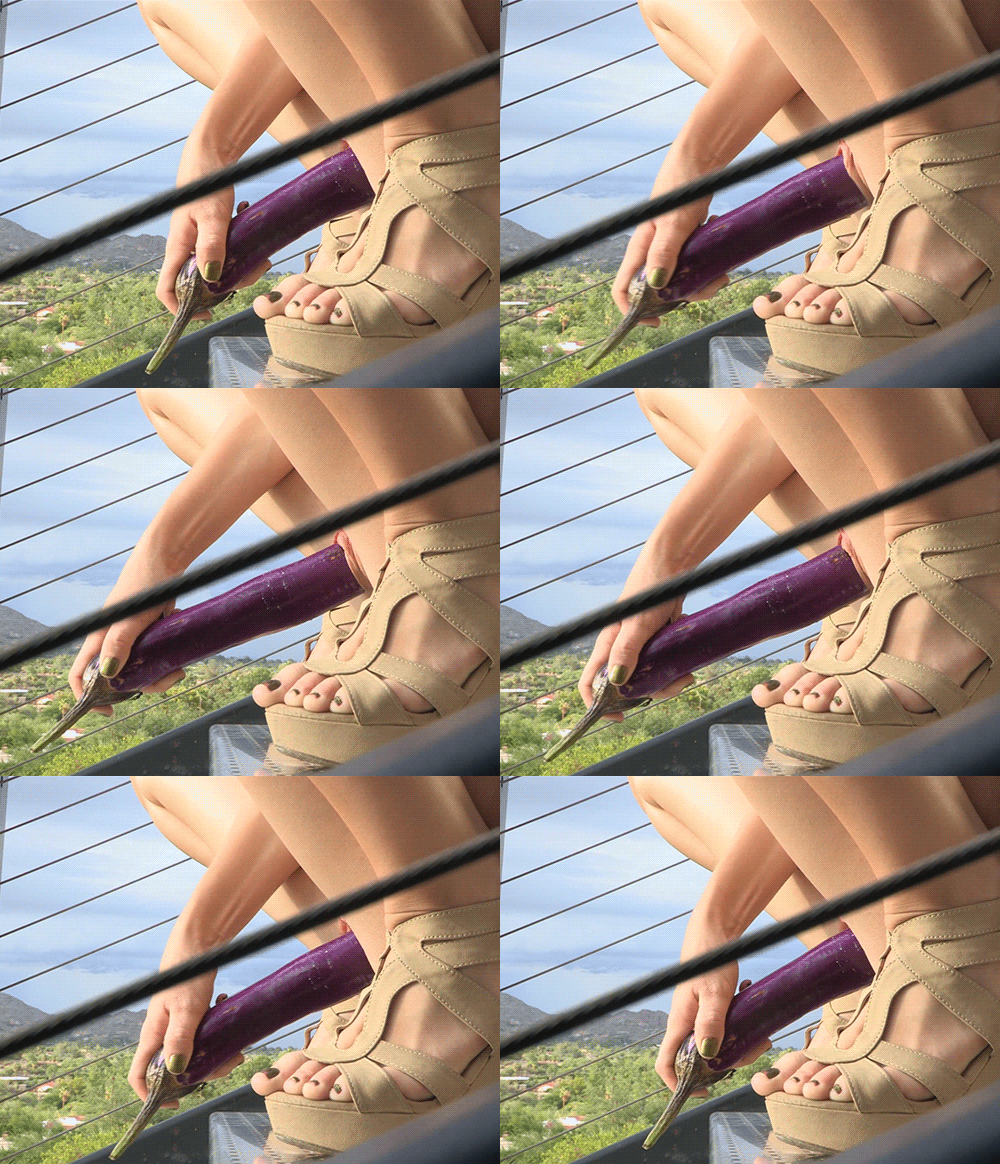
FTVGirlsTiny in Big Ways featuring Megan Rain (2015)

If someone were to tell me hey, there’s this clip where a girl uses an eggplant as a dildo, you’d be wise to bet on the fact that I’m going to find and view said video at my earliest available convenience.

What I would expect given the above description is a preoccupation with the extremity of the action and a tone that shifts mercurially between coy and so over-the-top with awkward enthusiasm that it’s vaguely uncomfortable.

That is exactly what you get from these production stills.

And while I can’t argue this is a good clip, there are some interesting elements to it. The action isn’t played directly toward the camera–and although it’s still hell of graphic, the graphicness seems more consequence than motivation.

The distinction seems important. Unlike the stills, this scene plays as if we’re getting to watch someone experimenting. The experiment isn’t necessarily for the viewer, it’s merely something the viewer is allowed to witness.

Also, it really appeals to me how obviously public this location is. And I feel like that ties into the effectiveness of this gif. After all, masturbating like this in such a public location renders ambiguous that line between the risk of being seen vs. actually being seen. In my mind, that heightens the sense of voyeurism and despite the close proximity of the camera to the action this framing allows for a suspension of disbelief as far as whether or not Ms. Rain is masturbating or pretending to masturbate for the benefit of the camera and subsequently the consumers of this content.

Peter HujarThe Piers (198X)

“Queerness is essentially about the rejection of a here and now and an insistence on potentiality for another world.”
—Jose Muñoz

I apologize in advance: this will be scattered. But by attempting to get at something I don’t really have any idea how to say, I’m fighting against my default setting of shying away from the prospect of saying things poorly and making a cluster fuck of everything.

The above quote came to my attention a little over a month ago when Andy Wachowski came out as Lilly. (The statement she released is exceptional and very much worth the read.)

Like any truly revelatory insight, Muñoz admonition has never really drifted much further than the periphery of my thoughts since then. I’ve thought about it as Republican controlled state legislatures enact hateful and hypocritical legislation against LGBTQ folk–or, as I think of them: my people.

A good number of these laws are couched with a simple premise–protecting religious liberty. Nevermind the fact that religious freedom is firmly and irrevocably protected by the first damn amendment of the constitution. Nevermind that these strictures are specifically designed to protect those who would chose to pervert their religious beliefs as a means of justifying indecency and bigoted hatefulness towards those with whom they disagree.

If one examines this impetus from the standpoint of armchair psychology, it’s easy to dismiss hate as a defense mechanism against engaging with difficult questions regarding individual agency, institutional sexism/homophobia, what the fuck notions of gender and sexuality actually entail in theory and/or practice.

I don’t buy this perspective. If nothing else that famous study that Chomsky was involved in where he suggested that with the depth and complexity of the ability of your average everyman to engage with sports statistics suggests that the galling lack of familiarity with world politics among the average citizen has less to do with any inherent ability and more to do with a lack of engagement.

This is something I encounter frequently with my family–who are all very conservative if not also fervently religious.

For example: my mom and I argue all the time about this or that consideration. Invariably, she adopts the stance that the end of the world is nearing and there’s nothing to do but get right with ‘God’.

I think that’s really the larger problem. The focus of so many people is on the destination–instead of the journey. So many folks are innured with this belief that a life of piety leads to eternal reward.

It’s not that I don’t buy that–being raised in an Evangelical Xtian milieu really programmed some fucked up shit into my head that I’ve had a hard time completely shaking; no, it’s more that I object to the lack of personal agency and responsibly this perspective seems to very nearly universally foster.

But what does any of this have to do with Hujar’s photography?

I think it’s easy to dismiss his work as hedonistic and transgressive for the sake of transgression (not that the later is necessarily a bad thing in and of itself). Yet to do so, seems to be to miss an opportunity to study the world through someone else’s eyes.

There’s an unflinching, non-judgmental immediacy to Hujar’s work. The ugly, the beautiful, the graphic, the mundane–and always a reverential quality to the gaze, employed with rigorous consistency across the work.

Hujar always manages to find the few glowing embers scattered among the ashes–not unlike the mythical phoenix.

Finally–on a personal note: I’m extremely interested in the way both Hujar and Tress use doors, apertures and other openings as a means of interrogating notions of participation vs voyeurism. Additionally, I find their impetus for exploring abandoned, ruinous locations to be starkly different from folks nowadays who seek to document similar scenes as a means of projecting an internal state externally or as a means of serving a particular tonal ambiance or aesthetic.

As someone who dabbles in urbex activities, I feel a resonance with the queer use of neglected spaces far more than I do with the glut of shooters making highly stylized nudes in empty warehouses, asylums, etc.

To me there’s something extremely gratifying about people seeking out liminal spaces to not shrug off or externalize their feelings of marginalization but to feel connection in spite of them. I may be projecting but there is something thrilling about embracing what it is to be alive and free and to stage that in an environment which so clearly exemplifies death and decay so perfectly resonates with the little death some of us pursue as a means of coming to terms with the on big death towards which we inextricably slip.

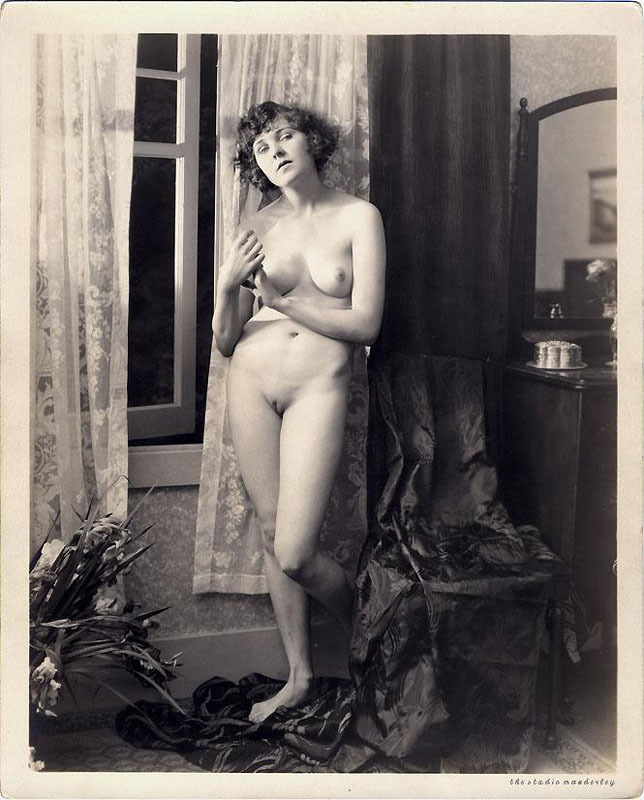
Albert Arthur Allen – Untitled (192X)

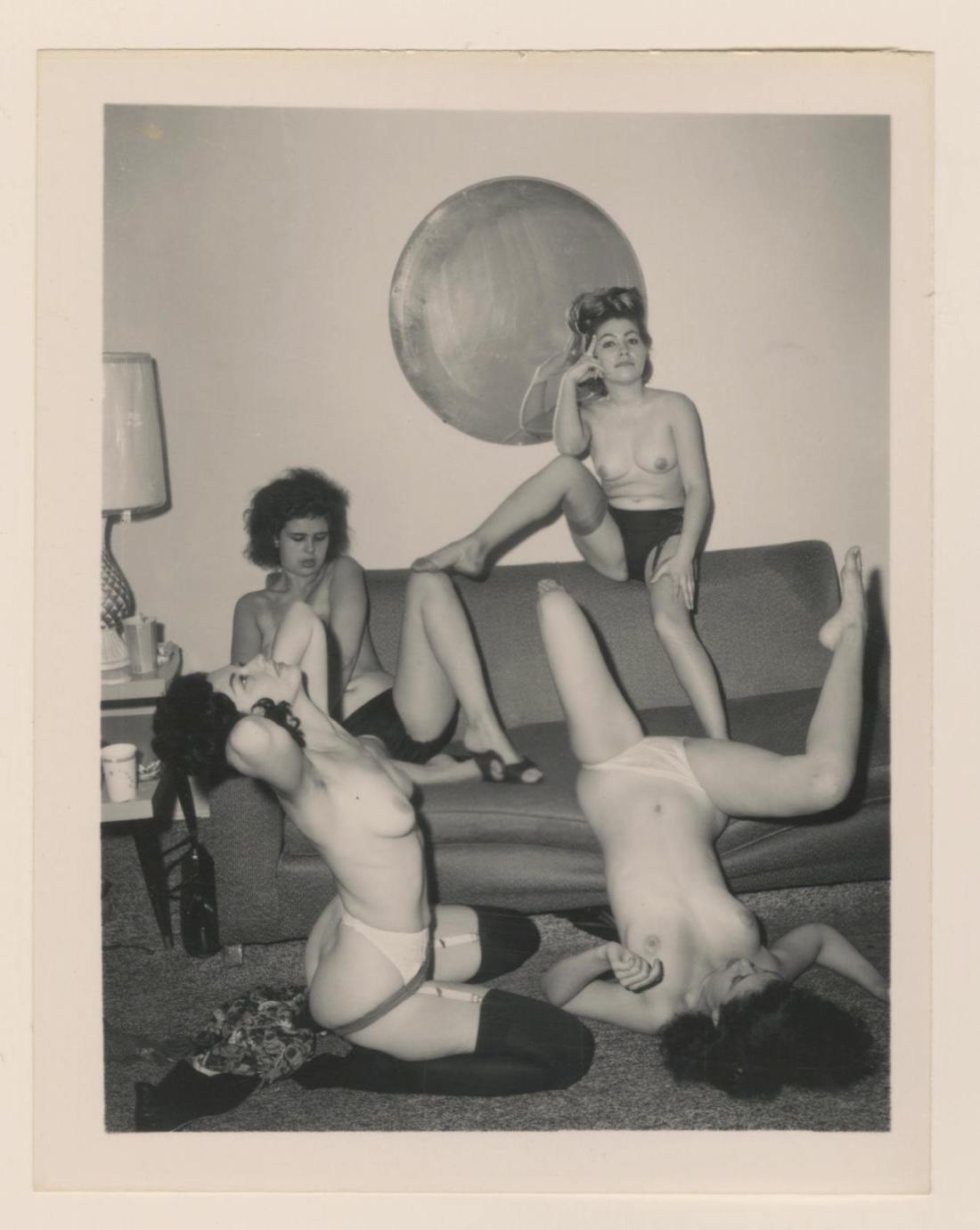
Excluding the border, sepia tinge and interior design, this could from a modern image maker who took this last year and only got around to uploading it to Tumblr last week.

But this was made sometime during the 1920s by a man born in Massachusetts, who moved to the Bay Area and started shooting nudes.

In this way he was singular in focus and profligate in output.

The work is a bit of a chimera; words like ‘camp’ and ‘contrived’ pop up whenever Allen’s work is discussed–sadly the former obscures a more important feature, the latter perhaps misses a pertinent point.

Take the above, for example. At first, it strikes one as charmingly intimate and unselfconscious. Upon further examination: the composition mostly works. The relationship of the lens to the mise en scene is studied, carefully composed–the half of the plant in the lower left corner is great as is the reflection of the room in the mirror.

Yet, as one gazes, inconsistencies take on a sharper focus: why in the hell is her ankle hooked behind the leg of the chair; did the shutter fire mid-blink or is she half asleep? That’s entirely too much fabric to be a robe and why is it draped on the chair like that–is it an effort to rubber stamp Classical Ideal ™ bonafides?

And now, almost a century after the images were made–despite their sometimes clumsy habituation, they are still better than 95% of the stuff made by so-called Tumblr famous image makers who shoot nudes and nothing by nudes.

In fact: I think there’s an argument to be made that Allen is perhaps a better photographer than someone like David Hamilton–if for no other reason than at least Allen is honest and straight-forward and owns (for better or worse) his rote repetitions and foibles.

But the interesting question here is: by seeking to document a subject which has been tested–tried and true across the ages–as perennially of interest as a subject addressed by art, to what extent does surviving 100 years render a photograph less document and more art?

I’d argue that the continued interest in Allen’s work has less to do with the work itself and more to do with what the viewer might interpolate about the longevity of fine art nudes as a photographic genre based upon the work.

We want the work to be Capital-A Art because it suggests a degree of merit to the undertaking and in so doing we subtly fixate upon the charm to the diminution of the awkward.

And really, Allen’s work is better than 95% of the work by this or that Tumblr famous image maker–I mean at least he is compellingly conversant in art history and its considerations.

But I’m not sure that which makes his work enduring is something that should in any way be seen as a voice from beyond the grave legitimating these our most earnest of efforts.