The Japanese have a phrase for this dual perception: mono no aware. It means “beauty tinged with sadness,” for there cannot be any real beauty without the indolic whiff of decay. For me, living is the same thing as dying, and loving is the same thing as losing, and this does not make me a madwoman; I believe it can make me better at living, and better at loving, and, just possibly, better at seeing.
Category: Uncategorized




Sources unknown – Titles Unknown (20XX)
I have mixed feelings about this photoset.
Part of it hinges on inclusivity. Yes, kudos for representing a panoply of sexual behavior–i.e. group sex (something by which I’ve grown increasingly fascinated) circumcised vs. uncircumcised, shaved vs. unshaved and oral/vaginal/anal.
But the problem becomes more glaring because of the inclusion of the lesbian scene. I’m not opposed to spread-so-wide-the-viewer-can-see-the-urethra shots; but I can’t shake the fact that this is essentially a lipstick lesbian scene–like so much of things pertaining to depiction of lesbian culture–played out in a way which appropriates a portion of the spectrum of female sexuality that notably has fuck all to do with men and stages it as yet another location for male pleasure.
I’ve started to draft a modification based upon this set where I replace the lesbian image with this image–because it would fit aesthetically–but also it just seems more legitimately about documenting pleasure than the appropriation of pleasure as aesthetic.
Then I’d also need to add at least one image to combat the stifling heteronormativity–probably something like this.
However, in doing that you lose something of the charm of the photoset–which is probably the entire reason I ever noticed it in the first place.
Excepting the retro looking sixth image from the top there’s something approaching consistency in image quality. I won’t for a second argue that it looks like all the images were made by one person. (There’s at least a hundred reasons that’s not the case.)
Yet, the images do feature–across the board–one of two things: a sort of surrender to extremity of sensation or a loving attention to detail. For example: the way she’s reaching behind her head to stroke his side in the second image, the way the visible top quarter of his member is covered with the sheen of her juices in the third image, the way it she’s trying to catch every last drop in the fourth image, the bracelet on her right hand in the fifth frame, the way she’s trying to do all the things at once in the sixth image, the visible bubbly spit in the seventh image, her tongue, its piercing and her expression in the eighth image and the way the angle of the light accentuates the texture of her skin in the tenth picture.
And I guess what it boils down to is not only that these are all scenes that I think warrant more expansive consideration but I also feel there exactly the sort of stuff that would provide a solid grounding for an examination of how documenting people fucking in explicit and graphic ways is hardly antithetical to Capital-A Art.
Also–the longer I run this blog–the less out-and-out porn I consume. But when I do consume it, I want it to present sex as anything but rote or by the numbers. I’m interesting in consensual experimentation and extremity.

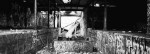
wonderlust photoworks in collaboration with Cam “Hannibal” Damage– [↑] Above Scorched Earth Falling Is Flying (2015) ; [↓] Graffiti Seizures Rust + Decay (2015)
Finally got the B&W I shot with @camdamage in September developed and scanned.

Eusebio Penha – Title Unknown (2015)
“In this love you are like a knife with which I explore myself.”
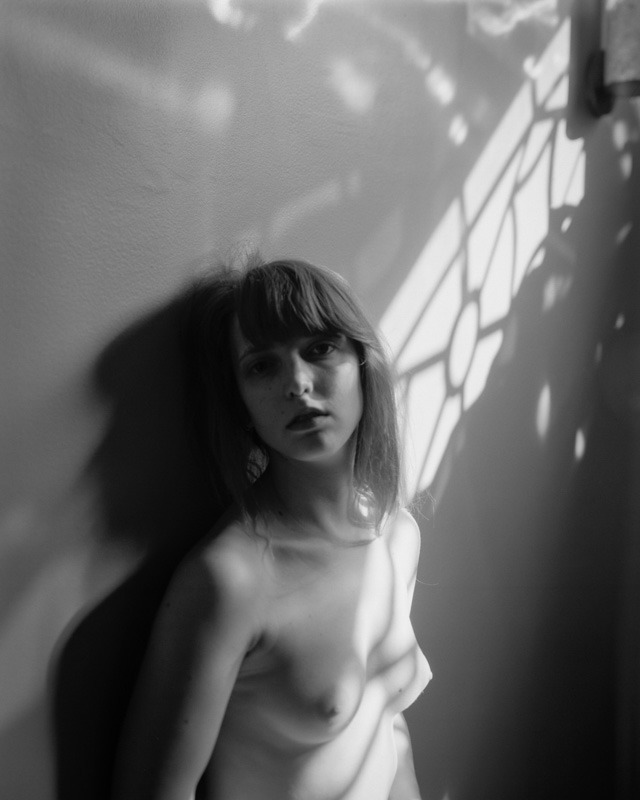
Rachel Jump – Untitled from In Progress series (2014)
I like Jump’s work but I have no idea what to do with it.
She mentions her conceptualization revolves around ideas of ‘memory’, ‘belonging’ and ‘home.’
It’s not that I think she’s misjudging her own work. It’s that if those are her primary considerations–then they are not readily apparently in the work (at least not without enough mental squinting to prompt a migraine).
I’d venture that the work is about those things insofar as each of those notions involve some degree of fragmentation. Memory–I remember it like this, you remember it like that but the truth was likely somewhere between contradictory accounts. Belonging–do you accept me for who I am, who you think me to be, who you want me to become? ‘Home’–as a very wise person once told me: home is the place you can’t leave fast enough but once you’re gone all you do is count the days until you come back.
It’s as if she’s trying to produce work that matches the vision in her head but in doggedly pursuing that vision, she loses sight of subtle course corrections suggested by the ways product contradicts process.
Like she makes wonderful self-contained images that are visually dynamic (1, 2) yet convey a strong sense of temporal-spacial distension–as if the viewer is a voyeur watching a dreamer experience their dream.
But such cohesive and clear photos are placed side-by-side with the above–which is lovely, yes; but there’s something languid, informal and uncertain to it.
Interestingly, as dynamic as some of the other work is, I get caught up wondering what I’m missing with the image above. And I can’t help think that if whatever is absent was at least pointed to by the photo, I would probably prefer this to the more compelling but distant considerations.
Still, I think Jump is talented and she clearly has a solid enough foundation that if she continues to make work, I have no doubt her work will become more focused and incisive.
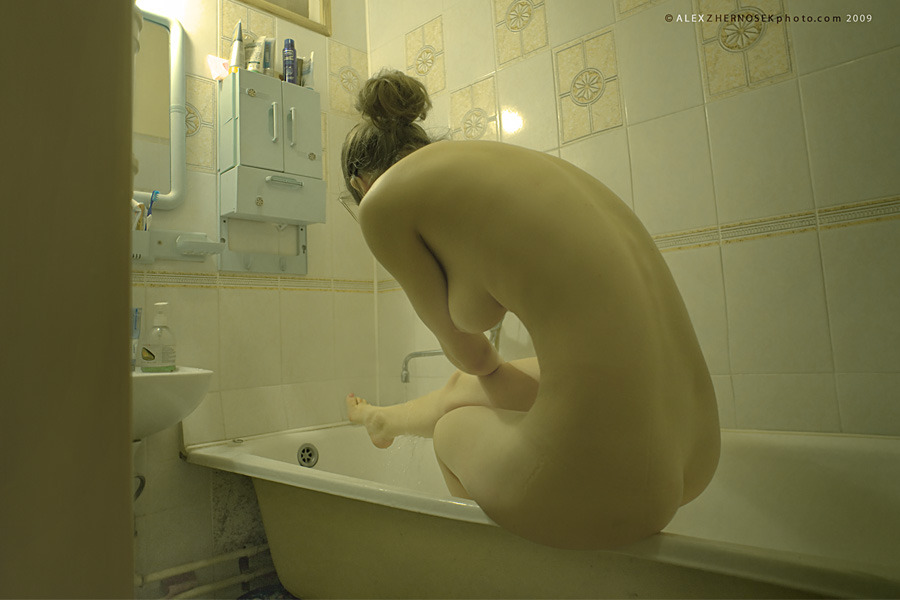
Alex Zhernosek – #9633 (2009)
When I first encountered this my thought was along the lines of wow, that’s very nearly perfect.
Spending a bit more time with it has caused me to question my initial reaction. Yes, there’s a very strong sense of mood. And it’s actually rather unlike the rest of Zhenosek’s work–which reeks of objectified sexualization of bodies/run-of-the-mill straight/white/cishet misogyny.
But there’s something interesting about the documenting of a sensuous moment here (warm water splashing over her ankle) and how that pushes up against the sense of imposed voyeurism (the visible door jamb and the uncertainty as to whether or not this woman knows she’s being viewed).
And as much as the focus is the curve of her back, Shifting her several inches toward frame right would’ve better balanced the door jamb, as well as blocked the reflected hot spot on the tile with the models head, creating better separation from the background and also underscoring the fact that the water is splashing over her foot.

Source unknown – Title Unknown (19XX)
From a technical standpoint this image is garbage. There’s seemingly not logic for the composition, the way the guy in the background is decapitated, the guy being fellated’s left arm stretching awkwardly out of frame and then the bend of the elbow of the boy in the foreground could’ve been used to frame the sex act if he’d shifted his arms back and to frame right ever so slightly while sliding maybe a half inch toward frame right at the same time.
It is not, however, an uninteresting image. I really want the camera moved back and two the left about two feet; along with a shallower depth of field that instead of focusing on the boy sucking dick, the focus is instead on the way the guy in the mid-ground is looking back at the person whose hand he’s holding.

Barry Marré – Untitled from The Last Boys book (2015)
There’s this zen aphorism: don’t put another head on top of the one you’ve already got.
At it’s core, it’s a statement about the relationship between conceptualization and praxis and relates to another far more familiar zen-ism: do or do not; there is now try.
One of my struggles–particularly with writing but it bleeds into every corner of my life–is a deeply rooted commitment to ‘being original’. More often than not, obsessing over whether or not the thing I am going to do has been done before transforms into an insurmountable obstacle to the doing itself.
The truth is: while I don’t exactly agree with the prognosis that it’s all been done already–in my experience the exceptions to that rule are so few and far between that they almost don’t even warrant discussion.
Take this image. The pose is clearly a reference (with some slight variation, namely the mirrored pose, the subject’s gaze acknowledging the camera and supporting leg bent instead of fully extended not only balances the composition–the available light falling from the implied window beyond the left edge of the frame balanced against the off-center right positioning of the bulk of the body) on Michelangelo’s Adam.
The light itself is reminiscent of later Caravaggio’s.
Yet for these obvious influences, the resulting work is hardly beholden or otherwise limited via similarities.
…
I feel like I’m circling what I really want to convey–my point has something to do with the way people who don’t have a great deal of experience posing for the camera frequently question what they are supposed to do with their hands. Yes, one solution is to throw it all at the wall and see what sticks but this is where an intimate familiarity with art history is a boon. As far as visual representation goes, when artists’ find something that works, it tends to become enshrined as a part of the form. You can consider contrapposto, pietas or the fascinating history of the coded visual language used to ‘label’ apostles and saints.
Such poses and coding function much like cliches–the present a ready, pat way of communicating something that is otherwise complicatedly nuanced. (And here I would note as an aside: one of the many purposes of good poetry is it’s mapping of new ways to express what would otherwise function as cliche–there may be a lesson here about what distinguishes lower case a art from upper case A Art.)
In other words: the conventions are there because they have proven to be an exceedingly relevant way of addressing universal concerns w/r/t visual representation of bodies. The convention is not unlike a platonic form–but as always the devil is in the details. The ideal form will always be sterile, lacking in resonance. It’s the slight variations, the obsessive fixation on the mechanics of gesture within a rigid framework that tilts beauty either towards abstraction or towards something grounded in an observed and unmediated moment of transcendent seeing.

Arthur Tress – Kent on Slide, N.Y. (1979)
As much as I like Tumblr, I think spending a lot of time on here ends up being a bit of a mixed bag. Yes, it’s reasonably on-point when it comes to keeping abreast of new work and new artists making work in lens based visual arts.
Unfortunately, the volume is such that I can’t always properly follow up on various makers. I mean I have around two dozen names of people whose work resonated with me strongly after only a glance.
Tress’ name is on one of those post-its. I remember a while back Getty released a spate of images Tress made during the 60s where he staged children’s nightmares for his camera.
I was extremely impressed with several of the photss but ultimately haven’t made time to return to his work because it didn’t seem to fit the purview of this project. I’m now seeing my mistake.
Some of his more surrealist inflected work is nothing short of stunning. He takes a Minkkinen-esque approach as far as mood and tone but his images seem more grounded in an even-handed incisively observed eroticism. In other words, the work adopts the structure and form of a glimpse from a dream but it retains the same fluidity that inspires the dreamer to remain unaware that they are dreaming.
Lastly, Tress is clearly EXTREMELY familiar with photo history. Were I a photo teacher, I’d assign an essay wherein students could pick between Ralph Eugene Meatyard, Rodchenko or Ed Ruscha and compare/contrast with Tress.
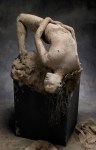

[↑] Alain Rivière-Lecoeur – Interstate 2 (201X); [↓] Source unknown – Title Unknown (201X)
Juxtaposition as commentary.
 Acetylene Eyes