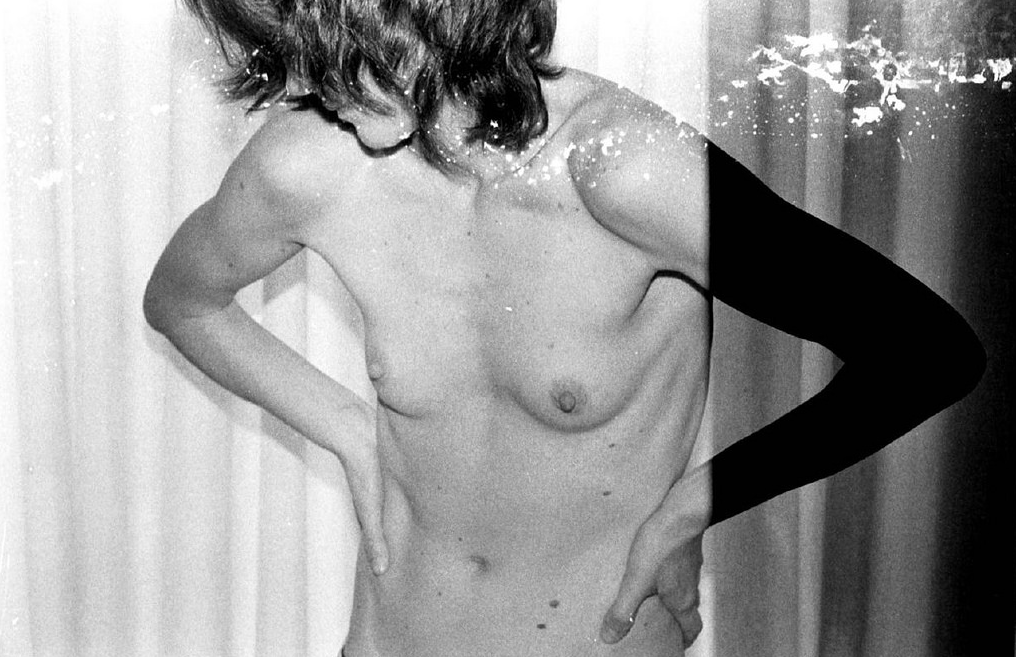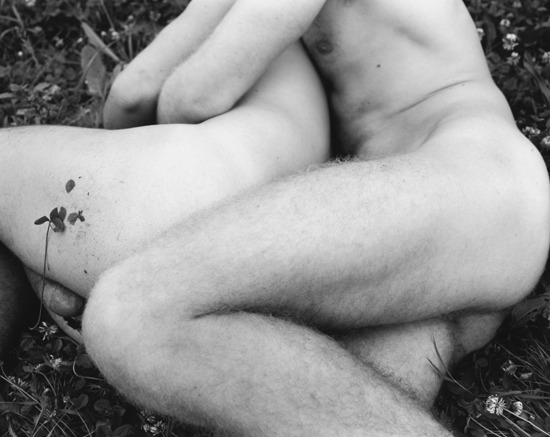
Nicholas NixonY.A., J.S., Vevey, Switzerland (2000)

Viewing Nixon’s work I am reminded of Emmet Gowin. Both share an interest in portraiture and more-or-less abstracted landscapes.

I prefer Nixon’s trajectory more–as he’s pursued both tracks over the course of his career; whereas Gowin has all but stopped making portraits.

However, even though Nixon has made more consistently engaging work–it’s never quite managed to invoke the same intense and simple clarity as Gowin’s pre-aerial photography work.

The above frame is actually emblematic of what frustrates me about Nixon. He’s using a large format camera. Awesome. I totally support that and if I could afford to, I’d only shoot large format (although I prefer 4×5 over 8×10 because beyond a point, dragging large, heavy equipment around is a turn off). And I really like the way it toes the line with regard to a degree of gender ambiguity. (It took me almost 30 seconds to note the protruding scrotum of the little spoon.)

I just don’t think that ambiguity actually balances out against the lack of broader contextual clues as far as the setting. Nixon uses standardized naming conventions when titling his work. A brief description of what is pictures, where the photo was taken and the year it was produced. With much of the rest of his work it doesn’t bother me. (The tact is–after all–endemic in fine art photography.)

Here though, it reads like an effort to activate the work in a way that the purely visual does not.

Yet, then there’s the broader context of the work within which this photograph coexists–a project documenting amorous couples. This resonates strongly with the ambiguity of gender in the presentation. And while I don’t think it has the immediacy or empathy of other images in the same series it is nice to see effort made to represent the act of love as non-hetero exclusive.

Kerstin DrechselUntitled from if you close the door series (2009)

With the exception of The Cabinet of Dr. Caligari, I’m not all that fond of expressionism.

In fairness, I can’t imagine Drechsel fancies herself an expressionist. But I think there’s an argument to be made that while if you close the door starts off more classically photo-realistic as it becomes more enmeshed in the private experiences of loves, it begins to disintegrate into something that shares elements of expressionism.

I love how the work is at once both graphic and implicit. The sometimes fumbling awkwardness of the exchanges.

Take this image: I can’t get over the matching knickers. The way each partner is stimulating the other and holding the other at a distance. (The one on the left in an effort to watch her lovers body and the one on the right because she is approaching orgasm–note the way the partner on the right has her lips parted but at the same time this expression is partly elided by the clumsy shadow her partner is casting across her face.

I also really like the vaginal shape of the composition. It’s not at all subtle but in the context of the work it’s a powerful statement about whom and for what purpose the work was created (i.e. it wasn’t made for white cishet dudes to objectify).

Peter Marlow – SPAIN. Barcelona (1993)

Henceforth, when someone asks me to define ‘fine art photography’, I’m going to point them in Marlow’s direction.

See: unlike the photo above, most of his work is in color. His Magnum portfolio features the kind of work that when you’ve been looking at images for a while you realize embodies painstaking discipline in service of making frames appear ‘effortless’ or ‘incidentally perfect’; or, a better way to say it might be to suggest that the photographer goes to absurd lengths to imbue the work with a seeing-the-scene-as-if-for-the-first-time-even-though-it-was-clearly-studied-at-great-length.

And as much as I appreciate those types of compositions–hell, Stephen Shore is one of my favorite photographers–Marlow’s color work comes across as employing color as a means of flirting with the every day nature of perceiving the world in color while simultaneously seeking to draw attention to the foriegn in the familiar.

Ultimately, I think Marlow makes photographs in color more than color photographs as exploration of the role color plays in image making. Saying it that way makes it sound like a criticism and it is–but also it isn’t. I think I’d just be able to chalk it up to a lack of interest in considering the nature and purpose of color in fine art photography… except that this image (although certainly less formal and rigorously observed) embodies a giddy melancholia. There’s loneliness, lust, longing, attraction, separation–pathos; and knowing that this sort of deeply felt experience could’ve been distilled into the more formal work but appears not to have been strikes me as a great loss.

Diana Reinoso – Untitled (2015)

So-called ‘lifestyle photography’ can be a huge drag. It tends to be folks performing cool in ironically coded ways that only their fellow hipsters shits are going to ‘get’.

Reinoso doesn’t seem to give a single fuck about ‘cool’. Instead, her work seems precociously fixated on the virtue of a panoply of experiences.Another way of putting it: sex, drugs and rock and roll are less the entry fee and more the perfectly curated opening act that whets appetites for the headlining band.

Consider the juxtaposition between this more formal photograph (which could be a reference to Clare Laude) and this more grungy strobe variation.

And this one where a pants-less, high-as-fuck guy pisses on a couch.

Or this one. No description. You just need to click on it. (Also, full disclosure: have done, would do again.)

I just can’t shake the feeling that much of the work features people who sexually aroused and are either about to fuck or are thinking about fucking.

I’m not saying it’s all great. But insofar as all of it is interesting, it’s at least good and there are glimpses of simple, candid greatness both in the more erotic work as well as in the quieter, more candid portraiture.

Olivia Locher – In North Carolina it’s a misdemeanor to pee on someone else’s property (2015)

This image is from a series called I Fought the Law. In it, Locher focuses on all those crazy laws you hear are still on the books in various states.

I appreciate the straight faced delivery–the sense of anarchic playfulness inherent in the conceptualization, the panache in execution.

Considering the gleefulness with which this body of work transgresses these laws, I think it ends up mitigating some of the earnest charm of the images. I mean, they were almost certainly shot in a NYC studio–not on location in the states where the actions depicted would violate legal statutes.

I’m not going to be a total Grinch in this case because it does seem clear to me that this is less about the punchline than a rigorous commitment to a well-told joke. (A criticism that can probably be just as easily applied to Wes Anderson, come to think of it….)

Source unknown – Title Unknown (201X)

It feels like this clip’s raison d’etre is: Beautiful Agony is cool and all but wouldn’t the format be improved by a more DIY approach.

As you can see there’s trade offs. this avoids BA’s almost universal flatness by setting the action in what appears to be a field in the waning light of the evening golden hour.

Instead of the crisp, clear sound, gusts of wind completely exceed the range of the on-camera mic–resulting in cringe inducing soundtrack blow outs.

Also, I don’t really understand the framing. Yes, it allows reasonably wide coverage wherever the subject moves. But the tripod in the lower right corner is distracting.

Perhaps that’s the point: a sort of Kubrick’s Full Metal Jacket-esque meta commentary (the numerous dolly shots that track camera men shooting similar tracking shots); but it comes off as a little too ambiguous to successfully tic that box.

Criticisms aside there are some goddamn fucking phenomenal things to celebrate here. When the sound is clear, there’s texture and timbre to it that conveys a blush worthy degree of explication to any otherwise implicit image. Further, it’s lovely how the cruddy video renders the patina of sweat in the dying light.

But as if that wasn’t enough where this clip actually comes into its own, is when you realize the seemingly orgasmic echoes are the result of a second woman–who is very much like the woman we are watching, positioned facing a camera mounted on the tripod visible in the lower right corner.

Magdalena Franczuk – [↑] Untitled from Body Language series (2014); [←] Untitled from The Needle danced with the Thread (2014); [→] Untitled from Sailing the Big Sea (2014); [] Untitled from Mathilde and the other girls (2015)

What the eff is going on in Poland?

Seriously… for better or worse, I have become a curator. And whereas I’m frequently asked by folks I interact with AFK about various issues pertaining to photography/image making, I’m generally going to address specific considerations (i.e. the nature and functionality of color in lens based fine art will elicit references to Prue Stent), the female gaze (Arvida Byström or Ashley Armitage) best American fine art photographer (unequivocally Allison Barnes).

But if you ask me to create a top ten most exciting image makers in the world right now, I swear to fucking Christ, the list is probably going to be half women working in or connected distantly to Poland (ex. Allison Barnes is of Polish descent).

I’ve not done the above images justice by removing them from their rigorously-cultivated respective contexts. (It really is very much worth your time to click over to Franczuk’s page and tuck in. It’s goddamn breathtaking.)

In choosing images, to pass along to you I very much wanted to focus on both the incredible production design which went into making these. But, that’s also telling because the production design is merely an organic facet of the whole. There’s this constant balancing between curiosity and caution, between fantasy and reality.

And it’s all surprisingly racy–but whereas the rote pathway for most erotic work follows the line between explicit and graphic depictions of desire/sexuality, there’s a careful duality in Franczuk’s work; less implication than uncertainty with regards to where on experience (say: intimacy) ends and where another (say: arousal) begins.

For an artist in her early twenties, there’s a distinct visual voice and a strong sense of faith that the process of mastering technique and contemplating concept will result in a sometimes strange but always unshakable sense of something fundamentally true.

Absolutely amazing work.