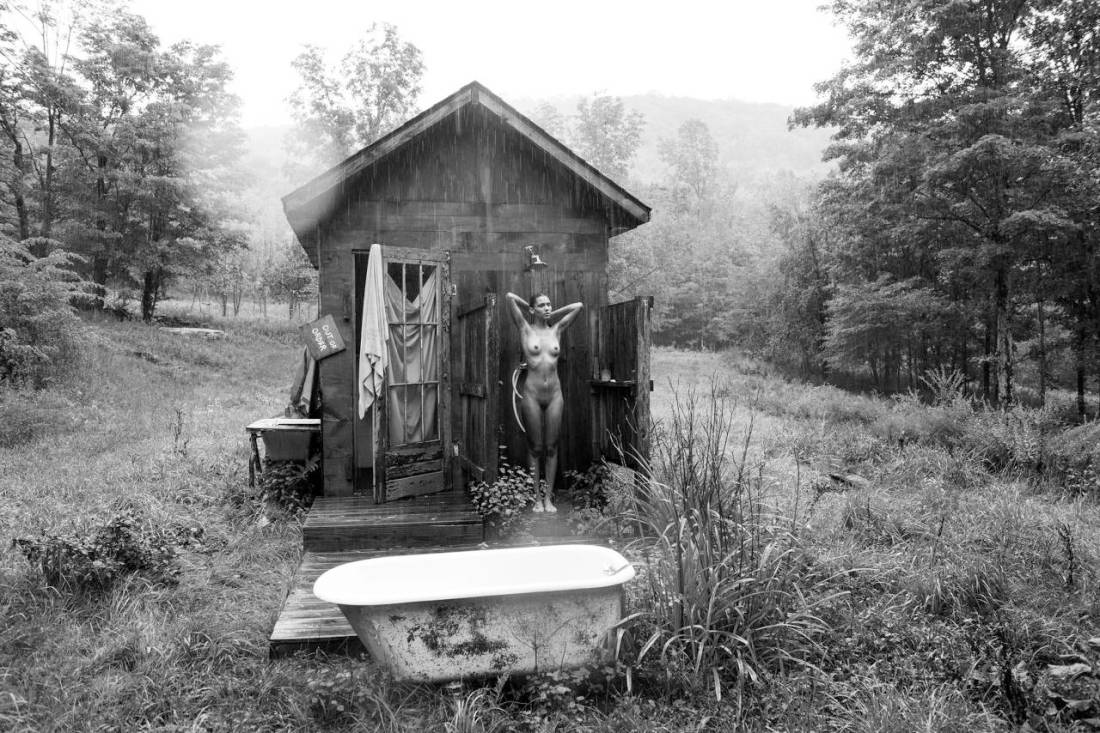
Tim BarberUntitled [rain/shower] feat. Kaya Wilkins (2013)

I’ve probably seen this image at least three dozen times but today is the first time I noticed that it’s raining.

A good part of why I’ve never noticed is that the most circulated version features compressed contrast and lower resolution.

As a result, I checked out Barber’s work and discovered that not only is it of an especially high quality, it’s also categorically interesting. He’s rigorous about formality of composition while showing a rare ability to make color vs. absence of color integral to the image.

Further there’s something about his work that transforms rather typical, nearly-prosaic scenes into something that feels autonomous, distinct and thoroughly singular.

The above image was included in a 2014 show at Capricious 88 in NYC’s SoHo.

In relations to that show, Barber claims:

I’m interested in the slippery
narratives that my photos can communicate, and a good narrative always
involves relationships of some kind […] Photographs can be so literal, but I’m
more interested in them as entry ways rather than finales; windows on a
wall, question marks. Another way to put that is I’m less interested in
what they are about then what they could be about.

And while I don’t think he has an especially good grasp of what narrativity actually entails, there is a strong sense that this image “could be about” a sort of Thoreauean search for existential vitality.

In the same breath, however, there’s an undercutting of that notion: the absurdity of showering in the rain; the out of order sign on the cabin–a sort of winking glance toward the ‘backwards-ness’ inherent in the proposition.

I could never abandon the hustle and bustle of big city life but there is a part of me that craves departures, ruptures and disjunctions with that life. Is it too much to want to stand naked on your front porch drinking coffee and staring off into the forest or to bathe in the falling rain?

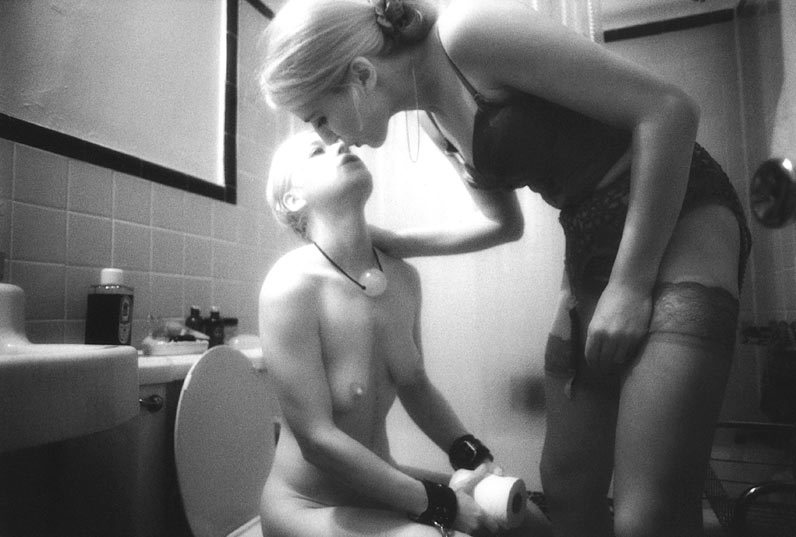
Barbara NitkeBathroom Kiss from Kiss of Fire series (1995)

I have mixed feelings about Nitke.

Besides her stated aim of “find[ing] the humanity in marginal sex,” her work all features a clinically dispassionate eye.

This allows the viewer to bear witness to an awkwardly tender moment such as above. Her presentation of action as jarring, motion blur and off-kilter compositions have become endemic in the work of image makers interested in both fine art and BDSM documentation (I’m thinking here specifically of Aeric Meredith-Goujon and his ilk.)

What irks me is the insistence upon conceptual layering for the pornographic to receive art world credibility. It’s almost like for something to be deemed Capital-A Art, the pornographic has to be somehow mediated and/or commented upon by the work.

Let me give you an example: I’m beginning to consider (with some level of seriousness) pursuing a PhD in Art History. What I am interested in is studying the dichotomy between Art and Porn throughout history and then insofar as it can be reconciled suggest transgressive art as an art historical current seeking to point toward a synthesis between these two allegedly opposite poles.

Invariably when I’m talking to academics–trying to sort potential recommendations, seeking advice w/r/t receptive/non-prudish programs–invariably people ask me why I’m so interested in Jeff Koons or throw Noam Chomsky at me.

I detest Koons. And my favorite incident in Miriam Elia’s indispensible We Go To The Gallery relates to Koons–it’s the perfect take down of his vacuous work but it also serves as a damning critique of why the ‘art world’ tolerated his’ short-lived foray into porn with his Italian porn star partner.

(As far as Chomsky goes, I’m not even going to address it because people far more eloquent than I’ll ever be have already pointed out how it’s bullshit to code switch from critiquing capitalism to a feminist perspective without acknowledging the overarching shift in context. Chomsky’s is allowed to find porn distasteful; he’s not allowed to use his status as a notable (white, cishet male) Academic to attribute unassailable factual status to his own poorly considered concern fapping.)

I guess my point is simply: the subject of Art is inherently relateable to the human experience. Sexuality (or asexuality) is a facet of the human experience. Therefore it is well within the purview of Art to consider it.

I object to the pretense of bending the work into conceptual pretzel shapes to earn a distinct of being meritorious. I want more de Sades, Bellmers and Batailles; fewer Gaspar Noés.

Tor Larsson – Fifteen 15 (1974)

I have no idea what the story is with with these images. (I very much want to know more/everything about them–so if you know anything, please share.)

I have half a mind to use them a prophylaxis against Clark and McGinley’s youth and beauty. And, I mean–yes, the above photograph is #skinnyframebullshit and not especially technically accomplished, but, at least, it embraces what it’s ostensibly about contrasted with Clark and McGinley’s constant equivocation. It’s like I always feel with maybe not as much Clark but McGinley feels like this sort of fragile fairy tale that will wilt or collapse under too much scrutiny.

I mean… maybe it’s just me–after all I was raised in an insanely regressive Evangelical environment but the stories my non-Xtian friends tell about discovering their sexuality are a great deal less curated.

Everything about this feels if not authentic then perhaps at least grounded. There’s a playfulness that serves as a sort of lubricant against what would otherwise been an arousal killing gravitas. I love the way that her sticking her tongue out conveys both a mugging for the camera–which actually de-emphasizes the way her legs are spread for the camera to get an unobstructed view of her vulva; but it also teases the implication of oral sex. (Also, I really dig that you can see the reflection of the edge of the tub in her hippie glasses.)

I don’t know. Unlike Mcginley, these resonate with me not because of some sort of false nostalgia–a wish for an experience so rarefied it might as well not exist. Instead, it reminds me of dear friends who have told me about how your best friend was someone who not only knew you masturbated but would lay side by side without under the covers masturbating, racing to see which of you would orgasm first. (Contrary to my own experience where sex was dirty and solely for the purpose of procreation.)

Also, I really–in a way I cannot clearly articulate–respond to the woman in the shorts and shirt. The way she’s participating in the intimacy but not the physicality.

Lightsong StudioEmma and Katja (2015)

One of the benefits of learning my way around a traditional darkroom when I did was that so many people were adopting digital that there were times when I would have a darkroom with 10 enlargers all to myself.

I kept trying to figure out interesting ways to manipulate my prints. My first experimental efforts was to make a perfect print of a diptych with images from two different negatives. (This is much more difficult than it sounds.)

I figured out how to use a print to make a contact print that rendered a print that reverted to the look of the original negative.

And then I discovered Witkin and Uelsmann and wasted an entire month trying to among other things: seamlessly splice half of one negative together with half of another, composite a scene from elements taken four different negatives. I made progress–but it was slow and cost prohibitively expensive.

Eventually, I realized that as much as I enjoy printing and am in some ways better at it than I am with a camera, I’d rather work with real people, on location and try to as much as possible produce the desired look in camera.

Thus I’m not really fond of this image makers work. The vast majority of it at least draws attention to if not serves as a comment upon its own artifice.

For example, the above image has been burned in to suggest a stylized vignetting. The skin has been ever so carefully toned so that the woman acknowledging the camera stands out by comparison to the woman with her eyes closed. And don’t get me wrong–I only wish I could achieve grading like that in my own work. But perhaps part of the reason I can’t is because the effect is achieved by obvious, heavy handed manipulation of the rest of the frame.

It’s unfortunate because there is something simultaneously post-coital and womb-like about this image. (And it would be stronger without the vignetting to goose the viewer.)

But looking at this something else occurred to me that should be presented as a basic rule of photograph to compliment the rule of thirds and the rule rergarding an odd number of subjects in the frame always being preferable to an even number–namely, if you have to have an even number of people in a frame, have only one acknowledge the camera.

Zhang XiaoUntitled from They series (2012)

The first and third time I read BarthesThe Pleasure of the Text, I was on a metric fuck ton of drugs.

I’m pretty sure the seed of the initial idea started the first time and then started to send up emerald shoots during the third.

And I guess because I am stoned now I’m willing to jump into this half-cocked and without any sort of safety net but it strikes me that there is an analogy between ‘a narrative’ and ‘the erotic’.

I am specifically avoiding the word ‘story’ due to the fact that a story can technically be X then Y then Z and a narrative entails some awareness of the relationship between the form the story takes and the iteration with which it unfolds.

A less abstract way of saying it might be conveyed in the deconstruction of the adage never tell where it is possible to show–a story tells; a narrative illustrates.

A great many things may draw the audience into a narrative. A story about a lesbian software engineer in love will have varying resonances with an IT systems admin vs. a single mother vs. a gender queer high school student.

Yet, what a successful narrative does is to encourage a suspension of disbelief. At the most basic level, even the illustration of events are by their very nature not the events themselves.

One element of the success of a narrative could be the degree to which disbelief is suspended in the audiences. (Of course, this is only one–and a relatively minor one, at that–metric.)

I feel that a similar correlation exists between erotica and arousal. (You can argue that arousal is the point of erotica–but couldn’t you say the same of the relationship between a narrative and suspension of disbelief?)

Let’s return to the matter of form. Whether one is preoccupied with the traditional five act structure or the Hollywood three act progression–the latter being a compression of the former, there is a rather unnerving parallelism with the experience of eroticism: exposition/background/context/et. al., inciting force, rising action, turning point (of no return), falling action, climax, catastrophe/denouement.

I really don’t like the formulaic. In literature, we talk about these structures to provide a gross framework for grappling with the mechanics of written fiction. Writing that uses these frameworks will never be great but it can be good–in the same way using a template to build a website at least keeps the designer from fouling things up too terribly.

So let’s consider a different analogue. How about physics? We know that an object at rest stays at rest unless acted upon by another force. And that an object in motion tends to stay in motion until acted upon by another force. We term these potential motion and inertia, respectively.

By and large, porn isn’t interested in the book hanging half off the bookshelf ledge. Ostensibly porn is interested in the book falling and hitting the floor.

Alternately, a narrative is going to be interested in the teenager who had a crap day at school and came home and picked up the latest bit of crime fiction she’s enjoying until her cell rings. Caller ID says its the girl in her class she has a crush on. So she puts the book down absently on the book shelf and answers the phone. The book hangs their for a second and then tips, crashing to floor scaring the kitten sleeping in the open window half out of its skin.

(Again I’m stoned as fuck so I’m not 100% sure this works but this sort of distinction might also be a means of better differentiating between erotica vs. art vs. porn–that that the three are or should be considered mutually exclusive.)

I would argue the above image is a narrative. It illustrative of a background–the poor illumination, the two beer bottles on the table to the left, the way the young woman is sitting barely propped upon the chair, her face flushed. There’s been a night of riotous drinking and she is perhaps too intoxicated at this point. There’s a sly expression of resignation, coy flirtation and expectation. (And as a just so we’re clear: someone who is visibly this blasted cannot give informed consent when it comes to sexy times.)

It seems clear that the photographer and this woman are likely to go home together. Whether they know each other is unclear. But that may not be the case–apparently these series was made from the photographer’s observations while working in Chongqing. (All the images were made with a Holga camera.)

Either way this is a veritable Cartier-Bresson-esque ‘decisive moment’ where the viewer is presented with a clear context for what has happened and is asked to imagine how things might have played out after the shutter clicked. (All the more impressive because so very much is communicated with startling lucidity with so very very little.
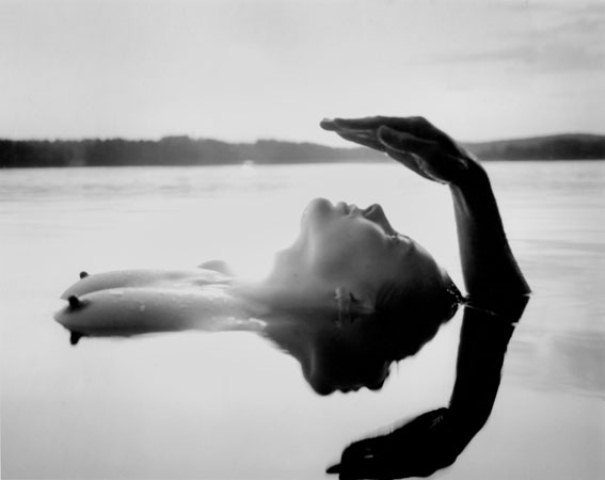
Arno Rafael MinkkinenSelf-portrait with Maija-Kaarina (1992)

Regardless of the discipline, I think anyone interested in pursuing the visual arts in an academic setting should be given a single sheet of paper printed on both sides.

The front would read:

Nobody tells this to people who are beginners, I
wish someone told me. All of us who do creative work, we get into it
because we have good taste. But there is this gap. For the first couple
years you make stuff, it’s just not that good. It’s trying to be good,
it has potential, but it’s not. But your taste, the thing that got you
into the game, is still killer. And your taste is why your work
disappoints you. A lot of people never get past this phase, they quit.
Most people I know who do interesting, creative work went through years
of this. We know our work doesn’t have this special thing that we want
it to have. We all go through this. And if you are just starting out or
you are still in this phase, you gotta know its normal and the most
important thing you can do is do a lot of work. Put yourself on a
deadline so that every week you will finish one story. It is only by
going through a volume of work that you will close that gap, and your
work will be as good as your ambitions. And I took longer to figure out
how to do this than anyone I’ve ever met. It’s gonna take awhile. It’s
normal to take awhile. You’ve just gotta fight your way through. –Ira Glass

The back would reprint the entirety of Minkkinen’s The Helsinki Bus Station Theory: Finding Your Own Vision in Photography.

Partly, I think it’s good form. Also, I feel like the assumption is made that the student wants to learn or they wouldn’t have enrolled in the course. But wanting to learn and having to learn are very different states–for example: as I approach middle-age I still want to learn to play the cello but when I was a toddler I didn’t so much want to learn to walk as I had no other choice.

Those who want to learn are a dime a dozen. The majority of them will become bored, will shirk the work or drop out.

But what academia does a shit job at is teaching you how to keep going when you don’t have a choice because to cease would be tantamount to death. Students are direly ill-prepared for those plateaus, brick walls and handfuls of hair pulled out frustrations that come part and parcel with practicing a craft.

I feel like leveling from the beginning–admitting it’s hard and dispirit but reminding folks that the process–no matter how wearying–is far more important than the product.

Or to put it another way: practice doesn’t make perfect. Only perfect practice makes perfect.

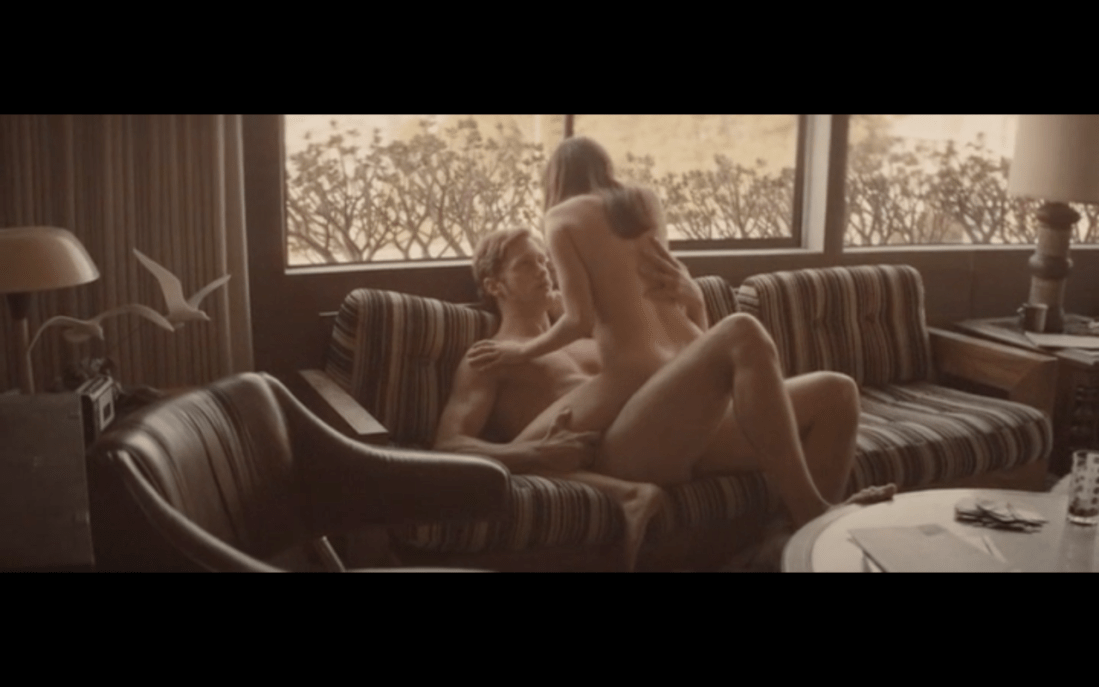
Marielle Heller + Brandon Trost – Still from Diary of a Teenage Girl (2015)

If you haven’t already, you really, really, really, really, really (that’s 5 reallys) should see Diary of a Teenage Girl.

The premise of the film is a fifteen year-old named Minnie (an excellent Bel Powley) carries on a relationship with her mother’s boyfriend Monroe (Alexander Skarsgård).

If you’re thinking isn’t that crossing some kind of uncrossable line? Well, Powley was twenty-one during production. Yes, she’s playing younger but the film is carefully structure to introduce us to Minnie as a precocious teenager. We’re given a glimpse of who she is and how she thinks, responds & interacts with the world around her before anything carnal unfolds.

Minnie’s response to her initial sexual explorations is a natural extension of her personality. And it’s frankly fascinating how the movie uses the fleeting–and yes explicit (but tastefully so) sex scenes–as depth charges to test and more thoroughly define her character.

That there was no outrage over this is likely due to the fact that the makers carefully avoid any sort of obvious or easy imposition of moral prudery–in fact there’s a feeling that it was intended as a sort of quasi-fairy tale as to what the world might be like if the world weren’t so sexually repressed. But, it’s also notable as the film was directed by a woman.

Also, Marielle Heller was one of the few women to direct a film with studio backing. That it’s one of the five best movies of the year, should speak volumes about why we need more women filmmakers.