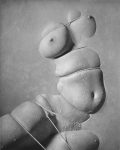
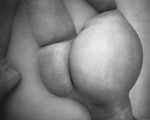
Hermann Försterling – [↑] Torso gebunden 2 (2007); [+} Nicki hinten (2007); [] Knie (2007)

I’m not sure these are necessarily good–Torso gebunden 2 is trying to round up a golden spiral. The others are thinly veiled attempts use the study of form as a strategy to sublimate an erotic fixation.

I’m not saying they are bad, either. More that they are interesting but I’m not entirely sure they work.

If these look a little different than your usual B&W images, then congratulations on your sharp eye. These are actually heliogravures AKA photogravures.

I’m not super adept with this process. As I recall you transfer the image from the emulsion onto a sheet of copper and then etch the copper, so the copper can be used to create prints. (This photo of Victor Hugo from Wikipedia is more or less what I’m accustomed to thinking of when I think of heliogravures.)

I do really like the texture in these. The water on the skin and the way the skin stretches and folds in on itself. And the consideration to render heliogravures was likely driven by a smallish negative or digital processes. However, given a 120 or 4×5 neg, I think a platinum print would’ve provided a more consistent tonal range that would’ve increased contrast and sharpened the resulting print.

Hell, if the originals were negs, gimme them along with some amidol, Bergger Prestige Variable CM Baryta paper in semi-matte finish, a bit of selenium toner, a bit of gold toner and a week of dark room time and I can make split grade prints that are objectively better than these.

Anastasiya Shevela. (2015)

According to the tags in the original post, this image was made with a sheet of 4×5 Kodak Ektachrome.

Long story short: Ektachrome ‘replaced’ Kodachrome. (The scare quotes are to respect the opinion that Kodachrome was without equal and irreplaceable.)

It’s a fine grain color positive (or slide) film. It was discontinued in 2013.

There’s no way of knowing when the sheet resulting in this photograph was exposed. It could’ve been in 2013, while the film was still ‘fresh’. If it was exposed this year–which would be my guess–it’s held up reasonably well. (There’s a blue shift due to the boat and a yellow shift in the skintone but both facets only contribute to a stronger image.)

I used a few rolls of Ektachrome before it was scrapped. I’ve never really cared for Kodak film stock–the T-Max grain structure irritates me and Tri-X has never been as smooth as the high end Ilford stocks to my eye. And I’ve had several interactions with Kodak as a company that have left a very bad taste in my mouth. But Ektachrome was solid. It never had the dazzling skin tone of Fuji’s Astia. (Now sadly also discontinued–but I do still have a small stockpile in my freezer.)

If you’ve never shot slide film you aren’t going to appreciate the nuance in this photograph. Unlike negative film–which has a sometimes a nearly five stop exposure range wherein you’ll get a ‘usable’ photo–slide film is unforgiving in the extreme.  Without perfectly even lighting, Fuji’s Provia 100 in medium format gives about ¾ of stop range; 35mm is ¼ a stop if you’re super lucky.

So, if it’s that much fussier to shoot slides as opposed to negs, why bother? Well, on the one hand, I’m a photographer who strongly dislikes the lemming-like obsession so many fashion/editorial/’fine art’ folks have with Kodak Portra. If you’re using a flash and/or have controlled lighting, you can do some interesting stuff with it. But it’s texture tends to be plastic-like and the colors skew a little too pastel for my taste. (I suspect so many people use it because it tends to provide a ‘flattering’ skin tone by default.)

The truth is: I only ever shot one negative stock which rendered what I would refer to as acceptable color fidelity–Afga’s Optima II. (I’m convinced it was better able to render grey scale in the shadow areas.) Alas, it was discontinued soon after I stumbled onto it.

The first time I shot slide film was the first time I was really even halfway on board with regard to color fidelity. So I continue to shoot it.

And I think what I’ve come to realize is slide film just renders color in a fashion closer to the way my eye sees color. For example, in the above image, it’s difficult to tell if the blue is bleeding out from the boat into the pebbles or if the pebbles were just close enough in color as to provide that illusion. A well exposed slide leaves that ambiguity. Just pop in down on a light table and you’ll see it one way or the other depending upon how you look at it.

With a negative, that distinction would be something that one would develop in printing. (And it would take a long time of futzing back and forth and printing a bunch of images that didn’t work.)

That’s why slide film appeals to me: if you shoot it and it looks like crap, there’s no fixing it. It’s not strictly WYSIWYG but it’s so close it may as well be. I appreciate it’s unforgiving nature. It forces me to think and then think again before I click the shutter.
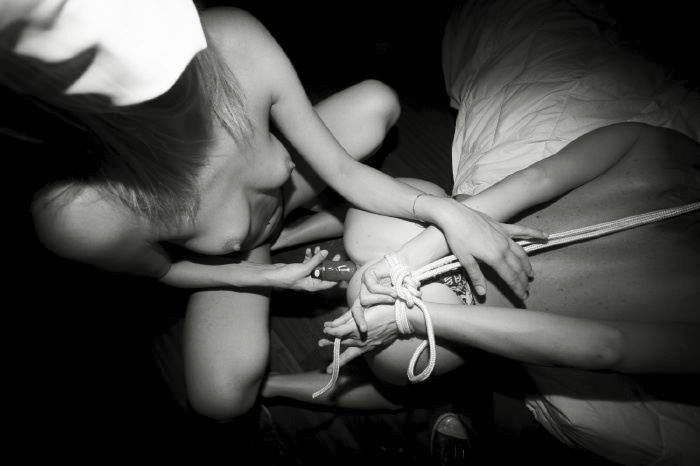
 Evgeny TimofeyevNightlife (2015)

Although I’m not fond of virtually all Timofeyev’s work, I adore this picture.

It’s very in-the-moment, both philosophically as well as self-consciously aware of the flavor of the week with regard to prevailing trends in fashion and editorial image making  in 2015.

The flash contributes a (false) feeling of documentary immediacy–this scene is very obviously contrived. Yet at the same time the way the head is turned away–which can be interpreted as either the result of being in the throes of self-pleasure or (probably) more likely an acute preoccupation with retaining a degree of anonymity. (Really, if I’ve said it once I’ve said it a hundred times–putting in the creative labor necessary to figure out how not to decapitate the subject with the frame edge pays off in spades. And if you need further examples besides this, @thewillowrae has been goddamn fucking killing it lately.)

Clearly, this shot is intended to imply a masturbatory scene. At the same time it has this feel that both the photographer and the young woman, have maybe had a little too much to drink and the suggestion is made that a picture feigning masturbation be attempted. There’s a sense that while this is staged, that it’s teetering on the line between staged and actual by nothing more than the virtue of a strong willingness to entertain the premise.

Finally, I don’t normally like images where the verticals take on such an intense angle. Here it may be the thing I like most about the image is the fact that the tilt is motivated by the way which the woman is pushing her hips forward and leaning backwards against the wall to engineer a non-horizontal/non-vertical angled plane.

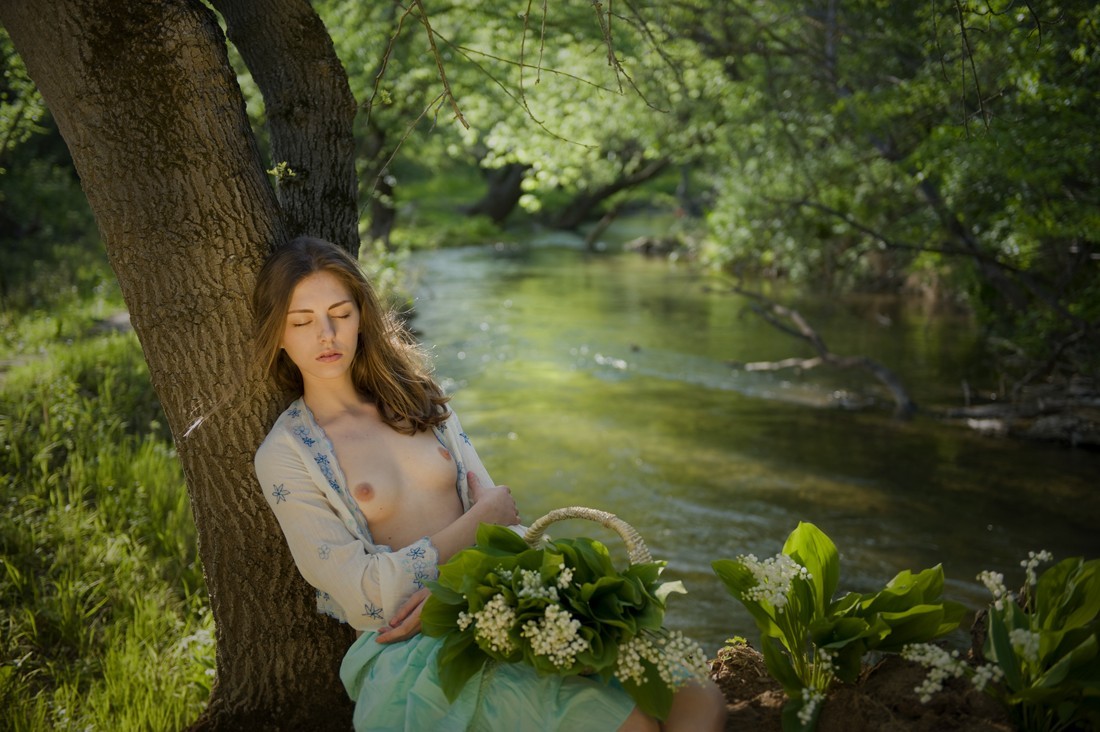
Source unknown – Title unknown (201X)

Working on this blog for the last four years, the seed of an idea has taken root, grown. More and more, I am of a mind that there is something not unlike a visual grammar which applies to image making.

I’m not sure it’s fully formed enough of a notion at this point and I’m probably going to disavow what I’m about to bumbling attempt six months down the road but here goes:

I think when one looks at an image one does so with a question–whether conscious or not: what does this tell me?

In the case above, the image seems fixated upon itself as ‘pretty’. (The initial response to the question what does this tell me? is rarely more than a cursory, instinctive response–in other words, it’s acritical.)

What follows my own notion that this image is ‘pretty’ are questions about genre and form that occur in tandem. This is ostensibly a portrait. It’s presentation is very studio-esque; however, removed as it is from a studio, it is also a landscape.

This second point is heightened by the way the image emphasizes physical location in a manner similar to strategies codified by pictoralism, i.e. the off-balance composition and the way light is subtly sculpted–there’s likely a bounce board of some sort reflecting the light so it accentuates the model’s face.

At this juncture, I am inclined to ask why her shirt is unbuttoned. She’s sitting in the shade, so it’s not to get a tan. And of all people I understand the instinctive desire to be naked in nature; but her pose suggest she is about to nod off.

The Baby’s Breath she’s collected in a basket explains her presence–and also reminds me of John Everett Millais’ painting of Ophelia. Further, her outfit is strange. The turquoise of her skirt seems very modern and clashes with her blouse, which could–with a certain squint–strike one as provincial.

My own inclination is to look closer to make sure I’m not missing cues that might, if not rememdy, then better focus my questions. But there are no further answers and instead I begin to notice all the things that diminish this image’s overall quality: the way the bounce that’s directing such flattering light onto her face also is highlight the tangle of low hanging limbs over her left shoulder, the weird motion blur at her knees contributing a sense of tension which contradicts everything else in the image.

I walk away from viewing this with the idea that the image maker had something in mind more along the lines of the gorgeous work Owen Gray has made with Dolly Leigh but either failed to achieve it or (more likely) neglected to communicate the true impetus of the image to the model.

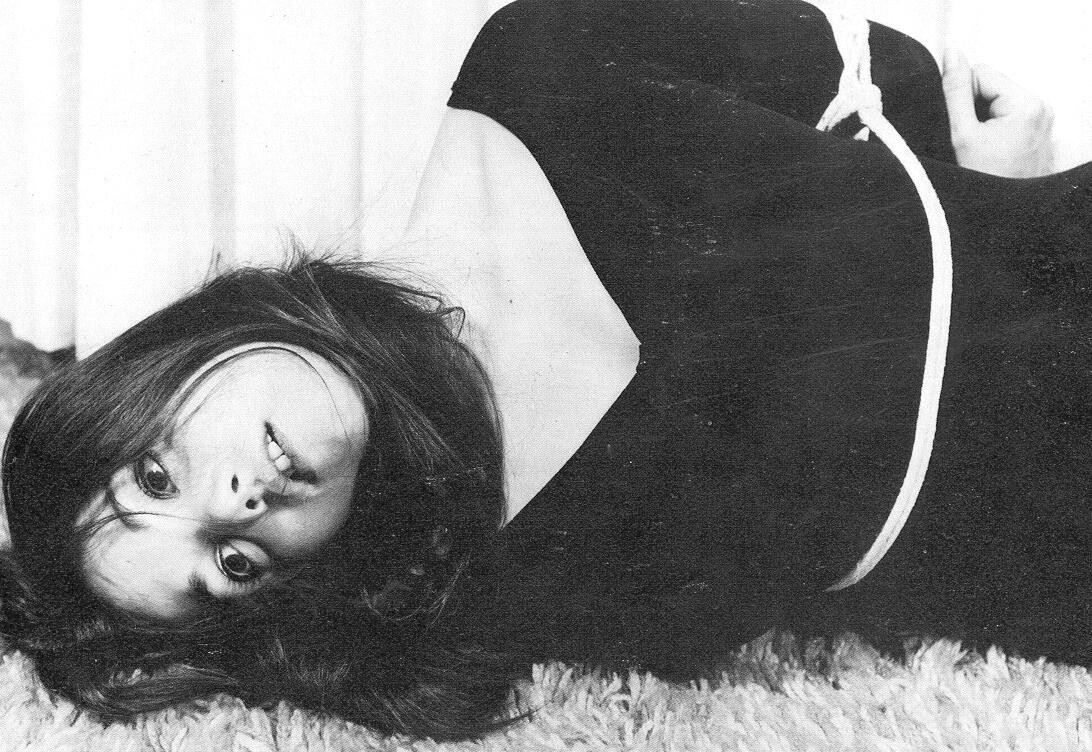
Source unknown – Title Unknown (19XX)

Excepting her face, the carpet and too a lesser extent the curtains, there’s almost no mid-tones to speak of here. Everything is bright white or deep shadow black–there’s enough of a hint of grey to insinuate the clavicle, differentiate her left hand from the background and keep things from going completely flat.

The black dress conceals her figure but the rope is enough to emphasize the curve of the body, imply a bust line.

The composition filters the gaze from the loop in the rope, to the hollow of her fist and then back to her vaguely dissociated expression–which is highly reminiscent of Renée Falconetti in The Passion of Joan of Arc.

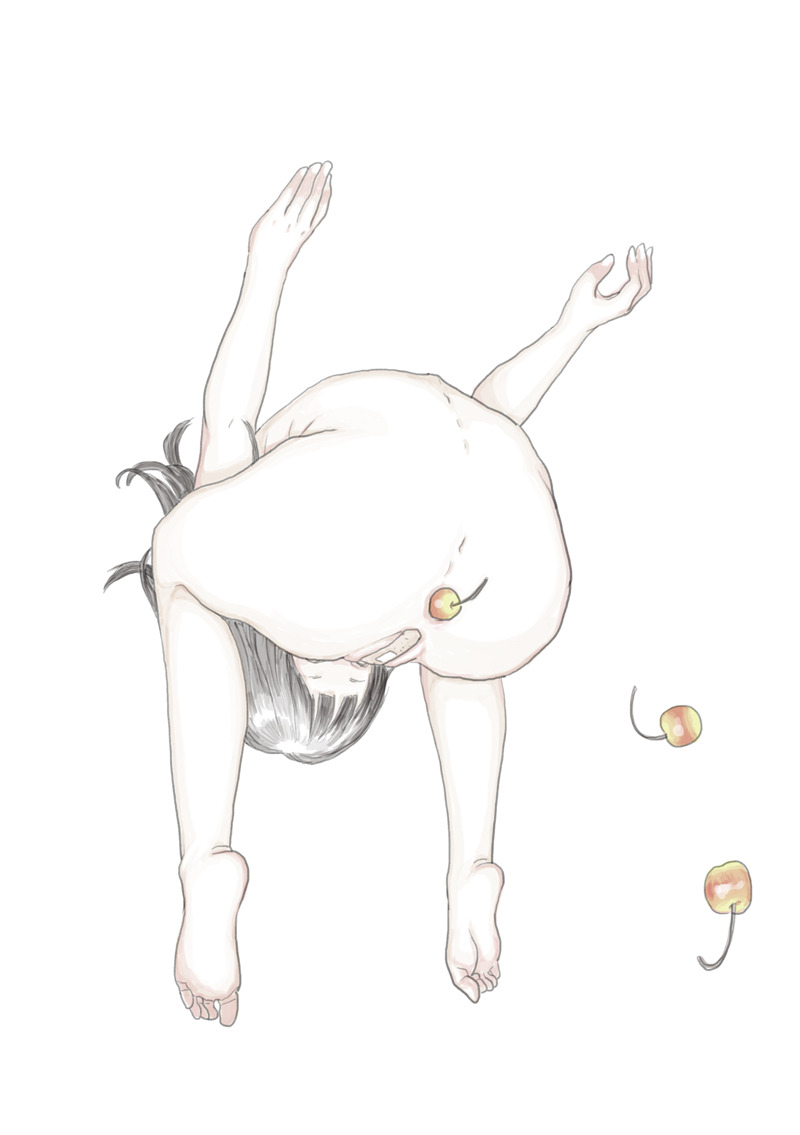
Ryuko AzumaSakuranbo (2005)

I like the way this presents the entire body in a compelling pose that suggests both a bilateral and hemispherical symmetry (i.e. the position of her arms mirrors that of her legs).

The line work is clean and simple. Very minimal tonal shading contributes dimension.

I also really dig that those appear to be the best cherry known to humankind–Rainer cherries.

In other words: this is the perfect balance between visually arresting and WTF. (But why the fuck does her vulva look so totally resemble a Band-Aid?)