Mutsumi Yamamoto – Untitled from L’Eros Sacre (2010)


Death, The Last Visit
By Marie Howe

Hearing a low growl in your throat, you’ll know that it’s started.
It has nothing to ask you. It has only something to say, and
it will speak in your own tongue.

Locking its arms around you, it will hold you as long
as you ever wanted.
Only this time it will be long enough. It will not let go.
Burying your face in its dark shoulder, you’ll smell mud and hair
and water.

You’ll taste your mother’s sour nipple, your favorite salty cock
and swallow a word you thought you’d spit out once and be done with.
Through half-closed eyes you’ll see that its shadow looks like yours,

a perfect fit. You could weep with gratefulness. It will take you
as you like it best, hard and fast as a slap across your face,
or so sweet and slow you’ll scream give it to me give it to me
until it does.

Nothing will ever reach this deep. Nothing will ever clench this hard.
At last (the little girls are clapping, shouting) someone has pulled
the drawstring of your gym bag closed enough and tight. At last

someone has knotted the lace of your shoe so it won’t ever
come undone.
Even as you turn into it, even as you begin to feel yourself stop,
you’ll whistle with amazement between your residual teeth oh jesus

oh sweetheart, oh holy mother, nothing nothing nothing ever felt
this good.

AJ MokshaRainy days featuring Kyotocat (2015)

The shadow-light interplay in this is masterful. Mid-tones appear compressed (the hallway wall in the left foreground is separated from the mid-ground wall behind it more by softening of focus than tonal variation) allowing for a great range of detail in the highlight areas. Alternatively, there’s little variation in shadow tones–used to staggering effect to separate Kyotocat’s silhouette from the mid-ground wall.

Unfortunately, the air return vent is an eyesore and detracts measurably from the image.

The dangling bulbs are a strange addition. Are they ornaments or are they those new fangled things with succulents growing in them. (Given the dim illumination, I can’t tell.)

I am torn between thinking their inclusion adds an unpleasant touch of kitchy contrivance–I mean they wouldn’t be hanging at that level in a hallway or whomever passed them would knock their head against them; thus they appear to be dangled like a puppet into the frame for the sake of the picture.

It reminds me of Jeff Wall’s After “Invisible Man” by Ralph Ellison, the Prologue–which was quoted nearly verbatim by the production designers for HBO’s terribly uneven but dumbfoundingly ambitious series The Leftovers.

Or–since these bulbs are not illuminated–it could be a reference to Amir Naderi’s Davandeh (one of my top five all-time favorite films). In it, the young protagonist lives on an abandoned ship, the roof of which is covered with hanging bulbs.

There’s also the matter of the image being some pretty flagrant #skinnyframebullshit. The vertical frame renders the proportions of the wall in the left foreground, the wall in the mid-ground and the pitch dark hallway at the right of frame. A horizontal frame would have required a definitive decision on how to use the size or each plan relative to the others as a means of unifying the composition. With the vertical orientation, the obviousness of the arbitrary way in which they are used is diminished–the to detriment of the work, sadly.

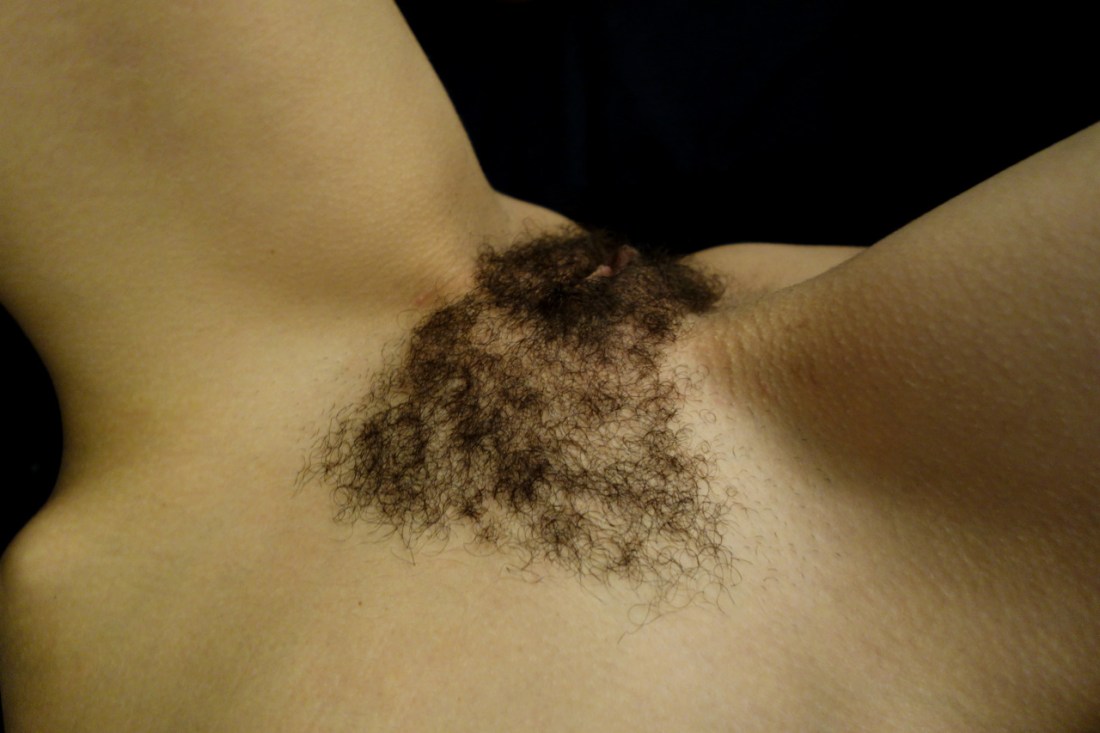
Un instant avec ElleMyself, intimate moment (2015)

So here’s a picture which proves an exception to the rule of my general distaste for close-ups in image making.

The gist of my objection is that by diminishing contextual cues with regards to setting (interior, exterior), orientation relative to other subjects (or lack of other subjects for that matter) in a given space, time of day, historical epoch, etc., etc., the information the image can clearly convey is severely truncated. This truncation has a tendency to be employed to foster a sort of forced intimacy–this is especially true with regard to portraiture, where seeing something with one’s own eyes up close invites the viewer to bridge the absence of detailed information with a sort of god-like omniscience; or–to state it in a less abstract fashion–the close-up encourages spinning the inherent lack of certainty as to the identity of the subject into a sort of nebulous knowing predicated upon predictable tropes and societal preconceptions. The close-up works–more often than not–because it gives the viewer permission to fill in a number of blanks. And while this is the base nature of the eternal question with regard to what the frame includes and excludes, typically, I feel like close-ups encourage the viewer to fill in blanks they quite frankly have no business filling in.

This image succeeds partly due to its simplicity. There’s a balance between the warm tone light and the dense shadow space, a similar equivalence between smooth skin-tone and texture; also, flatness and dimensionality–the subtle shadows imposed by the musculature are luminous here.

The composition doesn’t quite work: one triangle is formed from the vertices of the shadow space adjacent to the left hip, between the legs and in the fall off at the right hip; while either leg form vertices with an implicit third point at the navel just beyond the lower edge of the frame. This results in the image having an unbalanced visual heft–with the scale tipping slightly to frame right, undermining the careful balance so stunningly apparent throughout the rest of the image.

However, there is one incredible astute conceptual conceit managing to eclipse this minor transgressions. It’s sort of hard to explain it but try something: invert the image and look at it; now, return it to it’s normal orientation. There is a way in which the grammar of an image suggests that the bottom of the frame is closer to viewer and the top of the frame is further way. Orienting the frame as above makes the action depicted not for the viewer. (Given the angle of the frame it’s not strictly a POV perspective either. In tandem with the caption, an intriguing tension is created between a voyeurism one is allowed to observe even though they are not invited to participate with.)

Subtle (not subtle) reminder

Greetings all.

Several months back, I started a Patreon account to help facilitate this project.

I have zero intention of ever charging a penny to view/read posts. I do what I do out of love.

But it does take approximately 25 hours a week to keep things up and running ‘smoothly’.

Therefore, if you dig what Acetylene Eyes is doing, think about pledging a few bucks each month.

I know it sounds silly and I detest asking for money but if every follower pledged $3/month, Acetylene Eyes could become my day job. And that would free me to do more and better work here as well as allowing more time and resources to dedicate to my personal photographic endeavors.

If you feel like contributing, you can go here or click on the brand spanking new Support button in the masthead.

Thank you all so v. very much for following!

Be well.

-A.

Hans BellmerStudy for Georges Bataille’s L’Histoire de l’oeil (1946)

Bellmer is one of a handful of artists that I don’t really know how to talk about.

I know more people are put off by his sadistic bent and his obsessed penchant for depicting sexualized pubescent female bodies.

I’ll never argue that the vast majority of his work isn’t pornography and I think that to the extent that it includes children, such work is actually unconscionably irresponsible.

The trouble is that the work is of an unusually high quality. Much of it has–rightly, in my mind–earned the distinction of Capital-A Art.

So the question is: does being of an exceptionally high quality give the work a pass when it comes to elements that toe over the line in terms of child pornography?

My background is academic. But–if I may confess something: I’m not a good academic. I have no patience for genuflecting at that Freudian shrine. Yes, the man suggested and subsequently implemented a ‘functional’ framework for quasi-scientific analysis. But the framework was gallingly sexist, heteronormative and largely misguided.

The criticism on Bellmer bends itself into pretzel shapes similar to several of his Dolls, trying to use Freudian notions or Sue Taylor’s ‘feminist’ defense of the artist or Catherine Grant’s Bellmer as ‘queer doubler’ tact.

I can abide pieces of each attempt to justify Bellmer but I can’t really follow them down the garden path to their various conclusions. It’s too much heavy lifting for something that in my mind doesn’t require it.

To my way of seeing, history is Bellmer’s justification. Think of that Picasso quip made when his portrait of Gertrude Stein was criticized because she did not look like her image: she will.

Bellmer’s rage against fascism and the cult of the perfect body do not read as if they’ve dated in 70 years. They very much fit in with the Tumblr erotica vein and with the current emergence of this sort of misplaced hipster nostalgia, these images could have been made a month or two ago. (Note: they’d still stand head and shoulders above similar modern images.)

Ultimately, what I appreciate about Bellmer is that–like Balthus–the mission of his work was to disturb. However, unlike Balthus–who one has the feeling was almost always the smartest person in any room her entered–Bellmer was open and in your face about the considerations underlying the work, while Balthus strenuously avoided any attempt to fuel equivocations about his motivations.

I find it curious that critics are so willing to give Balthus a pass but grin and rub their hands together when it comes to crucifying Bellmer. Yes, Balthus’ work is arguably of greater quality. But there’s something tempestuous, resonant and grotesquely messy to Bellmer. It’s as if Balthus sought to prompt people to ask better questions so that they might receive better answers; while Bellmer was more interested in leading folks to nothing more than being happy with better questions in the face of a world which is incapable of providing anything like what we think of when we think of an answer.

Source unknown – Title Unknown (20XX)

With this there needs to be a few slaps on the wrists for rookie mistakes.

For example: It’s clear the horizontal level was set using the bottom of the couch. One problem, the back of the couch isn’t flush against the wall and as such the frame on the picture is askew.

Also: the way her right leg gets cut off at the ankle is sloppy because it looks awkward and it distracts from the lovely angle of his splayed legs.

Lastly, it’s way overexposed. The visible grain suggests a high ISO. Pretty sure this was digital and the image maker was using the histogram to judge exposure. (This is one of those instances where unless you’re shooting RAW, you really super need to decide whether you want the emphasis on shadow detail or highlight detail before you trip the shutter.)

Although it needs to be made clear this does far more right than wrong. The curtains, hanging picture, phone, lamp and carpet all clearly convey the context that the setting is a hotel room.

Despite the problems with framing the composition is cinematic. The way the boys body is slightly turned towards his lover presents enough of a question as to whether or not this is poised specifically for the camera in order to allow a suspension of disbelief that one is viewing a staged scene.

I love the way he’s gingerly holding himself–as if he’s just orgasmed or has just edged and is doing everything he can to hold back. And his flushed face is incredibly appealing to me.

But the two things that make me love this are the way she’s holding him. As someone who grew up in an extremely abusive environment where I was constantly having to navigate and interrogate complicated power dynamics, I don’t understand D/s interactions.

However, I do appreciate the sort of give and take that develops with a partner where they can say without words: you are mine, I have you and you are safe, you can completely surrender control to me.

Plus, I am always going to dig imagery that subverts the art historical male gaze by presenting men as naked and vulnerable while women remain clothed and empowered while still remaining very much sexually engaged.

lusting-and-thrusting:

Samantha-fucking-Saint

Source unknown – Title unknown (201X)

After my first encounters with porn, I rapidly developed a abusive relationship with it. Namely, my curiosity regarding it always seemed to outweigh the loathing and alienation it triggered.

There was a local video rental chain with a location within walking distance of my house. After some cautious prodding, I realized that several of the staff members didn’t give fuck one when it came to determining whether or not I was old enough to rent items from their enormous back room.

Thus by the time I was sixteen I was renting two or three XXX videos a month.

Amazingly, I found some stuff that if I didn’t necessarily like, it certainly interested me. In particular, a gonzo series called New Faces, Hot Bodies–made by, if memory serves a Cleveland based kink smut purveyor named Bob Bright–never failed to pique my interest.

As I remember it was the diversity of the scenes that fascinated me. In any one tape, there would be a range of scenes from vanilla to hardcore and bizarre kink fetish.

I believe a testament to how different they were is that I can still vividly remember a number of scenes from the series. One was my first introduction to bukkake–in the scene five to eight studs ejaculated at least 3 times a piece over a young woman while two other women used spoons to collect the semen off her body so as to feed it to her.

In another scene in the first video I from the series I ever viewed, there was a parenthetical return to the first scene. The lead in said something like fifteen minutes after we last saw them and then the couple went for round two.

I found the second scene unbelievably hot. It didn’t matter that it had likely been filmed on two separate days. The imposed continuity and the notion that the scene didn’t end just because the guy blew his load really turned me on.

It was another five or so years before I saw anything similar. It was one of those videos that makes you feel a little uncomfortable watching. Low production values, with most of the shooting budget going to acquire a superficially opulent location and then the performers being paid in drugs.

The performers were clearly coked out of their brains. The guy was fucking like a spastic jack hammer. He pulls out, ejaculates so forcefully the first two spurts shoot over the woman’s head and end up on the carpet. He immediately starts rubbing his glans around the woman’s clitoris, while a small puddle of come leaks out of his cock and then he promptly reinserts and continues as if he’s just getting going.

All this is by way of saying I like deviations from the straight cisgendered heteronormative porn script. For example, in the image above it’s clear that guy has already ejaculated forcefully on the woman–who the captions say is Samantha Saint but I remain unconvinced of that attribution; yet, the scene clearly continues while he ensures that she gets off.

Yes, the notion that sex has to result in orgasm for both parties is also fundamentally heteronormative but it’s one of those things that although micro-ly problematic, still–for me at least–represents a decided improvement on the status quo.