Paola Rojas H. & David PérezVisceral series (2015)

True fact: I was born cross-eyed.

Still being the 70s and with my post-natal health care provided by the US military, I underwent surgery that evens out the eyes by snipping muscles.

The result almost four decades later is that I only truly have binocular vision for a very short time period each day. As my eyes tire, I only use one eye at a time. I tend to prefer my left (non-dominant) eye.

So in addition to having an autism spectrum level aversion to eye contact, most 3D movie spectacle is lost on me.  (Wenders’ Pina Bauch documentary was wonderful because the use is so minimal and used to subtly emphasize depth of field and in Mad Max: Fury Road the 3D contributed an amplified sense of post-apocalyptic setting and therefore rendered the over-the-top color design less obtrusive.)

Visceral‘s palette is two tone: red and blue. As with 3D movies red advances and blue recedes–bestowing an unusual dimensionality to what would otherwise be relatively flat studio work. (I think if you donned 3D glasses, this image would probably even pop a bit.)

@lisakimberly will tell you that I’m a bit of a Rojas detractor. But I should confess a change of heart. Reviewing her work now reveals how she’s pared down her muddled early work, focusing on the more sinister and surreal threads in her work.

On the surface, Visceral hits as a bit of a left turn but the simplicity of it puts a very fine point on her technical chops and finds a way of bridging the gap between fragmentation as literally depicted to a more scientific/poetic/conceptual exploration.

And although I’m not as fond as the rest of Visceral as I am with this image, it’s still exciting work from a talented image maker who appears to be fully coming into her own.


Marc Attali [p] / Jacques Delfau [t] – Les érotiques du regard (1968)

I don’t speak a lick of French–so best as I can tell: this image is from a book entitled Les érotiques du regard (trans. Erotic Gaze).

It was published in the late 60s and features Attali’s photos and Delfau’s poems.

What’s online from it looks effing exquisite!

There’s something mysterious about this photo. Has she removed her own undergarment to holding it up like a flag? Does it instead belong to a lover? Is she holding it up to the light the better to see it? The text–again I do not know French–but Google translate seems to suggest something like “dedicated to the unfaithful” as the meaning. (EDIT #1: I’ve been informed by my favorite native French speaker that it means literally: “[v]owed to an unfaithful role” or maybe something like “[d]oomed to be unfaithful”. EDIT #2: After further contextual investigation it seems it means “relegated [as if by societal perception] to be unfaithful”)

Vermeer may be my all-time favorite artist. That’s because many of his works feature what I call a ‘story seed’.

Much the way an acorn contains the oak–a story seed is a single static frame given which the viewer can interpolate much if not all of the events leading up to the moment rendered as well as some notion of what follows given the scene as presented.

It is unlikely that Vermeer ever intended his paintings to bear titles. But what’s interesting to me is that frequently the titles that have come to be historically attached to his work tend to describe as opposed to definitively encapsulate.

One of the many things Joel Sternfeld is up to in his On This Site series is majorly fucking with the conception of the relationship between photographs and their accompanying titles.

With the project, he pairs self-consciously mannered fine art photographs bearing descriptive titles with additional text explaining the broader historical context which motivated him to make the picture–in this case: incidents of stunning violence.

I object to artist’s who hang titles on their work as an attempt to activate a perceived narrative that might otherwise be missed by the viewer. Worse though are the scores of folks who pretentiously intellectualize titles as a way to add a sense of lofty intellectual ambition to straightforward work.

A good title serves as something closer to an ergonomic handle never–and yes, at times knowing a handle is a handle can be instructive if you are questioning how to carry something. But as a rule, if you title your photographs: your title should not function as a instruction manual or explanatory dissertation.

If that’s how you employ titles then you might be better served pursuing something more in keeping with the artists’ books tact of Les érotiques du regard–in that way you’ll have room for didactics instead of bragging about how oh so super smart you are.

ZmouseGrool catching (2015)

I’m not sure this piece is qualitatively ‘good’ but it gets me super hot and bothered.

I think what resonates with me is that cunnilingus is bar none my favorite behavior on the sexual spectrum. The sight, feel, sounds and dear lord the taste are things I absolutely crave.

So while I hardcore relate to this image being solidest around the glaze sheen around submissive’s nose and mouth–mirroring the way in the moment of licking, sucking and penetrating perception can winnow down to just mouth and genitals; there’s also the way that the dominant woman is rendered in a vague archetypal fashion which undermines the specificity of the submissive’s hunger.

The way the legs muss the submissive’s hair seems thoughtful until you look again and see that it’s flat and relatively forced. All the legs are is a graded wash tying the frame together with the painstakingly rendered vulva.

I feel like–depiction-wise–this minimal approach actually has (whether knowingly or not) quite a bit in-line with Georgia O’Keeffe–if O’Keeffe had opted for a lazier, less rigorous approach to her visual experimentation.

Édouard Chimot – Untitled (1930)

This is clearly a sketch. By that I mean the figures are posed for the artist to render them. Yet here, how they are rendered is interesting. The presumable draped dais upon which they are standing is rendered in the drawing in sculptural fashion–the base requiring strategic load bearing functionality to support the figures rising from it. (It bears mentioning that the shading to suggest depth is masterful and I love the simple line and asymmetrical form of the standing woman’s breasts–an incisive application of the classical contrapposto posture to a female figure.)

And although the poses are hardly exact matches, the tone does remind me very much of Gustav Vigeland’s Kneeling Man Embracing a Standing Woman.

Also, I really like the cartoon face in the margin that appears like what I’d imagine the main character would be in a Jean Vigo directed anime.

msjanssen:

lovely backlight!

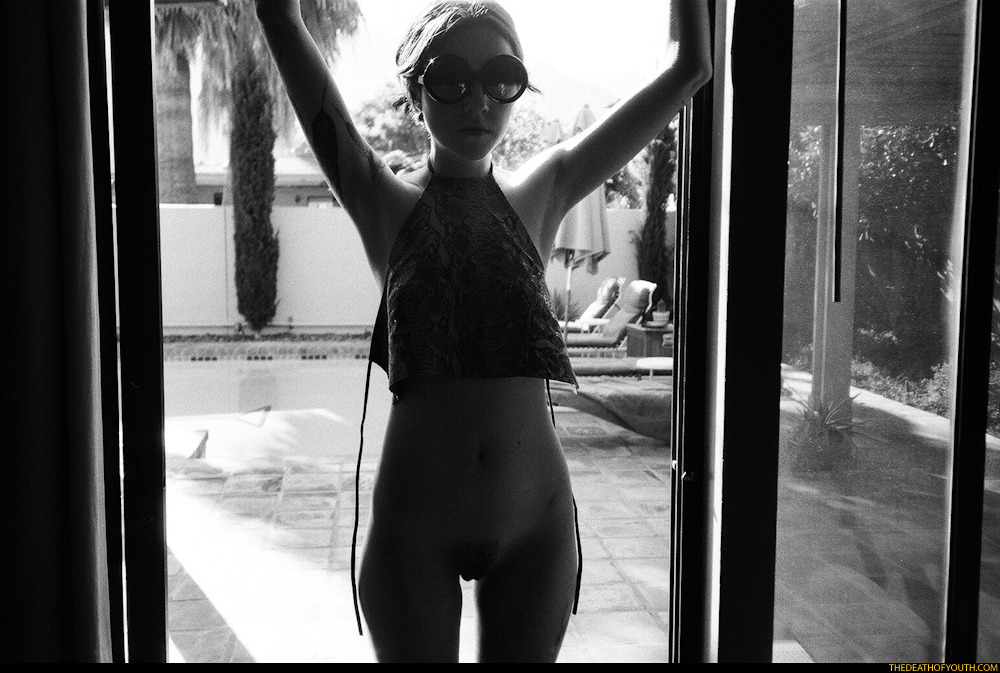
The Death of YouthAlanna (2012)

@msjanssen has already covered ¾ of what’s so arresting about this image.

All I can add is that you also need to consider the angle of the light. Yes, it’s backlit; but while the background is bright and the foreground is dark, the angle of the light is falls in such a way that you can actually make out the general shape of Alanna’s face and unlike the flattening silhouetting effect of backlighting, her body has dimensionality–you can see the shape of her hips and tummy and just make her pubic thatch.

Also, you can gather enough to get a clear notion of the pattern of her top–which is super cute. The loose hanging strings contributing a casually coy hint of eroticism.

I’m generally put off by tDoY’s semi-slick, desert counter culture as new glamour aesthetic ethos. And while I think there’s room for improvement with the above image–Alanna’s left elbow gets lost in the shadowed doorframe and the down tilt of the wide angle lens renders the plumb lines of the door as converging instead of parallel and this encourages a downward cast of the gaze that walks a razor wire line between breathless appreciation and leering; in turn that renders the way both her arms and legs are amputated problematic regardless of which side the viewer tips toward.

Something in “The Red Meadow” reminds me of Duchamp’s “Given: 1) the Waterfall; 2) the illuminating gas.” It’s the pose of the figure lying down and the relative difficulty seeing exactly what’s going on, I think. Not really a question; more an observation.

An astute observation regarding the pose. (The Duchamp work referenced can be viewed here.)

I’m not sure it’s difficult to see what’s going on in Étant donnés so much as it’s difficult to fit what’s going on to a rational explanation. The viewer may not be entirely sure what’s going on in Red Clover Meadow; however, the implication appears pretty unequivocal–at least to me.

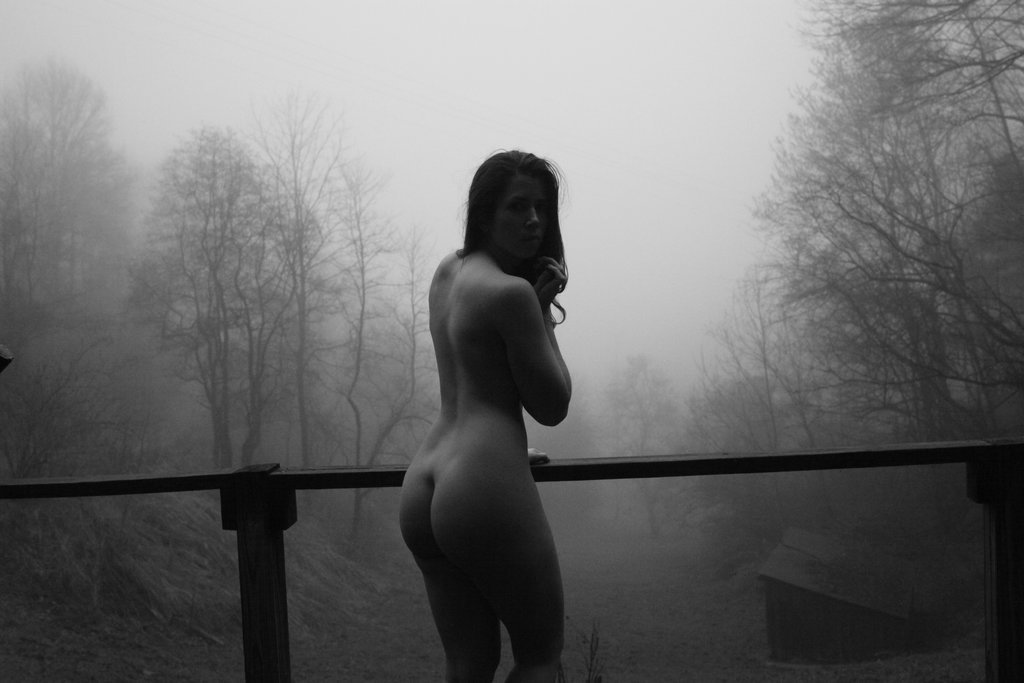
Renée King AKA atlas-7self portrait at the cabin (2015)

I
can’t endorse the composition on this. The lower frame edge cuts right
across the knee, the off-center left position of the subject along with
the slant of the railing and that little protrusion just below the
center of the middle left frame edge set the image askew in a way that
to my eye distracts from the scene.

However, I do love pictures
featuring fog. There’s something magical about it–the foreign in the
familiar masking of it, an ephemeral, fairy tale otherworldlyness.

One of the best uses of fog I’ve encountered appears near the end of Theo AngelopoulosUlysses’ Gaze.
In the scene, fog descends on war ravaged Sarajevo, halting incessant
sniper fire–allowing folks a reprieve to walk around under its cover.
Harvey Keitel’s character walks around in a field of nearly translucent
white. It’s visually arresting in a way very few things ever achieve and
contributes a chilling weight to the subsequent events.

I feel
like what this falls short on with regards to composition is more than
made up for in tone. Only the shadows are solid. As things take on light
and shape suggests a solidity that while separate from the fog still
resembles it in texture and tone.