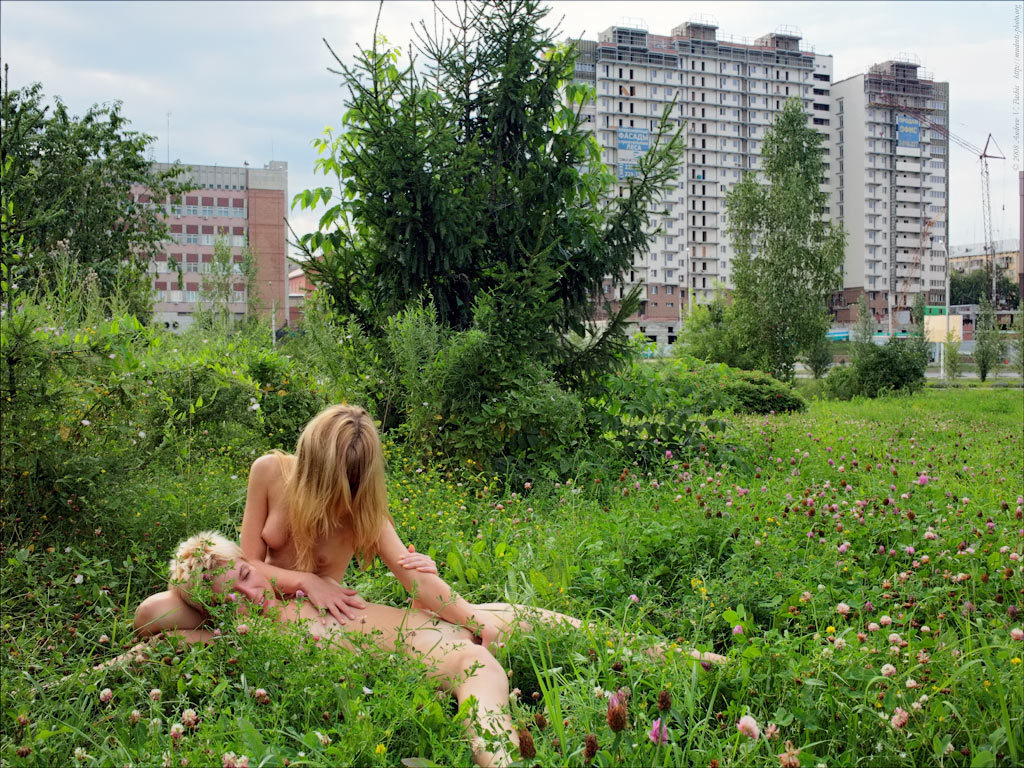
Andrew V. PashisRed Clover Meadow (2008)

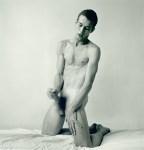
This isn’t a good photo–the composition is more concerned with getting the shot than rendering the scene in a clear and legible fashion.

Plus, I’m really not a fan of simulation, fakery or pretense in depictions of sexuality.

However, neither trait prevents me from outright adoring this image and it’s audacity certainly helps with that. The sort of devil may care presentation reminds me that some of the best sex I’ve ever had has featured a comparable setting–i.e. a place that is exceedingly public yet simultaneously secluded enough to render the chance of getting caught with pants down or dress up is not absent but small enough to justify the risk.

The rest of Pashis’ work is significantly more thoughtful than the above. It’s possible to see the broad strokes of the visual it-factor that marks most if not all Eastern European and Russian work so that you can spot it forty yards out. The feeling that nudity although culturally mired to a degree with sexuality is more a by product of the intensity of surviving the harsh winters. A matter-of-factness about the mad desire to soak up sun with as much skin as possible during the white heat of summer.

But whereas someone like Mukhin seems charged with a certain higher octane vitality when his work witnesses the more transgressive features of Russian youth culture or someone Evgeny Mokhorev’s likely inappropriately edgy fixation on young bodies as the locus of a darker yet also truer sexual freedom, Pashis is more openly voyeuristic, classically inspired, contrived and at times unapologetically aggressive in his presentation.

Although mad props are in order for his transformation of one of Ryan McGinley’s worst images into something fantastically crackling with the unfettered potential of being young, free and if not immune to consequence then aware that there’s no bending heaven so you might as well raise some hell.

Source unknown – Title Unknown (20XX)

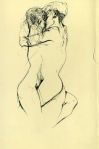
The way I feel about the Marquis de Sade is not unlike how I feel about hentai–downright irresponsible in its extremity but at the same time relevant and necessary due to its radical openness to a dizzying spectrum of non-traditional experiences.

It’s like that infamous Terrence quote: homo sum, humani nihil a me alienum puto, or for the non-Latin kids: I am human, and nothing of that which is human is alien to me.

Sure, that doesn’t go along way to explain tentacle sex, and I’m not going to start going out of my way to become familiar with hentai but I do feel that there’s a virtue to obsessively cataloging depravity in all it’s shapes and forms.

Yes, it’s easy to see that sort of thing as a checklist or map–a curriculum for sexual deviance. But, two counterpoints: if so, why bother–I mean isn’t the fun of it at least partly in the novelty? And, those who insufferably follow maps and extant formulas obsessively, lacks the proper imagination to truly embrace depravity.

I feel like–at its best–hentai manages to invent simple, straightforward means of depicting expressions of sexuality that are like nothing I’ve ever seen before and also vaguely synesthetic. For example, looking at this it’s almost as if I can feel it as if I were there.

Unfff.

JoymiiWhat a Ride featuring Josephine and Den (2015)

There are a raft of reasons I ought not be posting this:

  • I am suspicious–at best–of close-ups (let alone extreme close-ups such as this)
  • It’s heteronormative in a way which really goddamned irks me
  • The above image has been cropped from the original (which I would’ve posted if it didn’t feature an intensely intrusive, dumb watermark).

All that BS aside, there is something not if not exactly substantive then I guess ‘considered’ about this. I don’t mean the polished gloss of it–although it certain supersedes that of quotidian porn.

What catches my eye is the extremely shallow depth of field–which allows both out of focus bits in the foreground and background.

Image makers are frequently obsessed with the flattering effects of so-called bokeh to isolate and emphasize the subject of the composition. But bokeh centers on rendering the background out of focus. Out of focus elements in the both the fore- and back- ground is more commonly associated with cinema–where due to the scene playing out of thousands of frames shifting focus can be used to guide who or what within the frame the audience is supposed to attend to. (I’ve written about this before.)

In the above image the point of sharpest focus draws attention to the act of genital penetration. In this crop, the action still manages to be ever-so-slightly off-center. No matter how pretty the soft focus, the image would’ve crumbled given knee-jerk dead center placement.

What’s interesting is in the uncropped version, everything shifts left and down. It’s a better frame by miles but I don’t think I’d have necessarily realized what I have about the image and why it appeals to me without comparing the crop and the original–although not strictly compliant, there are absolutely points of correlation with the composition and the Golden Ratio. (I recommend opening the diagram and the original side by side.)

Peter HujarBruce de Sainte Croix Triptych (1976)

The central image here served as my introduction to Hujar’s work. (I posted about it 2.5 years ago–misattributing the subject and excerpting just the one image from the grouping.) But, I recently discovered that I was familiar with another of his photos well ahead of that–probably the photo most commonly associated with Susan Sontag was made by him.)

I keep coming back to his work, though. I guess the reason I do is due to his patently even handed approach to all subjects. From portraiture, to landscapes to erotica, he invariably affords his subjects a calm dignity which more often than not edges over into a flash of stubborn pride.

As if in the mid-to-late 70s and big bad eighties in Manhattan with the specter of HIV and AIDS stalking the gay community, there was a camaraderie and joie de vivre that you just don’t really ever see. (And to be clear, I have no intention of romanticizing. It just strikes me that the romanticization of much of the work emanating from the downtown scene possesses an openness an candor that was bred as a result of surviving, the creation of which was clear eyed and unpretentious and for those who didn’t live through those years in that climate read as charmed in a way that was never intended by the creators.)

His tone and frank presentation of ‘high’ and ‘low’ subject matter with the same, quietly incisive approach are things I would very much like to achieve in my own work.

mpdrolet:

Kourtney Roy

Kourtney RoyUntitled from Hope series (201X)

I really, really, really, really, really super (that’s five reallys and a super) dig this image.

There’s a way in which a figure in a landscape skews towards being indicative of an underlying narrative.

I could digress into speculation on the relationships with staffage, segueing into an analysis of staffage’s inherent narrative potential by contrasting an idiot like Gregory Crewdson who won’t shut up about narrative but whose work is fundamentally un-narrative and a masterful painting like Bruegel’s Landscape with the Fall of Icarus. (It’s worth noting that Roy’s image does suggest broad answers to the questions why is this character here–she clearly intends to go for a swim and is undressing to facilitate that. Before the moment we see now she was ostensibly not in the pool and we can presume based upon what we’re seeing that she will soon wade into the brackish water. Is her motivation being in a sort of dream-like state where she will sink into the puddle and be transported to another layer of a dream? Or are her actions driven be a sort of suicidal abandon–perhaps motivated by bourgeois ennui? Unlike Crewdson, Roy gives her audience nuanced implication from which to draw conclusion and does not rely on empty spectacle to miraculously catalyze the suggestion of the action leading up to this point and potential actions trailing away from it.)

Of course, there’s also comparisons which can be made with Stephen Shore’s American SurfacesHope seems almost self-consciously aware of it’s reverent emulation of the former.

But I think it’s all a little too easy to head down these rabbit trails. It’s not that I don’t think the work supports them–it very much does. And it’s not that while I am extremely fond of the above image, the rest of Roy’s work is a bit too late-70′s/early-80s high end fashion editorial kitsch in it’s frequently garish execution.

There’s an argument to be made that perhaps a more productive approach might be to examine the influence on her work of cineamatic auteurs. There’s a clear strain of Lynch–likely more directly localized in an idealization of Hitchcock. (It’s difficult to look at her supersaturated pastels and not think of Kim Novak’s wardrobe in Vertigo.

However, when you browse through Roy’s oeuvre–as I did this morning while sipping Chameleon Cold Brew Coffee–there’s a sense that you really miss the central thrust of her work examining her work as if it’s born solely from the influence of photographic progenitors. I dare you to try to look at her Carte blanche pmu/le bal series without flashing back to Jacques Tati–in particular: Playtime.

Willy KesselsFemale nude from behind (19XX)

I’m too fuzzy on the the epoch to identify the progenitor here but this is reminiscent of both Edward Weston and Man Ray.

I’ve mentioned before that Weston’s enduring reputation is due to the brilliance of his skills as a print maker not especially as a result of his compositions.

And with Man Ray, who referred to images of himself as rayographs, there’s always a feeling I have when I look at his work that he felt the women he photographed were art only because they were fucking him at the time.

Kessels’ photo manages to skip the sentimental nostalgia for heated fumbling adolescent sexual exploration and present something unusually reserved, almost reverent.

w-y-s-f:

Hanna

Hanna GraceUntitled (2015)

Given several years, art historians are going to have to grapple with the fallout from this prevalent notion of the ‘selfie’.

For all intents and purposes, Wikipedia considers a selfie anything where the operator of a lens based imaging device produces an image of themselves. I think that’s more than a little problematic since it conflates self-portraiture with the selfie phenomenon.

What’s the difference? You might inquire. I’m not sure I have an answer and even if there were a way to flowchart things so that we can easily facilitate a distinction, I’m not sure that will ultimately be a good thing, though.

There is an art historical trend of associating women with mirrors. The most unequivocal of these instances is probably Charles Allan Gilbert’s All is Vanity–where a woman (who in an art historical perspective are always treated as if they have a corner on the vanity market) is staring at her own reflection in a mirror transforms via optical illusion into an enormous skull.

This knee jerk association of women with vanity is disingenuous considering many of the artists who ran with this motif also painted self-portraits which would have required them to stare at themselves in a mirror for countless hours. And the resulting work would be seen as meritorious and not at all vain.

More recently–the backlash over the sorority members more interested in taking selfies than paying attention to the baseball game they were attending. It’s all just an extension of the societal double standards with regard to performance of femininity: the fine line between prude and slut and regardless of how carefully you try to walk it, you’re still going to be cat-called on the streets and it’s going to be your fault for being a a woman.

But beyond that what does the term even mean? Ostensibly it means you hold the camera and take a picture of yourself. But with the advent of loathsome selfie sticks, where’s the line? Despite the visual limitations of the selfie, the results are frequently more appealing than the ubiquitous bathroom mirror reflection image.

I’m not one to poopoo any of it. If your preferred method of ontology involves self-portraiture, I am 120% an ally. (However, I do think like anything else there are pitfalls–I’m thinking of the young woman who recently acknowledged her Instagram wasn’t as candid as she presented it to the world and the toxic effect it had on her self-esteem.)

But most of all I don’t want work like the above images by Hanna Grace to be lumped in with the sort of casual, knee-jerk let’s take a picture because it’ll last longer motivation of selfies.

Maybe it’s snobbery but a part of me thinks if you take the time to set up a tripod and think about your framing, there’s more going on than something incidental. Not that making selfies is always easy–I saw two young woman on the Brooklyn Bridge several years back spend close to 15 minutes taking and retaking the same image to get it right. I won’t deny there’s an art to that but I think that the highest that a selfie can aspire to is probably a well-made document. There has to be more than just capturing the moment.

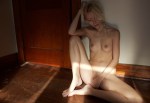
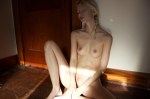
And that’s why I like these images so much. I’d hate to see them termed selfies. There’s thought behind them. A sense of the tone of the room, dynamic light. But also implicit interrogations over questions of the cultural sexualization of nudity–the way that the shining through the top of the window creates a frame within the frame that is aggressively controlled and shaped by the woman in the image. It conveys a totality of personhood.

I’m not sure these are effective as examples of fine art, necessarily. The pose grows increasingly confident/less awkward from top to bottom. The exposure is best in the middle image. Also, the middle image makes the best balance between the space occupied by Grace’s body in the frame contrasted with the room as negative space.

If you take the three together though and sort of take the mean average, I feel like they are sketches that could be used as fodder for a truly breath-taking image.
Rick Ochoadust and dusk (2014)

Ochoa passed away last year.

I didn’t know him and was not especially familiar with his work. But I did note the outpouring of grief regarding the loss of a dear friend, trusted co-conspirator and ally.

I’m a little late arriving but this image takes my goddamn breath away.

First of all it, reminds me of this iconic shot of Marlene Dietrich in Shanghai Express. Not in execution so much as substance–there’s a sense of individual agency, verve and independence. As if in the moment where the scrim separating performance of identity from bed rock selfness caught in a breeze and at the exact second the rift between the two was the largest, the shutter clicked.

Second there is something not unlike the tension in the best Vermeer’s, where you find yourself thinking that in a moment the maid will have poured all the milk out of the pitcher, that the letter will slip from the young woman’s hand and drift like an autumn leaf to the floor. Is the girl with the enormous pearl earring turning toward you or away from you?

Is the model Penelope Machine breaking eye contact to experience her own inner world exclusively on her own terms or is she about to make eye contact and share something devastatingly wordless but immediate and true in the way that only standing in the truth of the moment with another?

What I’m saying is that Ochoa–unlike so many of the rest of us who think Barthes’ notion that photography is death obsessed–find a way to make photos that if you turn your ear to them, you might well hear the faint ticking of a clock. Or in this case, the beating of a heart.