John LorenziniTrish (2014)

This is an effing goddamn gorgeous image–which is something coming from me given that my default seeting with regards to studio work is best labeled: ‘intense antipathy’.

From the stand point of scale, it’s interesting that the distance between the tip of her toes and the baseboard is identical to the distance between the top of her head and the top frame edge. (Further, I suspect those echoed distances can be subdivided into three equal parts which are the same height as the space between the lower frame edge and the tips of her toes.

The way the one point perspective of the floor boards recedes drawing your eye toward the woman and then having the beautiful gray background blossom in variegated light is an extremely effective compositional flourish. (Also, the light in most of his other work seems to fall at a very contrived 35-40 degree downward slant. It’s doing the same here but the light is broken up, inconsistent and thus appears more natural.)

That Trish is not acknowledging the camera seems to be a nod towards and awareness of the highly problematic art historical ‘male gaze’. However, there’s some downright maddening inconsistencies with regard to acknowledging the camera/not acknowledging the camera across the work that suggests less underlying subversion and more edits made to foster a personal aesthetic.

And even though I love this image and super wish that I’d shot it, I do have to take the image maker to task–rather pointedly–on two fronts. First, given solely this image, I wouldn’t be inclined to call #skinnyframebullshit. Unfortunately, considering the rest of the work, yeah, it’s used as a means of hyper-stylization. Which is fine but use it consistently. Things get in a muddle when the seemingly suggested strictures governing the use are abandoned for seemingly no reason or rigidly followed to the diminishment of visual effect.

My second objection has to do with the impetus for nudity in this image. I don’t think, for example, that this work is nearly as vapid and frivolous as this image–which features superior lighting but is otherwise vapid and positively seethes pushy/sleazy heteronormative suggestion. Alternately, consider this image which features garbage lighting design and asinine composition but actually conveys a logic behind the nudity it is exhibiting (note: the discarded top and knickers on the arm of the couch and on the floor near the edge of the frame; also, the acknowledgement of the camera)–in this case a semi-coy I want you to see me naked (which is entirely valid but does require a certain responsibility on the part of the image maker to address the legacy of white, cis-male heteronormative entitlement).

Lorenzini’s image is exceptional except there’s no context for her to be seen nude–sell the studying figure and form BS elsewhere, we’re full up here–other than to be seen nude. Thus, although it’s good natured and probably entirely well-intentioned, this image–while extremely aesthetically pleasing and technically prescient, is unfortunately at it’s most basic level: an exercise in objectification.

mrchill:

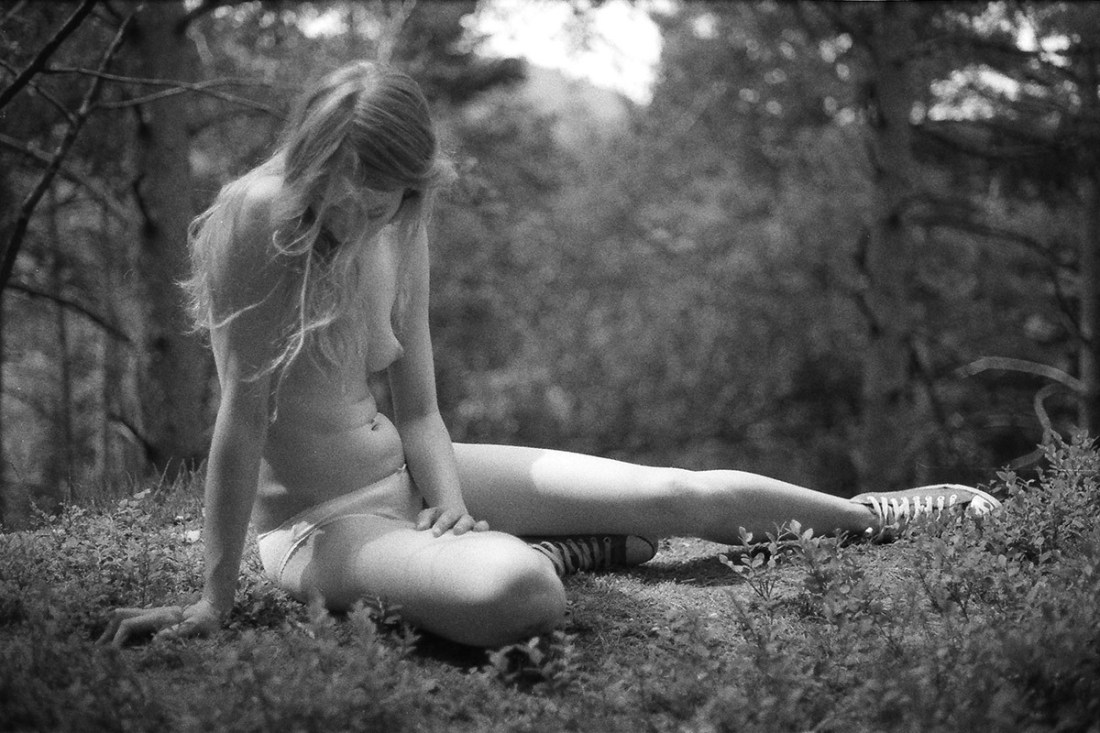
Pierrine, waiting in the woods
Canon AE1 & Kodak TRI-X 400
(expired film from 1969, found on a flea market)

© Chill
tumblr · portfolio · facebook

I’m a fan of Chill’s work. So much so that a bit over a year ago, I interviewed him.

He continues to do breathtaking things with color. (This recent image is not only one of my favorite of his, it’s an exceptional example of color as intrinsic to both composition and legibility of the image.)

But I wanted to take a minute to draw special attention to the above image. Consider the parenthetical note about how this image was made on 46 year old analogue film. Looks good, no? A bit grainy but Tri-X has always been super grainy. (I dig how the focus is ever so slightly behind Pierrine. Lovely.)

Here’s the thing: even expired B&W film renders better results than digital. Yeah, yeah. You can get ‘passable’ B&W if your camera allows you to shoot in monochrome natively–if you are shooting in color and then desturating in post, it’s my humble opinion you have no business anywhere near B&W.

The reason B&W film will always be the only way of shooting monochrome is simply this: digital’s Achilles’ heel is that it lacks the depth of black that analog provides. Film renders a depth of black exceeding what can be read by the human eye. But, operating off what the human eye can interpret, given the existing digital frame work, the math is something on a scale of given 0-255 as a range of black, you’d need a theoretical bit depth of 256 to get you to within spitting distance of what the human eye sees. Digital flat out wont scale to anywhere near that level… (And for the record, I realize I’m playing fast and loose with science here; this example is intended to be descriptive not empirical.)

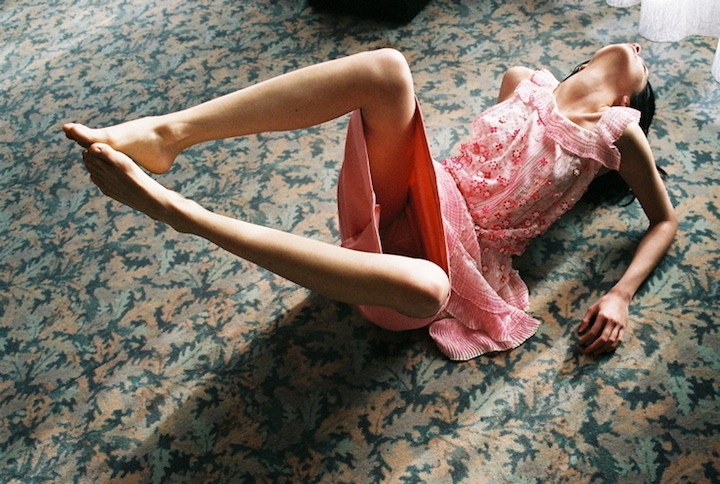
Lina Scheyniusmariacarla (2008)

Remember how from the point you started to learn long division onward, your teachers were always admonishing you to show your work!?

Up to that point the right answer has been more than enough but increasingly how you arrived at the answer becomes just as if not more important.

Lina Scheynius–more than any other photographer I can think of–shows her work.

To illustrate what I mean let me draw your attention to this heart-warming story about Peyton Thomas and what happened when her mother took her to skateboard at a local skate park.

The eye which lights on the figures and compositions that Scheynius chooses demonstrates a curiosity–nervous and often fumbling but completely engaged. When she captures an image, Scheynius is surprisingly like the girl in this story–she wants to skate but the circumstances surrounding it and her lack of confidence are all obstacles.

As such her work often shows a almost careless whimsy with regards to composition. For example: the above image doesn’t logically break down into any sort of sensible geometric proof. It’s literally about the diagonal (top right to bottom left angle of the light, interplay between the pattern/color of the dress against the carpet. Like most of her work–the colors are muted and muddy in an effort to render light the central focus.

Further, to me it feels as if the instinct of the image maker is to present Mariacarla in context. Due to this instinct, the curtain fringe and whatever the dark object pushes in along the top, slightly right of center frame edge.

In the end, it’s these two likely circumstantial elements that unify the image. And here is where the eye that edits the resulting images is comparable to Ryan Carney in the story about the little girl and her skateboard. Lina as editor acknowledges the wonderment but applies a critical eye. The accidental embellishments serve as a means of rendering the wonder impetus the sparked the shutter triggering legible to a viewer.

There are scads of photographers whose work functions as a primer in how to read images. But Scheynius, in the way she reflexive makes photos inextricably tied up in her process, is trying to show us how to better see wonder in the world around us.

marason:

Sögur/Stories

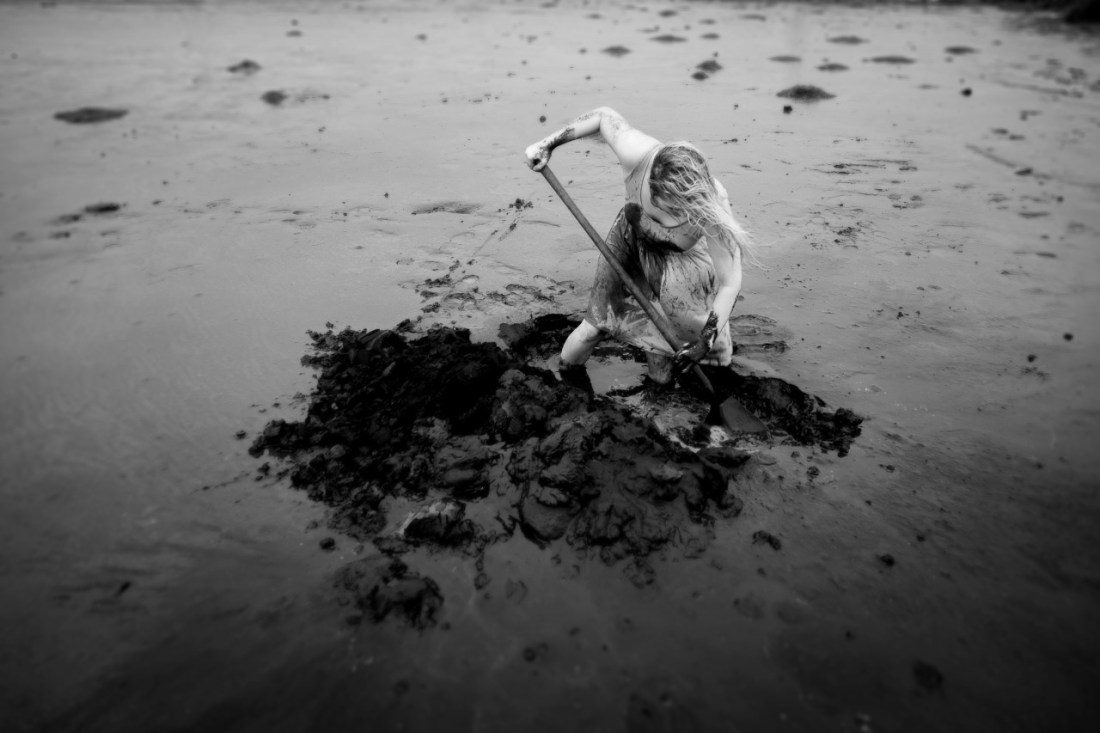
Sigurður Mar HalldórssonUntitled from Sögur/Stories series (2015)

This reminds me of one of my favorite scenes in one of the best TV shows of all time: Breaking Bad.

There’s something primal about the struggle of bone, sinew and skin trying to excavate the landscape. It’s mysterious, edgy and the amount of exertion required to make any progress is damn near monumental. (I think all of these reasons feed into the trope of characters digging their own grave under the watchful eye of a menacing captor–you really can’t approach the violence done to the earth without a mixture of literally morbid curiosity and dread.

Visually, this is a dynamic image. There’s a sense of heft and twist and flex of the physical motion conveyed in the pose. The mud streaked skin and fabric as well as the earth that has been cast aside all indicate this is only the beginning of a grueling task.

Insofar as the image is logically suggestive of a time that there was not a hole in the location, the present moment where a hole is perhaps beginning to yawn (more on that in a bit) and a point in the future when their will be a deep hole, it is flirting with narrativity. However, without an indication of the purpose for the hole, it only fits itself to the structure of narrative.

I will concede that there’s a fairly good chance this image is intended to reference an Icelandic Saga with which I am sadly unfamiliar. (The fact that it appears her shovel is currently empty and also that she is standing in the hole she is digging up to her shins in water leads me to this thought.)

However, whether or not it is supposed to refer to a widely known story, the fact that it the purpose of the hole is left so ambiguous, is actually very disappointing. I can’t really fully level the criticism I want here because I don’t know where the image was headed–although it seems very confident in itself. (Rightly so, for the most part.) Consider though how–and these are all cheesy cliche suggestions–the image would improve for the edge of a treasure chest in frame or the legs of a dead body.

In fact, as I think there’s something of an edgier tone and I get an amorphous feeling that the woman in this frame might very well have thinly veiled self-destructive motivations, a composite of her digging and then her body laying on the ground would’ve proved breathtaking in its simplicity and clarity.

foldingsoulsSelf Portraits (2015)

Back when I was a film student, I recall reading about an argument between an auteur (it may have been Buñuel) and a cinematographer. The cinematographer took issue with the fact that they were shooting on an iconic street using more or less the same frame as at least seven previous films. The auteur responded: yes, but this is the first time I’m shooting it.

Minimal body scapes with white sheets/walls are a dime a dozen on Tumblr. Which is precisely what makes these so freaking compelling: they take a tired conceit and with simple, specificity transcend the easy trappings of cliche and remind the viewer of the freedom limitation can bestow when approached with a humble, patient eye.

Take Me To Your BedroomUntitled from A Bottle of White series (201X)

From the outset, I should mention that I have way, waay too many feels about this image to approach it critically. There are a number of things that in all probability are highly problematic with this frame–but I’m not really able to go there.

Why? Well, where to even begin…

I flat out do not understand why the parameters for being ‘normal’ and ‘well-adjusted’ so frequently demand a sort of pre-dissociative state. It’s like this is the compartment where my work experiences go, so let me put on my work person-mask and get down to tit. Oh, this is the cubbyhole where my personal experiences go, let me put on my personal person-mask. We are ourselves perpetually for the time between our mothers and some maggots, why are we so damned and all fired determined to equivocate?

I know it’s not always that simple to dodge such equivocation. I mean consider our language. What percentage of our words describe visual stimulus? There’s words referencing a spectrum of light to dark, the totality of color, texture, etc. With sound we have a widely varied set of linguistic indicators–but (and I don’t know this for certain, I’m merely thinking out loud) there’s probably half the available words that describe what we hear than the total of words to name what we see. Smell and taste being a physiological response with overlap, feature much of the same language–which again is only a fraction of the total available sound describing words. When we get down to touch–what’s left: hot, cold, dry, wet, hard, soft, rough and smooth, essentially.

I know there are exceptions and that I am committing the most grievous sin of generalizing here but it feels like we use this sort of either or dichotomy when it comes to touch as a means of ordering shades and tonalities that do exist between extremes but are very difficult to fit to words.

For example: it’s very difficult to express concern, empathy and sympathy to someone who is grieving. We reach for stupid cliches–I’m sorry for your loss. How the fuck can you be–the nature of my feeling of loss is goddamn singular you fatherfucker! That’s part of what sucks so much is it’s a burden that only one person can carry.

I know there’s the whole sexist society coloring things as far as the experience of physical things go–the bullshit virgin whore dichotomy–another either/or for you. And you can’t discount that as it seeps its toxic way into everything. I’d like to think there’s another way, somehow.

It’s easy to point at monogamy and other aspects of patriarchal heteronormativity as roadblocks. And I’m aware that a counter-criticism can be leveled against me that I’m just cratchety because I am terminally unrequited. But honestly, although it’s true that I do feel terminally unrequited, I do not sit around all day bemoaning the fact that no one wants to fuck me. What frustrates me is that I almost never know the right words. I’ll frequently try to explain what I’m thinking or feeling to someone and they’ll be like, yeah, sure, I get it. And I’ll be like do you? I have no idea. With touch it’s clearer… or maybe that’s a poor way of putting it. If touch is misunderstood, the misunderstand is like a jolt of electricity–there’s no ambiguity as to whether or not things haven’t been muddled somehow.

As usual, I’m abstracting. Let me try to be concrete: during my Junior year of college was one of the three times in my life I’ve been suicidal. I was very close with my flatmates–even though I’d known not a one of them prior to moving in with them. Amadine (not her real name) had the room next to mine. I wasn’t as close with her as some the other five, but she was always staggeringly kind to me.

Everyone knew I wasn’t in a particularly good place but I think Amadine was the only one who picked up that it was actually a far worse place than I was letting on. With only maybe two exceptions, for three months, she would get up just before I was leaving for the day and stand in the hallway between me and the front door. She’s spread her arms and say sleepily: hug. And she wouldn’t budge until I complied.

The first couple of times I was furious with her. Everything about it felt manipulative. But since she always went out of her way to be so exceedingly kind, I couldn’t really justify how angry her insistence made me.

At first, she’d end up just hugging me. I refused to hug her back. She’d hold on until seconds before I felt like I might actually murder someone and then she’d step aside and let me leave.

By the end of things, I virtually lived for those morning hugs. She’d always be the last one to let go and would hold me for as long as I let her.

Her hugs weren’t passive either. She was attentive with something I can only refer to as openness and presence in the moment. Sometimes it felt as if she was trying to comfort me, other times calm me, other times still it was very clear that she felt sad and needed to feel connected to someone.

So while the polyamory/group sex implication of the image above appeals to me, what I appreciate most about it is the emphasis on touch and the ambiguity as to whether or not it’s merely intended as physical or if it’s also sexual (and if it is the latter, the openness to reciprocation absent any expectation for it.)

I’d like to be this open about myself, my body and my desires with those who matter to me. There are just for me times that words will always fail to convey what a touch (simple, sexual or otherwise) can. Sometimes you need to hug, be hugged, slap or be slapped, kiss and be kissed, come and be made to come. It doesn’t have to be about romance or love or lust, it can just be a profound need to communicate something in a way that is immediate and entirely clear.

Loreal PrystajUntitled from Byrdcliffe series (2014)

There’s a fucking shit ton of image makers producing work with a sort of super high contrast, post-urban decay nightmarish feel.

Unfortunately, as appealing as any one of those facets are in and of themselves, taken together they almost always signify shitty work attempting to glorify style over content.

Prystaj appears to have discovered a means of making what should be an archetypal aesthetic and fuses it with a rigorously formal approach to composition.

Consider the above: the position of the subject is utterly perfect–curves balanced against the rectilinearity of the room and an awareness of the weight and ghost-like forms of shadow and light.

Normally, I’d be inclined to dock points for the 2-3 degree up tilt of the camera. A lesser image maker would’ve down this as a new jerk way of goosing the viewer into attributing a greater dynamic fluidity to the upward stretch/downward pull of the model. However, note how the tilt actually pulls additional angular symmetry between the light pouring into the room via the doorway and windows, the angle of the open door and most importantly the way the spill bouncing off the curtains and rising up towards the unseen ceiling echoes the angle of the falling direct light.