lesbianartandartists:

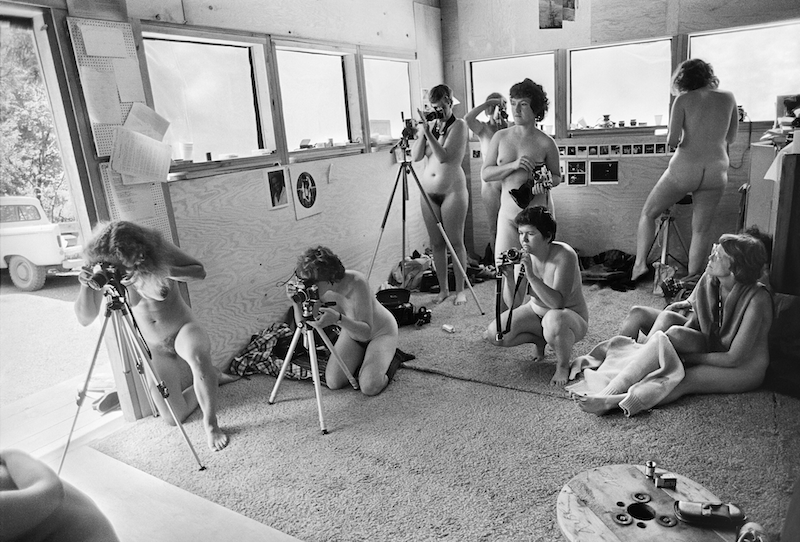
JEB (Joan E. Biren), Photographers at the Ovular, a feminist photography workshop at Rootworks, Wolf Creek, OR, 1980, Printed 2011, Digital silver halide C-type print, 12 x 17 in.

This perfectly illustrates what I hold to be the golden rule for photographing nudes: thou shall not photograph nudes unless thou art willing to be photographed nude.

The first rule when it comes to making pornographic art, never ask anyone to do anything they wouldn’t request of you were roles reversed.

Hunny BummyComfort Zone (2015)

These images are presented as a diptych even though they do not function as one.

They’re solid; neither composition holds up under scrutiny–the left appears symmetrical until you look at it a second time and discover it’s really not and that the positioning of he arms is actually makes it even more glaring; the wawkerjawed-ness of the second one is even more obvious but here the position of the arms actually de-emphasizes it ever so slightly.

Either way, together they round up to good because of the thoughtful use of color.

What’s interesting about the relationship between them not being diptypical (hurr durr) is that they imply a continuum between concept and execution.

The left image is simple, clear, the color pops and as a result it’s absolutely memorable. The right image uses negative space to draw entirely undue attention to the use of color–it’s like screaming hey, everyone look at how great I am at using color. However, the slight shift in the position of the arms on the right is utterly fucking sublime. (Also, you get water drops splattered on the side of the tub highlighted by the light pooling on the side of the tub.)

Split the difference in the distance between the left and right, make sure you line up the lines of the tile grout with your frame edge and include just a hint of the bathroom floor and keep the pose on the right and you’d have a great image.

Source Unknown – Title Unknown (19XX)

Although I am not especially into retro/vintage porn thing, I do kind of dig that this image was snapped, printed and published in a magazine that someone held onto long enough to scan and upload it in the Internet age. (Not to mention the way the center fold presents here resembles a similar sort of photo stitching used by someone like Accra Shepp.)

While from an art historical standpoint, it’s enormously problematic to suggest that part of what determines whether something is capital-A Art is survival–how many brilliant works have we already lost because the author wasn’t a white cis man?

Yet, there is something to be said for the test of time. This is an imperfect image–I really can’t overlook the way her legs have been amputated by the frame lines render her legs perpetually spread toward the viewer–not unlike a dead butterfly pinned through the thorax to felt under glass.

There are several allowances that while they certainly don’t mitigate the objectification, they do perhaps soften it: the young woman eschews eye contact with the camera, she’s wearing both a top (ostensibly her own, instead of a wardrobe piece), earrings and a watch; lastly, the three different textures of the back of the couch, the cushions and the carpet are sumptuously rendered in nearly synesthetic detail.

It seems as if the direction she’s been given is that she’s beginning to masturbate. As much as one can accurately judge an expression based on a fraction of a seconds representation of it, she seems very much on board with the notion; however, the contrivance of her pose and self-consciousness directly address the inherent on-your-mark’s-get-set-go! approach that underlies the majority of heteronormative porn.

I feel like if this wasn’t a porn shoot and the goal wasn’t based on a vague erotic notion of depiction of orgasmic paroxysm as narrative denouement, then this image–if it had been content to wait patiently and adopt a wider, less implicitly violent/objectifying frame–could’ve been pornographic art instead of artfully depicted porn.

It strikes me that current international literary cause célèbre Elena Ferrante (and feminist enfant terrible) is addressing something on a similar track when she points out in a recent interview:

Yes,
I hold that male colonization of our imaginations—a calamity while ever
we were unable to give shape to our difference—is, today, a strength.
We know everything about the male symbol system; they, for the most
part, know nothing
about ours, above all about how it has been restructured by the blows
the world has dealt us. What’s more, they are not even curious, indeed
they recognize us only from within their system.

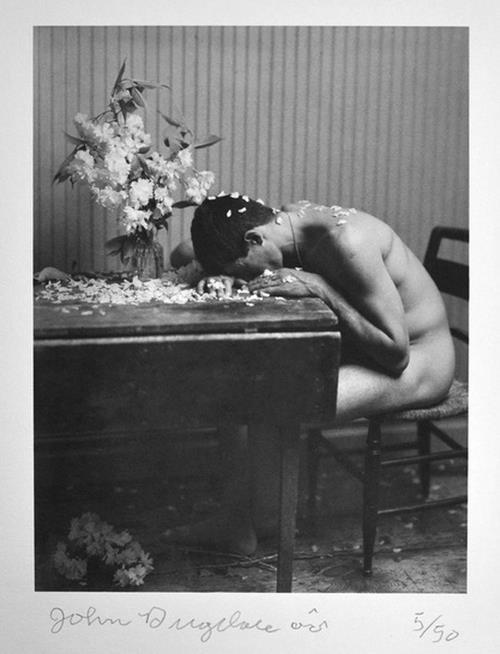
John DugdaleA Turbulent Dream (1996)

I’m forever suspicious of artists who lead with a list of influences. It always feels a bit like an effort to force your work to rub shoulders with the work that initially drove you from passive consumer to active creator. And it frequently comes off as an attempt to predispose the audience to approaching the work in a proscribed fashion.

I’ve learned to be especially dubious of people who lead with exceedingly obvious options. Like I’m not going to talk about the influence of Francesca Woodman or Andrei Tarkovsky on my own work because the debt is so extensive and front-and-center that to draw further attention to it would be rudely redundant.

Dugdale’s portfolio is there double quick with the suggestion of a genealogy shared with Henry Fox Talbot, John Herschel, and Julia Margaret Cameron. Excluding Talbot, they aren’t the usual suspects.

He goes on to mention the American Transcendentalists: Whitman, Dickinson, Thoreau, and Emerson.

I’m always intrigued by the cross-pollination of disciplines in the arts. So a photographer who cites writers as influences, has my attention. (In my own work, although I won’t get into Woodman or Tarkovsky, I will absolutely drone one endlessly about the global impact on my own creativity as a result of the music of Godspeed You! Black Emperor.)

For the benefit of those of you who aren’t necessarily well-versed in the art historical equivalent of card counting, Dugdale is soft shoeing it around a rather obvious exclusion: William Blake.

But wait, you interject, wasn’t Blake all about Red Dragons and The Ancient of Days?

Indeed he was. But, bear in mind that Blake was subversive as fuck. He was re-introducing the fantastic to the familiar–the familiar being prudery surrounding the practice of Xtianity. Or, if you’d prefer: Blake wanted to reappropriate wonder from centuries of lifeless liturgical boredom.

Dugdale’s work seems comparably preoccupied with searching for the transcendent in the mundane.

And now I’ve earned the right to inform you that Dugdale is completely blind and has been for the majority of his photographic career. 

Anna Grzelewska – Selections from Julia Wannabe series (on going)

I’ve had this post from Magenta Magazine sitting in my drafts for months now.

Part of the reason I haven’t posted it is because I am hesitant to place it side-by-side with some of the material this blog features.

Part has to do with Grzelewska’s artist statement–which I’ve made a point of excluding.

It’s not that it’s a bad statement–I mean once you come to terms that Artist’s Statements are more or less equivalent to an algebra teacher’s demand to show your work, it’s easy to tacitly acknowledge the utility.

In some ways it’s actually revelatory since it skips over the dissimulation you get from folks like Sally Mann and Jock Sturges. But even that is a slight of hand, in that it draws undue attention to the proverbial elephant in the room–the experience of between-ness intrinsic to adolescence.

But what’s actually at work here is something far more universal and double-edged–the agency of the subject standing in relationship to the perversity of bearing witness.

Grzelewska is like someone with a sore tooth. She can’t stop touching it. She clearly has a great deal at stake in the proceedings–and there is something undeniably transgressive in that act. Yet, the illicitness of the compulsion dulls when offset by the realization that what makes culture blame Lolita for Humbert’s crimes is the same tendency that drives the urge to avert the eyes, to not bear witness to the between-ness, to not acknowledge and shroud with shame.

This is hand’s down the strongest, most vital and completely fearless bodies of work I’ve seen in the last half decade I am head over effing heels for it.

Brian’s Dickcumshot (2015)

This is beautiful and I have all kinds of (effing intense) thoughts/feels about it.

In content and form, it’s not really all that different from scads of other ejaculating phallus images floating around Tumblr; it’s the execution that distinguishes it.

Note the positioning of the body–angled toward the suffused daylight and the off-center framing of the cock demonstrates a foundation with the basics of compositional logic. Points have to be subtracted for chopping off the head, arms and legs, though. I abide concerns for remaining anonymous when putting such content on the interwebz, but finding creative ways to accomplish the same thing without decapitation/amputation is always possible and will categorically result in stronger images.

However, this gifset does something better than any similar images I’ve previously encountered. Watch how the subject quickly moves his hand aside as he starts to come. This movement decouples masturbation as process resulting in orgasm and instead focuses on the mechanics of ejaculation.

One of my pervasive critiques of mainstream, heteronormative porn is the at best inevitability and at worst monotony of the proceedings. The premise itself–namely: watching folks give and receive pleasure–leaves a great bit of room for beauty.

Sadly, as things diverge from documentation as a means of facilitating empathetic experience and becomes instead a fantasy fueled by a vampiric voyuerism, that’s where objectification and exploitation begin to intrude.

The empathy of this set is actually disarming. It takes a clear, unflinching portrayal of orgasm and renders it not about the viewer–in the stupid way some folks will send unsolicited nudes to a potential paramour as a sort of evidence of attraction–and instead something shared with the viewer.

In a less abstract way: it’s difficult to look at this and not relate to the sensual nature of what it depicts. In that way it functions in a vaguely synesthetic fashion: conflating seeing something with an inkling of the feeling of it.