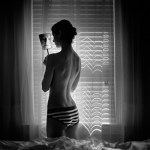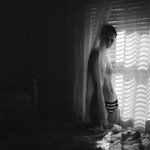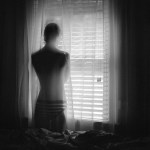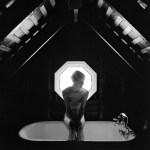
Magdalena WosinskaLA, CA (201X)

Quite frankly, there’s a lot of entirely unmotivated nudity in so-called fine art photography. (Not to hate on nekkid folks–after all, I’m a fan.)

You hear a lot of talk about not wanting to have images tied to a particular historical epoch. Or, it’s insinuated that there’s some nebulous narrative impetus. (Only in both cases, those justifications are more get out of jail free card since the work to which they are applied barely/rarely supports them.)

That’s what I am in love with about Wosinska’s work: nudity in her work reads like it’s motivated by the same compulsion behind Walt Whitman’s sentiments early in Song of Myself:

The atmosphere is not a perfume, it has no taste of the
    distillation, it is odorless,
It is for my mouth forever, I am in love with it,
I will go to the bank by the wood and become undisguised
    and naked,
I am mad for it to be in contact with me.

Patricio SuarezDesiree Film Scans (2015)

The list of photographers whose work I’ll unreservedly endorse is short. Today, it got one photographer longer: Patricio Suarez.

I’m not even sure where to start. I mean, the quality of the work speaks for itself.

My customary fetish for extreme quality takes a back seat here next to how strongly these images resonate with me. It’s totally knee jerk, but the compositional logic is more than a little reminiscent of Mark Romanek–and that’s not a reference I toss around lightly.

As someone who came to photography via cinematography, there’s a tendency in my experience for photographers to treat locations as more of aesthetic enhancement or simple back drop than a facet in a holistic image.

Thus, what really blows me right the fuck a-fucking-way is the way Suarez creates portraits anchored in the relationship between person and personal occupancy of space–location informs character, character informs location.

(It’s not at all surprising that Suarez’s day job is a commercial director of photography.)

His images of Nettie Harris are jaw dropping in their Nettie-ness. Short of ericashires, no one shoots Johanna Stickland in so unmediated and present-in-the-moment a manner. And Kelsey Dylan… bring my smelling salts because I’m feeling faint…

All-around fucking fantastic.

Darren AnkenmanDora Yoder (2013)

During the year I studied fine art photography at an MFA level, I was one of the few people in my class who only shot B&W.

My classmates who shot in color always digressed into these long conversations about the purpose of color in photography.

Unfortunately, I had no point of reference to participate in these discussions. So I tuned them out.

Now, some 7 years later, bits and pieces of their lines of reasoning are coming back to me.

The main contention was that while a photograph (or image) could be in B&W or color that color had to be used in such a fashion that the sense of the photograph/image would be lost without it. In other words: from the standpoint of fine art photography a B&W image was either fine art photography or not but when you dealt with color the decision for it to be in color must be debated prior to any comment on whether or not it could be classed as art.

In hindsight, I realize this discourse was based on the tendency for the monolithic art world to not accept work that was in color unless the fact that it was in color was conceptually unified with the work itself. The great color photographers–Eggleston, Shore, Sternfeld and Wall made work immersed in questions of the roll of color in photography.

(In order to further drive the point home: I say Cindy Sherman; you say Film Stills–but why not Centerfolds or Sex Pictures. I say Sally Mann; you think Immediate Family–but Mann has some extraordinary cibachromes that you’ve probably never seen…)

The above is an example of an image wherein the use of color is foundational to it’s legibility.

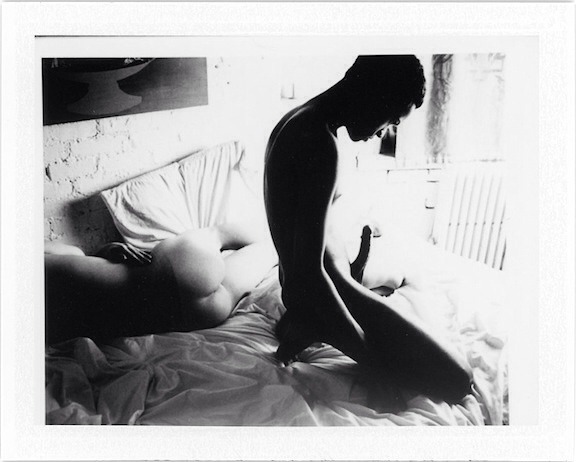
fotocrackertwo young men in bed (2015)

This is waaay overexposed–note the highlight at top center is indistinguishable from the white frame. Also, again–intermittently–along the upper right edge.

Same thing with the man kneeling on the bed–his skin is effectively three tones–shadow with no detail, overexposed with minimal detail and overexposed.

It’s a clumsy visual metaphor–shadow becoming light; probably due to the use of a high contrast Polaroid stock. (Although, I very much dig the mussed sheets being the only part of the frame with any trace of mid-tones–another visual metaphor and one that actually functions.),

As dynamic a sight as the the lad’s erection appears, I feel that the extreme contrast detracts from the enthralling composition. I mean ditch the painting on the brick wall and offer a more balanced exposure and this would be a world class photograph.

Which is not to say I don’t like it as it is–I’m just interested in the texture of the scene and the aesthetically wondrous hard-on and this prioritizes the latter over the former.

Source unknown – Title Unknown (20XX)

This could almost be a frame from Ryan McGinley’s Yearbook–same colored paper backdrop and a single studio light.

Unlike McGinley, however, this lacks the grimy, bleaching grain and the body objectification is way too unsubtle.

I like it–which is saying something because I have a strong bias against studio photography.

Explaining what I like about it is going to be a bit of a minefield because the things I like exist–moreover are facilitated–by being in tension with things that are hell of problematic.

For example, I dig the single, angled overhead light. It contributes to a pleasant peach skintone that’s just on the realistic side of hyper-stylization. Conversely, it also accentuates the oddity of the pose–the model has his back arched, his stomach sucked in and three-quarters of his ass is held just off the ground by his left leg.

I love that the texture of his scrotum borders on the synesthetic–sight as touch spectrum…but it is kind of disturbing that the rest of his body is so plastic-like (which could be the lighting, but is most-likely indicative of a Canon full frame camera).

The pose in tandem with the eye contact and the fact that the right frame edge amputates both the boys legs makes me uncomfortable. It’s like trying to interpret mixed signals. On the one hand this image seemingly goes out of its way to be respectful in its depiction; on the other, it’s still entirely prurient.

I feel like if the boy had an erection at least the impetus for the image and the image itself would be more in line. Hell, it’d almost even be even better if the boy had just masturbated to orgasm and made a cummy mess of his chest and tummy.

Timur SuponovUntitled (2013)

As someone who has–in fairness–done more than my fair share of drugs, I’m fascinated by synesthesia.

As someone who–and this is true–shops for clothing by going shelf to rack to shelf feeling the material between my thumb and forefinger and only evaluating the style, cut and color after finding something that feels nice against my skin, I think photography has crazy untapped potential to convey a synesthetic sense of texture.

I can’t say this is a good image. It does have a nice tonal range and I appreciate that the image maker has included her entire body without chopping off limbs. The angle of the headboard(?) and foot of the cushions is distracting and although it’s supposed to be counterbalanced by the suffused lights coming through the diaphanous curtains, that strategy is a failure.

But dat texture, tho. The warn nearly threadbare cushions, the knit skirt–look at the way it stretches against her outer left thigh and even the curtains. In fact, if this were film and printed on nice rag based stock, her skin would take on a sense of taut sheen that it only hints at here.

Furka Ishchuk-PaltsevaHen Party (2009)

If you’ve followed this project for a while, you’ll be well versed in my own personal bias against digital in favor of good, old-fashioned film.

I’m not a Luddite–hell, my day job is as Systems Admin. It’s not that I’m incapable of working digitally–I have digital gear and I possess a general mastery of working with it.

Why do I prefer analog? Well, there’s the obvious reasons: film’s vastly superior resolution coupled with the feel that an organic grain structure contributes the image. It is those things but it’s also about process.

One of the first things you learn when you begin to study cinematography is that not all light is created equal. By ‘equal’, I mean that the temperature at which a source of illumination burns determines the color of the light.

For example: although we think of the sun as yellow, we think of sunlight as white when, in fact, daylight is blue in color and burn at approximately 5600K. (Interesting note: daylight is bluer in winter, more yellow in summer.) A standard incandescent bulb–not these new-fangled CFL bulbs which you can buy in any number of color temperatures but always seem to make everything look like a pile of shit under restaurant heating lamps–or tungsten illumination burns at about 3200K.

Thus when you are shooting something you have to consider in advance what your light sources will be. Are you shooting in Midtown Manhattan at high noon? Well, then you’re probably going to want Daylight balanced stock. Shooting a family dinner scene that happens at night? Tungsten balanced stock is probably gonna be the way to fly. (Of course, you can shoot whatever stock and either adjust your lighting to match it or slap a filter on the lens to correct. The last time I shot 16mm stock, I shot everything on daylight balanced stock and made sure to shoot color bars at the head of each reel and then had the lab color correct the telecine.)

From a process standpoint, I prefer having the decision about color balance made in advance. It’s one less thing to measure. (And really that’s probably the thing I hate most about digital. The workflow is fussier to me than analog where I find my frame and the camera becomes a reference instead of a distraction. With digital, I have to white balance. I have to judge exposure using the histogram. (Honestly, fuck histograms. Give me a Sekonic L-398A any day of the week and twice on Sunday. That way I’m interacting with the scene instead of evaluating it on some shitty, small ass LED camera back or worse a $10K HDMI monitor.)

With digital, I am intensely suspicious of the instant gratification. You snap a shot, you record the scene and you can playback everything immediately. It foments this WYSIWYG approach to art-making that strikes me as repugnant.

It’s like the Stanford marshmallow experiment, wherein researchers offered children one marshmallow now or two later on. There’s no way around it, digital is the child who insists on instant gratification.

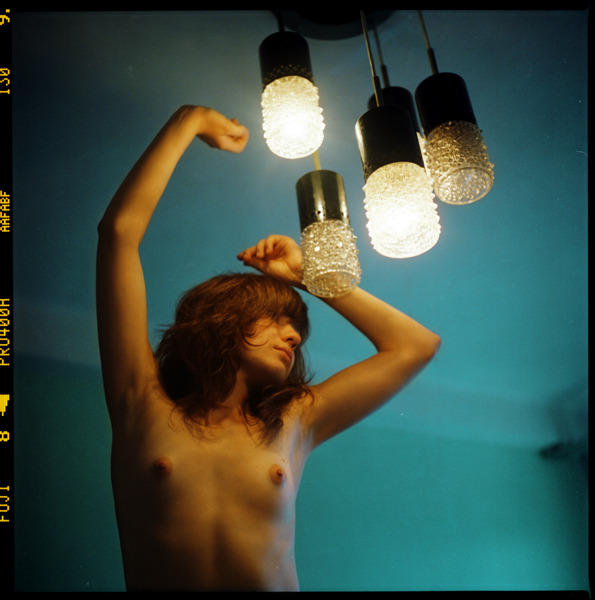
That’s what I love about this image. Fuji Pro 400H is a daylight balanced color negative stock. But the primary source of illumination comes from Tungsten bulbs in the overhead fixtures. This pushes the daylight on the ceiling and wall blue-green, while tinging the young woman’s skin orange.

In fact, it’s the color that ‘sells’ this image. The composition is interesting but not really inspired. The languid lazy dancing would seem contrived if not for the way the color functions to separate the body from the background.

Ultimately, that’s what I appreciate most about this image. Triggering the shutter on a scene like this is always a risk–no matter your degree of expertise. You can only intuit that it’ll turn out readable.

Yes, the more you do it the better your instincts become… but there’s always an leap of faith required on the part of the camera operator. You can’t just check the LED screen to make sure you’ve got it.

And that’s what I love this so much because I know what it’s like to re-experience the wonder that drove you to memorialize the image in the first place–without knowing whether or not it would turn out. And the extreme wonder when it does and the moment you see on the film is like a glinting spark in amber, that when it hits the light just right, puts you nearly out-of-body back into the feeling you wanted to hold onto so you clicked the shutter and prayed it would work out.

That ability is the reason I bother with this photography thing.
Source unknown – Title Unknown (201X)

Giving or receiving assplay of any sort is not exactly my cup of tea. But on a limited experimental level I’m down for just about anything except anilingus.

I do have a teensy fetish for pegging imagery. Less for the act depicted and more for the inherent gender-fuckery and while the power/control vs submission of BDSM tends to be a huge turn off for me, there’s a sense of being completely at someone else’s mercy that appeals to me.

In the case of this clip, I love that his touching and she’s caressing him. The smirk on her face as she thrusts suddenly and then savors his response is exquisite.

The same expression also makes me inconsolably sad. The only sexual pleasure I’ve experienced for just shy of the last six years has been self-driven. And one of the primary differences between masturbation and sexual intercourse, is that with the former there’s inevitably a point beyond which one cannot advance–not unlike the impossibility of self-tickling; but with (a) sexual partner(s), boundaries tend to stretch until they shatter completely.

Vivienne MokZhuzhu (2015)

I can’t say I’m fond of Mok’s quasi-Pictorialist tendency towards downy soft-focus.

At least it makes sense in the case of these two images–accentuating the dawn kissed skin and rendering clouds nearly worth of an El Greco.

What’s more: it’s a fabulous example of how to avoid #skinnyframebullshit. (Although, I think the first pose would be better suited to the second frame and the second pose to the first frame, but I admit that’s being so knit-picking as to be splitting hairs.)

Chip WillisNathalia Rhodes (2015)

As someone fluent in only one language (English); and who therefore is in the habit of reading left to right, this image caters to my expectations.

I wish I had the time to super impose angled rule of thirds indicator markings similar to what I did with this photograph by Igor Mukin. It would be immediately clear that what I’m guessing is an out-of-focus towel rack in the lower left foreground, the inside edge of the tub and the mildewy grout-line between the tub and the wall separate the image into thirds diagonally.

As a westerner who’s first language is English, I read left-to-right. thus I scan this image starting from the top left. The repetition of the diagonal draws my eye down and right, along the outside edge of the tub.

What’s interesting here is that unlike the Mukhin image, the diagonal of the top of the diagonals of the top and bottom of the mirror and the front and back of the toilet lid don’t align with thirds–but they do represent the most dense range of contrast with in the image.

In the absence of the second set of guiding third indicators, The angle of Rhodes legs functions as the compositional element that redirects the eye from right to left. (Notice: that the angle of her legs forms the base of an acute triangle of which the reflection of her face is the vertex.)

I’m not ready to attribute to this a status of some next level visual shit. It is inspired though. The pose and boots all scream tired porn tropes. However, the effort to include the face–anytime you shoot with mirrors you’re introducing seven different flavors of hell to the process–subverts the seeming unmitigated sexualization of the body as object. (In other words, even though Rhodes is effectively chopped in two by the frame edge, her holistic totality is at least illustrated.

The more I look at this the less I see it as gratuitously graphic. There are details that command attention: the black bobby pins against the white porcelain toilet lid, the strategic placement of the the rear hem of her dress and her gaze focused on the photographer instead of the camera are all inspired touches.

This is the first of Willis’ images I’ve seen where I’m convinced that my suspicion he uses porn tropes in a critical instead of incidental fashion is on the right track. And the fact the above is maybe a little heavy handed in its efforts to conflate fashion editorial work with pornography; however, the criticism is too stunningly on-point/fiendishly executed for me to even thing of docking points.