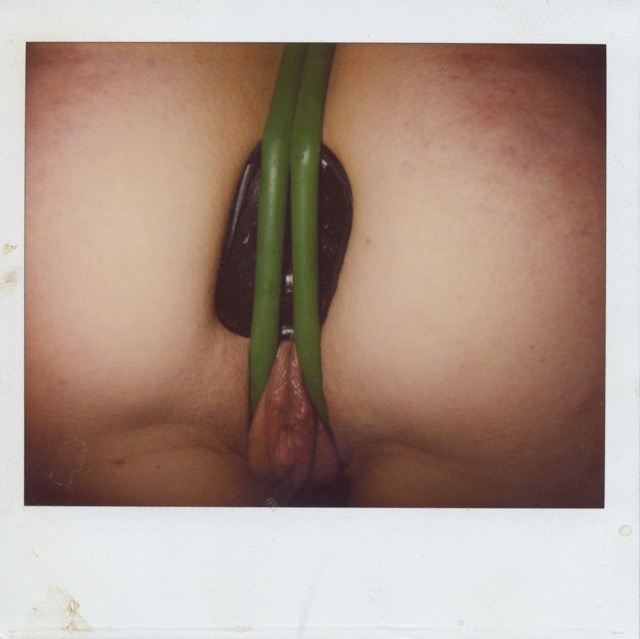
Source unknown – Title unknown (201X)

As much as there are performative heteronormative expectations when it comes to the FMM threesome, i.e. it’s perfectly upstanding, straight and good as long as penii don’t touch…

…it’s not something I’ve ever understood. But this makes me think about the mechanics of what porn instructs is the most common bodily configuration for two penis-havers engageing with a vagina-haver.

Like the owner of the lower cock is mostly passive. (If you’ve ever seen these scenes, it’s nearly impossible to get a workable rhythm going and the movement of the person in the middle is only really compatible with the person who is able to thrust and retract.

Second–while any sort of consensual sexual sensitivity is good in my book–there’s a way in which this configuration almost certainly amplifies the sensation of the person in the middle. Two of three orifices are full and there is skin to skin contact in both directions. That alone would be an emotional and intense feeling for me–even before you got down to whether it was pleasurable.

Then there’s also the way that in the heteronormative world there’s this proscription against penii touch. (For that reason I’m always interested in depictions of vaginal double penetration.)

But the rear wall of the vagina and the back wall of the anal cavity are not actually that thick, so there’s almost certainly a way that although penii aren’t touching they are engaged in conversation through a screen–like a supplicant confession to priest.

If any one of the the three orgasms, the body cavity they are inside would server as a resonating chamber of sorts.

And I think that’s why I end up looking at a lot of group sex porn–it’s not the fantasy of the explicit exchange that entices me, it’s the ease with which this sort of thing is depicted in pornography and the fact that that ease of trust and intimacy is nothing something I’ve ever known (or, unfortunately, am ever likely to know).

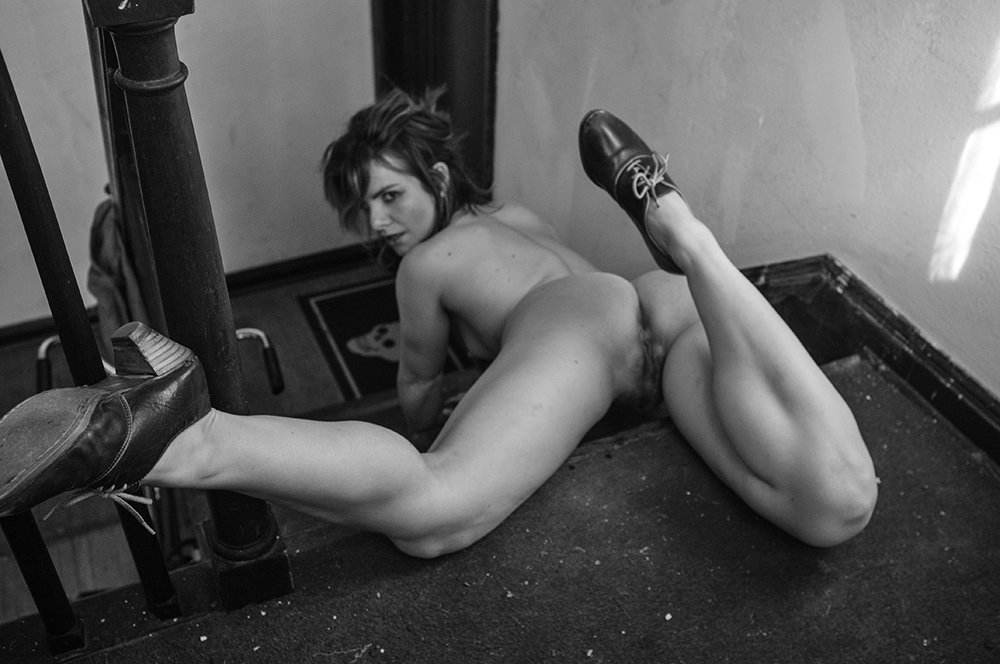
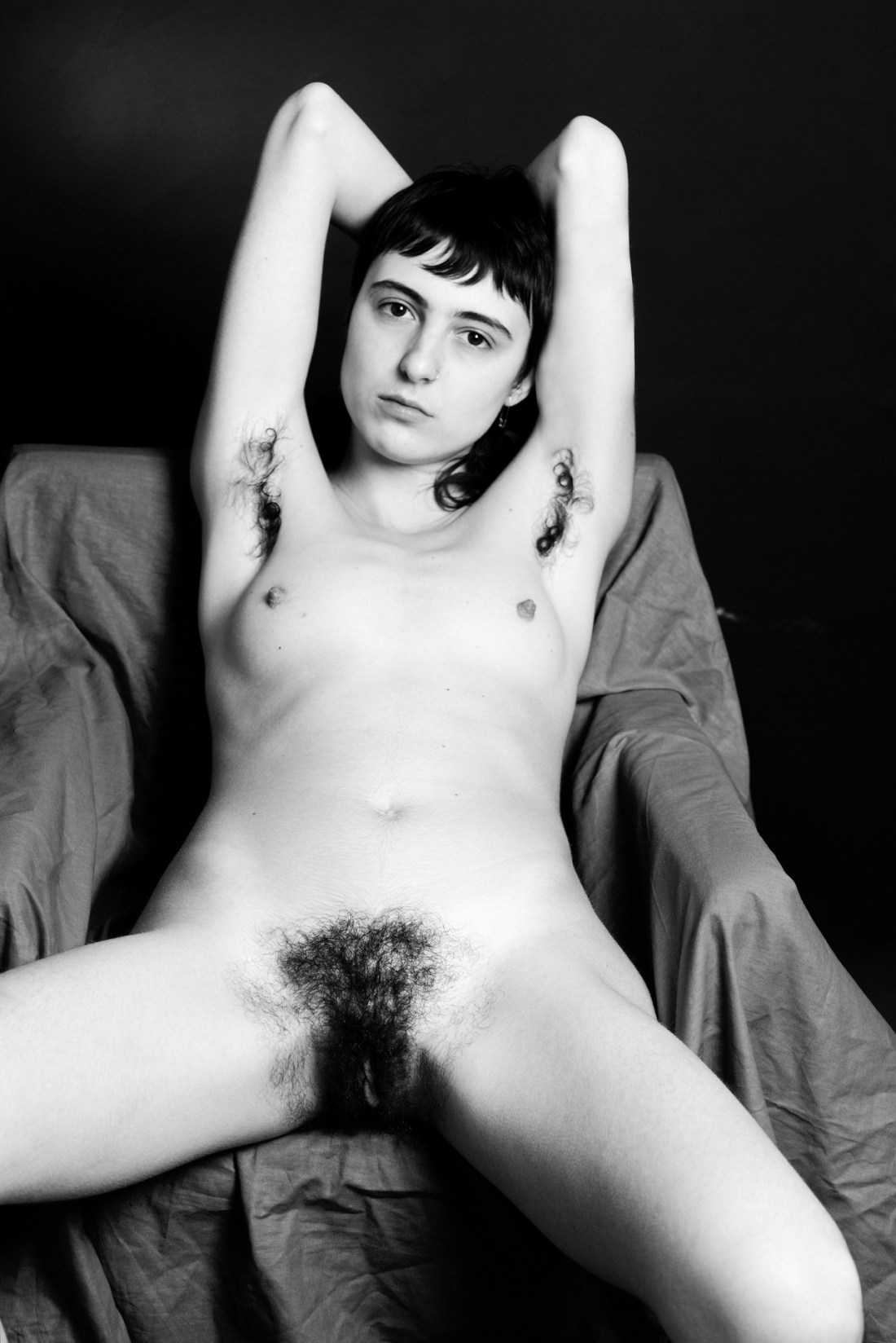
Giovanni PasiniChair feat. Eva Collé (2018)

At first blush, this is alluring. Hhigh contrast monochrome accentuates the skin, emphasizes the contrast between light and dark, skin and hair. And the angle of Colle’s thighs reiterate the negative space in the upper right of the frame–it exudes a sense of casualness.

After digging through Pasini’s work, however, I’ve come to a different conclusion: Pasini may or may not be a misogynist but his work utilizes visual grammar in a fashion that is profoundly sexist and super problematic.

It’s no secret: I don’t favor studio work. It’s not the studio itself I’m down on. It’s how the studio is customarily employed that irks me.

Studio work allows for greater technical control. You can get your lighting just right for the parameters of your project. Yet, there is also an directly proportional decrease in limitation. For example: if your project calls for a super model to be wearing a gown designed by a haute couture designer that features a five-figure price tag and standing on the ramparts of a Scottish castle, then–unless you’re David LaChappelle or Tim Walker–you shoot on location at an actual castle and do the best you can with the existing light.

Generally though the increase control with regard to lighting results in the limitation of any authentic sense of actual physical space. If we were talking in terms of the four W’s and H of classic new paper reportage, then studios represent a shift in emphasis away from questions of where, while allowing for greater room to elaborate on Who, Why, What and How.

Limitations are not in and of themselves inherently non-positive. In practice though, studio work has a decided tendency to diminish contextual information. (Don’t forget that questions of where also interact with questions of who, why, what and how.)

Pasini’s images are highly decontextualized–a nude model against an either dark or light background. (The image above is positive grounded in place in time by comparison.)

However, there’s also the way that his titling of the work further decontextualizes things. For example: the model’s name in the image above is not provided by Pasini–the model was added when the image was posted by the always noteworthy The Quiet Front.

As far as I can tell, Pasini doesn’t mention his models names at all. Odd when you’ve worked with popular models.

It’s almost easy to just think that he’s tact is to look at it as the-models-I-choose-to-work-with-are-established-enough-that-they-do-not-require-introduction. I can’t let it go that easily, unfortunately. Because there’s also the way in which Pasini’s work further decontextualizes the woman he photographs.

Take the image of Collé above. The title Pasini’ gives it is ‘Chair’. There’s also Chair, Chair (also Collé, uncredited again), Chair with Dr. Martens and back to just plain old Chair.

Or, if you think I’m cherry picking–consider Back, Back, Back, Back with secretions (really: ‘secretions’ is almost as unsexy as ‘moist’) and Back.

While we’re at it consider: Mature (and opulent) torso, Little girl lost and Panties down. (I’ll spell it out in the event that the mention isn’t enough to clarify why these are thoroughly problematic titles: you can argue that porn started or it porn merely reflects the programmatic of society at large which due to rich, white, cisgender and heterosexual men retain a white knuckled grip on the reigns of state, the beauty standard is young, white and cis-het-flexible female. Thus the title indicates that although the subject is mature (something I never would’ve inferred from only the picture) but also attractive because of a specific physical feature. Little girl lost applies the greatest male fiction ever invented–that of a sexually precocious young woman who has yet to reach the age of consent.

And Panties down is really endemic of everything up to this point: Pasini’s work focuses exclusively on presenting women as sexually available. (Let me preempt any of you #NotAllMen types: I am not saying that it’s inappropriate to make work that presents women as sexually available. Like seriously, have you spent any time on my blog?)

No: the issue is that at every step of the Pasini’s work makes decisions why diminish individual identity and agency in favor of characterizing them as sexually available and plugging them into a rote litany of titillatingly heteronormative tableux. The work is objectifying and sexist.

I have no idea if these facets are representative of the author or not. (I have my own opinion but I’ve purposely structured this so as to not cast uninformed aspersion.

I do find it galling that Pasini refers to his work as ‘art’. One the one hand I do not agree. However, it is precisely that designations that prompted me to articulate all the above. If you refer to your work as art, you are in essence inviting this (and even more in-depth analysis and criticism).

Lastly, while I generally go out of my way to make posts that are this openly critical of work, I made an exception here because I do think it’s interesting that the sense of casualness I mentioned at the start of this is actually something I’ve come to see as confrontational. There’s no way to know just from the photos–but I do feel as if Collé is at least consciously aware of the creepy factor of some of the work and is trying to present herself in a manner that runs counter to it.


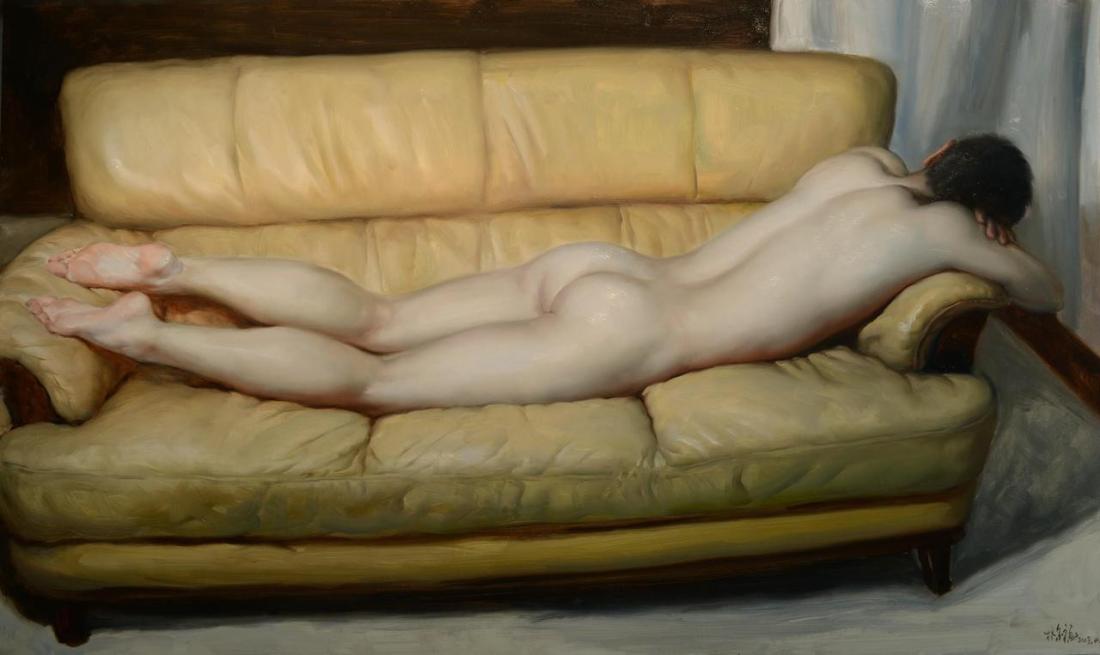
Lin Jinfu – Night (2014)

From an art historical perspective, there is a desperate need for someone who has a working knowledge of emerging work in China and southeast Asia.

Lin’s work is excellent but there is precious little written about him in English, e.g. I spent 30 minutes digging through Google results and was only able to discover that roughly a third of the English posts on his work believe that he’s Japanese or ‘Oriental’ :::shudders:::

He’s actually Chinese and lives/works in Beijing.

Other preposterous assertions made by idiots about his work: due to the influence of Baroque and Neoclassicism on his work along with–apparently the difficulty Westerners have in pronouncing his name– he’s referred to as Caravaggio. (This makes zero sense as he actually goes by the anglicized Jeff Lin; also: I know there’s a tendency to assume repressive regimes keep their people from engaging with more modern art–but I would bet a private cam session that he’s thoroughly familiar with the work of Lucian Freud–the more photographic rendering of light is an absolute dead ringer between the two.)

Lastly, folks make preposterous assumptions about Lin’s engagement with the male nude and gay eroticism–and how unconventional that is in China. Okay, got it–perhaps in painting that’s true but what about Ren Hang? (I know there are at least two others I’ve posted but since I can’t use Google to search my archive anymore… there’s no way I’ll ever find what I’m thinking of…)

But really, Lin’s paintings are excellent. I wish I had a single site to refer you to but you’ll just have to apply a little bit of elbow grease. (The effort is worth it, I promise.)

Andre de DienesNude (1955)

Dienes is known primarily for early portraits he made with Norma Jean Mortenson before she became Marilyn Monroe.

His worked primarily with nudes in natural settings. His poses tend to be ripped straight from Greek antiquity and there’s not a lot of differentiation between photos.

This is uncanny in a way the rest of his work just isn’t. From the standpoint of form–the models pose is a bit awkward. I’m not sure the positioning of the head works for the image but the way the models body echoes the form of the rocks upthrust is a bold choice.

The problem is… well, there are problems plural. First, while there are reasons to center the horizon line in a photographic frame at the center of the picture plane–it’s generally not a great strategy. It’s better to ask which contributes more to the meaning of the purpose of the frame and then going preferring whatever will carry the most weight. Or, depending on what the frame is depicting, perhaps giving the most important aspect too much weight obliterates any sort of ambiguity.

If Dienes had wanted to emphasize the upthrust of the rock more, he should’ve included more of the ground than the sky. To emphasize the surreal aspect of it, he could’ve treated the sky preferentially.

Further, the contrast isn’t quite right–it’s as if the contrast has been dialed down on everything in the frame except for the model’s skin tone.

Honestly though those are all minor problems that could’ve been erased merely by adding a red filter–resulting in a darker sky, light crowds and an increase in textural differentiation in both the boulder and surrounding sand.

Chip WillisNathalia (2015)

When it comes to Willis’ I harbor mixed feelings.

His work is singular (+1); his compositions are arranged compellingly (+1) and always imbued with a strange sense of existing as a prelude to sudden, dynamic motion (+1).

There is, however, no getting around the degree to which the work is tied up with male gaze governed expectations. (-5)

…except while trying to figure out what I wanted to convey with this post, I think my perspective has shifted slightly–the trouble is I don’t know quite how to translate from mental impression to language.

The first part of it has to do with the fact that he seems to be producing less work these days. Now, this is only my impression. I don’t follow him super closely and Tumblr is (unfortunately) a platform increasingly hostile to folks who make work in line with his–thus it’s entirely possible that he’s migrated to another platform.

Interestingly, when you look over his work–his learning curve remains impressively near-vertical. It doesn’t all work and I think there is a strong argument to be made for him developing a more contemplative approach to editing–the work is all distinct and eye-catching but there are times when it feels as if more ends up being less. (Take the scene above–I can’t find the original post of this photo but there are a half dozen frames from the same shoot; not one of the others is as captivating as this is.)

The second piece of my reaction to this is tied up in notions of evolution. This one is larger due to bringing my own baggage to bear subconsciously when I engage with (i.e. decode) visual documentation.

At present most of my friends are in their early-to-mid 30s. (I’m in my 40s, fwiw.) And I am starting to notice a trend wherein there seem to be two potential outcomes to any longstanding commitment to the project of self-determination: there’s a degree of comfortability which begins to entice. A still small voice saying: you’ve done the hard work for so long–time to ease up and enjoy the rewards for which you have worked so very hard.

The focus becomes how do I maintain what I have and when you get right down to it doubt and the nitty-gritty of personal reflection and growth are actually inimical when it comes to preserving the status quo.

It’s a perspective I–quite frankly–do not comprehend. Willis’ work signals (at least to me): that the status quo is BS and that the only thing worth pursuing is the dissolution of sedentary compulsions in the embrace of chaos, uncertainty and discovery–whatever its costs.

That last bit actually ties into another consideration–when I talk about the ‘intersections of art and pornography’–although I am definitely questioning the mutually exclusive nature the framing is recapitulating the framing it supposedly denounces.

I’m not sure I’ve found a better way to convey what I mean just yet. But I do think Willis’ work functions as an imposition of the artist of the question if the debate about art vs pornography might better be considered in terms of both and neither instead of either/or.

Practically, I’m not sure the long term implications are all that much different. However, once you see that sort of pioneering spirit as motivating the work–it renders the work all that much more enticing. (At least that’s my response.)

Genesis Breyer P-OrridgeTitle unknown (19XX)

As far as outsider art goes, it’s very difficult out outre P-Orridge.

I am hardly an expert on their (they identify as third gender and use them/their pronouns) life and work.

What I know is that if you haven’t you should absolutely know Throbbing Gristle’s 20 Jazz Funk Greats. (I can’t stomach much else TG did & Psychic TV totters on the brink of intolerable.)

All that being said: they were hugely influential to artists who have had a lasting impact on me.

I am not familiar enough with all the ins and outs of their life to really comment with any kind of definite hot take. They were impossibly controversial–in word, deed and thought.

At present they are being treated for Leukemia–it’s not looking good the last I heard. (Cancer fucking sucks.) If their work meant anything to you, you might want to consider support their GoFundMe for treatment. (How in the fuck did we get to this place in history where people have to crowd source their medical treatment…)

Source unknown – Title unkonwn (201X)

In biology: a ‘raphe’ is a longitudinal seam that usually indicates some sort of mid-line.

There’s one in the medulla oblongata as well as one running from the anus through the mid-line of human genitalia. (pictured above you can see the perineal raphe.)

It is thought that the biblical account of creation where God removes a rib from Adam to make Eve is actually an errant translation and that the actual meaning was something closer to a reference to the fact that unlike most placental mammals, humans do not have baculum. (The folk wisdom is that since god took the bone from Adam and used it to make eve; the raphe is less seam and more vestigial scar tissue.)