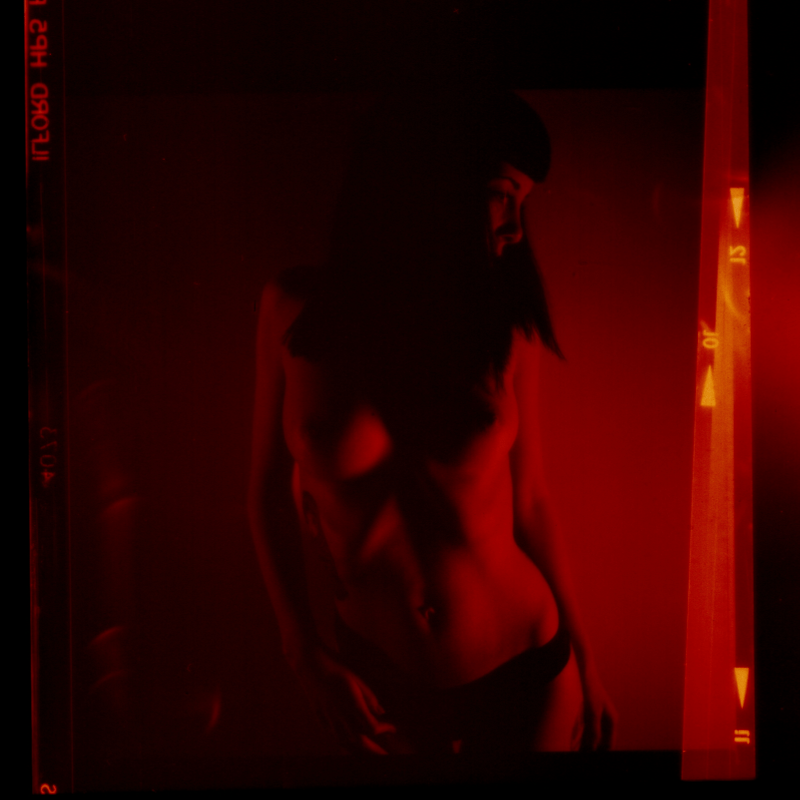
Lundesnombreux – Untitled (2014)


One of the highlights from our first ever threesome last week 😍 We’re lucky to have such beautiful and open minded friends to help make our fantasies come true. We’ve been fantasizing about this for so long and had such a lovely time and learned we really enjoy having sex in front of people. Follow us for more, there’s over 500 photos from the night. Full color ones too 😉
@aprivateexpose’s stated intent is to: “dance around that fine line between art and pornography”.
I feel like the above set does some things well and other things less well.
Let’s start with the bad and move toward the good.
I think the 3rd image from the top is extremely problematic. It’s very stereotypical male gaze porn movie POV shot. It decapitates both parties which in turn reduces the scene to an almost mechanical heteronormative essentialism of sexual intercourse and frames the scene to emphasize both a male POV as well as the bondage aspect. (Alternately, I really do love the way his hands serve as a frame within a frame and the way the do so reads as strangely reverential.)
However, in the 3rd picture is presented as part of a series of 4 images. And that connection does at least establish context, i.e. a group sex scenario. (And I love how the person standing to the side is presented as ostensibly focused on taking a hit on the bowl she’s holding and then the way the second frame hides the dude’s face with his hair so that the punctum of the frame becomes the Cheshire grins of the two ladies.
The final frame is less male gaze-y (remember the viewer always subconsciously associates the bottom of the frame with the fourth wall, so this to me is less creepy than the 3rd image.
I don’t think any of the images work independently of each other. Presenting them in this way makes them work as a whole–however, since what works with each frame doesn’t ever really fully integrate with the tableau, I am left with the sense that although this is a good bit more contemplative w/r/t the firewalling of pornography as a subject for art than most work on Tumblr, it separates the totality of impact across four frames and in so doing dilutes the artistic impetus in favor of the more erogenously charged documentary fixation. (In other words, the good things I mentioned about the work could conceivably all be staged so that they all might comfortably coexist within a single, static frame.


[←] Source unknown – Title unknown (2015); [→] Source unknown – Title unknown (2014)
Juxtaposition as commentary
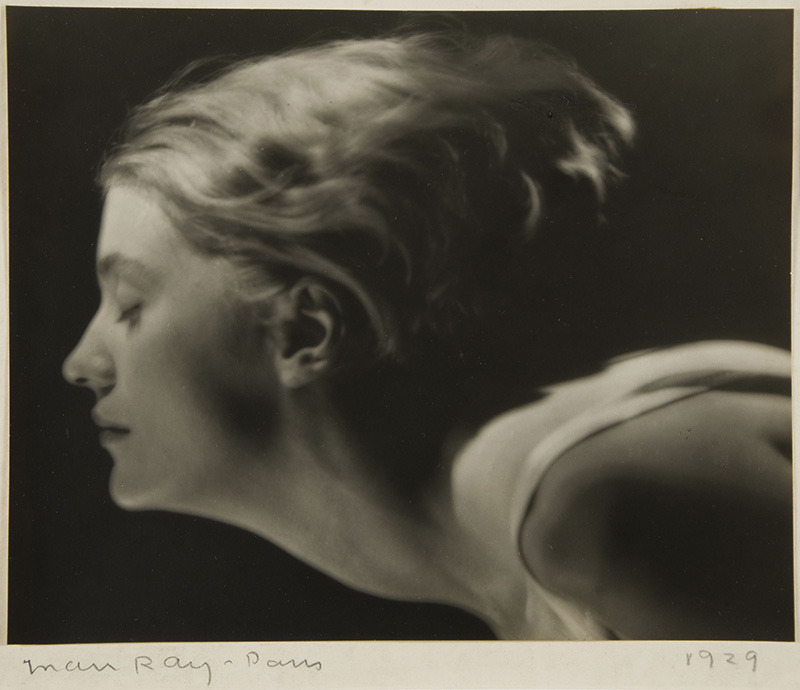
Man Ray – Paris feat. Lee Miller (1929)
My fixation with this photograph boils down to the line of Miller’s neck.
Weirdly, it reminds me of one of the weirdest notes I ever got from someone looking at a drawing I had made–way back when I was 17 and was determined to have drawing be my medium for becoming a famous artist: someone told me they thought my drafting skills were atrocious (true) and that I lacked even a rudimentary understanding of form (a bit overblown, as far as criticisms go) or the conceptual reflexivity between content, context and materials (also: true) but that they loved the truth of a particular line (which they indicated).
It always struck me as a way of making a scathing critique palatable but I realize now that it was actually a backhanded compliment. And it’s this photo that’s made me understand why that’s the case.
See it’s not just the line of Miller’s neck. It’s sensuous–the way the light chisels her body out from the shadows. The pose is meditative and intensely vulnerable but everything about it seems to radiate a warrior’s strength and self-possession.
Also–synchronously: my MFA cohort has begged me to organize an informal class where we screen underappreciated/forgotten miracles of the cinematic form. Last night we I presented Joachim Trier’s Thelma. (Trier is one of the most exciting young filmmakers in the world, having made three films that are all wildly different in style and tone but that all embody a startlingly refined sense of visual dynamism and psychological intensity.)
It’s the 2nd time I’ve seen Thelma (and it’s even better the second time around–I’m pretty sure it’s the first movie in a decade to crack my top 10 favorites of all time) and I was even more impressed with the attention to detail and depth. But also: it’s a bit unnerving to watch because I not only relate to the character but I also see the movie as a kind of mirror because the degree to which the character is aware of herself as both herself and a character in a dramatic scenario short-circuits a lot of my own parameter defenses and I have this weird experience of watching someone who not only looks like I see myself in my head but experiences the world in a way that goes far beyond superficial similarities. Watching it is almost like having someone take my notion of myself and putting her in a narrative that would be exactly the sort of narrative I’d put myself in given half a chance.
And that’s how I feel about this photograph of Lee Miller: that although it was made almost a full 50 years before I was born, it still shows me something unexpected about myself.

Daido Moriyama – Title unknown from Daido Moriyama in Color: Now, and Never Again (197X)
At first glance, the choice for this photo to be vertically oriented seems clever–the use of space so that the woman’s body is counter balanced in the frame by the negative space of the room around her creates a definite sense of downward movement. In other words, everything works together to imply that she’s taking her knickers off.
Stop and think for a minute tho: if you’re taking your underwear off, how often do you bend all the way down to do so? I don’t–I pull my panties down below my knees and then step out of them, the last leg out hooks the leg hole and then I kick it up to myself so I don’t have to bend over. I feel like that’s fairly common behavior.
You could also say that maybe she doesn’t want to let her undergarments touch the ostensibly funky love hotel duvet–which to me is all the more reason to push them down below your knees and step out of them.
I would wager $5 that she’s actually putting her underwear back on. The photo has just be presented in such a way where there’s an illusion that she’s taking them off.
But it’s a little off-putting to me that if she is–in fact–putting them on, instead of taking them off. There’s a sense that this image has happened post intercourse. The composition and framing tho–misrepresents the truth of the moment and in doing so renders her body permanently in a stage of readying to be sexually available for the (male) viewer.
Also, the scene is alarmingly predictive of Mary Ellen Mark’s Falkland Road project–about sex workers in Mumbai in the late 1970s.

Paolo Filighera – Caterina, Kodak tmax 400 (2018)
First: Fucking A this is a great tableau. Damn fine work.
Second: Digital B&W is not an actual thing. If you want B&W, then you must use film. (And yes, I know this is a digital file but you can 120% tell when you digitize B&W film vs digital monochrome.)

Alexander Gonzalez Delgado – Untitled feat. eddgein2 from somewhere in my head series (2018)
I like that this is analog. I like that the depth of field is such that the point of focus is actually somewhere behind Alice’s body but above the floor.
I also like the way the milk trailing down her body trails back to the bowl–due to the DoF, it’s all but devoid of texture (which adds to the sense of flowing liquidity.)
However, the way Alice’s body is dismembered by the frame edges–double amputation mid-thigh and having the top of her body removed feels like coded misogynistic essentialism (i.e. a woman’s body exists solely for the gratification of male sexual pleasure).
Also, I’m just really super not here for the whole milk bowl/cat/pussy riffing. (Several cat lovers have informed me that cats are by and large lactose intolerant.)
At the same time this feels of a kind with Marat Safin and I’d argue more honest than his in embracing the work’s fundamental depravity (in a value judgment-less sense…)
I have a lot less time to keep up with the 24/7/365 news cycle now that I’m holding down a FT job while also attending grad school FT but here are two stories that I felt were important enough to take the time to read and feel important to pass along.
The bombshell from the UN showing that without immediate, consequential expansions of environmental protections, climate change will very likely make Mad Max: Fury Road appear prophetic by predicting the look of the world in 2040.
Also: this article points out that the cruelty of the current US administration and it’s supporters is actually the only point of its egregious insistence on itself.
I do know what happened with Kavanaugh’s confirmation but I am still too livid to even begin to know how to talk about that.. so I’m going to let that lay and keep this post brief (for once).
Be safe out there, please.

Tamara de Lempicka – Les deux amies (1923)
I’ve realized that the art world is neither as progressive or avant garde as I would’ve hoped.
Invariably, when the subject turns to how to hold shitty male artists accountable for their exploitative fuckery, someone asks when criticism of him as a person will lead to the ‘cancellation’ of his work.
This is a straw man argument–no one is suggestion that Picasso be excised from the canon; instead: the proposition is that we maybe mention that his works are full-throated missionaries of misogyny. Given that fact, it might be responsible to make this explicit to consumers of his work.
But I think I’m just going to ignore the straw man argument and treat the supposition as serious: why the hell would you ever need fucking Picasso when there’s Tamara de Lempicka?


 Acetylene Eyes
