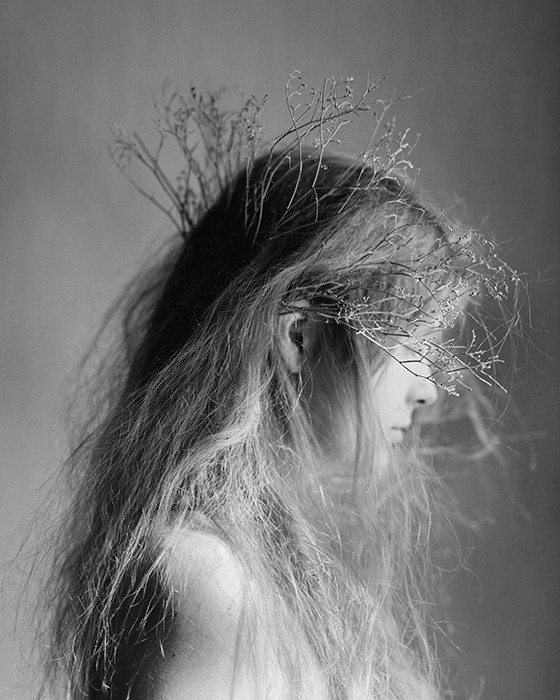
Claudia Jares – [↑] El Jardin Prohibido #8 (2015); [←] 7 (2011); [→] Untitled (2006)

Remember how I’m always going on and on about how there must be something being added to the water in Poland because of all the top-notch work being made there at present?

South America seems to have something similar going on.

Jares, like Paula Aparicio, hails from Buenos Aires–a city I’m hoping to finally visit next year.

The first two things I notice about her work pertains to influences. It is impossible to look at the uppermost image here and not think of Nobuyoshi Araki. And you can’t browse through more than a handful of her color images without flashing back to the hyper-stylized, violent cacophony of color and garish production design as an aesthetic intended to question whether ugliness and beauty isn’t more of a cycle than a spectrum that is Floria Sigismondi’s oeurve.

But I’m not interested in doing more than pointing to those names, because–in truth–although Jares definitely shares with both the aforementioned artists what I’ve previous referred to an omnivorous eye, the point of her work is less about proving a point (which in the case of Araki might be seen as proving that the deviant and depraved desires of the flesh can be beautiful to behold; or with Sigismondi, that with the right attention and focus, the ugly may be rendered if not exactly beautiful then aesthetically compelling).

To put too fine a point on it perhaps, Araki and Sigismondi make work designed to get the viewer off–figuratively in Sigismondi’s case, more often than not literally in Araki’s.

And it feels to me like Jares is far more interested in those indelible signifiers–the way already taut muscles begin to spasm in winter light, a stray hair looped and plastered with sweat and spit against the spit below a trembling lower lip; that moment of unplanned, accidental eye contact that sends you plunging over the edge sooner than you expected. Those serendipitous moments when someone comes, and then the force of it causes a chain reaction where in response the other partner comes and them coming only makes the first partner’s orgasm intensify.

There are little miraculous moments in each image that Jares’ makes–the rain coating the woman’s skin in the first image (not to mention the stunning contrast between skin tone and tile); the way in the second image the shadowed side of her face both dips to where their is shadow without texture but you can still see her eye (and eyelight) in the murk; and in maybe one of the best examples I’ve encountered in at least six months of a vertical oriented composition that should 120% be a skinny frame but also consider how the parabola of light on the back of his neck and shoulders adds such dynamic dimensional to the frame. (Also, back dimples…I’m a sucker for them.)

Or, more apporpriately, here’s Jares on the relationship between the erotic and her creative practice:

     My making erotic photography comes as no surprise to me: I’ve been drawn to the erotic since I was a teenager, drawn by the secrets and the mystery behind those images and its characters.
     Back from school at my grandmother’s house I would step in the bathroom where, hidden between the towels, lay an old porno, filled with sensual and sensitive images, and romance. It must have belonged to my grandfather, and thus to later generations…
     … I used to feed upon those pictures, wondering on the meaning and form of orgasm, masturbation… After twenty minutes my grandma would call out for me; the food was served.
     I’ve always been into sensual images, objects, clothing, shoes, stockings, which triggered ideas. I cut and glued to my bedroom walls pictures of Brigitte Bardot, Jane Birkin, Claudia Sánchez, Marlon Brando, Robert Plant, Jim Morrison.
     My music… was my kingdom, my shelter, the place where every feeling, every sensation ran through my body. It made my way into photography, and, considering my kinky teenage inclinations, it was only natural to combine the carnal with the power of creation.
     I’ve always enjoyed telling stories through my pictures. Enclosed, in the dark, at night… I’m thrilled by the unknown, the unlit, the irrational, the supernatural.
     The women that have worked with me know and understand that this sensitivity is with me in every job, be it a portrait, fashion, or an erotic shoot.
     There’s always a sense of eroticism in all my pieces. I’ve been lucky enough to work with people that have allowed me to take a glimpse of their souls.
      I often work with women, since there is a sort of symbiosis, of ease, encouraging, pleasantly gratifying for both of us. As a photographer I take pictures as I would take them to myself, which I frequently do. My strength lies in the artist, in what I am made of, a woman, a body of emotions.
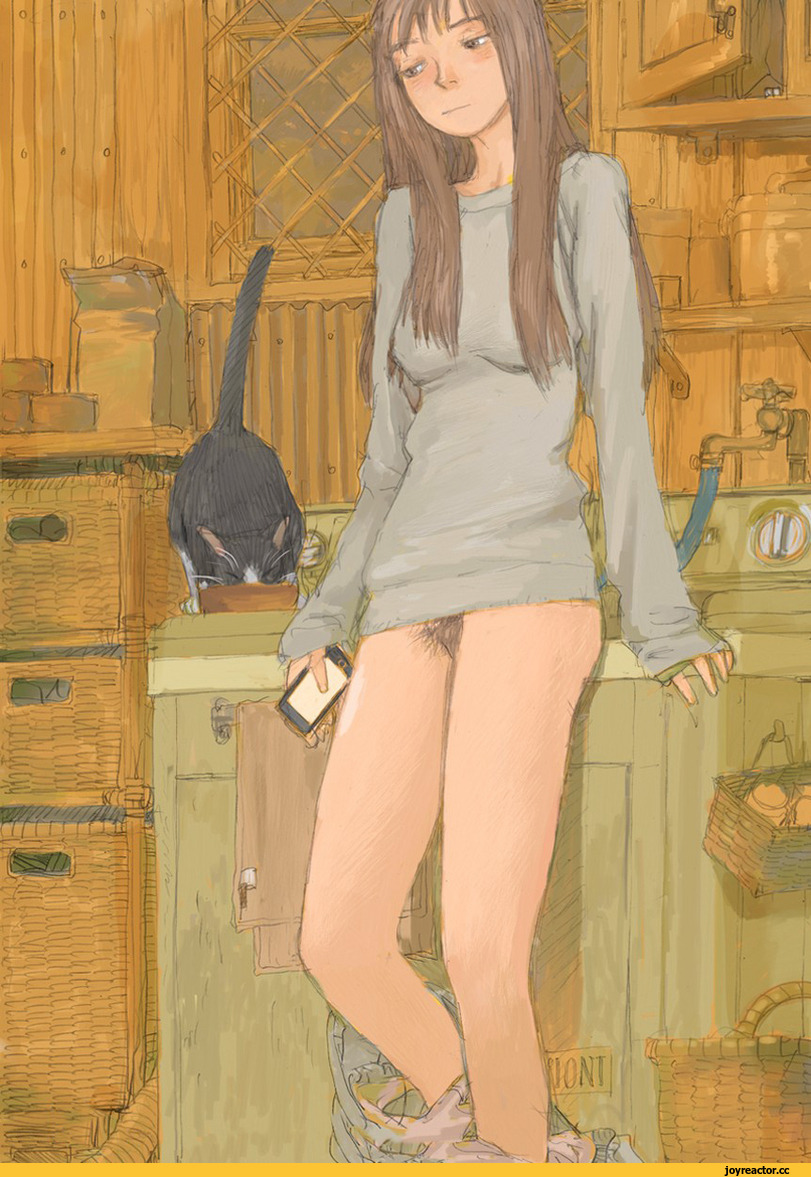
Kenji Tsuruta –  futari no tenshi feat. hita hita (201X)

I know fuck all about manga. Either way: I like this quite a bit.

It’s mostly that the woman bears more than a passing resemblance to my dear friend Amadine.

Yes, Amadine is decidedly Team Bangs-are-the-worst. But the longer hair, the bliss-stoned expression edging slightly towards melancholic introspect and just the general body language is spot on.

There’s also the stylistic overlap between this and her illustration work. She studied Japanese in HS and college. And although she’s more in the thrall of Georgia O’Keefe and Kiki Smith these days, she was entirely enamored with Miyazaki when we were flatmates during my Junior year.

I used to draw, actually. I was never very good at it. I lack the necessary discipline and focus. But it does strike me that there are three ways to use lines: to define a boundary, to darken or lighten (aka give the illusion in two dimensions of three) and to suggest texture.

Both Amadine and Tsuruta employ lines to suggest fascinating things about texture.

In the above there’s the wood paneling on the walls, the wicker chest of drawers, the sink (or is it a washing machine?) are all intricately detailed; yet, at the same time, the edges defining distinct boundaries between objects in the mid-ground become blurry, as if suffused with a sort of dream like lighting.

It’s actually not unlike Degas except Degas renders texture in such a fashion as to accentuate depth whereas Tsuruta uses it to flatten the scene. Tsuruta does uses color to heighten that compression–not to uniformity of the walls, wicker cabinet and cupboards, vs. the falling dark outside the window and the color takes on great gradations as we move towards the frames point of focus–the woman and her cat.

I also appreciate the way that the nudity appears incidental. (With an eye on overarching context–the panels leading up to the above can be seen here; and the scenario, while not unrealistic, feels a bit of a male fantasy contrivance.)

This also reminds me of Amadine yet again. Our last conversation was about Sally Nixon–Amadine was singing the praises of this illustration where a woman sits in her robe and underwear while smearing jelly on a piece of toast.

Amadine felt that it was an incredible accurate depiction of being unguarded and comfortable while a woman–and that sometimes the assumption that you’re granted great intimacy because you see someone nude is crap because it’s usually far more intimate to see people when they are comfortable, uncomplicated and at ease.

So while I think this is overly precious and coy, I do think it’s fly-on-the-wall voyeurism is perhaps an upgrade from the default male gaze voyeurism.

Jessica SlagleThis world we live in (2016)

Physical things are eloquent tokens of ideas,enriched by new meanings
through time even when the tokens are no more than evanescent paper
representations.

Mary Catherine Bateson Peripheral Visions: Learning Along the Way

***A note: I’m reblogging this from @lisakimberly. Seriously, if you aren’t following her already, go forth and do not pass go, do not collect $200, follow her immediately. Her curation has been KILLING IT.

@thewillowraeBathsheba (2016)

Either you already know who Willow is–in which case your response is most likely: holy fucking shit, she’s THE BEST. If you don’t, here’s a little by way of introduction:

Willow is a twenty-something model and  image maker She has a super conservative Xtian family–from whom she is estraged (as I seem to recall). She also suffers from a chronic illness.

I first encountered her work via @nymphoninjas Submission Sundays. But she also her own submission site The Coffee Club.

Her work was always both edgy and raw–two traits I feel are indispensable to any ‘good’ creative work. Willow’s personal work has been evolving rapidly. I featured one of her images almost a year ago; and the degree to which her work has sharpened in such a short period of time is goddamn jaw dropping.

Willow included a statement of sorts with these images. I’m including it here as she originally posted it:

First set in a series focused on
rereading stories of women from the Bible and finding the distortion and
misogyny in the way the Protestant church portrayed these women.

And it came to pass in an eveningtide, that
David arose from off his bed, and walked upon the roof of the king’s
house: and from the roof he saw a woman washing herself; and the woman
was very beautiful to look upon.And David sent and enquired after the
woman. And one said, Is not this Bathsheba, the daughter of Eliam, the
wife of Uriah the Hittite?And David sent messengers, and took her; and
she came in unto him, and he lay with her; for she was purified from her
uncleanness: and she returned unto her house. 2 Samuel 11:2-4

When I was in school, I remember our studies through 2
Samuel in my Old Testament Survey class. I remember Bathsheba being
painted as a seductress and a whore. In reality, she was just a woman
taking a bath being pressured into having sex with the king. Could she
really say no? The rest of the story was that Bathsheba became pregnant.
Then David sent Bathsheba’s husband, Uriah, to the front lines of
battle where Joab was instructed to have his soldiers in the front step
back to ensure Uriah was killed. The king then married Bathsheba and her
child died after she gave birth. The whole experience must have been
traumatizing to Bathsheba, but Biblical teachers paint her as a slut. No
person should shamed for bathing or wearing short skirts.  No one
should be made to feel unclean or guilty for being seen nude or enjoying
being naked. This has been your Anti-Christian Bible sermon for the
day.

Like Willow, I attended an Xtian high school where one out of seven periods each day was dedicated to an academic study of The Bible.

I think one of the things you’ll miss unless you share a similar upbringing is the degree to which everything objectionable to the story of Bathsheba is implicit.

I mean: Xtian schools have either a very rigid dress code if not a uniform. My school only transitioned to a uniform after I graduated. While I was a student: boys had to wear dress slacks three days a week and jeans twice a week; girls had to wear skirts/dresses three days a week, could wear pants twice a week and jeans twice a month (on Wednesdays).

Attendance was taken each morning and instead of ‘here’, ‘present’ or the obligatory joker who felt responding ‘gift’ was somehow clever, we responded: skirt or pants when our name was called.

And there were ultra-specific rules on how short a skirt was allowed to be. The usual rule was the hem of the skirt had to be longer than the tip of your longest finger with your palms pressed flat against your thighs.

The generous teachers would let you do this wile standing–which gives you about an extra inch shorter. Most of the teachers would make you kneel. I cannot tell you how many times I’ve seen a teacher call a young woman in front of a class to make her–in front of everyone–kneel with her hands pressed against her sides to reveal that her skirt was not long enough.

You get berated for pride, for vanity. I’ve seen young women have to apologize to the entire class for the visible skin of their legs.

By the time you get to the story of Bathsheba–there’s no need to explicit slut shame. As a young woman who has survived through puberty, you know that the way men look at you shifts. You adjust–the way you see yourself becomes bifurcated, you’re constantly not only aware of being, you’re aware of how you are seen.

You read think pieces about how young women in public schools are sent home because their legs, thighs or bra straps are going to distract boys from paying attention. It’s rape culture through and through.

But what you don’t understand is that it’s even worse at an Xtian school. By the time you hear the story of Bathsheba, you know that decisions regard your own body have ramifications beyond yourself. And so you hear how David say her bathing on the roof and there’s no need to mention that she shouldn’t have been bathing where she might have been seen–that’s already thoroughly ingrained.

I mean David was the king. He lived in a castle. He could’ve gone walking anywhere. But he went walking on the roof. And when he saw a woman bathing–he was so in lust for her that he kept staring (you know despite clearly not having her consent to watch her or even if she didn’t mind being seen, he certainly didn’t have her consent to respond to her nakedness in the way he did.

But what Willow doesn’t mention is that this is treated as David’s great sin, his downfall. It’s sad, because he’s tempted and succumbs to temptation. But the sadness hinges on how he let temptation encroach on his relationship with some magic man in the sky–who you’ll note is just the sort of asshole who will make a bet with Satan that his number one fan won’t turn on him if God lets the devil take away all the good things in his life. (See: the story of Job.)

There’s this disconnect that David had any sort of agency in his actions. It’s all like if he hadn’t been tempted, it wouldn’t have happened. But God let him be tempted… so in order to not view God as an asshole, you have to slut-shame.

Anyway, I have more to say on this topic but I’d rather move on to the images themselves. Bathrooms can be notoriously difficult to make images in. The lighting tends to suck. There’s usually too much white space. So, it bears mentioning that Willow has done a great job with this. The light is compelling, the colors liven things up without distracting too much from the subject.

I have mixed feelings on the camera angle. Yes, the sort of God’s eye view is conceptually resonate; however, the angle of the corners of the niche the tub is installed into with a sort of 3 point perspective look is a little too forceful. (If it’s not clear what I mean compare the visuals in a Sam Raimi or Robert Rodriguez film–or Bayhem, for that matter–and compare it with the visuals in Hitchcock or Kubrick’s work. Although I think it is actually worth noting that the composition in Willow’s images being more like Raimi or Rodriguez and the way in which those creators are more closely tied to genre and visual conventions lifted from comic books…)

I also think the images in their present configuration and presentation don’t entirely work. This relates to the story of Bathsheba but were clearly viewing a character who went to an Xtian school thinking back and sort of empathize with the way Xtianity throws women under the bus.

My first and strongest response to the image was that thought that it was one of those new fangled graphic novels where people who can’t draw, make images instead of drawing panels. That led to the thought of how much I’d like to see Willow have the resources to be able to stage her vision of David watching Bathsheba on the roof at night (’cause that shit would be in-fucking-credible) and how the way she’s framing this project has this sort of implied narrative within a narrative.

Even if that’s not what she’s planning to do with it, I have to say that she’s doing some crazy exceptional and fearless things with self-portraiture that are both intriguing and important.

Julia KlemUntitled (2014)

I’ve been thinking a lot about the difference between ‘good’, ‘better’ and ‘best’.

As with most of my mental tangents, it started as a digression; specifically, a friend was talking to me about their post-election anxiety.

They said: I feel gutted.

Gutted: a harsh word–the choked G, the clot of Ts; a former presence (I had guts before) and current absence (I no longer have guts); an implicit violence resonates.

Good/better/best?

Gutted: a word intimately connected with hunting and fishing–you gut the fish you caught, the deer you shot before you can eat it. Something dies so that something else might live on. If you’re gutted the benefit of your body is no longer something for which you may lay claim/benefit.

Eviscerated?

Like ‘gutted’ it conveys a similar sense of former presence and current absence, except presence or absence are connected more to uselessness of the presence. The word itself is violent but there’s a matter-of-factness to the treatment that feels sterile–the corpse on a slap with a Y incision and the visera packed into a plastic bag placed somewhere off to the side on a scale.

Hollowed out?

The former presence is downplayed to focus on the current absence. Did it happen slowly? Was it violent. Is it figurative or literal?

Good? Better? Best?

Initially, I thought that ‘gutted’ was good; ‘eviscerated’ was better and ‘hollowed out’ was best.

Now I’m not so sure. I think if I were speaking, ‘hollowed out’ would be the best choice. For someone else, it might be different.

I’ve been thinking about this in terms of artistic influences–that’s the prism through which I’m approaching Klem’s fucking FANTASTIC photographs.

Any schmuck who knows a bit about Internet famous photographers, can probably spot the overlap between Klem and Laura Makabresku. (And there’s almost no way that Klem doesn’t consider LM an influence–it’s much more than the repeated crow motifs.)

I don’t like LM’s work; it’s Brooke Shaden directing a Stabbing Westward music video based upon a little known Edgar Allen Poe short story aesthetic has always struck me as pure posturing (at best) or sycophantic contrivance.

Is it unique? Without a doubt. But does her gauzy, soft-grunge aesthetic compliment yearning and mournful–or is it yearning to be mournful– favors concepts and content.

It’s almost like hearing someone say they felt ‘gutted’ and then every time they find yourself in a situation that they think is similar they respond by saying they feel ‘gutted.’

And that’s not necessarily a bad thing. We learn what feelings apply to which situations through empathy.

Artistic influence is not unlike this. We find comfort and derive solace from work that moves us. So it’s easy to say: this moves me the most and therefore I am going to make this the example that I follow. Our heroes say they feel gutted and we are inclined to follow suit.

But none of us are our heroes. And part of being a gifted artist is knowing when to stay the course and part ways.

I’ve always felt that LM say she feels “gutted” when she might be better served by identifying as “hollowed out”. 

That not a bad thing, inherently. Although in my experience is does limit the range, resonance and accessibility of the work. What frustrates me about LM is that her choices always seem to so completely undercut what I feel is the central tact of her work–slow dirge for new oneiric feminine; and she stands behind those choices with such bravado.

Why doesn’t that diminish the value of Klem’s work–I mean if she’s influenced by LM, then doesn’t that discount her work? I would argue no. There’s a way in which Klem’s work manages a unified aesthetic but the aesthetic expands outward to engage with concepts. (LM on the other hand tosses concepts like darts at the bullseye that is her aesthetic.)

In other words, Klem work is comparable to the person who says “hollowed out” because it’s the fullest way of expressing their own multiplicity of meaning even though ‘eviscerated’ might make her feel smarter and/or ‘gutted’ might appeal to her desire for visceral resonance.

The two other observations I can offer on approaching Klem’s work:

  1. While I’m less fond of her experiments with color but her use of it is entirely in keeping with notions of what role color should play in fine art photography–her color work insists on its own colorness in exactly the way color fine art photography should.
  2. Less in style or execution but when it comes to the relationship Klem seems to wish her audience to have with her subjects, there is more than a passing reminiscence to one of my favorite photographers of all time: Lynn Kastanovics.

Bonus: Klem really knows when and where to preference vertical orientation over landscape. (It’s actually a subject to which I  am considering the dedication of a future post .)

Year Five

Acetylene Eyes first post went up November 15th, 2012.

If I could travel back in time and tell past me that I would still be  invested in this project after 5 years, I’m pretty sure past me wouldn’t believe future me.

Literally, I started the project because I was feeling as if I was slowly drowning. I was profoundly unhappy with my life, my circumstances (employment, relationship status), everything was fucked.

Writing had been an integral part of my mechanism for coping with all the ways in which the world has just never made any fucking sense to me. I had several writing assignments that I was facing rapidly approaching deadlines or was already inexcusably delinquent in delivering. I could not write. I would sit and stare at a blank word processor page, the blinking cursor mocking my efforts.

The idea occurred to me: I spent several hours a week perusing Tumblr–why not participate?

Everything else has just involved doing what I already did with a bit more mindfulness and instead of merely like an image–forcing myself to slow down and answer the question of why I like this, who made it, how was it made, when and where it was made (and how those things contributed to and served to contextualize both the on-going process as well as the final product).

Doing this work has led me in a number of completely unexpected, but surprisingly gratifying directions. I’ve not only learned a metric fuck tonne about myself that I’d never realized; this on-going and constantly evolving work has become absolutely indispensable as far as fueling my own creative endeavors.

But really what kept me doing this has been the people I’ve met as a result of doing what I do. Yeah, I get my fair share of hate. But it seems for every ten nasty comments, I do get a message from someone that is humbling, makes me stop and think or changes the way I see something I thought I’d already gotten to the bottom of.

To my followers, thank you for bothering with what I fumblingly do here. I realize I’m manic and scattered and that my grammar is a goddamn atrocity–I always say I’d do this just because but it wouldn’t have been as rewarding without y’all along for the ride.

Anyway, I’ve had a number of ideas about how to bring a more rigorously focused approach to this project’s on-going curatory efforts. It is difficult. Matching the current political tumult of the country in which I live, my life is in a state of near complete upheaval. Plans for a cross country migration that were set in motion around 18 months ago are picking up speed and will reach a point of critical mass within the next six weeks. If I’m staying put, I need to know because beyond a certain point (Jan. 2nd), there’ll be no turning back.

My point is that the next couple of months are probably going to continue to be a bit uneven in frequency and quality of posts. (In some ways I feel I’ve painted myself into a corner; in others, it’s just that I don’t really have the time or resources to do things the way I would prefer to do them.)

I’ve mentioned before that my dream is to find a way to use this project as a means of paying the bills. At best that’s probably a naive hope, at worst entitled as fuck. But seriously, if what I do here resonates for you, consider supporting these efforts via my Patreon account.

I vow to keep doing this as long as I can. But increasingly as demands on my time increase because of external situations and the fact that I am being approached with paid curatorial gigs, it’s not always easy to do what I do here. So really, I do not want to beat a dead horse but even a couple dollars here and there goes a long, long way. I’ll never charge a penny for content. But it is extremely validating to know that people care about and value what I sink so much time and energy into.

May each and every one of you be well and stay well.

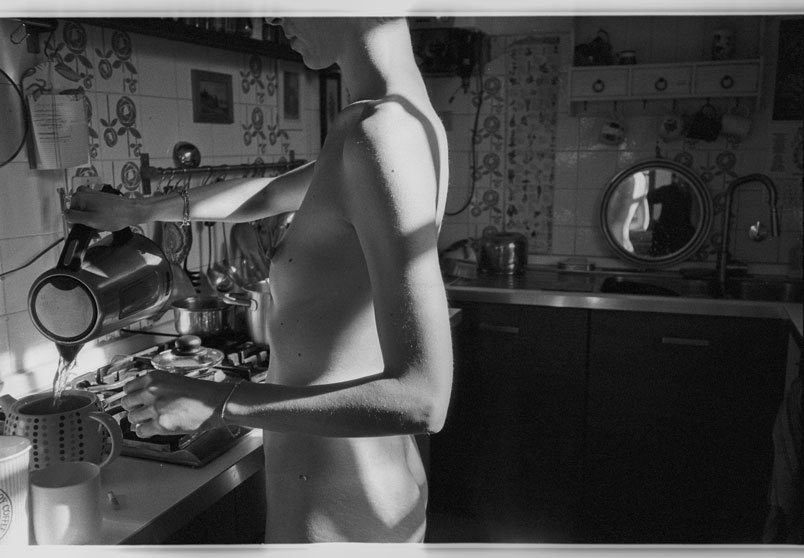
Giangiacomo Pepe – Untitled (2016)

Everything about this photograph is effing exquisite.

If we’re evaluating it in terms of the Zone System, the majority of bright areas in the frame are either close to overexpsoure or legitimately blown out. In other words: zones IX and X.

It’s similar with shadow details, there’s pure black (zone 0) and black with hints of tonality.

This compression of both highlights and shadows, stretches the dynamic range of the mid-tones.

There aren’t really enough instances to really distinguish zones VII and VIII. I mean they’re there but the objective underexposure of the frame effectively renders fucking dynamic ass microtonal variations in zones III through VI.

The staging leans heavily towards frame left. The young woman’s back bifurcates the frame. Her pouring water into the teapot and the visible kitchen accoutrements pull the viewer’s gaze leftward.

As an photographer/image maker, you always want everything in your frame to work together to not only present a visually interesting moment cut from the fabric of space and time but to also present it in such a way that the viewer not only sees something but sees something in a particular way.

There’s a general rule regarding composition: that due to the tendency for the human eye to miss things that are center field, we tend to favor things slightly right or left of center. (Part of why the rule of thirds is so sacrosanct.)

A technique frequently employed to unify positive and negative space in the frame is (when you’re representing people) have their eye line look off into the negative space.

For example: if you position someone so they are in the left third of the frame, the should be looking to the right; whereas if they are in the right third of the frame, they should look left.

This breaks that rule but it does something else that is ingenious: due to where the young woman is standing the frame is divided into light and darker halves. This allows the viewer to see more of what she’s doing while also render the reflection of the light on her back in the what is it a silver serving platter leaning against the backsplash.

I would be very surprised if Vermeer’s The Milkmaid wasn’t some sort of inspiration for this shot. They make almost completely opposite technical decisions but the reasons for those decisions are governed by practical concessions to the limitations of the available space.

Also, I’m head over heels for the way the angle of the light accentuates the fine hair on her arms. Freaking gorgeous work.

#1150

Estelle ChrétienLand Operation (2016)

I’m going to present the above largely without comment–except to point out that in the scheme of things political art tends to be garbage. But when I advocate for art as the single venue wherein terrorism is an appropriate means to an end, the above is exactly the sort of brilliantly nuanced and unsettling work I have in mind.

Independent of the current political context Land Operation is prescient; yet when you consider who Drumpf is considering for his cabinet and transition teams, it comes across as terrifyingly prophetic.

I don’t really have much more to say. I’m honestly still reeling. But I did promise to share some of the better stuff I’ve read in the last four days.

David Remnick’s response posted minutes after Drumpf was declared the President-elect is spot the fuck on.

There’s also this excellent piece by Masha Green–who has covered Russian under Putin–Autocracy: Rules for Survival.

And Harry Reid’s statement on Drumpf manages to accomplish what both HRC and Obama failed to do–insisting on accountability while also reasserting a commitment to democracy.

You’re already hearing a plurality of folks saying it’s time to come together, to unite behind a leader who won an election by embodying racism, xenophobia, bigotry and misogyny.

I’m here to tell you, you don’t have to get in line. Stand up, speak out and push back. Drumpf will be president despite losing the popular vote. And he must be held accountable for his hate-filled rhetoric.

Be wary of people who tell you not to protest, not to fight. If you’ll remember: right-wing militias were advocating armed revolution if HRC won. Thus I recommend reminding anyone who fucks with you about being upset regarding this bullshit election, that you inquire why it’s not OK for you to protest peacefully, when entire waves on the right were advocating for taking back control of the government from the candidate they didn’t support by force.

I have two further points. If you voted for Drumpf, please unfollow me. I know you don’t think you’re a racist, but as an erstwhile friend put it:

Saying that you voted for Trump because of his policies (ed: “policies”)
and not because of his bigoted beliefs does not absolve you of the sin
of bigotry. Placing some perceived economic benefit over the well-being
of others is definitively bigoted.

If you voted for Drumpf, whether or not you were or weren’t meaning to be a hateful piece of garbage isn’t something you get to dictate. You sided with hate and now hate is emboldened. (<—every conceivable TW attached to this link; please don’t click on it unless you’re in an OK space because you won’t be after you look at some of this shit.)

Drumpf voters there is blood on your hands and unfortunately, a great deal more is likely to be spilled behind this. This is what you wanted. So either own it or work with the rest of us to change it.

To those of you who are lost and terrified and feel completely hollowed out. I’m here for you. I don’t know what I have to offer or how I can even begin to help. But I’m here for you. This sucks. But we’re going to fight.

I’m weary and cynical and uncertain about just about fucking everything. But I do know that I still believe in the sentiments of this woodcut: