Molly WalshPubes (2016)

This little comic is excellent for a number of reasons.

It’s simple, cute and spends a lot of energy contextualizing the action in a fully formed world, i.e. the shower with a polka dot shower curtain, soap, shampoo, a razor–in other words the detritus you’d expect to see in any normal shower; the nude beach is palm trees, tropical fronds and flowers but also other people go about there lives pretty much normally (except for the fact that their nude in public).

Someone a great deal wiser than me once gave me the following advice: never tell where it is possible to show.

A lot of folks on Tumblr like to talk a lot about how radical they are. There are folks that argue that the normalcy of the patriarchal expectation for women to shave down there has rendered the natural state of post-pubescent women as undesirable. To combat this, some people go overboard supporting personal autonomy w/r/t body hair to a point that is–for all intents and purposes–fetishization.

This cleanly cuts through all that mess by showing a woman who clearly inhabits a world similar to the viewers own. The ‘politics’ of it don’t enter into her decision–it seems she’s just curious how it’ll look and finds it cute.

Subsequently, her friend expresses surprise in a joking fashion but is super accepting and supportive. (Instead of being like oh look at you, you rebel you!)

In other words, this isn’t focused on theory or praxis, it moves straight to simple application and in so doing it presents something that’s equally legible to folks who’ve spent half a lifetime immersed in critical theory to folks who just stopped in for a momentary distraction.

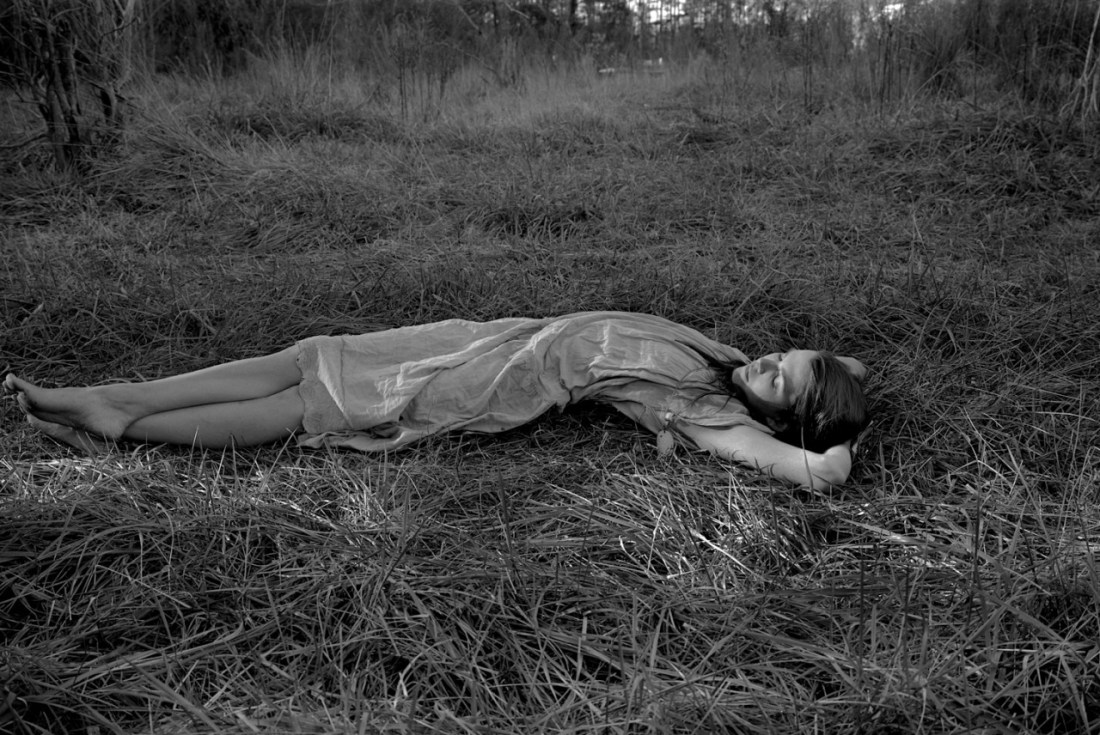
Mark SteinmetzAthens, GA [Carey] (1996)

I’ve seen this photograph a dozen times but haven’t fully engaged with it. At first glance, it’s lovely enough.

The forested dappled light falling on the grass is reminisicent of Kurosawa’s magnificent Rashomon.

The camera is low to the ground–giving it an almost Russian feel–except for the fact that near the top of the frame you can see just the hint of the top of some sort of structure. (I first thought it was the upper rear door of a van parked at the curb on a suburban street but on closer view, I’m pretty sure it’s the top of a house you’d expect to see a conversion van parked at the curb in front of in the Suburban south of the United States.)

It all feels a bit slapdash for Steinmetz. But then Carey’s position is so purposefully arranged–and given the way he necklace has slipped against her armpit, it’s not unreasonable to assume that at one point she was laying on her side before rolling onto her back.

This sort pose recurs at intervals in Steinmetz work. Consider: this from Summertime, Athens, GA [Jessica] (1997) & Athens, GA 1996. The pose–which you might term recumbent–is usually reserved for kids and young adults.

(E.D. Note: Here the author thought of the word ‘supine’ as a result of listening to Swans pretty much constantly for the last three weeks but had to use google to verify it meant laying face up as opposed to face down.)

I remember in a presentation Steinmetz referred to why he is interested in photographing teens that are no longer children but not yet adults is a result of what he terms a “ramshackle elegance”. (I know, it’s a dreamy turn of phrase; heart eyes emoji.) For illustration he showed pretty much my favorite photo he’s ever made.

There’s another thing he does assiduously in his work–subvert anything that might push things towards any sort of objectification. Take the previous photo of the young woman standing at the screen door. She’s clearly post-pubescent, but the aluminum cross section on the door is framed to block her chest. The viewer is left with both a profound sense of the subjects physical presence but the only means of connecting with that in any sort of way is through a confrontation where she’s ‘safe’ behind the door looking out; in other words, the visual grammar indicates a confrontation as opposed to any sort of clandestine, subtle or even outright voyeurism.

It’s always as if Steinmetz is diverting any sort of sexual objectification but leaving room for sexual potentiality. (I may be projecting a bit here and if so I apologize both to Mr. Steinmetz and you, dear reader.)

I think the best way to put it is to compare two other artists I find very similar: Ren Hang and Yung Cheng Lin. Hang is raw, gritty and in your face. His perversity is loud and clear, front and center.

Alternately, Lin inverts Hang’s lo-fi aesthetic and shoots the obverse of what Hang shoots. As I’ve noted previously, if you want to really grasp the degree to which Lin is the equal to Hang in terms of pervsity just consider everything the camera strategically doesn’t reveal in his frames and then you’ll start to understand how truly audacious his work is.

I wouldn’t necessarily say Steinmetz conceptualizes his work in a fashion where he distinguishes between sexual objectification and sexual potentiality. I think it’s just that his interest is ostensibly people and their stories in relationship to the stories that construe reality in the world around them.

But, to come back full circle, I don’t think my initial notion of comparing this to Rashomon is off-base. I mean Steinmetz, although an expert on the history of photography, like myself, is almost more likely to reference filmmakers than photographers.

I think it’s interesting that the story in Rashomon centers on four incompatible/irreconcilable testimonies detailing the events of an encounter in the woods. In turn that reminds me of the best advice I’ve ever received on writing: do not write about anything for at least three years because what seems important to remember in the immediate aftermath and what you remember down the road are two completely different things. The latter will have the most universal resonance to those who read what you write.

Elias HotNatalia (2016)

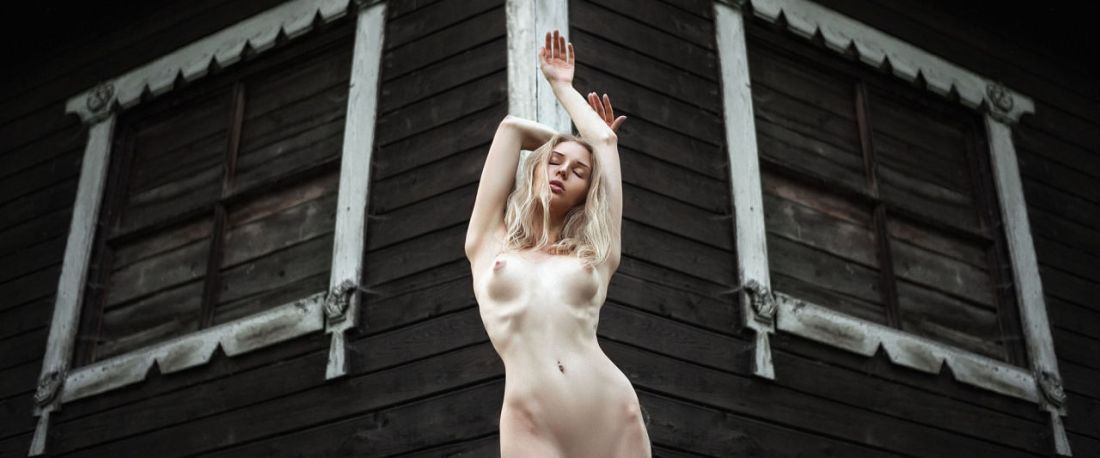
Given that the corner of the building is ostensibly a 90° angle, that leaves 270° from the side of the building at frame left to the side of the building on frame right.

Were everything perfectly symmetrical–and spoiler alert: it’s admirably close, but alas no cigar–looking at this from overhead and drawing a circle around the corner of the building, the building would represent a quarter of the circle. You’d divide the remaining circumference in half, in other words: 135°.

With the camera perfectly centered on the corner of the building the camera would align perfect with the 45° bisection of the 90° building edge.

This does not do that. If you measure the 270° of the circumference that isn’t occupied by the building, then Hot has situated his camera at about 138° (It’s more on a plane with the side of the building at frame right than the other.

That shouldn’t really be a big deal. Unfortunately, it is. One thing you learn working with a camera on a tripod for long enough is that rigorous symmetry in composition is extremely goddamn difficult to achieve. Lens distortion and the fact that there’s almost no SLR viewfinder that allows you to see 100% of the frame. Add to that that things that appear symmetrical, rarely are exactly symmetrical. (Also, the up-title and that this has been cropped in post complicates things even further.)

Still, I think it’s an audacious image. I don’t think it entirely works–but there’s something dynamic about it. If it weren’t in color, it could almost be a lost photo of Edith by Emmet Gowin.

apanthropinization

(noun) A rare and ancient word in the English lexicon, apanthropinization is defined as the act of withdrawing oneself from the state of humanity and its inevitable turmoil and anxiety. Although, phonetically and aesthetically, the word is harsh, its meaning originated from a delicate urge: the primitive human need to lust in beauty, particularly the beauty of nature. Without a doubt apanthropinization possesses hermit-like behavior, but surfaces from instinct. One does not retreat because he/she is bitter, but rather retreats to the primal urge to admire and become captivated by beauty and symmetry.  (via wordsnquotes)

Sophie Harris-TaylorFrances (2016)

Like most of the rest of Tumblr, I just finished Stranger Things. (I have mixed feelings about it; I never really felt that it ever came together in any kind of totality. The mid-to-late 80s nostalgia comes across as heavy-handed and seems more designed to fuel a sort of instant-geek connection to the show than to actually provide any sort of substantive immersive world building. It’s saved by unusually committed acting and surprisingly dexterous attention to consistent application of visual form and spatial continuity.

When I saw the above image, the mussed dark hair and the shape of the model’s face reminded me rather strongly of Natalia Dyer’s character Nancy.

Like the show, I have mixed feelings about this image. The color is nice–a very rigidly circumscribed magenta spectrum from skin tone highlight to the ribbed peach top to the pink-red lipstick.

However, the pose is odd. Does anyone else wonder what in the hell is going on with her right arm? And the pose–the tentatively uncertain hovering of her hands near her neckline–almost like she’s fingering a beloved pendant. But it’s designed for her to stylistically pull the top up to reveal her breasts. Why? For whom? Things are a bit a-muddle with this as far as questions of voyeurism.

It reminds me of this image of Génia by PeterVR. Both feature awkward/odd, self-conscious poses. Harris-Taylor’s is technically superior. But I feel like PeterVR actually provides enough context where the self-consciousness actually dovetails nicely with a more consistent application of the conceptual underpinnings of the image–i.e. his image takes a definitive stand on whether or not the work is voyeuristic.

Jo SchwabUntitled (2015)

Studio work de-emphasize setting and by extension temporality. The notion–or at least the notion as I understand it–is that this contributes to an isolation of the subject and through that isolation any adornments or distractions are removed and the viewer is confronted by the visual embodiment of an individual identity.

I think what bothers me about studio work is that I’ve always felt it jumps up and down and screams: look, I’m telling you the truth! Unfortunately, I feel that other factors shift and upend the implicit truth value.

Arguably, good studio work requires image makers to remove their own intentions from the picture so that the image will function as a sort of confrontation of the viewer; the camera and the image maker disappear, in a fashion, and the audience is placed in direct correspondence, vis-a-vis another person.

But the relationship between the image maker and the subject isn’t some sort of catalyst that foments the reaction and completely burns away in the process. It fundamentally shapes the resulting image. In other words, the pose and composition are only half the equation. Invisible things–like the mood of the image maker, the mood of the subject, how warm or cold the studio is, the shape and form of the relationship between the subject and the image maker. (Does the image maker want me to like the subject? Be wary of them?)

There’s at least half a dozen reasons why I dig Schwab’s portraits. Partly, I feel like he gets out of the way more the most folks who embrace studio portraiture. There’s a simple, effortlessness–which I know enough to realize is anything but–to his images. You get the feeling that you aren’t face to face with someone who is trying to be liked or disliked. His work feels very much like that moment when the facade cracks and the real person shows through–like that de Botton line about hav[ing] to be quite heavily invested in someone to do them the honour of telling them you’re annoyed with them.

Not that Schwab’s subjects are annoyed with the viewer… it’s more that their expressions belie emotions outside the norm of decorous interpersonal interaction. The model in the above image seems that she could’ve been given the same instructions–give me a look of “world weary ennui” that Sally Mann gave her daughter in this image.

I especially like the lighting in the image above. It’s simple and imperfect. I’d guess a key light with a softbox on the left, overhead and angled down, with some sort of bounce board or reflector on the floor–giving that background just a little kiss of light to separate the subject from the background.

But note also how background behind her hair remains completely dark, pushing her hair forward in the composition, emphasizing the texture. In fact, I think that’s one thing that holds true of the work beyond the amazing expressions–there’s a ridiculous capacity to use extensive technical acumen to parse the frame in such a way that the subjects take on something more akin to a sculptural dimensionality.

It’s really quite impressive.

Arrival is the culmination of the sequence of events, the last in the list, the terminal station, the end of the line. And the idea of arrival begets questions about the journey and how long it took. Did it take the dancer two hours to dance the ballet, or two hours plus six months of rehearsals, or two hours plus six months plus a life given over to becoming the instrument that could, over and over, draw lines and circles in the air with precision and grace? Sumi-e painters painted with famous speed, but it took decades to become someone who could manage a brush that way, who had the feel for turning leaves or water int a monochromatic image. You fall in love with someone and the story might be of how you met, courted, consummated, but it might also be of how before all that, time and trouble shaped you both of the years, sanded your rought spots and wore away your vices until your scars and needs and hopes came together like halves of a broken whole.

Rebecca Solnit, The Encyclopedia of Trouble and Spaciousness, pg. 199; (2015).