Nazif Topçuoğlu – The Curious Operation (2005)

I can’t quite decide whether the way this bloody mashes my buttons is masterful or ham-fisted…

The lighting is pure Caravaggio chiaroscuro, the compositions utilize Vermeer as a point of departure and the poses are the most Balthus thing since Balthus Balthused.

I’m a little discomfited by the way so much of the work depends on a sensational presentation of adolescent female bodied-ness. And don’t get me wrong–I’m not against nuanced, complicated and even edgy visual depiction of that issue. There’s just…

Let’s let Mr. Topçuoğlu explain himself:

When employing the representations of youth as imagery, one has to deal
with the issues of gender roles and male gaze. In these photographs,
unlike the more common examples, a respectful stance towards the female
has been taken. The subjectification of the female youth as a
gender-free ideal, inevitably involves her intelligence, beauty, energy,
and struggle as the major concerns of this work I do photography
because… I need to produce the images which are provocative but not
exploitative that I would enjoy looking at
.
(Emphasis mine.)

I’m trusting each of you to be sophisticated enough to note the contradiction and to multiply the concern it raises by the power of it being deployed by an ostensibly heterosexual, cis-gendered man.

The thing of it is: I want to embrace the narrative and its implication. The obsession with youth and the line separating innocence from experience is the quintessential fascination. And it’s not that I don’t believe there’s a sort of bullying going on wherein that fixation manifests itself in a sort of full-contact exploration that may or may not include–strictly speaking consent. I know that when kids are curious about each others’ bodies, they’d rather ask for forgiveness than permission. Folks gets pantsed, you get pinned to a wall while someone looks down your shirt and makes pirates dream jokes. My point is: those actions are based in this weird curiosity-shame spiral.

The resistance in this photo–besides being hell of stylish–is perfunctory. There’s the presence of a bullying sense to it but it seems more like a perhaps slightly more intense game than anyone participating signed on for.

All of Topçuoğlu‘s work–with one exquisite exception–assigns an implicit lesbian subtext to adolescent female interpersonal transactions. Touch is almost always at least informed by some miasmatic subliminated sexual desire. My experience is that while that is definitely a possibility, it’s in no way the default.

I’d be curious to see someone like Prue Stent or Lula Hyers re-imagine these images in a more authentic fashion–since it seems to me the prima materia is solid enough that it would benefit from being informed by lived experience.


Nobuyoshi Araki Untitled (19XX)

After college, I moved to Greenpoint, Brooklyn. I’m not talking McGuinness & Nassau, either. We’re talking practically under the Kosciusko Bridge.

It was a 15 minute walk to the Nassau G and either 13 or 18 (depending on traffic) to the Graham L.

By New York standards, my room was enormous. But I shared a wall with a Dave Grohl wannabe sax player who constantly practiced atonal three note arpeggios at odd hours.

I was only working part time and after commutation expenses, it was a struggle to make rent each month.

At the time, my significant other was in a similar place. We spent a lot of time walking–which really and truly is the best way to get to know this city. We’d hang out at hip bars sipping a beer between us. Anything that was free and appealed to our mutual creative predispositions was a draw. But if you’ve spent any time in this city, you know it’s not a place you want to be poor.

It took us two months to discover the New York Public Library. Not the one with the Lion’s guarding the stairs but the one that’s caddy corner and a block down. Over the next few months, we spent hours there pouring over their photography section.

We scanned work the likes of Steiglitz, Friedlander and Goldin.

Thing was–and I swear I’m circling back to the image above, hang in there–the selection lacked any sort of breadth and instead focused on an obsessive depth. The number of fucking Araki’s books exceeded a plethora to the exponent of plethora.

I remember three things about the work:

  1. An image like this except with an orange and black flower with petals more like a daisy and Araki himself squatting beside the suspended model.
  2. It was the only thing besides Goldin where sexuality figured in any denotative fashion in the photos,
  3. I preferred Goldin even though I found her work exploitative.

My opinion w/r/t Goldin has evolved rather dramatically; my thinking w/r/t Araki has, yes, shifted but it’s less pronounced and far more complicated to explain.

See: on a purely formal level his work is on-point. His compositions are impeccably executed and his work is hugely influential: would Wolfgang Tillmans be a name anyone knew if Araki hadn’t shot highly styles hair and eyes? Probably not. (Also, the shit he shoots that subtly skewers skewers fake sets in high profile fashion shoots–looking at you, Tim Walker–are about as good as polemical provocations get.)

I can’t even really argue that Araki should pursue more aggressive edits. If he’s published it, it’s almost certainly publication worthy. My primary continued objection to his work (beyond the aggressive heteronormativity of it) has to do–synchronously enough–with an idea I encountered more or less concurrent with my first encounter with the work: William Ian Miller’s The Anatomy of Disgust. In it he attempts to analyze why humans experience feelings of disgust.

One of his points is that profusion is–almost counter-intuitively–a potential locus for disgust. I don’t completely recall the rational underlying this assertion but it absolutely serves in application to my queasiness regarding Araki: there’s too much that’s too good.

The thing that’s especially galling is the fact that almost seems to be the point of the exercise. And I’m no less sure how I feel about that now than I did eight years ago.

How Can You Tell if You’re Being Sexually Empowered or Objectified? Ask Yourself This Simple Question

How Can You Tell if You’re Being Sexually Empowered or Objectified? Ask Yourself This Simple Question

Source unknown – Title Unknown (20XX)

Most folks would instinctively term this ‘porn’.

Given the content and the manner in which depth of field is deployed to focus on her genitalia while blurring her face, it’s hard to argue that the purpose of this image isn’t primarily as a masturbatory aide.

To my reading, there’s more to it. Yes, the framing is problematic as it amputates limbs–not to mention offering a textbook example of #skinnyframebullshit; but the sense of immediate intimacy it presents is unusual.

I’m really super aroused by it; also overwhelmingly concerned about it’s genesis given the rare vulnerability it depicts and this the era of leaking nudes and revenge porn, I worry whether this individual has consented to these images being published. (Google Image search and TinEye both return zero results–doing nothing to alleviate my concern.)

And my worries aren’t necessarily tamped down as a result of noticing the texture of the couch and the pillow seem anachronistic enough to suggest the sort of set dressing favored by authors of Internet smut–if that’s the case I’d have to retreat momentarily to amend my knee-jerk finger wagging w/r/t the depth of field to a vociferous objection.

Ultimately, the reason I’m posting this is although it’s hardly a good image as is, its various elements are valuable and I’m convinced that benefiting from more logical composition, increased depth of field and a more nuanced approach to lighting design it could be mistaken for fine art.

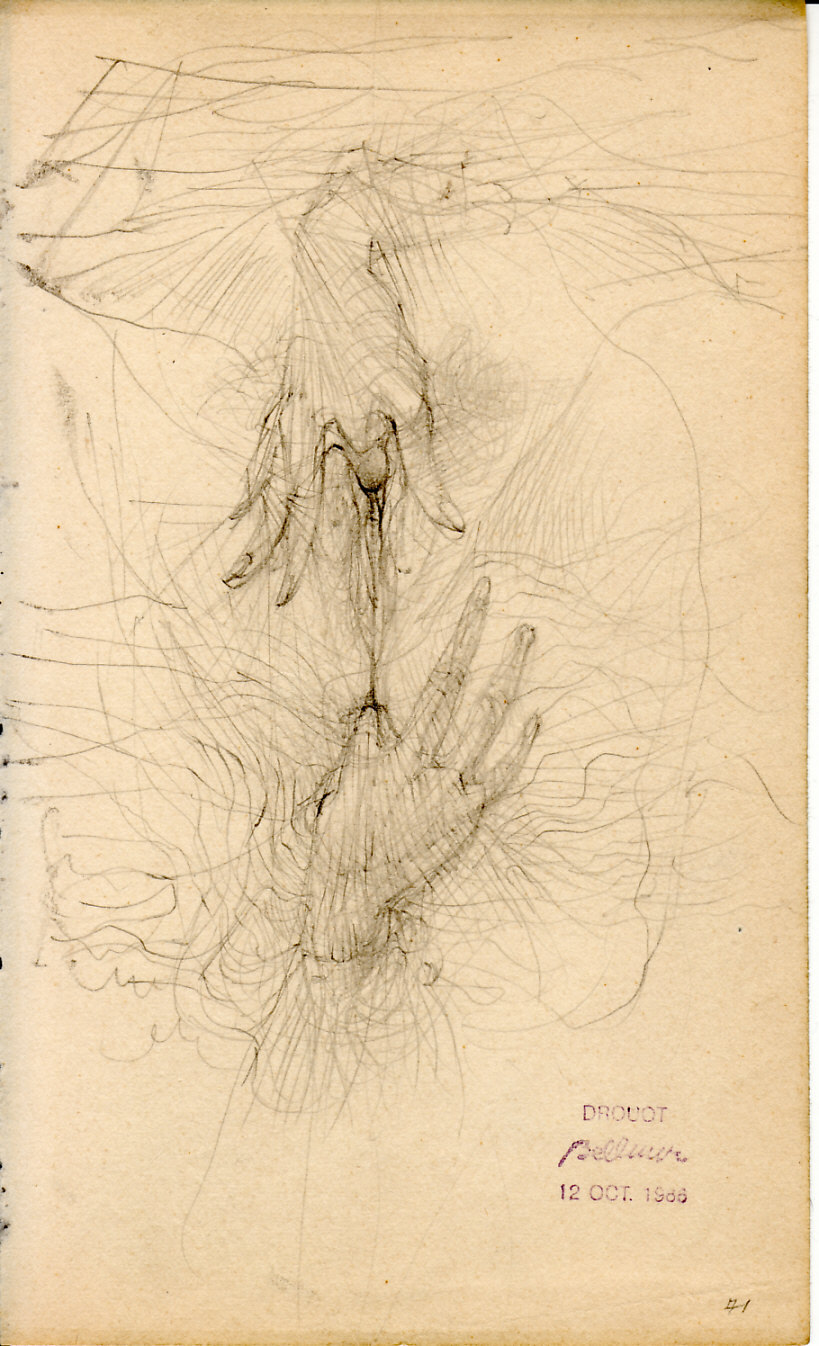
Hans BellmerTitle Unknown (19XX)

Individual perversion and obsession are so inextricably interpenetrative that it’s difficult to judge where the former ends and the latter begins.

Bellmer positions his paraphilias front and center, pulls no punches and generally gives zero fucks about your puny concern fappy ‘moral’ outrage. There is definitely an off-putting integrity to an artist who doesn’t bother to sublimate the fact that he’s fixated on the sexual potential of pubescent female bodies.

(Of note: Bellmer shares this predilection with Balthus. However, unlike Bellmer, Balthus refused to engage conversations regarding the ‘hebephiliac‘ themes in his work. As such, it’s interesting that while Bellmer is the better technician, Balthus’ enjoys wider cultural renown.)

It’s all fucking enormously problematic. And I’m never sure how to address that because there always seem to be some unshakeable truth transcending binary gender identification and either/or sexual orientation which his line work always seems to be struggling to give expression to. As if Bellmer believed in the depth of his soul the grotesque is the veil one must penetrate to truly experience the sacredness of beauty.

Source unknown – Title Unknown (197X)

Although this seems–initially–highly staged/contrived in an effort to balance the composition, there’s also something profoundly compelling about it.

I knew from square one that I fucking adored it. Putting my finger on the why of it took some time. But, last week I stumbled upon an article about a photo snapped during one of the many brawls in the Ukrainian Parliament and how it has garnered a great deal of attention because its composition resembles the Golden Ratio governing composition of Renaissance masterpieces.

It’s really the first time the how of the Rule of Thirds derivation from the Golden Ratio has made sense to me. But it triggered another correlation that’s generally overlooked in most work governed by the rule of thirds–the reliance on an increasingly dense deployment of negative space as thing spirals outward.

This realization reminds me of the wonderful–as per usual–analysis Every Frame a Painting presented of Nicolas Winding Refn’s grossly under-appreciated Drive and it’s use of a so-called Quadrant System of composition.

Granted Refn’s use of quadrants isn’t exactly in line with the Golden Ratio; however, I suspect if one had the time and energy one could demonstrate that the reason some of the unexpected cuts he uses work so well is actually due to an overall respect for the Golden Ratio across connecting scenes… the point is if you overlay quadrants over the rule of thirds and recall that one quadrant needs to be predominantly negative space, then the logic of the rule of thirds suddenly clarifies itself. (At least for me it does.)

I strongly suspect that the above image was originally composed according to the Golden Ratio and subsequently cropped prior to publication. It’s interesting to note that if something is rigorously composed according the Golden Ratio, then any thoughtful crop retains a logical consistency in composition.

Yet, what especially fascinates me  is that although my first thought is stylized contrivance–looking at this now, I view it more as a lie about a lie that manages to tell something not unlike the truth.

I love her introspective expression, the way it conflicts with the obvious catering to the voyeur suggested by her pose and it now strikes me as disarmingly intimate and beautiful.

Source unknown – Ace, Joy and Erica (2008)

As a general rule: I don’t post images shot in color and subsequently desaturated. I’m making an exception with this because it’s literally a thousand times better than the low contrast, optically flat and unappealing original image.

Also, I really try not to post excerpts from shitty corporate porn often. I’ve noted the source here as unknown simply because this image has been licensed and relicensed so often, I really have no idea who the original author even is.

So with two strikes against it and the fact that even if the desaturation restores some desparately needed depth and contrast, it is still a compositional shit show–why the hell am I posting this?

Well, not unlike labeling oneself an anarchist unfairly welcomes correlation with Caucasian crust punk wannabe layabouts who smoke too much weed and have a less than nuanced appreciation for Bob Marley, I feel that the credo sex, drugs and rock n roll gets a similar bad rap by association.

That such a ready-made comparison exists is politically expedient. Thoughtful practice of anarchism is a threat to power structures in a way that few other -isms manage and sex, drugs and rock n roll as a baseline system of belief/motivating factor is similarly if not more dangerous because all three independently or amplified in combination have a proven track record of demonstrating to the individual the extent and degree to which learned limitations are bullshit.

I guess my point is that there is only so much you can to to push your own limitations. It’s like tickling–I can’t tickle myself, someone else is required for that.I know in my own experience that although best orgasm I’ve achieved through masturbation is only slightly better than the worst orgasm I’ve ever experienced during sex. You know what you’re going to do before you do it and you know what you like… there’s nothing unexpected about it. Whereas someone else can tease, cajole, surprise and push your body towards amazing experiences you never knew were possible.

And something with which I am preoccupied is the limitation of how much is too much, is too sensitive really a thing? In my experience, the answers are nothing and no, respectively. But I feel like I haven’t considered all the options and when I die, I don’t want to wonder if I was wrong I want to know with certainty that I was wrong or that as I suspect, I was right.

I think at the root of it that encapsulates my fascination with group sex in the face of the fact that I am a misanthrope with pronounced anti-social tendencies.

Lux Aeterna Girl – Untitled (2014)

(I’m not 100% on the source for this. The original post appears to be a now defunct Tumblr named luxaeternagirl; thus I have credited it as such. If that’s incorrect, please let me know and I will edit the attribution.)

This isn’t a good image–not even close. The camera is off-center a foot and panned right about 15 degrees to attempt to compensate. I understand that after cars, bathrooms are some of the most difficult places to shoot due to them almost always being small and cramped but the two shadows in the upper left and right alone with the angle of the tub edge in the lower right corner is really effing distracting.

What I will say is that given what is probably a single incandescent overhead fixture, the skin tone here is very much on point. It has that natural peach tonality that you get from remembering the rule of thumb w/r/t skin tone: Red > Blue > Green.

The rendering of the skin is super important here–by getting it right, it makes the fact that both participants skin is flushed red more discernible. The edge of the left partner is obvious along the outside of the ears; while the partner on the right has reddening ears, faces and neck. It might almost be sunburn but with the pale complexion in tandem with body language, it seems more likely that she’s just extremely aroused.

And that is what distinguishes these images: chemistry. There is no questioning the primacy of their physical desire for one another. The partner on the right in the top image is doing the hesitant if-I-so-much-as-feel-your-skin-I-will-lose-any-trace-of-self-control; the way the partner on the left is leaning in, in an effort to draw the other out. The response in the second image doesn’t give in so much as beg for defenses to be laid to waste, to earn the victory by no other means except total surrender.

To me–chemistry like this is what is missing from 95% of erotic work. And it’s a shame, really… because were effort expended on facilitating it–less artful work (much like this) would shine in spite of it’s technical shortcomings because it would present a record of physical desire it would also simultaneously illustrate something true about the psychology of physical desire.