Lula HyersUntitled (2014)

Were you to take the current bumper crop of twenty-something lifestyle/fashion image makers, write their names on slips of paper, fold up those slips and place them into a hat, shake the hat about and pull out a name at random, any name would share some obvious parallel with Hyers’ work.

I am certain that Hyers would be at least passingly familiar with the large majority of names in that hat. She probably even considers many of them influences. The thing is: her work is also frequently better than the work of at least ¾ of those names that might emerge from the hat.

A bold statement: yes; but if you stop and look at her work–I mean engage with it–you can’t dispute the assertion. Add to that, Hyer’s still being a teenager and Jesus Harold and Maude Fucking Christ on Christmas her aptitude is freaking unbelievable.

And while I am of a mind that she’s better than the majority of her peers/influences, what she does better than just about anyone is the way she presents bodies and the sometimes related sometimes unrelated sexual expression of bodies as almost an afterthought–allowing her broad latitude in presented the truth of those in her life without misrepresenting the complexity of the moments she captures or relying on knee jerk shock value.

It’s surprisingly mature work for someone so young. And although comparisons to those aforementioned twenty-something lifestyle photographers are astute (along with correlations to Goldin and McGinley), I feel there’s a closer relationship with the frenzied urge to document life exemplified by one of my favorite photographers Igor Mukhin.

What I see matters little next to  than simple truth that this work is breathtaking; I cannot wait to see where it goes from here.

X-ArtMy Best Friend’s Boyfriend feat. Katka and Mikah  (2011)

There are like a fucking million and half things I don’t like about this scene. Let’s start with the fact that it typifies the heteronormative porn trope that all women are bisexual and the cisgender male gets to reap the benefits. (And that’s not to shame any sort of bisexual women who have negotiated consensual best girlfriend sharing with their boyfriend arrangements–I say more power to y’all.)

I don’t like the implicit assumption and the subsequent straight cismale entitlement is particularly intolerable.

Honestly, those more social justice oriented objections get the volume turned way the fuck down on them–at least in this gif, less so in the full scene–because I’m so fucking captivated by the reverence with which Katka watches Mikah and her open and unselfconscious masturbatory response. (I think that’s part of the attraction I have to group sex scenarios, the notion of being in a safe space where you are invited to contribute your own individual sexual expression in a fully consensual and accepting environment is a big part of why I bother with this blog–as it allows me to express thoughts and facets of my identity for which there is no outlet in my life AFK.)

I know it’s staged in such a way that she’s splayed out for the benefit of the stud and the traditional male gaze but her authenticity subverts all that–at least for me.

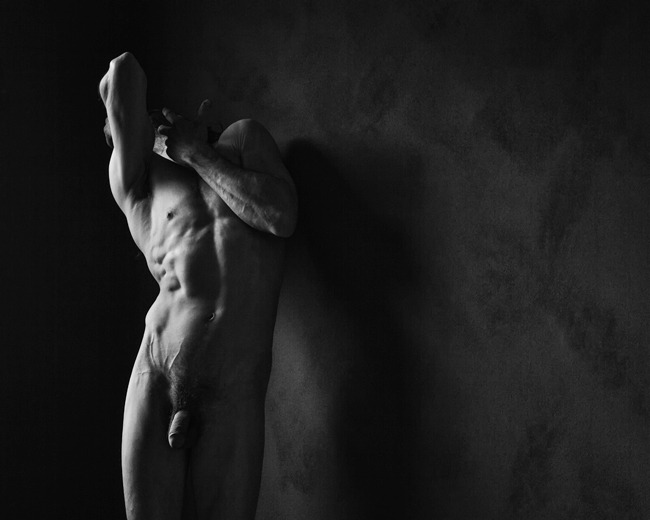
Source unknown – Title unknown (19XX)

I have a preference for graphic depictions of sexuality focusing on a woman’s pleasure. Thus, although clearly staged–this appeals to me with a particular intensity.

The intensity is amplified by the fact that I also find it alluring where nudity is not presented as a facet of a woman’s sexual expression.

What I am really trying to communicate is the completeness with which this had me from the start.

There are two things it refuses to clarify: is the woman’s thousand yard stare a by product of the obvious staging of the scene or is she fantasizing about another man–perhaps the one rendered as a ghostly presence in the background.

My suspicion this is the intended–as much as authorial intention bears any relationship to the audience’s reading/interpretation (which is to say little if any)–outcome; however, to me the image exudes a sort of aching physical desperation. And that feeling causes me to wander if the ghostly presence is perhaps actually corporeal–a third party waiting to be invited to join the proceedings. The positioning doesn’t really support this interpretation; but wondering about the position caused me to notice the pose and musculature is oddly posed–legs together and touching, abdomen perhaps stretched…

…and I can’t help but thinking if the woman is thinking about the Crucifixion–a notion that would certainly fit with the feeling of seething sexual desperation I get from the image.

It doesn’t have to be that. In all likelihood it isn’t; but the ambiguity within the work that allows such an obscene meditation appeals with glee to the stretching darkness in me.

Sebastién GherrëFeña (2011)

If I have a weakness when it comes to image making, it’s audacity. Show me an image with the same couldn’t-give-a-fuck-less single-mindedness seen in that iconic image of Johnny Cash and I’ll be happier than a pig in shit.

The stumbling block with audacity is not unlike the problem with punk rock–the feral burst of righteous fury is usually usually at it’s best when it’s both absent discipline and especially clever.

Thing is: making good art requires at least some concerted discipline and cleverness is all too often willing to rest on its laurels which in turn predisposes cleverness to providing the impetus for a lot of bad art. [Consider a spectrum from clever (Andres Serrano) to smart-feigning cleverness (Arvida Byström) to smart (Laurence Philomene).]

With the above image, I adore the underlying idea: lotion as lube as foreshadowing of masturbatory ejaculation. Unfortunately, the execution–context eliminating close-up, unmotivated middle-of-the-road strobe and soft focus–is just fucking sloppy; detracting–woefully–from an otherwise promising image.

Sabrina DacosThe hand that rocks the cradle (2010)

The bumbling mad scientist in me would love to facilitate an experiment on the effects of porn consumption on straight, cisgendered boys.

This experiment would consist of two groups–one left to their own devices while another was granted access to sex positive, body positive, feminist and artfully executed pornography. (In other words, work of the sort for which Dacos is–in my mind–the quintessential exemplar.)

Of course, such a project would never pass muster with an ethics board (primarily for reasons to which I’m almost certain I would strenuously object). And I’m not naive enough to think there would be a total mitigation of heteronormative sexism in the second group; however, I’d like to think the second group would demonstrate a slightly different post-study trajectory of porn consumption.

I admit a strong bias driving this hypothetical experiment–I’m motivated by a retro-active wish that I’d had access to exactly the sort of sensitive, sophisticated pornographic material at the time I was navigating puberty. I suspect it would have diminished much of the guilt I experienced consuming such material given not only the front loading of puritanical bullshit into my Xtian upbringing as well as assuaging the nascent feminist awareness I felt at that juncture in my life.

EDIT: It’s been brought to my attention that my conceptualization of feminism and Ms. Dacos’ diverge significantly. That’s fine–feminism is a big tent. I’m not about to tell anyone else what they should think. That being said, I do find some of her commentary to be disturbing and sometimes even repugnant. So much so that my first response was to delete this post. I’m going to leave it though–to show that I’m not always right and that I make mistakes when I assume things just by only looking at someone’s work and not doing any research about their pubic facing persona.

My sincere apologies if my glaring oversight offended anyone (and thanks to wyoh for opening my eyes).

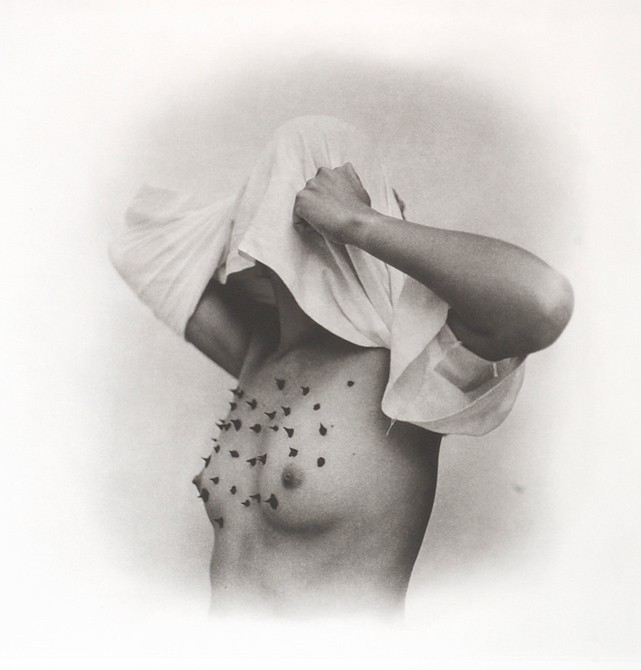
Marta Maria Perez BravoProtection (1990)

You know that class everyone has during their first year of uni that teaches you have to write a paper and use the library for research, etc?

Well, during my first college try, the teacher who taught my orientation course was a curmudgeonly fucker who smoked in class while refusing to let anyone else partake; he told us right off that he only promised to read the first paragraph of our papers and if he wasn’t interested he had five steps from his vestibule up to his living room and he’d stand in the living room and toss the offending papers down rendering the binding final grade based upon where they landed–top step being an A, bottom step an F.

I was one of three students who had every word of every paper read. This was not necessarily a desirable status due to the fact that unlike the other two folks, my tactic wasn’t finding a way to present the material in a direct and pithy manner so much as to present a first paragraph that made the reader ask themselves how the ever loving shit is this fucker going to bring this back around to the assigned topic?

To this day I struggle with directly engaging with material. It’s so much easier for me to indicate overlap and then address things in terms of analyzing things with which I am much more thoroughly familiar. I worry a lot about getting shit wrong and it’s easier not to fuck up when you are dealing with the familiar instead of the foreign.

The benefit to my approach is occasionally, the apt metaphor is the perfect decoder ring. So for every time it works, the nine other times it doesn’t just seem like the price of admission instead of a deficit of diversity in tactics.

Whatever that’s a whole lot about me and very little about this amazing photograph. But part of the reason this photograph appeals to me is that it presents the equivalent of an initial paragraph that is both completely outlandish and also simultaneously tied to a rigorous artistic unity within the work.

For example: when I look at it I notice two things predominately. It provides an oneric as opposed to dream-like consistency. (Perhaps the best way to explain what I mean in juxtaposing ‘oneric’ with ‘dream-like’ is the difference between Maya Deren and David Lynch–the former is interested in replicating the logic, structure and mechanics of dream states on the silver screen whereas the later is interested in borrowing the fragmentation, ruptures and disjunctions familiar from dreams as a means of structuring/sequencing images in a more-or-less narrative fashion.

Thing #2 that I notice is that when researching the additional, non-visual context of the image this distinction broadens and enriches my perception of the images; i.e. there is a reason that this reminds me of an image emerging from a dream instead of being an imitation of a dream–Bravo being deeply immersed in the Afro-Carribean Santería, a belief that “the divine exists in all things, even everyday objects.”

I will be forever fond of work that rewards engagement by unfolding and intensifying. Plus, I pretty much live for those moments when I learn something without any sort of awareness of didactic intentionality. In other words, the engagement is both its own reward and an invitation to deeper levels of resonance and understanding.

When did we become so small and so apologetic? Why do we apologize for our humanity? Love what you love, and make no apologies. This is your identity. The most horrendous suspensions of freedom are self-imposed. We imprison ourselves daily, hourly.

We have one life, one shot at all the glorious things of life, and we walk about constricted, apologetic, afraid. We have so little time; we have so little space upon which to spread our love and our talents and our kindness. Run toward life fulsomely and freely.

It runs from us so quickly, like a frightened dog or youth or daylight. Chase it and care for it.

Of course art should be about something big. Something terribly big must be at stake. I don’t see this anymore. Our art is becoming terribly polite and apologetic, much like us. It slinks away like a sagging breast, empty of milk or promise or comfort.

We need to get very fervent again. We need to get jacked up.

Tennessee Williams (via jrmgh)

Malinda WasellSlowly, my soul awakes (2015)

Out of every 24 hourrs, I spend two–give or take–perusing the work of various photographers and image makers.

Every day, I find work I like. Work I love is harder to come by–perhaps a couple times a month. Then–in an especially good year–a half dozen image makers completely beguile me.

Wasell’s self-portraits are rarer beast. It’s not so much that her images resonate with any great profundity. It’s more their one masterful aesthetic flourish–the knack of employing absolutely fucking impossible light to devastating effect.

I’ve experienced a comparable reaction before. Four and a half years ago, in fact, as a result of of first stumbling upon Lina Scheynius’ work.

On the one hand I grant that it’s not exactly fair to connect a nineteen year-old with a handful of promising images to one of the quintessential badass Internet famous photographers. But look at the way both manage to coax cooperation from insane lighting situations. So the comparison may not be fair but it’s damn accurate.

These two images in particular are wonderful. They’d almost certainly benefit from a more thorough engagement with questions regarding the boundaries separating selfies from self-portraiture as well as concerns over representation vs. identity. Yet, independent of more intensive conceptual framing, there’s both a raw potential and precociousness that is all but absent in photographers twice her age.

Lastly, I would be woefully remiss in my duties were I not to mention Wasell’s Tumblr curation. Yeah, super beyond on point.

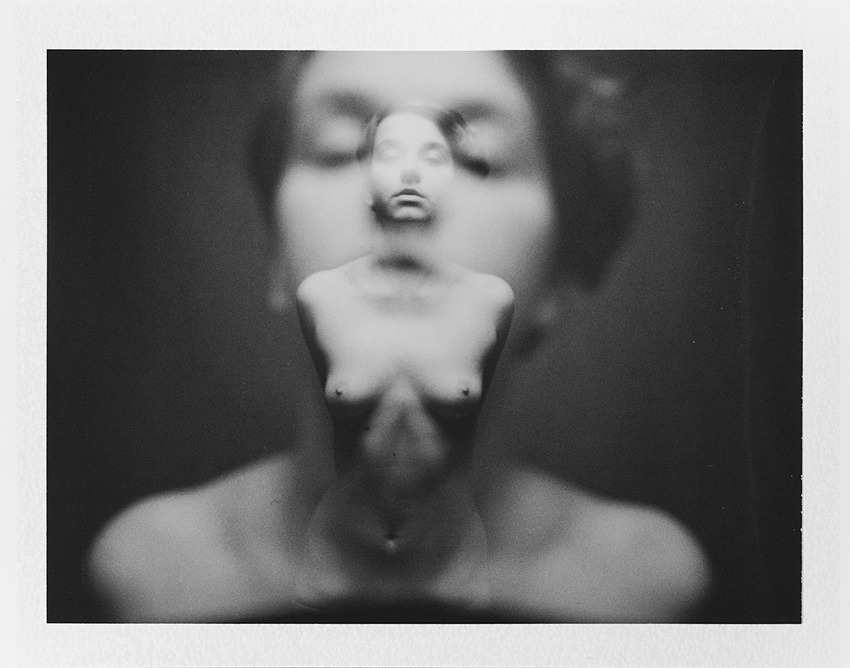
Andres Contreras Rodriguez/untitled/deni (2014)

I’m not solicitous when it comes to multiple exposures. To the extent that I am struggling to find another image besides this to which I can point to and say I’m okay with this.

In fairness:  my motivation for singling this out are entirely based on extrinsic properties; namely, the single harsh overhead light source and extremely soft-focus closeup remind me of the iconic still of Marlene Dietrich smoking in Shanghai Express.

Secondly, it feels weirdly reminiscent of Floria Sigismondi’s music video work, esp. Marilyn Manson’s The Beautiful People. A correspondence that is interesting to me considering I’ve never known quite what to do with Sigismondi’s seemingly free-floating, untethered creative vision. Recognizing it as a bizarre, mutant appendage extending from the corpse of neo-noir makes her work a wee bit more accessible and perhaps even strangely endearing in the same way cloying small towns are always deemed quaint.