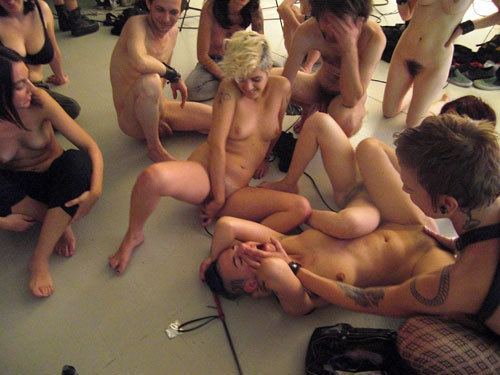
FeminismoPornoPunk – Documentary still from Public domain porn version (2008)

Catalan Theater Directory Roger Bernat staged Public Domain in 2007. The underlying notion being to eliminate the audience/actor distinction.

[Public Domain] is (like) a life-size board game in which the spectator is more than just a pawn. Theatre-maker Roger Bernat assembles a group of people – the audience – on a square. Who are they, where do they come from and what is their relationship to each other? They walk across the square while listening to a series of questions and instructions on their headphones. Some are more innocent than others. The same can’t be said for the result; through the participants’ simple movements, small groups start to form in the audience. These micro communities expose underlying social patterns and tell a tale that Bernat carefully orchestrates. While [Public Domain] starts off looking like a 3D poll brought to life, the project ends up transforming into a bizarre fiction.

Maria Llopis reimagined Bernat’s concept as DIY porn for the Beatriz Preciado curated Arteleku in Donostia, Spain one year later.

I’m an extremely sexual person. However, I’m also aware that as someone who passes for straight, white and cismale–although I would never claim any of those terms in self-identification–I experience a degree of privilege.

As someone who passes, it’s assumed that I fit squarely into the cismale heteronormative default. I don’t though. I care very much for others’ autonomy in self-identification but the truth is I’ve never found label words especially useful. About the only label I don’t dispute is the distinct of being a ‘switch’ on the D/s spectrum.

It’s difficult to lack a readily available means of expression. On the one hand I want to distinguish myself from what I may be perceived as being by others. But how do I do that in a way that isn’t appropriative at the same time as also not being entirely fucked up and entitle?

I can’t say I’ve discovered anything that works. But I have definitely learned the importance of safe spaces–and not just safe spaces for me but spaces that are safe for myself and inclusive and safe for others, too.

At present this fits the form of a tweak to the ubiquitous Golden Rule: do unto others only as the would of their own free will and volition do unto you. (Being that I am on the autism spectrum, this isn’t the most effective coping mechanism…)

The above image suggests several things:

  1. I can’t look at this and not flashback to that scene in The East where the anarchist kids are playing spin the bottle. It strikes me that there’s huge overlap between that space in the one above; an emphasis on  intimacy, connection and using consent and negotiation/re-negations to test/push through largely arbitrary boundaries. (It’s also enormously helpful–not to mention fucking wonderful–that The East includes a queer perspective!)
  2. It also reminds me of Stranger by the Lake (a great film for it’s artfully graphic depictions of gay sex and is currently streaming via Netflix). With the world growing increasingly compartmentalized, sex is everywhere but unless you are a multinational corporation or resemble the board of said multinational corporation–whether or not you have access to similar mountains of cash in your private life–there is increasingly no viable venue for safely and consensually engaging with sex on a non-conceptual, tangible level. I think the idea of creating such space is important. But it’s hardly new. The LGBTQAAI community has fought tooth and nail to create such spaces.

This relates to the above image insofar as it is very clearly a safe space, concerned with sexual expression that insists on equal space for queerness.

It also doesn’t feel as if it’s about exhibitionism. That’s a huge thing for me. I am hardly shy. Truth told, there’s like maybe three things I would never consider doing in front of a camera. But I am not an exhibitionist. I don’t have any sort of problem with exhibitionists. But I am not happy with my body. However, for better or worse, my sexuality is tied to the body I have. (I regret very little in life but I wish that I’d done something like appear on I Feel Myself–although they probably wouldn’t take me and I’d have to do something more in line with Gentleman Handling, unfortunately… stupid biologically male body.)

I wish I knew where I could find spaces like the ones this image points toward. I would love to be able to express my sexuality more openly in a fashion that was neither intrusive or entitled.I wish there were more spaces like this–focused on rejecting mass marketed fantasies and instead projecting DIY ethos and creating for ourselves the truthful and open spaces for complicated expression we most want to see in the world.

Interesting, the lack of such space is perhaps the biggest obstacle I face in my own creative work. i patently object to the myth of the rock star photographer. I think the vast majority of Tumblr photographers (good or bad) use fine art nude photographer as a pretext to appropriately channel sexual energy. I have an immense problem with that–not in and of itself but if that’s really your goal then at least be up front about it.

I love looking at naked bodies just as much as the next person. But I am more interested in the correlation between you and your body–with particular emphasis on your negotiation of your own sexuality. I want to ask what turns you on–not as any kind of prelude so much as I find it endlessly, almost transcendentally intriguing to understand how someone else experiences something that profoundly moves them. I’m curious as to what their experience of puberty was like, how they masturbate, whether or not they’d be comfortable with showing me? Is it okay if I show them?

I can’t approach photography except as collaboration between equals. The subject has just as much of a stake in things as does the photographer. And as far as my own work goes, what affects me is conveying something of the highs and lows, the narrative of what it is to be a being with a carefully considered inner life, hopes dreams and aspirations but who is also tied to an inconvenient simultaneously autonomous and desiring body.

It seems simple enough but it goes back to the question of would the person I am asking realistically ask the same in return from me. So far my life so far has demonstrated the answer is a resounding no.

Chris LowellUntitled from N. America series (20XX)

If you have any investment in entertainment that passes the Bechdel test then you likely know who Chris Lowell is already. Remember Veronica Mars? Remember how amazing the first season was? Even the second season–despite its flaws–was a cut above most serial dramas. Then came the inexcusably awful third season.

Well, Lowell–who played Veronica’s college boyfriend Piz–was among a clot of reasons the show suddenly started sucking shit through a tube.

All this is relevant only insofar as it suggested a way of responding to a raft of questions I have about his images.

On a certain level, I want to like his work. His compositions are logical, exploiting the inherent dynamism of strictly observing the rule of thirds. I see some of my own compositional tendencies mirrored back at me.

What sets me off is the framing of the work as ‘fine art photography’. Yes, it’s a term that I am ambivalent about at best but its inclusion here catalyzes my various impressions into something unflattering.

In the absence of titles and any sort of framing statement, there is only the skeletal suggestion of the respective continent on which the images were made. This seems to imply the images are clear and self-contained enough to carry their own weight.

They are all pretty; some even alluring even but they do not stand on their own as-is.

Consider the above image: the strobe blown foreground contrasting with the carbon black night is compelling. And I get that the image maker is riffing on Yves Klein’s Leap into the Void.

Beyond that nothing is clear: the void in the latter has been transformed from a French street into a literal void.

Is this–as Leap into the Void was–preoccupied with questions of photomontage? (If so, the stakes are lower here; it’s child’s play to composite a figure over a single, seamless solid color.)

Is the figure going to land on a trampoline or a pool? What’s with the screened in tree house/porch?

Whatever fine art photography entails–and really who the fucking hell even knows what that is–a fine art photographic image MUST demonstrate an unambiguous bearing toward its audience. (And that bearing may be ambiguity.)

In most cases the photographer get’s their ass out of the goddamn way. Yes, the Cartier-Bresson’s style is as singular as a fingerprint. Ultimately though, he’s less concerned the polemics of his own style as he is in seeing the world as a stage waiting to be wondrously set through the lens of his camera.

Stephen Shore takes things a step further by de-emphasizing any stage setting in favor of images that seem like in a accidental and miraculous moment the world offered you (the viewer) and you alone a magical glimpse of its underlying symmetry/meaning and purpose. Alternately, Eggleston gives zero fucks about his audience. He was a terrorist who wanted to profane gallery walls with an extravagantly unrestrained profusion of colors that served no other purpose than to slavish ornament mundane existence.

Meanwhile, the relationship of Lowell’s work seams to at best position him–as it were–beside the viewer. He watches them watching, hoping against hope that they’ll tell him they like it. Waiting for the proper moment to interrupt them and inquire: what do you think? Is it okay? Do you get it?

I don’t mean abandon such harsh criticism at Lowell’s doorstep like flaming bag filled with dog shit. I point this criticism in my own direction. I think what original drove me to pick up a camera was the belief that since I was terminally unrequited and undesirable that maybe it might be possible for people to love me through my work.

Such isn’t at all a bad initial impetus–but as long as the artist’s drive is governed by it–’art’ if it happens will be more a happy accident than a summation of any progress or growth.

50 Shades of Non-Consent: Editing BDSM Erotica as a Queer Top

azura09–who served as as this blog’s lone guest curator (thus far)–has an important article up over at Autostraddle.

In it she details her experience working for an Austin based publisher–specifically: how the non-consent/heteronormativity/misogyny underlying 50 Shades of Grey have become a template for the way kink is packaged and presented in erotica.

Her account is horrifying; but also essential for the light it shines on the current mainstreaming of deeply problematic/irresponsible/unrealistic depictions of BDSM/kink.

50 Shades of Non-Consent: Editing BDSM Erotica as a Queer Top

Haejung LeeInevitable (2014)

I’m hesitant to start off by pointing out the degree to which Lee’s work seems preoccupied with violence. But it’s hard to miss the implicit decapitation/dismemberment, tattered tissue– ripped, sometimes stretched taut, caught in sinewy webs.

The work is about violence but it is not violent. It is interested in sex; but it remains asexual.

I keep wanting to say it’s ’primordial’; Yet, with how that’s all tied up in time, it doesn’t fit. What I want is the taste of a roiling swamp I get when the word slides along my tongue along with something dissipative, corrosive.

I am making it sound ugly and harsh–trying to talk about visionary art is not unlike attempting to disembowel oneself with a crayon–and doing so misses a point: once one has lain with Chaos, you are hers alone. Her whispers make sense in the moment, befuddle and madden in hindsight.

Lee is truly audacious in her resisting consistent definition of boundaries and her openness to letting sense and logic remain at odds.

Spectacular and important work.

Petra DolezovaUntitled (2011)

Have you ever come awake too soon from a beautiful dream? I’m talking one where you immediately roll over, screw your eyes shut and focus every bit of energy on descending bacl into it again?

If you can recover it, it’s never quite as vivid as it was the first time around. like a dream seen through gauze, in a mirror.

It’s a feeling not unlike the thread that runs through Slovakian-born, Dutch educated Petra Dolezova’s stunning work.

I’d very much like to share some of my impressions but her work truly deserves at least initial contemplation. So please, do the internet equivalent of closing the text around your finger and go through her entire Flickr photostream. Treat each image the way you would a savory mouthful of food, chew slowly, twenty times, before swallow. (I’ll still be here when you get back.

Oh and may I suggest a sonic pairing, this 1997 vintage Labradford enhances the oneiric grace notes rather well.

I keep fighting a strong urge to term Dolezova’s work ‘minimalist’; except as much as I’ve studied both art history and critical theory, my understanding of minimalism is a bit like those words that are their own opposites.

On the one hand–and I think this constitutes more of the general denotation: minimalism suggests a diminution of ornaments (necessarily entails additional, implicit emphasis of form). One declare Philip Glass and architecture with clean lines to be ‘minimal’.

On the other hand, there’s a tendency to think of minimalism as something additive. I add this line or that curve to negative space–the relationship of the line or curve to such space is minimal. However, if you invert it and consider empty space as the locus of meaning, the what appears maximal is actual razor sharp in its subtly and nuance. (Silence is a sound; melody is sometimes what is excluded.)

And that’s glossing over questions of conceptualization, concerns over execution.

I think my instinct to label them minimalist has to do with the way the presence of each image all but extends to the viewer the key to its own undoing. As if the image is less witnessing document and more kataphasis/apophasis perpetual motion machine.

As if there is no author [praxis] in which theory and practice are fused; as if there is no sayer to impose two words when one will do–all that is unnecessary or extraneous has been removed; there is only the image.

P.S. PH Magazine did an interview with Dolezova a few years back. The questions are underwhelming but it’s difficult not to admire her straightforward and meticulous responses.

350

Acetylene Eyes–in any final analysis–boils down a sex blog. An admittedly high minded and sometimes pretentious one, but a sex blog nonetheless.

The degree of privilege enabling this project is not lost on me. Yes, my time and resources are limited, but I am able to pursue this due to the fact that after I labor to meet my needs for food and shelter, I have enough downtime left to spend two hours a day on Tumblr.

Not everyone is as lucky.

Further, given the tendency towards hyper-politicization of sexuality driven by Puritanical factions, it seems inexcusably irresponsible not to pause from time-to-time to ground these proceedings in the desert of the real.

:::Trigger Warning:::

Shit in our world is a total fustercluck right now: pro-Russian sepratists shot a commercial airliner out of the sky over the Ukraine; Israel continues it’s increasingly less thinly veiled terrorist campaign against Palestinians (1, 2, 3) and stomach churning stories of Florida teens torturing and murdering defenseless animals and their ilk make me question if perhaps the virus of humanity has finally run it’s course.

All the above could be viable things to post about here. I want to go a different direction.

About two months ago I had to take a giant step back from Tumblr.

Why? Well, there was a two week period beginning with some assdouche backwash Slurpee (who I will not grant the dignity of being named on my blog) attacking Corwin Prescott.

A week or so later the USCB shooting happened.

The very last thing I want to do is pick the scabs on that wound. Instead, I want to focus on a particular facet of the response: the discussion about rape culture and the piss poor logic that many on both sides foisted in defense of their biases.

What I know first hand is of my 73 Facebook friends who are women; 15 have been raped. The math suggests a 1 in what 4.8 instance. You can object to that on the grounds that being a victim I am drawn to victims or what have you but my response is gonna be little more than a middle finger–don’t you ever diminish or dictate what my experience has been/should be based on your own fucking bias.

We can certainly dicker about statistics, insist that men can be raped also–full disclosure: I am a male-bodied rape survivor, split hairs w/r/t whether or not the notion of rape culture encourages a culture of fear or whatever but doing so does exactly fuck all to address the overarching issue.

Here’s the thing: none of that shit matters. It’s just a distraction from the indisputable underlying reality: rape culture exists. Full fucking stop.

By now I’m sure everyone is familiar with #YesAllWomen. Most such comments were v. on point–based on knowing something about the experiences of women in my life.

Of course there was some misguided and in some cases foul and logically fallacious notions that went viral. I am primarily thinking of the notorious poison M&M meme.

As ridiculous and obviously preposterous (not to mention unsourced) as the proposition is–you don’t have to ever eat M&Ms but unless you are cloistered in a convent you will interact with men–people I consider to be observant and insightful immediately suggested that the way to illuminate the bigotry inherent in this framing was to substitute Muslims or blacks for men.

No. Really, stop and for the love of Christ learn to fucking logic. Such a substitution entails that all oppression shares more or less interchangeable structures. Bullshit. The matrix whereby women are oppressed is fundamentally different than systems of racial oppression. Read Marilyn Frye or consider Yoko Ono and John Lennon’s infamous blunder. Simply: when a claim is so colossally wrong it’s staggeringly disappointing to see such a limited, lame brained response from people who should damn well know better.

For the record, I actually have less of a problem with the misandry–which is not a real thing, by-the-by–of the M&Ms assertion than I do to the inept refutation of it.

There are two reasons for this fact:

  1. The assumption that being a ‘misandrist’ is incomptible with being a feminist piss me off
  2. My own experience suggests that men are, in point of fact, taught to at least tacitly benefit from rape culture.

Let’s take those in reverse order.

Coming of age I was brought up with the notion that the only emotions a man could show were varying shades of stoicism, anger and frustration. I was taught that women were to know their place and serve men. That no mean maybe, maybe meant yes and yes meant yes always. No one and I mean no one ever taught me that rape was wrong. It’s something I figured out on my own, thankfully.

I don’t necessarily assume my experience of being taught to at least tacitly accept rape is universal. But given how many of my dear friends have been raped, it does make me wonder.

Further, it makes me empathized with the perspective–whether founded or not–that 10% of men are poison. I know the argument that allegedly being fearful makes you an easier target. But in my experience, if someone has it in for you it matters fuck all what sort of attitude you project.

A lot of feminists who expressed support for this post were summarily stricken from the feminist charter by other feminists. Look: It’s easy to say feminism entails equality. It’s a simply elegant solution with which no one is going to argue. But the inability to reach a ‘feminist consensus’ on issues such as headscarves to pornography to Beyonce should be a clue-in to the fact that when you sit feminists down and ask them what ‘equality’ entails, the answers will be so diverse as to be incompatible. That’s not a bad thing. It’s part of what makes feminism so incredible, in my mind: a woman who claims men have had their turn, now it’s ours is just as vital a voice in feminist discourse as one who exercises her right to refuse to participate.

Sorry, I know this is overlong. I have one more point to make and then I will shut up.

The notion that undifferentiated equality lies at the root of feminism leads to an implicit fake it till you make it perspective on sexism. In other words: we’re not equal but the only way to achieve equality is to forget we aren’t until we are.

It’s a ridiculous, losing proposition. And it leads to elevating the ideals of certain groups that really ought not be legitimated. Lindy West over at Jezebel elegantly summarizes how the aims of feminism and the aims of MRAs are actually not opposed at all–both object to and aim to address systemic concerns with one thing: patriarchy.