Source: Unknown

As far as terms go: ‘fisting’ is problematic.

It’s used because well, duh it’s hell of effective–immediately obliterating any ambiguity regarding its meaning.

Yet, with ‘fist’ routinely associated with  the context of ‘fighting’, ‘fisting’ arrives on the scene back filled with at least an implicit connection to violence.

In keeping with this fisting depictions tend to emphasize the extremity and violence of the act. I don’t want to yuck anyone’s yum–if someone wants to have violent sex with (a) consenting partner(s), I support them. But to me, fisting has less to do with extremity and violence than trust and intimacy–again not that those things are in any way mutually exclusive.

She lay face down on the bed in my dorm room. I sat beside her, two fingers to stimulating her g-spot.

Shimmering pre-orgasmic tremors curled my fingers slightly and  I began to twist my wrists side-to-side.

More. Her voice strangled and husky.

I introduced my right ring finger. Letting it gently plumb her wetness, her warm depth.

I teased her clitoris with my thumb for a moment before corkscrewing my fingers in her again, Her body began to tense.

With both hands she reached back, grabbing my arms: more.

Four fingers; More.

Quick–like dropping a heavy rock into thick mud, my hand was consumed up to the second joint of my thumb.

Are you okay? I asked.

She nodded, pressing my pillow around her face with both hands–a muffled: don’t stop.

I met resistance, pushed into it until little by little the widest part of my hand disappeared.

Her breathe–short, sharp gasps sending shimmering contractions racing along the musculature of her back and thighs

Instinctively, I licked the finger tip and gently massage her clitoris with my left hand. A long, atonal moan stretched itself out from her throat into the room. I twisted my hand so the first knuckle of my thumb moved over her g-spot.

Her moan stuttered and caught in her throat; my hand was suddenly immobilized and then shimmering spasms cascaded in waves.

Source: Unknown

While I object to the sepia tinge, strobe vignetting and canted frame, the pervert in my is intrigued by this image.

I have certain reservations about imagery depicting threesomes; therefore, I appreciate how the above eschews the typically stultifying heteronormative script.

I read something about fluid sexual orientation. Namely, I don’t stop to ask is that boy gay or bi. (Although I admit that with the way his head is being forced into the woman’s pubis, I could understand that reading.)

Does it really matter? Everyone here is clearly enthusiastically engaged/invested in the proceedings.

‘Straight’, ‘gay’, ‘bisexual’ and ‘genderqueer’ are words, labels. Increasingly, treated as if it were a discrete street addresses: 123 Main Street, Podunkville, ID.

I don’t think it’s that simple. At best, ‘bisexual’ is comparable to one New Yorker telling another she lives in Brooklyn–as opposed to Manhattan, Queens or the Bronx. (As far as I’m concerned there are only four boroughs.)

Saying I am a bisexual woman who prefers women to men is analogous to mentioning that she lives off the Lorimer L stop.

If she really trusts the person with whom she is talking, she might say: I’m on Ainslie between Leonard and Manhattan.

Even that falls short. Each of us manifests a singular sexual persona; labels are broad, vague and ambiguous, they will always fail to summarize the intricacies of our desires. Words merely facilitate communication by nudge us toward a better heading, towards the truth.

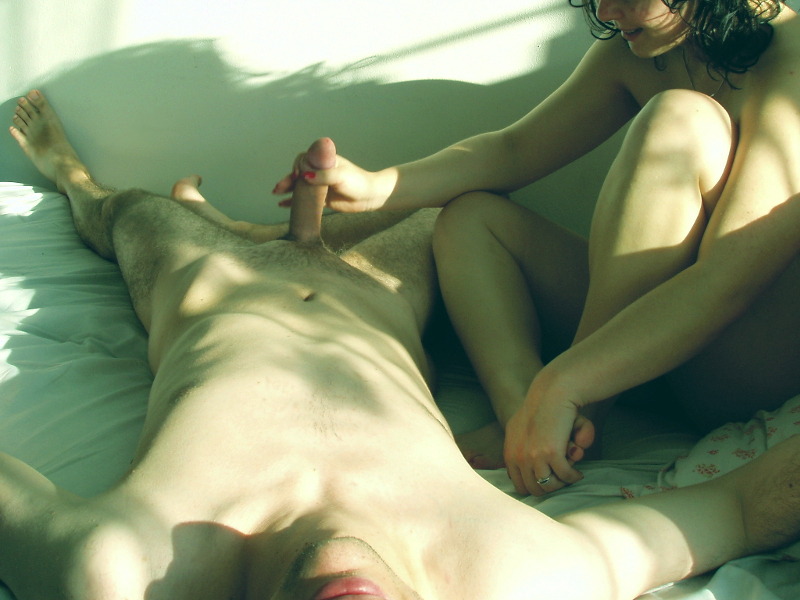
Source: Unknown

This is not an objectively ‘good’ image. Overexposure leaches color from an already truncated palate; while the framing–presumably orchestrated to preserve anonymity is painfully awkward. (Scooting the camera back as little as two inches and squaring the level would have done wonders.)

Still to my eye there is something magical here–although I am not entirely sure how to explain my meaning.

It seems–in my head, at least–more of a still from an amateur sex tape than a discrete image; I keep imagining how things will proceed from here.

Not knowing the source, it seems inappropriate to project my own sexual predilections onto an image that has fuck all to do with me, instead of reading and interpreting things at face value.

Here’s somethings things that grab my attention:

  • Both are smiling in playfully curious/knowingly smirking way,
  • He is laid out, open and on display while she is more curled into herself,
  • His pubic hair is carefully trimmed,
  • Her red lacquered nails draw attention to the slightest bit of motion blur, suggesting teasing strokes,
  • Her hair is a mess, having what could be a either bed head or post-coital, shower wet hair that has dried unevenly over the course or further lovemaking sessions,
  • And, she’s wearing what may well be a wedding ring.

All of it taken together suggests to me the crucial distinction between the taking of pleasure and the receipt of it. One is a central tenet, the prerogative of patriarchy; the other: demands a willingness to surrender, to become vulnerable, to let go and in letting go, letting another.

Josh WoolAmanda – Brooklyn (2014)

You are probably familiar with Wool’s work whether you know it or not: he handled the darkroom/chemical processing of Victoria Will’s Sundance tintypes—which included the final photograph of Philip Seymour Hoffman.

This is a killer portrait. Just fucking lovely. But although I don’t want to slight Wool, I am much more interested in the subject: Amanda Jasnowski.

Full disclosure: I think Jasnowski is blushing-while-staring-at-the-top-of-my-Docs-and-kicking-dirt pretty.

But in light of my previous Jacs-Fishburne-is-a-goddess post, I wanted to take a moment to indicate Jasnowski as another artist who is not only a photographer willing to put herself in front of the camera, she also shares glimpses of her inner world via social media.

As a photographer her work which ranges from unnervingly precocious (i.e. Julia, November) to sloppy whimsicality of the All’s Well That Ends Well series.

That sounds like more of a criticism than I intend and I am not sure it’s envisioned that way but with Jasnowksi, her persona seems less curated and more openly experimental. As if in an age of the NSA, PRISM and digital encroachment into individual privacy, she appears to be externalizing the inner in a purposeful manner—showing her work, owning her process, successes, missteps, mistakes and all.

Which brings me back to this image—there’s a way in which every facet of the presentation cancels out other facets. There’s a vulnerability and a defiance. Softness of hair and light the hardness of the nose, the sharp, uneven crease between her lips. Her hair looped around her neck logically segments the composition which emphasizing the face but also suggests a noose.

It fits with Jasnowski’s persona: accepting the revealing as an act of concealment and merely reporting it as it is.

Holly BurnhamJacs Fishburne (2013)

This is my favorite image of Ms. Fishburne; it is painterly, enigmatic and fucking regal as all hell–it gives me chills.

Truthfully, I don’t care for Burnham’s overwrought, hyper-produced aesthetic. But I do find this image incredible. More and more, I think it’s due to Ms. Fishburne.

I am a not a model so I am wary of assuming any sort of understanding of technique or process. Yet, what I see as a mostly failed photographer is as if wildfires were capable of daydreaming and Ms. Fishburne somehow embodies such dreams in the moment the shutter snaps–not at all unlike Toshiro Mifune’s turns as Sanjuro.

In addition to modeling, Ms. Fishburne is a talented photographer, Her work shares a similar tooth and nail determination to remain present and unselfconsciously aware in a moment. (Actually, her images remind me of Traci Matlock & Ashley MacLean’s collaboration as Rose and Olive, only more searching,)

To do this sort of work–let alone to do it well–requires a well-developed, incisive inner life. It’s not exactly a full access backstage pass, but Ms. Fishburne reblogs work she digs/finds inspiring over at The Imaginarium of Jacs Fishburne.

Really anyone with an interest in the intersection of edgy art with pop culture should check it out. (It’s wonderful and I end up <3’ing about ten percent of what she posts.) But what really thrills me about it is seeing the way that the art and artist sees shapes both who they are and the work they go on to make. This is one of the truly mind blowing applications for Tumblr and Ms. Fishburne is out in front, miles ahead of the pack.

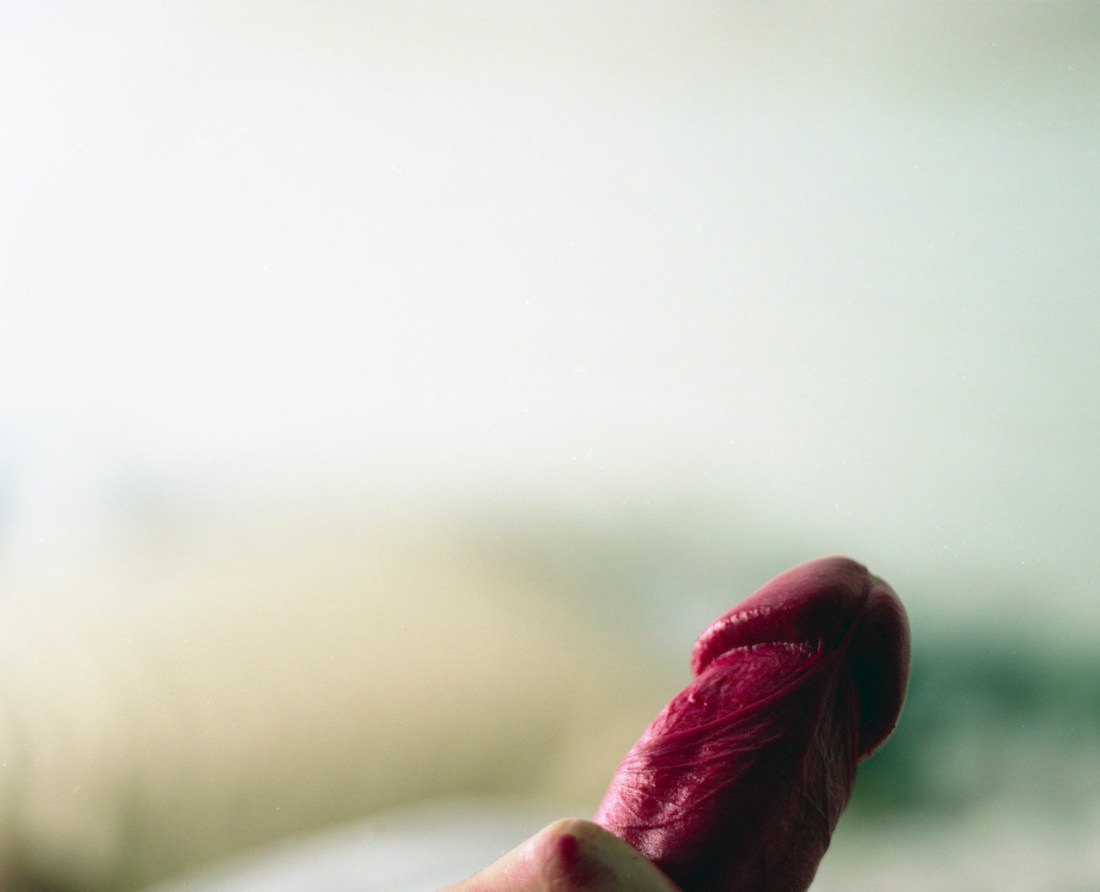
bumblebail:

True Red

Vanity, vanity, all is vanity. – ubiquitous paraphrase of Ecclesiastes 1:2

There’s no way around it: no matter how lovely, this is a dick pic.

Seeing it as such it’s easy to focus on the impetus for such leering color: friction? lipstick? Photoshop? I’m not really interested in that.

I am almost tempted to interrogate the close-up frame and bokeh, attribute them to a so-ascetic-as-to-be-decontextual minimalist aesthetic bent.

But my thoughts drift further afield; circle and finally alight on the concept of vanity.

Carly Simon would have us believe vanity is seeing oneself as the bright center of the universe around which smaller, less bright things swirl.

And any art history student worth their salt will couch things in terms of mirrors.

There is, however, a danger in conflating symbol with meaning–narcissism is decidedly self-sustaining; vanity must feed off others.

In a way, vanity requires empathy.

I want to double back to that matter of this being a dick pic but I feels necessary to suggest a corollary with the so-called selfie.

I am not sure it’s wrong to think of them as vain as long as it is borne in mind that the selfie can also be an ontological document–look here I am in this place-time.

I feel like what makes a shitty dick pic is narcissism combined with ontology–this is me-now, this is my desire which is your desire.

To me that is what this image does so exquisitely well: it displaces any vestige of ontology to elicit an unselfconscious perspective. There is no identity, merely a view one or any lover might glimpse of another.

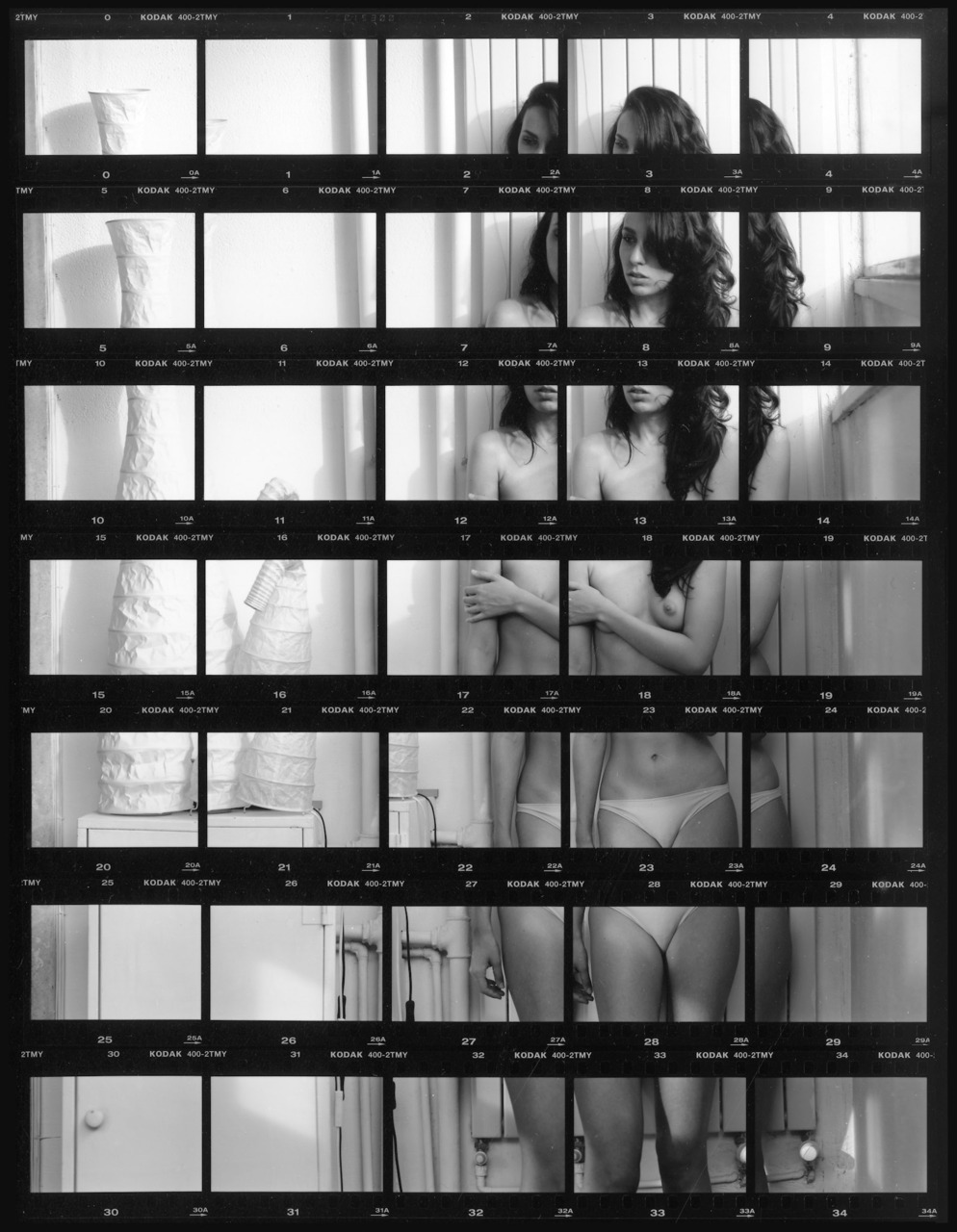
Mario ZanariaAlessia from Pianosequenza series (2011)

When I see this I think immediately of Ed Ruscha’s Every Building on the Sunset Strip(Also, his use of contact sheets.)

There’s also something maybe vaguely Cubist about it, too.

Regarding the work, Mr. Zanaria offers the following statement:

The Pianosequenza (“long take”) project came about through a reflection upon a tool that is closely associated with analog photography, something that has been almost totally forgotten, despite its crucial role in defining the history of photography as we know it.

Usually, contact sheets are used as a working tool. They are utensils needed to make an initial selection from the images captured on film, destined to be forgotten once they have fulfilled this transitory function. Although, when viewed as a whole, they narrate much broader and more complex stories than those visible in the few images chosen, these tales are known only to the photographer and to the few people involved in viewing the “contacts”.

In this sense, it could be said that they have a dual identity: they are fundamental for the photographer in choosing which images will come to life through being printed and made public. However, for those who later view those photographs, which have been selected precisely thanks to the contacts, they remain a complete mystery, or at best, an amusing curiosity.

In Pianosequenza, the roles are inverted: the individual photographs lose their original function as stand alone images, and become the building blocks of a greater whole, making them barely significant (if not indeed pointless) without each other. At the same time, the contact sheet goes from being mere container of frames to be selected, to being the central character, the essential element required for the final image to be revealed.

The end of this project is symbolically represented by portraits of some of the Masters of photography, who have grappled with this tool in the course of their careers. Here, the technique used not only refers to the sitters own work, but also highlights the complexity and wealth found in the setting of the portrait. The individual shots thus become clues, traces of a world that can only be reconstructed by viewing the contact sheet in it’s entirety.

Lastly, the title, which was inspired by the cinematographic technique of filming a scene without interruptions, editing it directly from a camera during a take. As in the cinema, here too the image is edited at the moment in which it is captured, with the frames shot according to a sequence based on the way in which the film will be cut during printing. The final image will only be successful if each single element is functional to the overall view, thus creating a sort of “Pianosequenza”.

Le sigh.

Pianosequenza translates as: ‘sequence plan.’ Due to the pre-planning and necessarily painstaking execution, the title isn’t incorrect in any denotative sense.

The connotation, however, is steeped in cinematographic tradition: Welles Touch of Evil opening, the oeuvre of Andrei Tarkovsky, Chantal Akerman, Theo Angelopolous and Bela Tarr; more recently and sadly plagued by verging-on (if-not-full-on) racist tropes: Cary Joji Fukunaga’s True Detective six-minute nail bitter.

Allowing Zanaria leeway and as far as pianosequenza go, I can’t exactly argue with the assertion that a single frame will be rendered meaningless when divorced from sequential context.

But strictly speaking it’s the replacement of one single, flickering still image with another–the illusion of seamless fluid motion that distinguishes cinema from photography.

In this work, the viewer sees everything at once. Zanaria argues that the presentation de-emphasizes the individual frames in favor of the larger context of the contact sheet whole. I can’t accept that because individual images are not as insignificant–to my eye–as insisted upon by their creator. If nothing else the overarching plan lends an artfulness to them, suggests a seeing of the foreign in the familiar.

One must also bear in mind the conceptual disconnect: pianosequenza are predicated upon a lack of interruption/absence of montage. The work is fundamentally built on montage–smaller pieces strung together to create a broader whole. Further a true pianosequenza would dictate an uncut strip of cinema film; while, the 35mm contact sheet involves at least five cuts.

Ignoring the statement, I am pretty into this work. The trouble is the statement is so overwrought, logically flawed and at a remove from how the work reads that I have to admit I am rather put off by it in the final analysis.

Margo Ovcharenko01 from Without Me (2008)

‘Intimacy’, ‘vulnerability’, ‘trauma’ and ‘stories’ are terms which recur in Q&As with Ovcharenko.

Although entirely befitting, they’re ultimately terms of abstraction.

In other words: what does one mean by ‘intimacy’: loneliness, togetherness, expressions of passion, etc., etc.

Don’t misunderstand: I am hell of fond of her work’s aestheticization.

Still, deep in the mix there’s something either coy and waffling; or–worse–intellectually dishonest.

I think it has to do with the way Ovcharenko speaks about her work.

In any interview with The Calvert Journal she offers the following explanation as to the implications of sex and violence in her work:

Sex and death are two of the most sensitive subjects for humans. The fear of death and the desire to prolong life by the passing on DNA are at the heart of everything. All of the social constructions that allow us to live in cities, such as the police and government, lead to perversions of these basic instincts. I am interested in how that works. I’m like a little girl poking a dead frog with a stick: I am sad and frightened but curiosity wins out. (Emphasis mine.)

It’s an adroit response that eschews abstraction. Viewing her work it’s easy to see her as a well intending child poking a dead frog with a stick.

Yet it runs counter to something on her website. (Note: I may be wrong in attributing the remark to Ovcharenko; how the quote appears is ambiguous due to a muddled layout. It could be attributed to the attribution is the author or several subjects.)

Pornography is an ugly and disgusting phenomenon. Erotic can be beautiful, porn–never.

Besides patently disagreeing with the statement, it contradicts her own admitted impetus for creating: what drives us to pornography except being sad and frightened but having curiosity win out in the end.It’s not merely that I disagree with her here.

Also, given her interest in depicting androgynous/non-gender conforming/homosexual folk, I find the absence of any explicit statement supporting LGBTQ rights considering the total clusterfuck in Russia at the moment to be somewhere between naively, tone deaf and irresponsible/exploitative.)

The last thing rankling me about Ovcharenko needs to be unpacked.

Remember that Wired article to which I took such umbrage: 10 Photographers You Should Ignore? It bothered me that the underlying point wasn’t that you can’t or shouldn’t learn from renowned fine art photographers; it was: unless you are making the work you want desperately to make then fuck off and die because you have no business behind a camera.

Fine art photography is a starting point; a set of initial vectors for approaching material. At some point the process and material will demand a very deliberative departure.

The problem is–just like religion–fine art photography is taught as if it is little more than a trigonometric function.

Until I come up with a pithy term in line with #skinnyframebullshit, I am going to call this approach to fine art photography as a trigonometric function as ‘photography as a function’.

The notion arose earlier this week while I was trying to write about Harley Weir.

I’ve run into her work a handful of times. It’s clean, solid. There’s a unity of content and form, muted colors, grounding in art historical perspective/scale considerations–it is what I expect fine art photography to look like.

But I felt fuck all for the work itself. Until I saw this; my brain did this thing it does where it leaps free associative and anchors images to music. I heard that line where the song says: 

But for now we are young
Let us lay in the sun
And count every beautiful thing we can see

I realized this feeling of being young, in love and overwhelmed by the beauty of everything was the raison d’etre for Weir’s images.

Now: why isn’t that made obvious by the work? Perhaps because there is too much emphasis placed on aestheticization and not enough on simplicity and clarity of effect.

(I dig Heidi Systo but her work is just as much photography as a function as Ovcharenko or Weir.)

I do feel an undeniable connection with Ovcharenko, though. In fairness, while the above dates from 2008, and while her newer work does little to avoid repeating the aforementioned pitfalls, it is at least much sharper.  For example, I am in love with 07 from her Hermitage series. It stands out from the rest of the images as a young girl who is bored with poking a dead frog with a stick, so instead she pokes it because she’s suddenly curious about why poking it makes her sad and frightened.


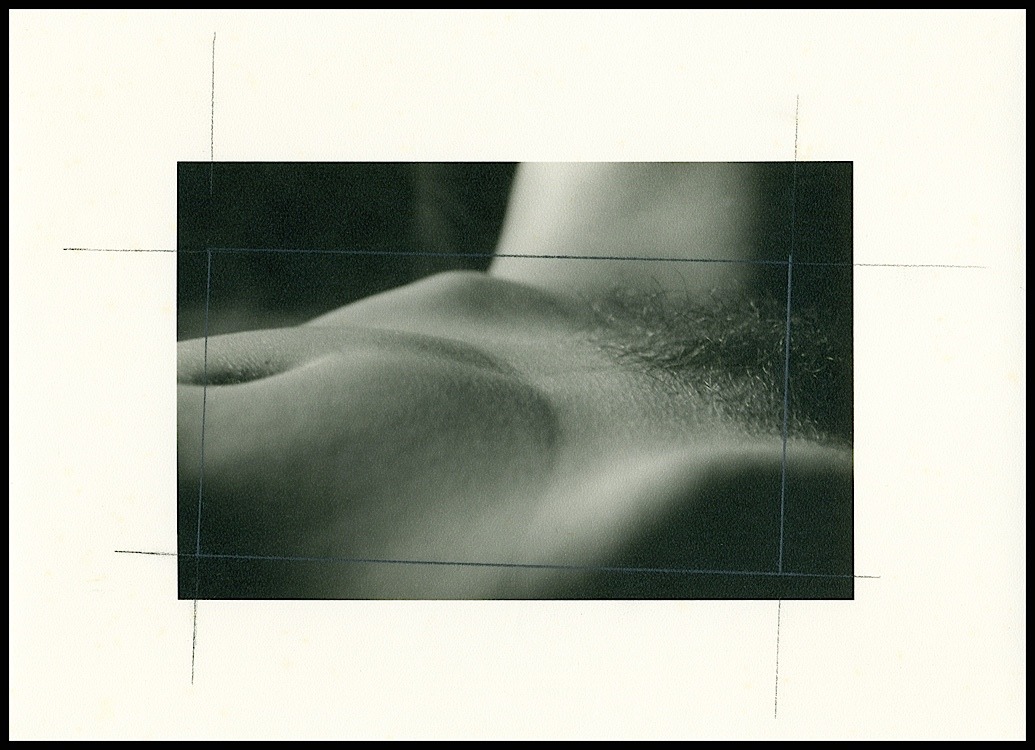
Nina Ai-Artyan10 (20XX)

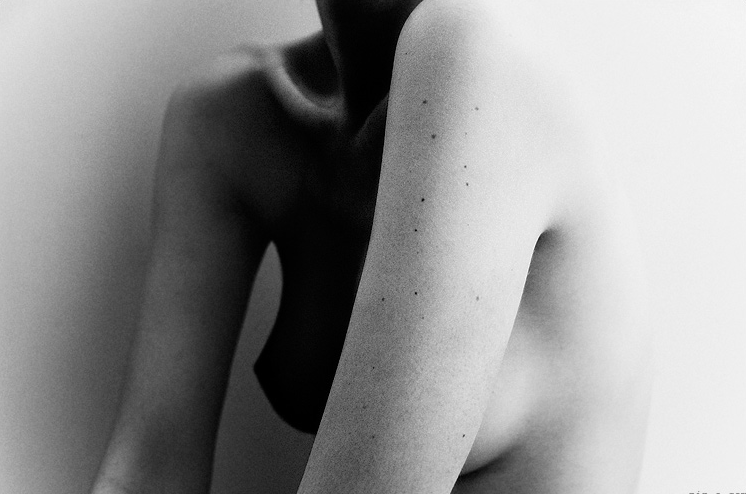
What draws me to this image is ultimately what alienates me from it: the impossible-ness of the boundary between middle-grey and nearly-black running along the inside of her left arm.

It’s meant to look like an analog print–although I’d wager it’s a digitally post-processed negative scan.

There are two dead give-aways:

  1. Although it is possible to exert God-like control over a traditional darkroom wet print; even with Edward/Cole Weston caliber perfect prints, the result will never be as clean as this.
  2. The white at the right-edge and especially in the upper right corner would not produce a tone distinguishable from the paper backing.

Ai-Artyan has done traditional darkroom work. Yes, her prints are sloppy; but accompanying the mess is a sense of struggle, of painstaking labor, a sense ennobling the resulting work in a way from which her remaining work is bereft.

I don’t mean to be overly harsh–the necessary raw materials for greatness are present. All that’s missing are some shift in perspective–inspiration maybe, more likely desperation–and a commitment to the truth underlying the image above everything else.