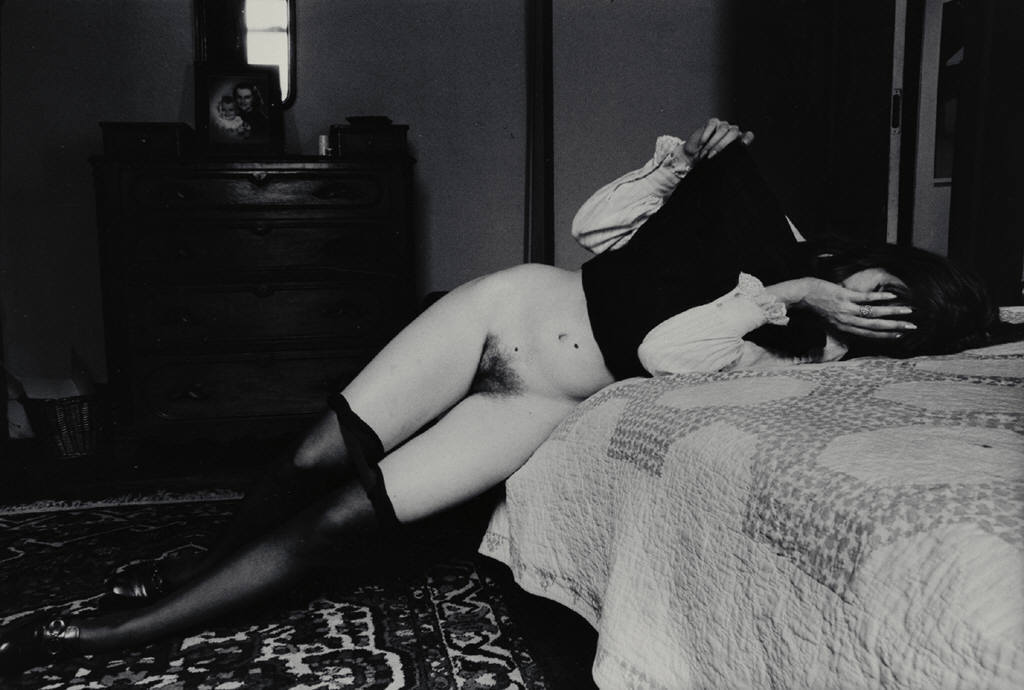
Duane Michals – Untitled 1968
Duane Michals – Untitled 1968

youarecordiallyinvitedtopissoff:
I dig this image. Part of it is definitely due to the latent pyro in me. Plus it captures all the best of what Kowalsky—no, not Kowalski—brings to the table as a violist-by-day/photographer-by-night.
Yet, I feel my response has to address the indebtedness of Kowalsky’s work to Brooke Shaden—whose work I loathe.
What makes Kowalsky’s work attractive—besides the violist bit (I am a love fool for musicians, dontcha know?)—is the manner whereby she dodges Shaden’s derivative interpretations with sincere photographic inquiry. Her images tell the story of how she sees herself as well as how she wishes she was seen.
In other words, photo manipulation is not an end in and of itself to Kowalsky—and make no mistake this and much of her work are composites (to which I normally object but if I’ll give Jeff Wall a pass…); instead, the implausibility of her contrived images recall in-between-ness of the moment after you glimpse something you are certain is impossible and the moment before you looking again to discover it was just the play of the light sparking your eyes’ imagination.
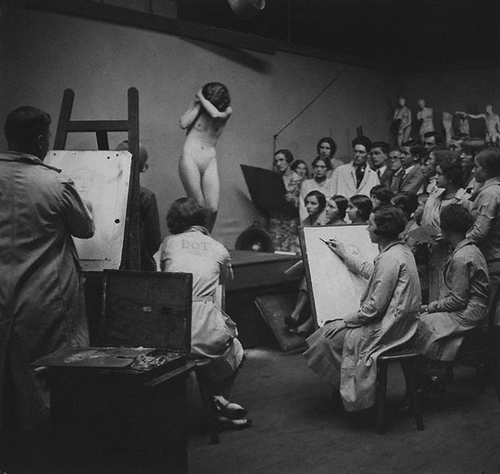
I endlessly bitch about lackadaisical composition so here’s an example of a photograph with fucking impeccable composition to balance things out a bit.
A loose rule of thirds is at work here. The young woman ostensibly nude modeling for a life drawing class stands inside the central-vertical third of the frame while the central-horizontal third of the frame starts at the top of the standing man’s head in the left foreground painting and extends to somewhere between echoed elbows of the two young women—one sketching, one sitting—in the right-hand mid-ground.
To the right of the standing man in the foreground and seated young woman there is a break the guides the eye toward the center of the frame; everything in the center, however, is stationed just inside the third-lines. This has the effect of pushing the viewer’s gaze outward.
What is fascinating is how that outward tension is then countered by the fact that all the eyes in the room are on the model—which immediately draws the eye back to her. Also, Cazneaux strategically positions the pencil held by the seated sketching woman toward the model’s mons pubis.
Unlikely everyone else, whose attention is focused on her, the model seems to be aware of the camera, facing it directly with head bowed and hands raised to cover her face.
One might say something about the constant framing and reframing the eye does on the fly when confronted with this photo. More interesting, perhaps, is the way the composition both insists on itself at the same time it cancels itself out.
Truth be told, there is never an instance in everyday life where a group of people could stand so picturesquely without direction. Thus, the image is inherently stylized. But it does not appear that way—and appears instead an authentic glimpse into an art lesson.
I can’t help drawing a correlation to the Zen tradition of koans, specifically the notorious: what is the sound of one hand clapping?
Victor Hori offers one of the best commentaries on the purpose of the question:
…in the beginning a monk first thinks a kōan is an inert object upon which to focus attention; after a long period of consecutive repetition, one realizes that the kōan is also a dynamic activity, the very activity of seeking an answer to the kōan. The kōan is both the object being sought and the relentless seeking itself. In a kōan, the self sees the self not directly but under the guise of the kōan… When one realizes (“makes real”) this identity, then two hands have become one. The practitioner becomes the kōan that he or she is trying to understand. That is the sound of one hand.
youarecordiallyinvitedtopissoff:
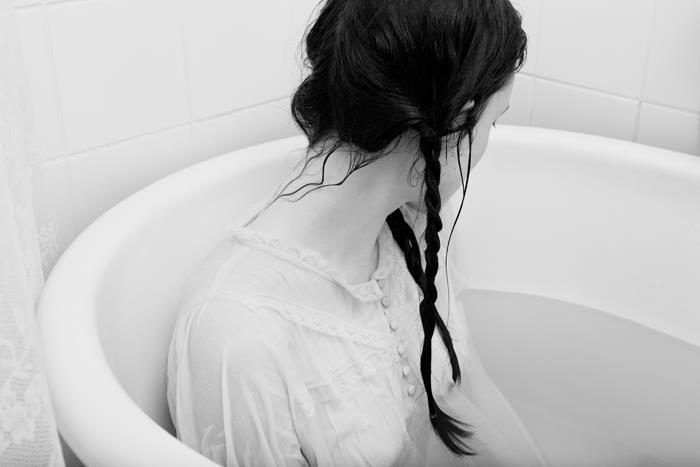
The dreamy ethereality of Jessica Silversaga’s work compliments her affection for fairy tales.
Despite their suffused light and idyllic innocence, her images have nothing in common with the ubiquitous Disney versions except the subject of beauty. But where the mass market films reify the notion that goodness always carry the day, Silversaga’s images employ the mechanism of the original materials—wherein the brutality of cruel, pricking thorns frame the delicate rose, rendering it all the more beautiful as a result of sinister intentions.
The brilliant white of tiles and tub, the few clinging strands of wet hair escaping thin braids at her neck and her averted face are replete with beauty.
But why is she turned away. I question whether she has a face– perhaps there is nothing but ragged skin lining the edges of a gaping black void.
Maybe such a response is a result of having seen too many horror movies. (Although I do not think I am entirely off base… she is after all turning left and as the eye enters the frame and passes left to right over it it becomes clear there is nothing she can be looking at. Interestingly, if this image were flipped and she was looking to her right, I think the singular thought would be she was merely turned away.)
It does not matter whether she has a face or not, what matters is her knowing what it is to hold chaos in one’s palm because like us all she too has a body.
By knowing this, we also know she is not another dime a dozen damsel waiting for deliverance from distress.
She is the thorn and the rose. As are we all.
Sex isn’t something you do, sex is a place you go. It’s a space you enter. Inside yourself and with another or others. So where do you go in sex? What parts of you do you connect to? What do you seek to express there? Is it a place for transcendence and spiritual union? Is it a place for naughtiness? Is it a place to be safely aggressive? Is it a place where you can finally surrender and not have to take responsibility for everything? Is it a place where you can express your infantile wishes? What comes out there? It’s a language. It isn’t just a behaviour.

Lina Scheynius’ photographs are above all sincere in their straight-forward simplicity and lack of self-conscious pretense—capturing not only the truth of a moment but something of the initial wonderment which sparked her mind and brought the viewfinder to her eye.
Like many young, internet-famous image makers she works at the interstices of documentary, editorial and erotic photography but her handles the material with a rare prescience.
Take this self-portrait where she appears starkly naked but protectively curled up on a leather couch. She is both seen and unseen.
I cannot help but apply that to her sense of herself as a photographer. She presents the world she sees from behind and through her camera. This is especially interesting given familiarity with her larger body of work as she takes great pains to push her personal boundaries more than her models.
In the minefield resulting from conceptual concerns over the visual representation of sexual identity and body politics, although what Scheynius’ is about is perhaps more instinctive than the collaboration between Traci Matlock and Ashley MacLean, it is no less vital or interesting.
And frankly, there are a lot of photographers who could learn something from this. I am sick unto death with voyeurs hiding behind cameras snapping away as they have models enact their most deeply repressed fantasies. (I am thinking here of an individual who I would rather not name but will give apply the psuedonym Reynard Yale.)

youarecordiallyinvitedtopissoff:
The color of the wall is highly complimentary to her skin and emphasizing both the translucent white and indigo pattern in her wonderful bra as well as the reddened impressions of the straps on her back.
It reminded me of a similar image of marks left by a bra but more than that it reminded me of a pose figuring prominently in perhaps the second most transcendent sexual experiences of my life.

I am not just an analog purist when it comes to photography: take your Nook/Kindle/iPad and shove it up your ass sideways.
Give my hand the solid heft of a book, smooth texture of cover and spine against my skin as it spreads open, beckons my gaze, waits for fumbling fingers and claims my mind so completely for a time.
And the smell…
So, in summary:
1. Books are hell of sexy as fuck.
2.This had me from lesbian foreplay in a bookstore.
Being a book loving nerd makes me no stranger to bookstores. But I have an affinity for them I don’t know how to explain except to admit that books very nearly jump off the shelves and latch onto me. (Also, I want to visit the Ryōan-ji Temple one day and when I imagine what it will be like it always feels the calm, timelessness that I almost always fee in bookstores.)
But there’s also Fowles’ The Magus and Franzen’s The Corrections framing the head of the young woman whose undergarments are being removed—both of which I have read and enjoyed to varying degrees. (Leave the Franzen. Take the Fowler.)
These tiny points of familiarity engage me with the tableau.
Right off, I notice the woman being undressed is not entirely comfortable with transgression of personal boundaries but remains nonetheless consenting.
This resonates deeply with me. See: I am borderline autistic and as a result have zero ability to negotiate expectations others have for/of me. As best as I can tell this is a result of my inability to understand inconsistencies in the personal boundaries of others.
A tact I have learned for managing this is to assume everyone I meet has the most highly restrictive personal boundaries I can imagine until I discover some evidence to the contrary.
This has the benefit of preventing many otherwise unnecessary misunderstandings with strangers and acquaintances. But it causes problems as I only know where I stand with them when they tell me. And in relationships such a prerequisite is not exactly desirable.
The only thing that works is the rare person who enjoys pushing personal boundaries and is completely unprepared for someone who almost completely lacks them.
All that is to say: I would give anything to trade places with the woman and have my friends who I trusted completely begin to undress me daring me to stop them. Knowing they would if I asked and knowing that I would not.

Untitled
Is it me or is there something almost post-coital about the way this feels to the eye—towel-wrapped, shower-wet hair and still damp skin sheathed in afterglow and diaphanous light?
In spite of being digital, I wish this were an image I had made. It exemplifies so many imagistic attributes I hold dear:·
All that is missing is a narrative seed, one moment suggesting what came before and what follows. But this is more of a tone poem, it would seem.
Tone poems, though, are slippery as eel skin. And there is a tendency to use them as an excuse for untouched inconsistencies.
For example, the framing here pans the camera slightly right to ensure the golden light on her back appears reflected in the mirror; this wawker-jawing complicated by the extreme wide angle is nearly balanced out by the uneven curtain rod’s counter-angle—keyword: nearly.
Also, her pose is odd. It is clearly staged but she holds it in such an unself-conscious way that it from avoids appearing contrived.
These inconsistencies cut both ways: justifying the unresolved aspects as endemic to the work is what makes it great; it is also what keeps it from being truly exceptional due to such justification obfuscating the implicit awareness the image provides of viewing something up to a terminal point—the snapping of the shutter—and then being left with little except the technical inconsistencies to ponder for clues that simply don’t exist.
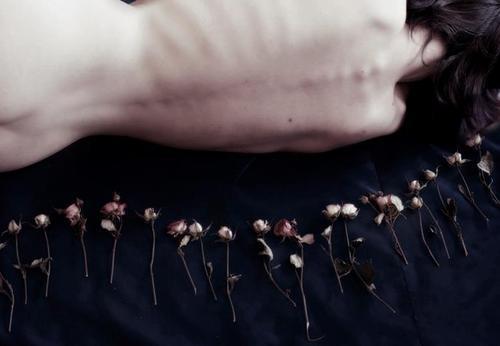
 Acetylene Eyes