When printing something one is given two options: portrait or landscape.

As best I can tell this is a vestige of painting: vertically oriented images were favored for portraits while horizontal frames lent themselves to the panorama of landscapes.

Although arguably more of an unconscious convention in painting, this logic has been actively internalized by photographers and virtually enshrined by digital image makers.

The trouble is two-fold: the logic of photography is not interchangeable with the rules and precepts of painting (no matter how the latter interpenetrates the former). When applied to each other, these conventions produce schizoid, contradictory compositions.

Photography—and by dint digital imaging which however misguided is based upon it—has internalized the landscape orientation.  Unlike painting, I do not think this internalization has been unconscious—after all, if you have ever looked at a strip of 35mm film on a light-table there is an easy-to-see bias towards horizontal framing. (I am so accustomed to this that when I encounter vertical compositions now, I tend to tilt my head sideways when looking at them.)

Portrait orientation is not without its uses in photography and digital imaging. Unfortunately, it more often than not contributes very little to the compositional ‘sense’ of an image; serving expedience by quickly fitting the subject to the frame—instead of forcing the image maker to contemplate the discontinuity between the subject/frame and subsequently address it in a more artful manner.

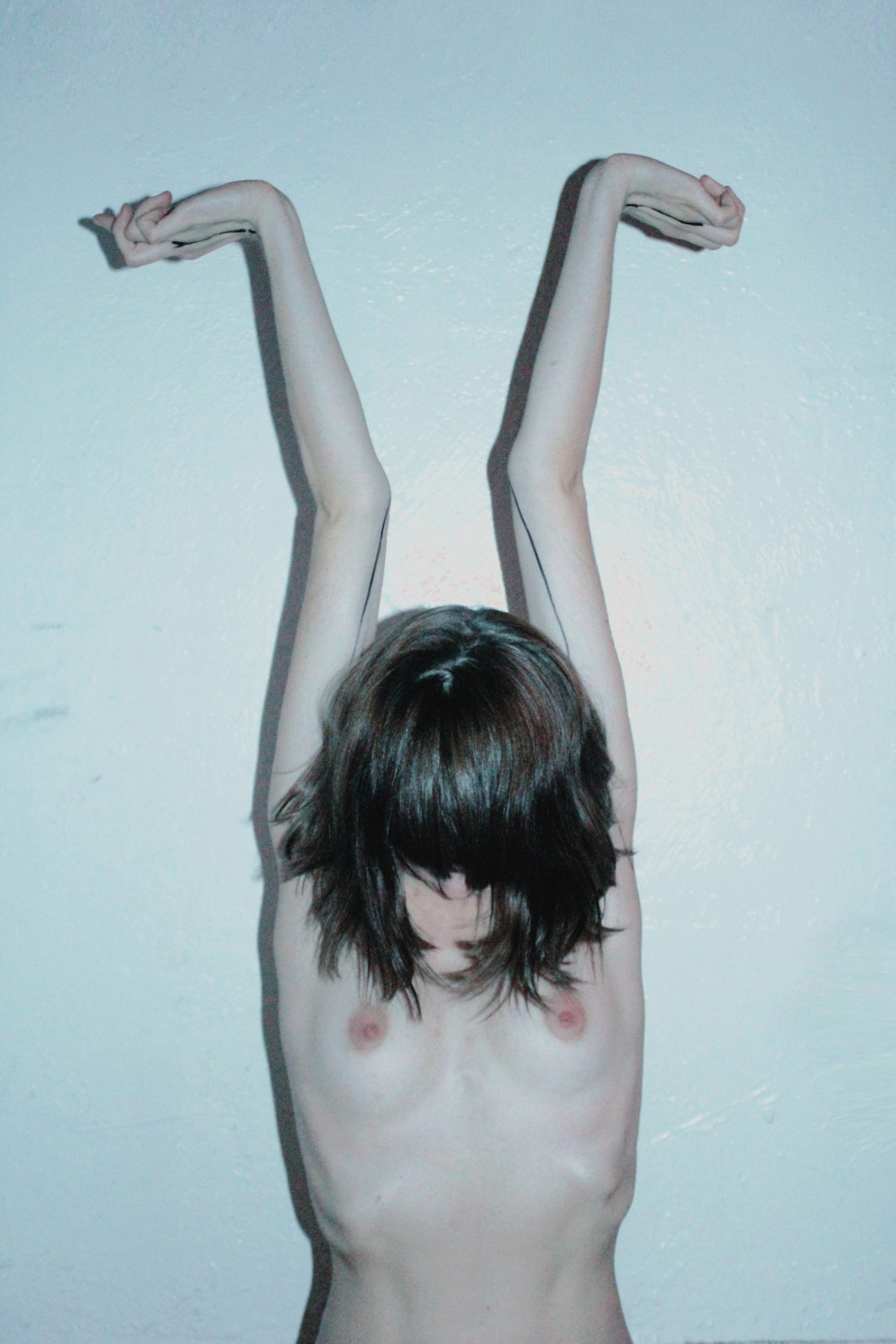
The above has almost certain been cropped. But I would wager its orientation was originally vertical. (The individual responsible for the image contacted me with assurances that the image was originally horizontal but was cropped to accentuate the vertical.) And although I think horizontal framing would have worked better (EDIT: Having seen a sample of the original image, it is better), I will admit that unlike the vast majority of portrait orientations, the image maker is clearly aware of the manner in which the shift affects how the image is seen.

The frame echoes the subject’s form. On its own, that is the worst of lazy justifications; however, in this case the poses, the simple line work of what I find to be one of the sexiest tattoos I have ever seen and the narrowed view work as a visual approximation of the feeling one gets from indulging in a much needed stretch.

Further, the portrait orientation allowed the photographer to be closer to the model, lending a sense of heightened intimacy while also preserving anonymity.

Finally, I would be remiss not to admit a large part of my reason for posting this is the model’s unnerving resemblance to someone upon whom I currently have a maddening crush.

[I]magine what would happen if, instead of centering our beliefs about heterosexual sex around the idea that the man “penetrates” the woman, we were to say that the woman’s vagina “consumes” the man’s penis. This would create a very different set of connotations, as the woman would become the active initiator and the man would be the passive and receptive party. One can easily see how this could lead to men and masculinity being seen as dependent on, and existing for the benefit of, femaleness and femininity. Similarly, if we thought about the feminine traits of being verbally effusive and emotive not as signs of insecurity or dependence, but as bold acts of self-expression, then the masculine ideal of the “strong and silent” type might suddenly seem timid and insecure by comparison.

Julia Serano, Whipping Girl: A Transsexual Woman on Sexism and the Scapegoating of Femininity (“Putting the Feminine Back into Feminism,” pg 329)

Damned if this didn’t just jump to the top of my reading list.

youarecordiallyinvitedtopissoff:

Blue over green fields and a distant siren sings muted rendition of fire engine red—the world’s colors are so effusive sight often spills into sound.

Black and white photography distills the manifest to its base visual elements: “light, line and form.”

Whereas color photography displays the world more-or-less as it appears. Among the keepers of culture, this begged questions as to the inherent art value of color in photography. What criterion could separate mundane snapshots from carefully considered works of art?

William Eggleston was one of the first to breakthrough this impasse. His use of color worked as a logical extension of his compositions and was anything but incidental.

Today, color is viewed as having equal viability with black and white as a medium for fine art photography. And while this allows photographers to focus on one or the other without recriminations, questions about the purpose of color in photography still linger.

You Are Cordially Invited to Piss Off posted this photograph by Ahndraya Parlato, who fuses a contemplative spirit with edgy surrealist hallucinations on sheets of large format film. The results are goddamn breathtaking even if the work is in color not about it.

The preceding image is a stunning exception: a young woman—framed from midriff to mid-shin—lays splayed on a green lawn flecked with autumnal leaves in a wet red dress; clear water pooling in the fabric between her thighs—a doubtless intended visual innuendo.

There are themes of sexuality as potential, the elemental (earth, fire and water) and I am of a mind that there is an auto-biographical element (every dead leaf in the frame appears specifically placed to me). However, it is impossible to dodge the insistence of the color in any conceptual consideration; the red and green complement one another perfectly, the skin tone, a touch sickly as a result of the hyper-stylized color. Stylization masked by echoing the pooled water with colors approximating the heightened saturation after rainfall on overcast days.

On Post-Orgasm Torture

At some point during a man’s orgasm, fluid stops being pressed into the urethra.  In some men, this ends the process of ejaculation, and continued stimulation of the frenum and corona has little or no effect.  In most, though, it brings only a need to end the process of ejaculation, and continued stimulation keeps the reflex spasms going, accompanied by a feeling of distress at being unable to stop them. Few women get the opportunity to observe this phenomenon; a man whose orgasm has gone on long enough is usually in a position to end the stimulation without making his partner aware of his vulnerability.  Some men, though, become so sensitive that when they fuck, they need to pull out immediately after ejaculation; the continued pressure of the vaginal walls on the frenum and corona, even in the absence of motion, is too much to bear.  If you’ve had such a lover, you’ve had an unusual opportunity to observe the male need to protect the penis from prolonged stimulation, though he might never have explained what was happening.  (Men, as we’ve seen, tend to be secretive about their vulnerabilities, and there’s many a man who would rather leave you feeling puzzled and rejected by his hurry to put some distance between you than let you know that his cock is too sensitive to leave in your pussy.) 

Most men don’t become quite that sensitive, but continued active stimulation of the frenum and corona causes them distress.  You’ll see it if you’re fucking your man from above and you hold his wrists down, tighten your vaginal muscles, and continue thrusting after he’s come; or if you tie his arms away and continue rubbing his frenum and corona with your hands after the spurting of fluid stops. If you want to hold your man in this state — and I recommend that you do, at least occasionally — there are four things you should know.  

First, it can’t do any harm. The distress of continued stimulation isn’t pain (though some men may call it that) and it doesn’t reflect tissue damage — not even temporary damage.  When you stop, your partner’s distress ends immediately.

Point two:  When you stop, even for a few seconds, the ejaculatory spasms also stop.  If you resume stimulation, it will have little or no effect, so don’t take a break until you’re sure you’re done. 

Third, the stimulation you apply must be specifically to the frenum and corona.  The nerves that end there are the only ones that reliably force continuation of the ejaculatory spasms; if you milk the shaft alone, the spasms will end, comfortably, when the supply of fluid runs out.  (If your man is an exception, great!  But don’t expect it.) 

Fourth, your man’s cock itself will give you some help.  You can feel the continuing spasms and use them to time the motion of your hands, which makes for a much more effective sort of stimulation than a random beat.  And for as long as you keep the spasms going, the process of detumescence is slowed, giving you a convenient degree of resistance to rub against.  Usually you can even continue fucking if you don’t give your partner clearance to pull out. 

I do not like the association with torture. At the same time what expanding boundaries of sexual pleasure with a male bodied partner may add in clarity, gets lost in the lack of brevity.

Either way, it’s worth giving a whirl.

On Post-Orgasm Torture

Grow your vocabulary

sookie-m:

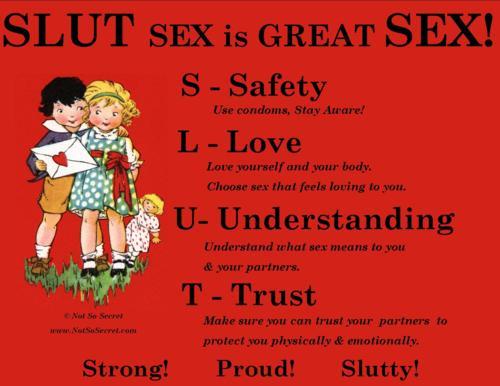
Why can’t people just say, “she engages in a lot of sex.” in a matter of fact way instead of saying, “she’s a slut.” do they not know what negative connotations are associated with the word slut? What the hell is so terribly wrong about being a female who enjoys sex? I’ve permanently deleted these words that are specifically meant to bring girls down from my vocabulary. I really wish not to perpetuate shame.

In theory, I agree.

The trouble is whether I choose to use a word or not—the word persists; and those who use it further stigmatize its connotation through their use.

Why can’t we ditch the bullshit shaming of female sexuality and reclaim the word? Its been done before.

Here’s a wonderful example:

source: http://safecampaign.tumblr.com/post/19741136475

(Source)

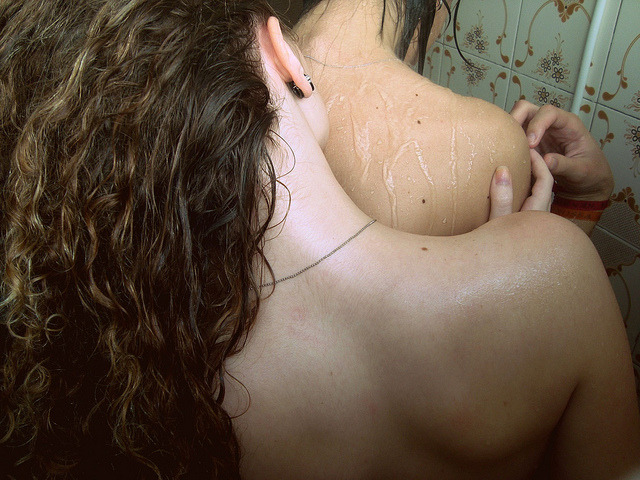
A mass of thick dishwater curls pulled aside—dry except where darkened behind an ear, down her back.

Shower mist glistens along a shoulder, the angle of her neck—a second skin.

Invisible lips press against the spine, a slow finger tracing a familiar line—A bout de soufflé.

Tongue sealed up soft in her mouth like clay beneath a highway where she waits in memories amid seasons of traffic and lulls praying to taste the wet sting as vertebral notches open her like jagged teeth of a spinning saw.

(Standing in line for a movie once, there was a girl dressed in backless black with bandaged stitches all down her back. I came within an inch of touching her wound before realizing what I wanted to do, that I shouldn’t.)

The words to truth are terrifying. I am trying to say: do whatever it takes to open me.

Maybe a week or so ago, the lovely sextathlon re-blogged a post featuring images of Michelangelo’s David side-by-side with a photo of a nude male pin-up appended with an question as to why the former is defended as Art and the latter is deemed obscene.

My suspicion is that the party line runs: the skill required to carve a nude dude from a chunk of marble exceeds what is needed to plunk a hunk down in front of a camera.

The dichotomy really centers on the way male nudity challenges invisible assumptions, i.e. the spectator will be straight, white and male or deferential to such a perspective.

Michelangelo was likely gay, David—a homoerotic sculpture. But Renaissance aristocrats didn’t get their dressing gowns in a twist because the work was conceived with fail-safes to diffuse the “gay”: the contrapposto of Greek statuary was the lingua franca among Firenze’s intelligentsia; also, naming the piece after a mensch who was such a bro that he had a man killed to bone his wife further obfuscates its homoeroticism.

On the other hand, photography is a relatively young medium and as such there are fewer ruses to diffuse perceived affronts to the invisible ‘heterosexual norm’. Thus: an image of a cock is, well… a cock—and most likely totes gay.

Pornographers, and trench coat clad old men standing on street corners, have done fuck all to ameliorate matters. Both reduce heterosexuality to metonymy—men are their swollen manhood; the sight of which is somehow sure to start vaginal secretions dripping down thighs.

With all that bullshit, I guess people see the hairless semi-hard cock tucked between the boys shaved legs and immediately dismiss the image as “gay.” Maybe, they are a wee bit sensitive and wonder about the subject’s ambivalent gender identity

Fuck that noise. And should your eyes’ appetite not be omnivorous enough to appreciate the meticulously considered, conceived and constructed pulchritudinous depiction of longing, then fuck you, too.

The first thing I notice—okay, truthfully the second: the first thing I notice is the muddled lighting design—has something to do with the difference between ‘work’ and ‘labor’.

I am not especially fond of work and I tend toward laziness.

Work is not a thing from which I derive pleasure. I do it because I prefer a certain degree of misery to living on the street at the mercy of my growling empty stomach.

Labor, on the other hand, while not necessarily intrinsically pleasurable does possess the capacity to induce joy.

Even that is perhaps too abstract. A better way to put it would be saying: work is unloading the truck; labor is not unlike making a game of unloading the truck.

On the surface, that sounds stupid. But everyone has experienced this transformation of dull, repetitive tasks into games: Joe stacks boxes on the loading dock as quickly as he can with Margie hefting them onto a conveyor belt even faster in an effort to allow her to stand around—if only for a second—and gets to friendly needle Joe about how slow he’s moving.

Sex is a form of labor; or, it should be—with give and take, friendly but unrelenting pushing of boundaries.

One gets the feeling that these two young women are working. This is a job for them. But their eye contact, the intense focus of the woman on the left and the pink flush to the girl on the right suggest that both are holding back, racing to make the other first in succumbing to a shuddering ecstasy.

But unlike most races, there are no losers—only winners.