Suffering through a long bout of writer’s block years ago, someone trying to be ‘helpful’ mentioned George Polti’s notion that all literature boils down to Thirty-Six Dramatic Situations.

I considered the assertion bullshit and still do to an extent, though certain objections have softened; for example: I am inclined to accept newness mattering less with regard to dramatic situations than does innovations in their means of conveyance/form.

While I was thinking this well before starting this Tumblr, the stunning lack of variation in content and form of images crossing my dashboard supports Polti’s thesis.

Thus, when an image like this appears, it stands out.

A young couple fucking in a vehicle—the content—is not as compelling as the execution—the inclusion of both their bodies full in frame and in doing so there is the suggestion of a broader context in which the scenario is unfolding (i.e. a truck cab parked somewhere in the woods).

I could toggle the greyed out heart icon to red and be done with it. But a technically accomplished and innovative shot is not enough for me. There has to be something more. Otherwise it is not unlike so many movies where a superb conceit gets squandered by half-assery.

And vertical framing is almost always half-assed. Let me spell it out as clearly as possible: ninety percent of the time identical information can be better conveyed by a horizontal frame. Of the remaining ten percent, eight consist of architectural images.

There is enough space above her head and below his that a horizontal frame would have provided the same information. I understand the existing frame echoes the positioning of the subjects. However, that logic is equivalent to the infamous parental famous because-I-said-so justification for nonsensical orders.

A horizontal frame unquestionably demands more and more difficult compositional choices be made. For example, do you keep the couple centered in frame or do you shift them off-center, letting more of either the windshield & hood or truck bed into the frame?

The implicit logic behind the vertical framing belies the real trouble with the image: it is self-consciously pornography.

That’s not a bad thing. The problem is pornography has a habit of separating sexuality from any interpersonal context: sex is an appetite, after all; all-too-often pornographers present appetites independent of the hunger that serves as their impetus. In other words, sex is presented as its own justification instead of something motivated by desire, passion and naked human need.

Imagine how much more moving this image would be if the boy didn’t appear to be doing a sit up, his head lulling back, biting the corner of his lip; his right hand caressing her left inner thigh.

If there is anything democratic about image making, it is technical acumen mattering little next to being present and ready at the most perfect moment.

The soft focus and sloppy composition amplify immediacy here—the boy with his belted jeans unfastened but as yet unshed, the young woman’s spine and pale skin spilling out of the zipper-opened dress back, the way her braced toes arch her heel, giving her body a sense of forward momentum. I love it all.

But what gets me most is the young woman blocked from view by her lovers’—the boy’s mouth surrounds her clitoris as if it were a nipple; her pulling the other young woman toward her with her right hand into an implied mess of lips, bone-hard teeth and searching tongue tips.

I would give almost anything in the world to trade places with this unseen girl—to know such rabidly dangerous wanting, to feel its reflection turned against me.

The oft trotted proverb goes: good artists borrow; great artists steal.

Whether it was T. S. Eliot or Picasso who provided this sentiment and regardless of any inherent merit, this has become a prima apologia for shitty artists the world over.

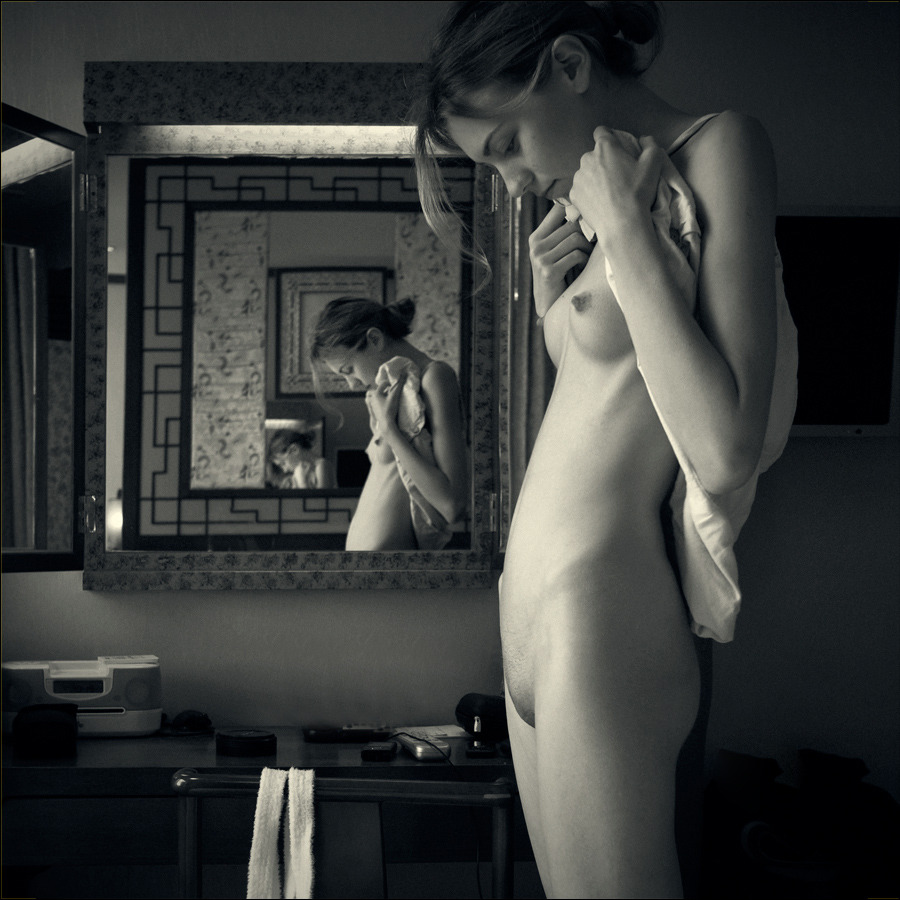
With its focus on a scene unfolding in a room lit from frame left, this image ostensibly borrows from Vermeer. Yet, unlike Vermeer—whose canvases present their subjects en media res: reading the final lines of a letter, pouring milk—this woman actions are ambiguous, her pose highly contrived in an effort to appear natural; however, consider what situation might require her to so pull her gown up around her shoulders and face away from a readily available mirror in order to stare down at her nude body?

I would be very surprised if the individual responsible for this image was unfamiliar with Vermeer. However, borrowing here from Vermeer is like asking a friend to lend you a designer sweater to wear with your new backless red dress. 

The theft that does work is from an artist I would wager is unknown to the image maker: VelázquezLas Meninas specifically

Mirrors have a way of fucking with subjectivity. Velázquez depicts the subject—that is, the king and queen—only in a faint reflection; the scene instead focuses on the artist—presumably Velázquez himself—painting. At the same time, note the painter is considering both his subject and we the spectators.

The mirroring in the image above is less complicated but does produce, if accidentally, an interesting effect. By angling the camera so it views the reflection without being itself reflected, as well as the inclusion of the reflection of the young woman’s face reflected from a smaller mirror along the so-called fourth wall gives the room an implicit dimensionality. An implicit dimensionality that, in effect, deletes the physical presence of the camera from the scene; muddling matters of subject/object, observer/observed along with the questions of exhibitionism and voyeurism accompanying them.

amorsexus:

robert mapplethorpe / bush

For me, the cloud of controversy surrounding Robert Mapplethorpe’s photographs becomes a filter through which I see them.

Mapplethorpe’s focus on taboo/pornographic content courts outrage. But it is an outrage unlike the allegations of child pornography leveled against Sally Mann for Immediate Family or claims of exploitation dogging Nan Goldin since The Ballad of Sexual Dependency; it is intended. Mapplethorpe invites a visceral reaction, even if that means pissing someone right the fuck right off.

Were that all he were about he’d be no more relevant than any other shock-solely-for-shock’s-sake artist. What makes Mapplethorpe matter is his realization that for good, bad or ill: even being pissed off at it necessitates at least some degree of visceral engagement with the work.

A dangerous thing when the work possesses a deep wonderment and the  taboo/pornographic content is carefully underscored with an uncommon intimacy. Even more upsetting when technical craft is so stunningly refined—and not for its own sake, as a testament to a belief in the labor owed as a result of being allowed to bear witness to profound beauty.

This is may be why Mapplethorpe’s work remains controversial—one either sees and embraces its beauty or the dissonance between authorial intent & audience reaction creates a deafening feedback loop.

(Then again, I could just be floored by finally finding a depiction of fisting that despite being a bit too much of a close-up is masterfully executed and resonates with my experiences of feeling my hand encircled tightly with wetness and warmth.)

William Eggleston – Two Girls on Couch 1976

When photographers gather and conversation turns as it will to Eggleston, you hear a lot of talk about color. After all, the man all but made color photography a meritorious visual art medium single-handedly.

What everyone misses in the justified fuss and bustle over grand spectacle of color is just how deliciously subversive the work is—rich with subtly deviant, transgressive flourishes.

Take the Red Ceiling: check out the poster edge stretching into the lower left corner of the frame; and how damn fucking creepy is this one yet you don’t stop to think about that because the print is so warm, mellow and aesthetically pleasing.

Eggleston is unrivaled in inciting within the spectator an understanding of why—visually speaking—the photo was taken without being aware that such understand implicates the spectator in the artist’s gleeful disdain for anything conventional.

Yes, Two Girls on Couch is not overtly sexual. At the same time, it is not asexual. It focuses on a slippery intimacy, how crossing that perilous bridge over the chasm of puberty changes our instincts with regard to bodily relationship to others.

The fluidity of girl-childhood and femininity in a shimmering ghostly game of leap frog. Customary lines of communication shorting, reconnecting, fading. Being your self to another no longer fits as well, pinches at the seams, effort a new ingredient to produce the same old recipe.

If this possessed the sumptuous colors of Eggleston’s dye transfer prints, the voyeurism of these girls intimacy would read as a leering older man fetishizing a moment he is outside.

Make no mistake such undertone belongs here even though it has been carefully diminished with harsh lighting (a single overhead bulb?)—atypical in Eggleston’s oeuvre. By checking the customarily sumptuous color, the focus shifts away from the artist’s craft and more toward the immediacy of the moment. 

This is not porn. It isn’t exactly transgressive either. But to not recognize the way it edgily toes the line is to miss at least half of what is at work here.

I dig the shit out of edgy. All the better when the craft is fucking impeccable.

Groupo SitcomCactus 2012

I have no idea whether this is a print—though the bent edges look a bit too thick; or, if it is some type of instant film with which I am not familiar.

Either way I like it a lot. It handles bright sunlight in a fashion similar to Polaroid’s discontinued Spectra 990 instant film with a little bit more latitude for underexposure.

The manner in which the image is composed is sublime. The swath of golden light draws the eye from top left across and down the frame to the bottom right. There is a balance between positive space (skin) and negative space (the more underexposed parts of the frame).

Note: how the hand—you really have to look to see it—in the upper right balances the sliver of cushion or whatever in the lower left corner.

I normally do not like close ups. But this close up provides just enough context to determine that the subject is in a room, presumably seated in a chair with a potted cactus shading her mons pubis—and what a beautiful but scant shadow it casts on her skin—if you look close enough you can see its texture.

The cactus is a loaded, ambivalent symbol—needing careful tending, not too much or too little irrigation. They are also spiny, dangerously self-protective.

But while the cactus is certainly hers it is separated from her by a clay pot. As such it could represent something that from one angle seems a threat to her tender areas but when the light translates its form to shadow; its threat appears diminished—a little beautiful even.

This strikes me as a carefully constructed scene suggestive of a male and female perspective. It is explicit while simultaneously remaining completely aloof.

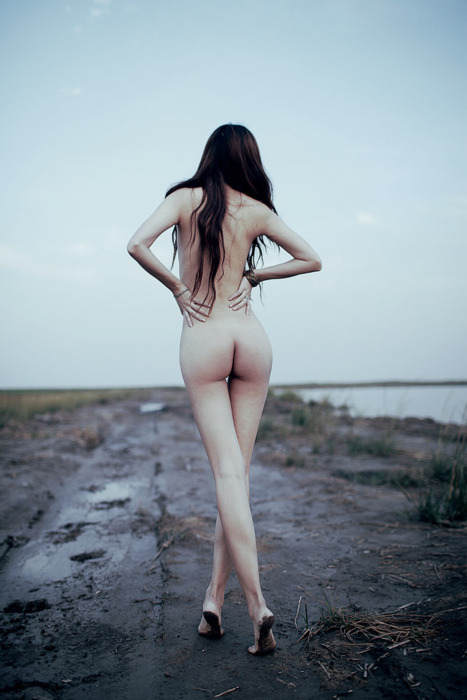
Why is there so often an direct relationship between sleek, high-production value and imagistic vapidity?

I mean, this image looks stunning. The color is controlled, Albers-esque. The light is just so—morning golden hour most likely, with just enough a kiss from the flash to provide a slightly unearthly skin tone.

But what is this photo trying to convey? All there is to go on is a naked woman with her back facing the camera, her legs crossed in a very contrived pose and the washed out and muddy track on which she stands has stained the bottom of her feet—somehow impossibly also visible.

As with 90% of all instances of vertical framing, nothing is added by this decision—except to make the woman appear taller.

This does succeed but recasts the image as a fashion image that is not selling fashion; sells an aesthetic instead. I suppose that’s fine but without something behind that aesthetic, it is all rather empty.

A better way to criticize this image is to imagine it framed horizontally. (Go ahead and keep the contrived posture.) How does her position in the environment change the questions you ask of the image?

For me, with a horizontal frame the questions I ask generally becomes less about what I think of her and her situation and more wondering what she thinks about herself and her situation.

Top: Most pegging shots focus on the shifting of the power dynamic. You won’t hear me argue that is not a part of it but it is not what interests me—I am not interested in the pain so much as the openness to sharing a side of oneself ones lover might not otherwise known. This is the only images mostly met my blog worthy criteria. I do like the way she is grabbing his ass—both holding and spreading it. Also, that she is watching attentively to how he is responding to is being done to him is great.

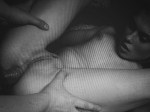
Bottom: I have problems with this image: the framing dismembers her body, the focus is on her expression, left nipple, bare vulva and erection partially inserted into her asshole. I’ll allow that at least she does have some sort of pubic hair. The reason I am posting this is its aesthetic is one of those rare occasions when form and content complement each other perfectly. I am not sure if it is a filter or if it was snapped with a smart phone off of a monitor, but I love the way it distresses the image without deteriorating it—as if it knows how sleazy it is so in shooting for that aesthetic, it manages to almost, but not quite, transcend it.

In film school there were some actors and actresses I made do some pretty absurd things toward the end of realizing my ‘vision’.

Looking back I am struck by how little of what I more or less convinced others to do willing would have been things I would have ever considered doing myself if the roles had been reversed—if I was put in front of the camera and told to enact the fantasies of someone hidden safely away behind it.

Morality is arbitrary at best and usually total horseshit. But there is dishonesty and disingenuousness in asking someone to do something I wouldn’t do if I were in their shoes—it makes the situation, no matter how carefully conceived or well-intended exploitative.

That’s really what I think of anal sex in the vast majority of heterosexual porn: the anus is presented is just another tighter hole that you just need to ask her to let fill with your rock hard cock.

I know all about the fact that it is four degrees warmer and has four more working muscles than the vagina. That’s great. But unless you are okay with being on the receiving end first, you really should not be thinking about what it might be like to find yourself on the giving end.

chichispalabanda:

Artfully depicting masturbation is not an easy feat.

The act is private, sequestered. Thus, the question of how one came to be able to witness such goings on becomes a central—is it voyeurism, exhibitionism or a bit of both?

The more voyeuristic the image, the less intentional it appears and the more it relies upon the reputation of the image maker to supplement its ‘artistic’ merit.

The more exhibitionist the image, the less artful it appears. Exhibitionism being rooted in self-consciousness; the efficacy of the work of art being so frequently measured on its ability to dissolve notions of self and other.

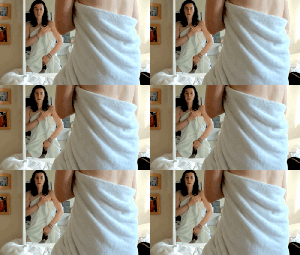
These clips of a larger piece suggest an altogether ingenuous way of subverting this dichotomy: fuck with the distinction between subject and object. What’s the easiest way to do that? Point the camera at a mirror. (And I do not mean any of this teen-girl-shooting-her-reflection-in-the-bathroom-mirror Tumblr noise. I fucking HATE that shit!)

Now, I will not for a second argue that she is unaware of the camera—I am almost certain she is. But is she looking at it or looking at herself in the mirror? This becomes about the spectator watching her watch herself cause and experience her own pleasure.

For me it also has the effect of focusing me on her growing arousal—which while certainly mirroring my own is continually refocused on hers.