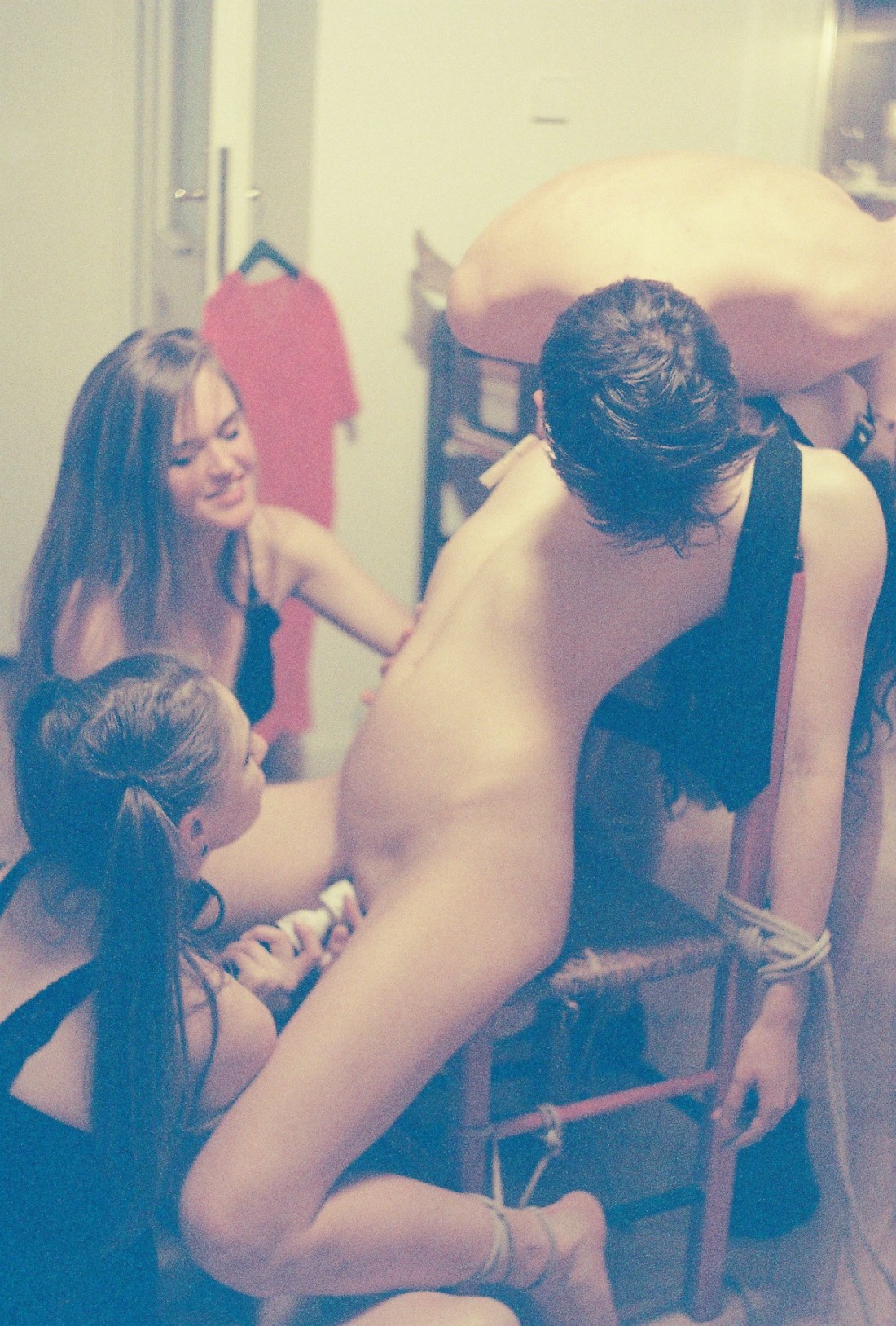
The Tiger and the PilgrimFriends. (2016)

This photo was made using Kodak’s 800 ISO Portra emulsion.

The higher the speed of a film, the better it is at producing photographs in low-light settings; however, the higher the speed the more visible the grain.

It’s also a film that is optimized for tungsten light sources, i.e. the color temperature of light emitted by most incandescent light bulbs.

It’s also low contrast—as a result of which this image suffers. It also doesn’t help that it was made using at the minimum a ceiling mounted overhead lighting fixture. (In other words: some of the most aesthetically unappealing light imaginable.)

But I’m here for what this depicts more than how it’s depicted.

I’ve been aware of the Folsom Street Fair since well before I started this blog. However, my conception of it has been off.

Basically, I had understood it as Pride only for leather and BDSM folks. It seems it’s quite a bit more than a celebratory parade. I’m not entirely clear on the rules governing it but it does seem to be closer to an open air sex party.

A while back adult content creator and performer Chelsea Poe (of whom and of whose work I am a tremendous fan) posted several images of her being dominated by Eden Alexander publicly at the Folsom Street Fair.

As kids these days are fond of saying: #AllTheFeels

The images of Ms. Poe tied to a tree reminded me of the above photo. In both cases a woman is physically restrained in a public space and she has consented to having her boundaries tested.

I’ll admit that it’s a tenuous connection. But it’s something I keep coming back to and I think I’ve finally figured out how to articulate something about it but it’s going to involve rather a good bit of TMI.

Give or take: I began masturbating when I was eight.

It wasn’t like I was horny. In fact—it was only vaguely tied up with anything sexual. It was more curiosity.

With hindsight, I realize that this curiosity was informed as a result of being molested when I was six. I didn’t understand the contradiction of the extreme interest on the part of my abuser with the parts of my body that I was otherwise told over and over and again and again were sinfully unclean.

Quite by accident, I discovered that by touching myself in very particular ways (read: humping my pillow), I could trigger this warm and fuzzy tingling sensation. I’d hump, feel myself start to climax, pause, ride the wave of the sensation and as it ebbed I’d go right back to humping my pillow, chasing the next endorphin rush. Sessions usual involved 4 to 7 orgasms.

I knew instinctively that because what I was doing involved the parts between my thighs, that it was something about which I shouldn’t ever tell anyone.

I think I figured out what I was doing was termed masturbation when I was eleven. My instinct not to tell anyone about it made a lot more sense…

Two things happened more or less simultaneously. Puberty struck and the way I masturbated shifted. Whereas previously, I would have spent an hour or so more or less continually stimulating myself with intermittent pauses; I started to experience more forceful orgasms. Like before I would feel the sense of release building, I would feel myself pass the rubicon and then my body would lock up. I would orgasm and then my intimate parts would be painfully sensitive.

I still needed the same endorphin rush but it took me sometimes as long as a half an hour before I could begin again.

The second thing that happened was that my peers and I were informed that masturbation was a mortal sin. It was presented in the following fashion. Girls were generally not interested in it and those who were didn’t because they weren’t gross floozies. Boys who were good Xtians didn’t and boys who weren’t strong Xtians might but they should repent and sin no more.

We were told that if we were freaks who experienced urges that we should pray that God removes the impure thoughts and desires from our hearts.

For the better part of a year, every time I felt the need to get myself off. I would pray. But unlike masturbation—which always felt like a prayer and an answer to that prayer; my actual prayers to God, never went any higher than the ceiling.

I feel it’s also important to note that although I conceptualized masturbation as sexual behavior, it was all but devoid of causal connection. It was something I did for the dopamine hit to my system.

It didn’t shift to being sexual until I was in my late teens.

There was this episode the reboot of The Outer Limits in the mid-90s staring Alyssa Milano. I remember being so aroused that it physically hurt.

The next day while I was in the shower—the only place I had any privacy—I masturbated but as I passed the point of no return, I kept seeing flashbacks to the show from the previous night and instead of stopping I climaxed once and without any pause came again after roughly three minutes.

It was a game changer.

I have no idea what prerequisites have to be satisfied for me to have multiple orgasms while masturbating. I’ve managed it roughly a dozen times—each time seemingly isolated from the rest.

I have substantially better luck with partners.

I think part of it is comparable to solving a chess problem vs figuring out how to get out of check without fucking yourself when you are playing against an actual opponent. In the first case, you control both the moves and countermoves in advance; in the second, you only have a vantage to the moves you make. Someone can make a move that surprises or confounds you.

A better analogy may be found contained within the observation that it is impossible to tickle yourself.

What I’ve discovered with a partner is that my experience of sexual pleasure is analogous to a river—the water level rises and falls depending upon other factors.

If the water overflows, there’s a levee to safely channel the excess. However, any overflow into the levee gets processed by my body as a pain sensation.

Even when it’s happening to me, I wouldn’t label it pain. It’s merely an amplification of sensitivity to a point that although I crave the sensation, my body actively revolts and recoils from continued stimulation.

The act of refusing to cater to this instinctive recoil from continued stimulation in the face of heightened sensitivity is called post-orgasm torture.

There are an increasing number of videos out there for it. As a lesbian, I’m very put off by anything I’ve ever seen involving femme folk subjected to post-orgasm torture. (Another reason I am into the above photo—it seems post-orgasm torture-y but in a way that is an intense as it is consensual.)

I end up watching a fair amount of content featuring post-orgasm torture involving masc. folks. (For example: this one—although vertically oriented video is never acceptable—is pretty run of the mill; this one is over-long, poorly edited and the technique is a little galling in it’s heteronormativity—also, I think the boy, contrary to the on-screen count, only orgasms twice, I think the rest are just leaks despite his concerted efforts at avoiding ejaculation. His response when he does actually finish and the way he responds to continued stimulation is one of the best documents of a body’s response to post-orgasm torture that I have ever seen.)

What does all this have to do with the initial photo? Well, given the way her back is arched and the way the vibrator is pressed vacuum seal tight against her genitalia—it’s probably understandable how I’d make the leap to this as a depiction of post orgasm torture.

The fact that she also appears to be the singular focus of a group of people is also appealing. (As someone who is over-stimulated any time there are more than four people in a room at a time, the social over-stimulation combined with physical over-stimulation is also something I would like to explore.)

The Chelsea Poe images make me curious as to whether a scenario like the image above might be possible at the Folsom Street Fair. The thought of being publicly subjected to post-orgasm torture while very publicly restrained is a prospect that I’m into. As long as I was blindfolded and trusted my dom to not let obviously creepy people touch me, I would be into a modicum of crowd participation.

And I think that’s the ultimately realization that engaging with this photo over the span of several years has made me realize that it’s not that I’m not into BDSM/kink, it’s that my relationship with it is very specific. I don’t want to be humiliated. Being humiliated is a massive turn off for me. I also don’t get the pain as pleasure exchange; mine has more to do with pushing the limits of pleasure so they pass through pain and back into pleasure again.
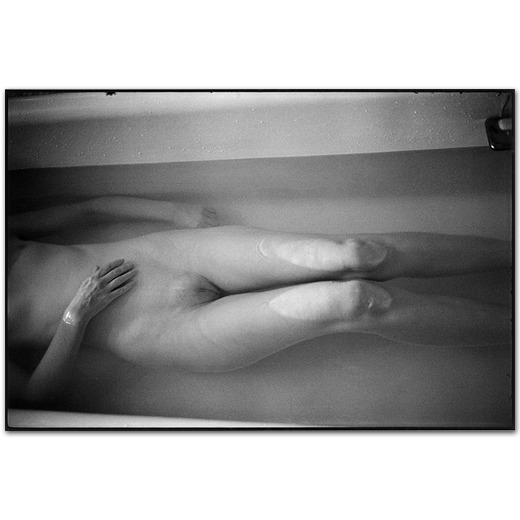
Mary Ellen MarkUntitled from Falkland Road: Prostitutes of Bombay series (1978)

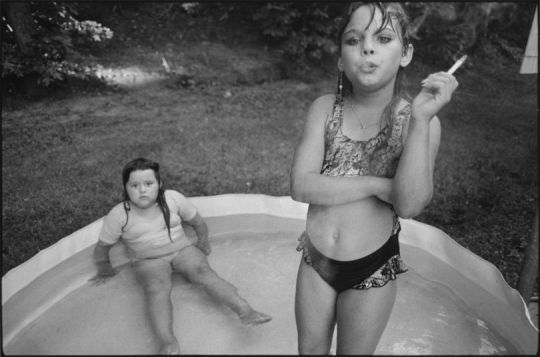
When I think of Mark, I don’t think color; I think of her B&W photos  and the way the seamlessly
blurred the line between street photography and social documentary all maximizing the impact of Kodak’s legendary Tri-X emulsion.

For example:

image

Amanda and her cousin Amy, Valdese, North Carolina (1990)

image

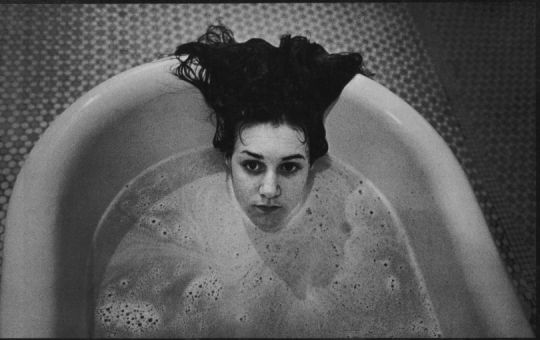
Laurie in Ward 81 Tub (1979)

image

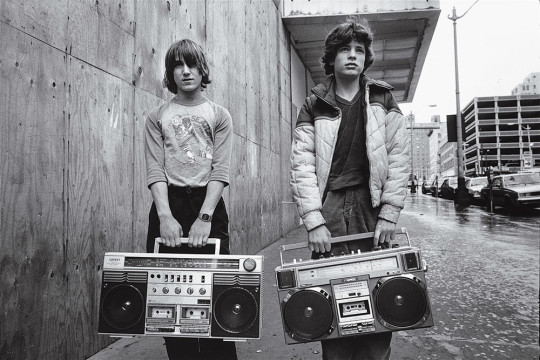
Untitled (1988)

Mark was deeply preoccupied with “[those] away from
mainstream society and toward its more interesting, often troubled
fringes
”–an M.O. is straight out of Diane Arbus’ playbook.

Unlike Arbus, Mark was less interested in playing up
her subjects station as outliers and instead emphatically orchestrated
her work to underscore the deep humanity of her subjects.

Or so I thought until I dug into her work—with more attention than my usual, casual I-need-to-know-who-this-person-is-so-I-can-talk-knowledgeably-about-her-work-in-a-very-general-survey-101-fashion but I-also-don’t-100%-vibe-with-the-work-on-a-personal-level-so-let’s-keep-it-superficial.

Honestly, there are some pretty significant issues that either I’ve gotten too sensitive to or folks have just been to willing to overlook.

Consider the photo of Laurie in Ward 81 Tub—it’s modern and wouldn’t be out of place posted on social media as if it was made yesterday.

It’s
from a project called Ward 81—for which Mark was commissioned by a
magazine to do a behind the scenes look at the Miloš Forman’s big screen adaption
of Ken Kesey’s novel One Flew Over the Cuckoo’s Nest.

At the time Ward 81 was the only locked women’s mental health institution in Oregon.

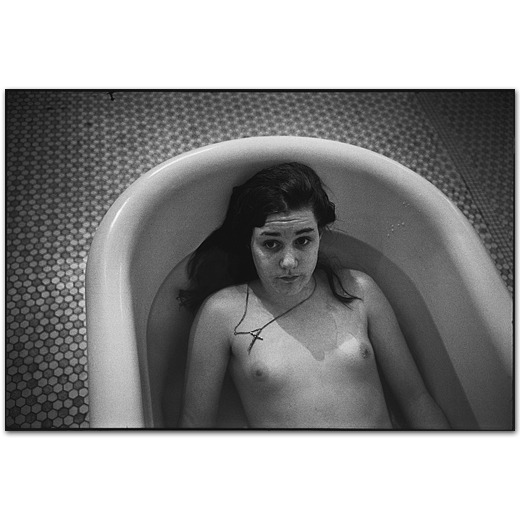
Here are a couple of other photos from that project:

image
image

On the one hand: as with all of Mark’s work, the quality and cultural
relevance are unassailable. Conceptually. however, I cannot help but
inquire regarding the informed consent of the women in these
photographs. Were they given a choice in whether they were photographed
or not? And given that they were institutionalized to what degree where
they considered to have some agency over their photographic
representation.

That’s baseline. Then there’s the nudity in the
two images and it makes me uncomfortable—and not in a way that is
in-line with the way the project is conceptually framed.

Falkland Road is problematic in the same fashion, except those problematics are significantly exacerbated.

Let’s
start with the photo alone. It’s obviously show on slide film with a
flash. In and of itself, that is a small technical wonder. Add to that
the simultaneously sumptuous and grungy colors—I have little doubt that
Nan Goldin was hugely influenced by this project.

Backing out a
bit further consider the photo in the context of the attributional
information: a white, cisgender, heterosexual American woman documenting
sex workers in Mumbai in the late 70s. (For me, this sets off a good
number of alarms. Not enough to dismiss it outright—the exceptionally
high quality of the work does counter these alarms reasonably well,
however.)

The story of how this project came to be is worth considering.Mark
travelled to India for the first time in 1968. (The same year as The
Beatles—my suspicion is that this isn’t coincidental and should probably
be examined with a similar lens w/r/t cultural appropriation.)

Curious
about Kamathipura, Mumbai’s red light district, she toured the area and
found herself increasingly curious about the lives of sex workers along
Falkland Road—a low-rent lane with rock bottom rates.

She was
not immediately accepted. In fact, she was initially run off by the sex
workers. However, she kept returning on that trip and on subsequent trips.
After a decade, she and her camera were finally allowed access to
several brothels on Falkland Road.

More alarm bells: a woman from
a colonizing country visiting a former colony to create a project
documenting the lives of indigent sex workers? What could possibly go
wrong… (The path of FOSTA/SESTA from ill-conceived do-good notion to
misguided legislation to free speech chilling modesty fiat provides a
great example of why issue surrounding sex work insist upon a lot of
nuanced, thankless labor to not eff up.)

By now I’m less straddling the fence and more deeply concerned about this project. Let’s take a look at the artist’s statement…

And…
wait? Most of the young women in this project are between the ages of
11 and 15?!?!!! (And just to preempt any shitty neckbeard protestations:
the age of consent in India was 15 from 1949 to 1982—in other words,
most of the women in this project were likely unable to consent to sex.)

That’s
already seriously WTF? territory but it gets worse—Mark describes
seeing the young woman beaten by house madams, pimps and boyfriends. She
points out that the situation tottered over into outright slavery
often.

Alarm bells have transformed into barrage cacophonously complicated
ethical chorus of protestation. On the one hand there’s the dictum that a
photojournalist ceases to be objective when she transitions from
observer to participant. At what point do ethics demand the sacrifice of
objectivity? And if she had interfered what would she have done? I mean
it’s not like she could single handedly rescue all these girls… (I
don’t have an answer to this query, actually; the best I can do is to
suggest that the rash of stories several years back about the stigma
surrounding menstruation on the Indian subcontinent and western NGOs
trying to address and educate Indian women and the subsequent backlash
about the heavy handed approaches that reeked of cultural superiority,
reiterating the same dynamics of colonial power structures; and then the
subsequent response to the backlash that stated the goal shouldn’t be
forcing pads or tampons or western menstruation products on Indian women
so much as working to empower them to address these issues in their own
preferred way within their own cultural reality.)

Conversely,
you really can’t dodge the argument for long that this project is
extremely effective at using the photographer’s rendering of the
incisive humanity of her subjects almost certainly brought awareness to
the plight of low caste sex workers in India.

The flip-side of that is that this raised awareness was paid for in straight up voyeurism.

(Additionally:
Kamathipura became a red light district under British colonial
occupation. And it’s a bit fucked up that the restraint of objectivity
indirectly supports the racist ass notion that this is just how things
are on the Indian subcontinent, contrary to the fact that this wasn’t a
thing until British rule. The British created it and then blamed the
creation–from which they benefited–on the victims.)

There’s
also the fact that Mark included photos of trans women living and
working on Falkland Road. She refers to them using the term transv——
(not a word cis people should ever utter and a word that I—a trans
girl—refuse to use).

And here again I find evidence of an ingrained
attitude of cultural supremacy. To the best of my knowledge, the term hijra was in
broad use in India during the time Mark was there. (Unfortunately, like most folks who received their
primary and secondary education in the 80s and 90s, I’m not super well
versed in Indian culture/history; the way it was explained to me was
that hijra indicates a broader category of gender
questioning/non-conformity that includes trans women but should not be
understood as exclusive to trans women.

If I’m wrong about that
then it would be just as easy to update the titles to read ‘trans
woman’, or, to preempt those who want to argue that this masks the true
face of history: why not render the titles so they ‘transv—— ‘and
then add ‘trans woman’ in brackets?

All this to say: despite the
quality and deep humanity of the work, I do think there are some very
serious ethical shortcomings. I don’t think those shortcomings
necessarily do the project any favors. From the perspective that one of
the bastions of capital-A Art is that it de-emphasizes the wrong
questions and contemplatively shepherds the viewer away from
unproductive questions and instead toward better, more fruitful queries,
Falkland Road is a goddamn train wreck.

I mean I’ve spewed text
for 4 pages and feel like I’ve only just scratched the surface.
Although it is interesting that a lot of the conceptual missteps of this
project are still very much active in a lot of the present political
discourse.

Lastly, it’s fascinating that Arbus, Mark and Goldin
all suffer in one way, shape or form from an intrinsic chauvinism. And
all three are saved to the exact extent that they evince a human
solidarity with their subjects—something I think should serve as a
prescient reminder that artist’s are not necessarily bad people but that
artist’s are more likely to make short work of dismissing substantive
ethical quandaries due to viewing them less an end in and of themselves
and more more an obstacle to both the means and the end. (This is
probably the most verbiage anyone has ever used to convey the need to–as the saying goes: check your self [privilege] before you wreck yourself.)

Erin Elizabeth KellyUntitled (2017)

It’s perhaps apocryphal, but on several occasions hardcore Aimee Mann fans (& in fairness: is it possible to be a Mann fan without being a hardcore fan?) have shared her apparent admission that for every 1 song her audiences hears, there were 99 songs that ended up in the trash.

Whether or not she ever actually claimed this, I savor her framing of the matter. Partly because it speaks to the importance of doing the work, of laboring; while also reminding us that Art is extravagant AF.

The other part which fascinates me is the question of how you know which 99 efforts to scrap and what 1 to keep. There’s the notion that you keep on the best and brightest. (This is something I have a tendency to do in my own work.)

However, I think some of the most interesting work that any creative person is ever likely to do (both for themselves and in terms of their audience) tends to be returning over and over to work that doesn’t squarely fit in either the 1% or the 99%.

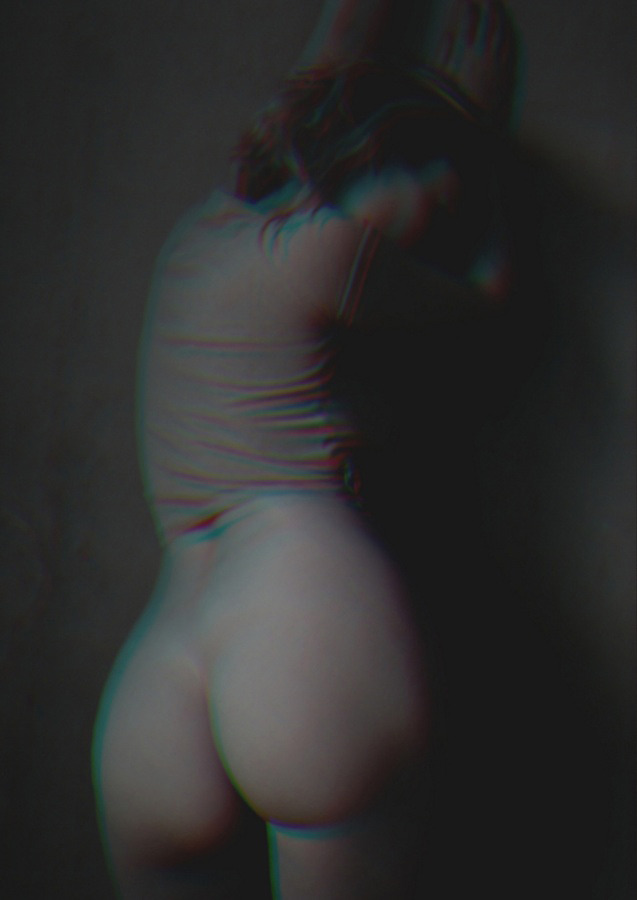
That’s my feeling on the above image. It’s a bit cliché–nude standing against the wall with back turned to camera. The original exposure was entirely too dark. Yet… there is something about the sense of the moment capture that is not easily shaken off.

Thus the question becomes how do you take something that has inherent merit but doesn’t really fire on all cylinders.

In the case of this image: Kelly introduces a RBG offset to the monochrome. The effect is understated psychedelia–just subtle enough to contribute a supple softness as well as an enigmatic tinge. And an image that doesn’t or shouldn’t work does–maybe not in and of itself but through contemplative highlighting of what about it the viewer is supposed to attend.

The other thing that interests me with this pertains to my own work. I’ve learned that although I categorically prefer analog B&W to any other medium, working in analog color is a bit like a whetstone to the blade of B&W. In other words: I’m more likely to notice improvements in my B&W work as a result of things I learn working with color. (There’s the added benefit that it also works the other way around: improvements made working B&W also filter over into color stuff.)

Alas, in the art world, especially in fine art photography–there is a tendency to segregate B&W and color work. I remember seeing the Leica anniversary exhibit at C|O Berlin several years back. It was fascinating because while the exhibit was entirely too crowded, viewers spent more time with the color images even if over all the merit of that part of the exhibit was less consequential than the rest. (It’s similar here on Tumblr and social media–work in color gets roughly 3x the attention that B&W/monochrome work does. And as far as my own work: it’s closer to a factor of seven to one (color to B&W).

Something I’ve been considering is since I work roughly 50/50 between B&W and color these days, how the hell am I ever going to be able to have my work all sit comfortably together. (Interestingly B&W and Color will sit side by side in a photo monograph–it’s the only means of exhibition that allows for it, to my knowledge. But I’m not as interested in the artists’ books trajectory.)

The idea that hit me recently–which this image has reinforced–is that finding a way to create photographs that are black and white and a single third color or B&W with a sort of dreary fog bleached landscape mess of muddy hues instead of any true white. (My feeling is this is actually probably a pretty good way of reconciling B&W and color across a single body of work in a gallery installation context.)

The effect of the work above wouldn’t fit my own work but I am very curious about the process that went into making it. If there are any Photoshop Wizards reading this who have an idea, I’d be interested in the process that went into making this so that I could reverse engineer it for analog application.

[↖] Jean-Baptiste HuongUntitled (201X); [↗] Source unknown – Title unknown (201X); [↑] Source unknown – Title unknown feat. Victoria Daniels (201X); [←] @graveyrdslutTitle unknown (2017); [→] Source unknown – Title unknown (2013); [+] Erika LustXConfessions Vol. 4: A Talk Too Dirty feat. Poppy Cox & Dean Van Damme (2015); [↙] Abby WintersTitle unknown (2005); [↘] Source unknown – Title unknown (201X); [↓] Fabio BaroliSujeito da Transgressão #4 (2011)

Follow the thread.

Source unknown* – Title unknown (????)

Lately, I’ve been thinking a lot about mutual masturbation.

Those thoughts are amorphous but I’m going to try to fit them to words:

I guess what I don’t understand–literally ever–is where the heteropatriarchy draws the line on what is and isn’t sex. I mean penis in vagina (henceforth PiV) sex is sex. Anal sex is sex.

Bill Clinton famously tried to suggest that oral sex wasn’t sex and I think folks general consider oral sex as sex these days.

What about mutual masturbation? And before someone claps back about it depends on whether you touch someone else’s genitals–is the above image a depiction of a sex act?

And why the hell do we categorize masturbation as not also sex because of the absence of a partner? What’s the problem with it all being sex?

As I’ve mentioned about a bazillion times: I grew up in a Xtian doomsday cult. I was taught that masturbation was a mortal sin. Even when the topic crept into conversations in my junior and senior year of high school–the response was I don’t do that and think anyone who does is a disgusting pervert.

Conversely–now that I’ve escaped that orbit–most of the folks I know have these wonderful stories about climbing into bed and pulling the covers up to their chins and then racing to orgasm or you be the boy and I’ll be the girl and you perform oral sex on me and then we’ll shift roles.

As far as masturbation goes it’s the type of sex I am the most comfortable with because it’s the most familiar.

I completely missed out on the experience of exploring my sexuality with those I essentially trust.

I think less these days about finding a partner and more about how to get a group of friend together solely for the purpose of a mutual masturbation party.

It would be something I think would be enjoyable and personally it would come closer to scratching the itch I have to have a reliable sexual partner–which just isn’t possible for me right now.

Le sigh.

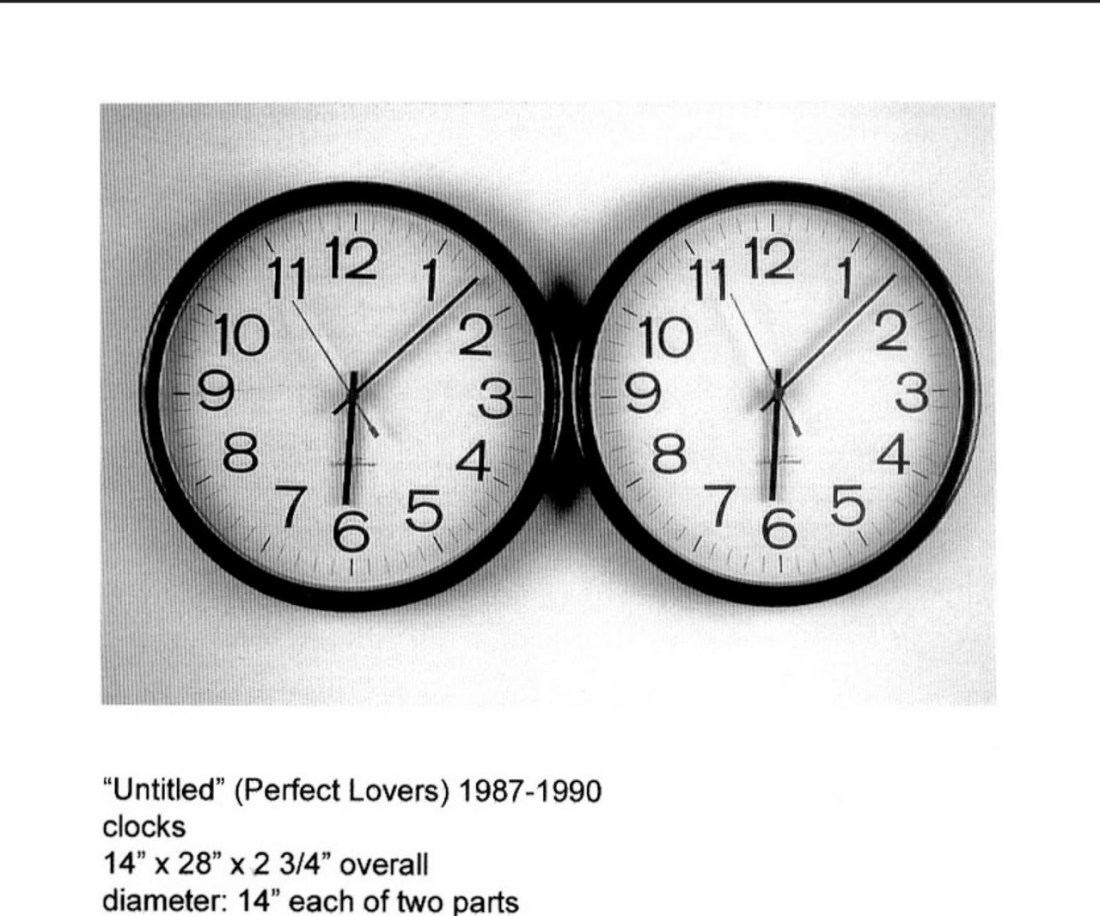
Félix González-Torres – Untitled {Perfect Lovers} (1987-1990)

I was completely unfamiliar with González-Torres or his work until earlier this week. I don’t think this piece has ever been far from my mind ever since.

As the story goes, González-Torres‘ partner Ross Laycock learned he had AIDS. In an effort to process the news, González-Torres outlined the following conceptual exercise:

He acquired two identical black rimmed wall clocks and hung them on a wall so they were touching each other. The clocks were synchronized and the set running. Slowly over time they fell out of sync with one another–whether due to one having better batteries or just the reality of entropy.

In an interview with ArtPress a year before he AIDS stole his life also, González-Torres stated:

Who is your public?’ I say honestly, without skipping a beat, ‘Ross.’
The public was Ross. The rest of the people just come to the work.