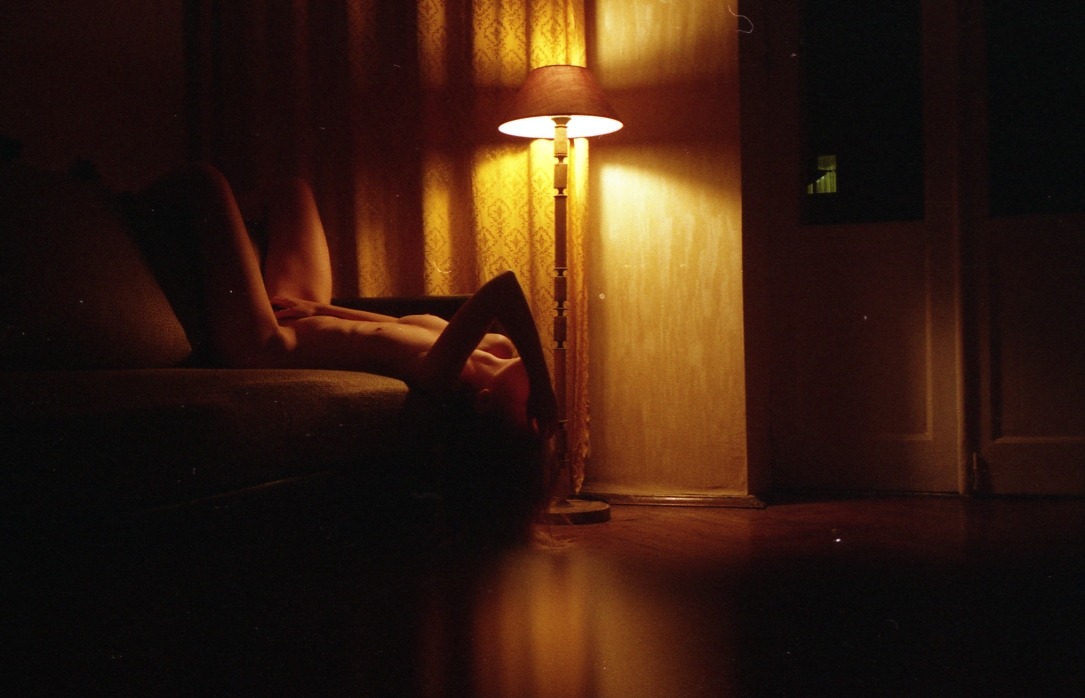
Paula AparicioUntitled (2010)

Aparicio is a 25 year-old photographer based in Buenos Aires.

Her photos elide any too obvious debt to her influences mostly because of the meticulous care with which she handles both sexuality and nuances of nudity.

But there’s also the characteristic sense that within her frames seduction and consummation are done; leaving in their wake that palpable feeling of  impermanent post-coital stasis, the waning of ecstatic satiation and the waxing hunger of wanting more.

Brooke LaBrieBlack Tape 1 (2013)

I’ve said it before and it bears repeating: if you aren’t following Cam, you’re doing Tumblr wrong.

Without question, Cam is one of the preeminent models in the Tumblr-verse. She’s extremely intelligent, has a nice voice, is six feet tall, has really cool tattoos; and when fuckwits antagonize her she spouts incredible, tongue-in-cheek mythological backstories, is socially awkward and a consummate bad ass. (I don’t feel the three things I haven’t linked require additional documentation.)

I have mixed feelings about this image. It was made with a Hasselblad 500C/M and I am all about analog photographic processes. And I don’t think I’ve ever seen Cam presented squared to the camera. (She really is beautiful.)

I am not quite sure how I feel about the tape is being used to cover her tattoos, though. I mean Cam has some AWESOME ink work.

But looking at this what stands out to me is the compositional logic to the placement of her tattoos. I mean if you suggest the body as a canvas for art, there is more than just a passing reminiscence in the lines suggested by the tape to Piet Mondrian paintings or the De Stilj aesthetic.

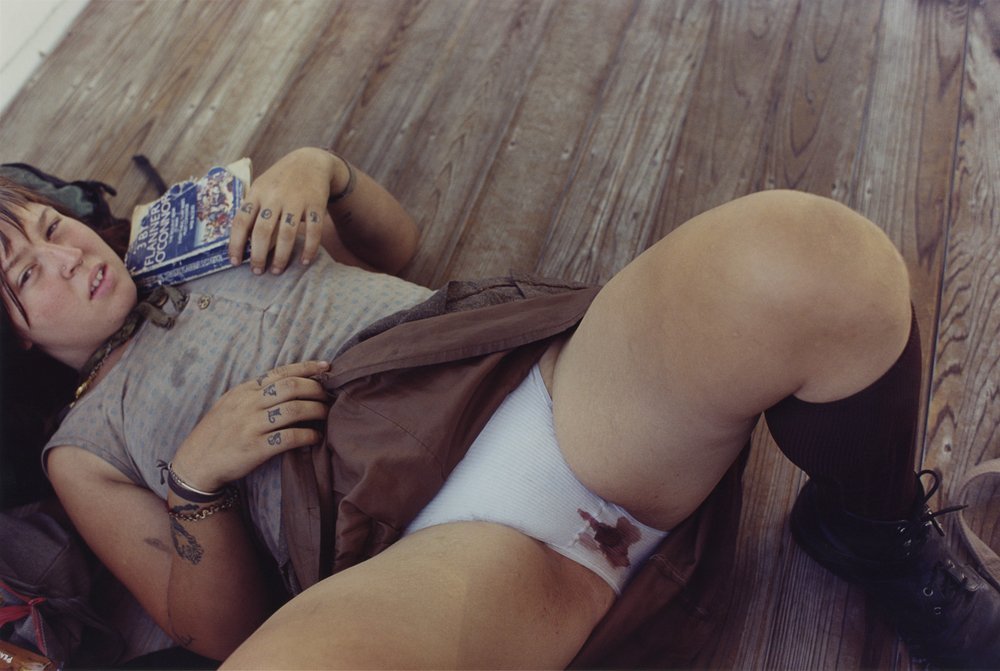
Mike BrodieUntitled Frame from A Period of Juvenile Prosperity (200X)

Brodie was born in Arizona circa 1985.

Next we hear from him, it’s 2002. He’s 17 and now lives in Pensacola, FL.

He gets it in his head to visit a friend in Mobile and hops a train–as luck would have it–headed in the opposite direction. He ends up in Jacksonville, FL.

After bumming around for a few days, he catches the same train home.

“[The experience] sparked something and Brodie began to wander across the U.S. by any means that were free – walking, hitchhiking and train hopping.”

In 2004, Brodie found a Polaroid camera stuffed behind a car seat. Sans any formal training, Brodie criss-crossed the States using the camera to document his travels. .

In an effort to stay in contact the transient communities he came into with, Brodie shared his images on various websites; becoming known as The Polaroid Kidd.

When Polaroid discontinued the stock his camera used, he switched to a sturdy camera of 1980’s vintage.

On the subject of his process, he’s said:

Sometimes I take a train the wrong way or… whatever happens a photo will come out of it, so it doesn’t really matter where I end up.

Unwilling to be chewed up by the pressures and expectations of the art market, in 2008 Brodie ceased making photographs.

He graduated from the Nashville Auto Diesel College (NADC) in 2012 and now works out of his silver ‘93 Dodge Ram.as a mobile diesel mechanic.

A Period of Juvenile Prosperity was published in early 2013 by Twin Palms.

(Note: there are two biographies for Brodie–his publisher’s version and his personal website’s. Both feature a wealth of information but are bogged down by choppy, artless prose; the versions are riddled with contradictions. The preceding text is not original; All I did was to reconcile the information contained in both versions in order to present it with as few changes to the original language as possible. I repeat: the preceding text is not original.)

Emma HardyPersonal (Date Unknown)

I want to talk about this photo over drinks into the wee hours– it’s really, really exceptional.

Trouble is, I’m having on of those every-idea-seems-inspired-until-I-put-it-to-words-and-everything-turns-straight-to-shit sort of days.

Also, part of the problem may be every time I look at this, I flashback to being 11 or 12 and chasing Hannah around the corner of my grandparents house in Vermont.

Hannah, is a year and a half my junior. I’ve always thought of her as a tomboy–able to easily outrun even my older athletic cousins. The only thing I can do better is scurrying up trees and she’s always grudgingly appreciated that fact.

I’m chasing her but I’m hyper aware of color: her white bare feet, green-green grass, light-weight lavender sundress fluttering around the flesh-tone blur of her pumping knees; a long wake of brown-blond hair trailing behind her.

I’m too far behind to catch her and as if she’s read my mind, she smiles over her shoulder mischievously.

She stretched her arms over her head, splaying her blue lacquered nails against the summery sky. Her step stutters; her body pitching forward.

Her body follows her arms. I notice her toes are painted the same color as her nails a second before I’m staring at her underwear–cornflower blue trimmed with cadmium yellow.

It’s not that I’m trying to look up her dress, there’s just nowhere else to look. I am suddenly painfully aroused.

Her dress slips as she nears the apex of her flip, turns inside out and falls down around her chest.

She floats there for a split second–it feels as if we are both floating outside time. There’s orange sun on pale skin, cornflower blue and cadmium yellow.

She pushes herself to keep momentum and is on her feet again, looking back at me–her cheeks reddening a little (as if her mom has already impressed upon her the importance of being lady-like and not showing boys her underwear).

But I can tell she’s only embarrassed because she is supposed to be ashamed and simply isn’t.

She waits until I am almost within reach before she bolts again. Glancing back only long enough to ensure I’m still following her.

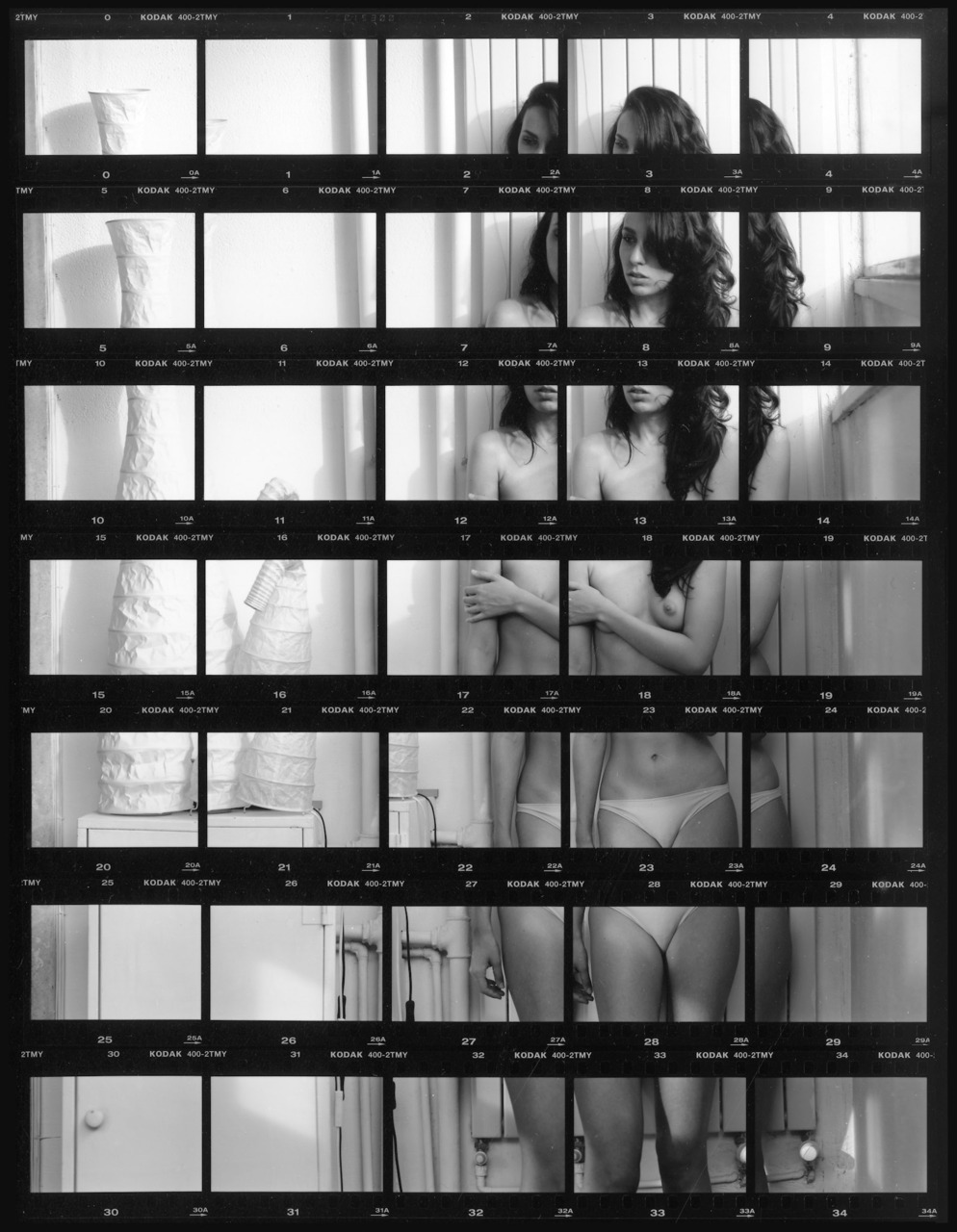
Mario ZanariaAlessia from Pianosequenza series (2011)

When I see this I think immediately of Ed Ruscha’s Every Building on the Sunset Strip(Also, his use of contact sheets.)

There’s also something maybe vaguely Cubist about it, too.

Regarding the work, Mr. Zanaria offers the following statement:

The Pianosequenza (“long take”) project came about through a reflection upon a tool that is closely associated with analog photography, something that has been almost totally forgotten, despite its crucial role in defining the history of photography as we know it.

Usually, contact sheets are used as a working tool. They are utensils needed to make an initial selection from the images captured on film, destined to be forgotten once they have fulfilled this transitory function. Although, when viewed as a whole, they narrate much broader and more complex stories than those visible in the few images chosen, these tales are known only to the photographer and to the few people involved in viewing the “contacts”.

In this sense, it could be said that they have a dual identity: they are fundamental for the photographer in choosing which images will come to life through being printed and made public. However, for those who later view those photographs, which have been selected precisely thanks to the contacts, they remain a complete mystery, or at best, an amusing curiosity.

In Pianosequenza, the roles are inverted: the individual photographs lose their original function as stand alone images, and become the building blocks of a greater whole, making them barely significant (if not indeed pointless) without each other. At the same time, the contact sheet goes from being mere container of frames to be selected, to being the central character, the essential element required for the final image to be revealed.

The end of this project is symbolically represented by portraits of some of the Masters of photography, who have grappled with this tool in the course of their careers. Here, the technique used not only refers to the sitters own work, but also highlights the complexity and wealth found in the setting of the portrait. The individual shots thus become clues, traces of a world that can only be reconstructed by viewing the contact sheet in it’s entirety.

Lastly, the title, which was inspired by the cinematographic technique of filming a scene without interruptions, editing it directly from a camera during a take. As in the cinema, here too the image is edited at the moment in which it is captured, with the frames shot according to a sequence based on the way in which the film will be cut during printing. The final image will only be successful if each single element is functional to the overall view, thus creating a sort of “Pianosequenza”.

Le sigh.

Pianosequenza translates as: ‘sequence plan.’ Due to the pre-planning and necessarily painstaking execution, the title isn’t incorrect in any denotative sense.

The connotation, however, is steeped in cinematographic tradition: Welles Touch of Evil opening, the oeuvre of Andrei Tarkovsky, Chantal Akerman, Theo Angelopolous and Bela Tarr; more recently and sadly plagued by verging-on (if-not-full-on) racist tropes: Cary Joji Fukunaga’s True Detective six-minute nail bitter.

Allowing Zanaria leeway and as far as pianosequenza go, I can’t exactly argue with the assertion that a single frame will be rendered meaningless when divorced from sequential context.

But strictly speaking it’s the replacement of one single, flickering still image with another–the illusion of seamless fluid motion that distinguishes cinema from photography.

In this work, the viewer sees everything at once. Zanaria argues that the presentation de-emphasizes the individual frames in favor of the larger context of the contact sheet whole. I can’t accept that because individual images are not as insignificant–to my eye–as insisted upon by their creator. If nothing else the overarching plan lends an artfulness to them, suggests a seeing of the foreign in the familiar.

One must also bear in mind the conceptual disconnect: pianosequenza are predicated upon a lack of interruption/absence of montage. The work is fundamentally built on montage–smaller pieces strung together to create a broader whole. Further a true pianosequenza would dictate an uncut strip of cinema film; while, the 35mm contact sheet involves at least five cuts.

Ignoring the statement, I am pretty into this work. The trouble is the statement is so overwrought, logically flawed and at a remove from how the work reads that I have to admit I am rather put off by it in the final analysis.

Giangiacomo PepeUntitled (2013)

(PART I)

Back in 1999, Garrison Keillor suggested a broader conceptualization of what sex entails.

Sex is not a mechanical act that fails for lack of technique, and it is not a performance by the male for the audience of the female; it is a continuum of attraction that extends from the simplest conversation and the most innocent touching through the act of coitus.

A dear friend had posted it on her Facebook. It was literally the first thing I saw–all bleary-eyed–this morning.

It was one of those Oh shit moments where someone else somehow manages to express something you’ve been stumbling over for half a decade with a spare elegance.

For me, my experience of photography belongs to Keillor’s sexual spectrum. I mean, what but beauty causes anyone to lift a camera and sight a shot?

My reaction to beauty is unswervingly reliable: it overwhelms me, somersaults my tummy; makes me a blushing, shoe-tip-staring, dirt-kicking, boy-crazy teenage girl wanting from lips that won’t wet to shuddering knees.

***

Soon after the Keillor quote, Willow reblogged this from Sex Positive Activism

I was like what the fuck? A second Oh shit moment in the same day?

Okay, confession time: other than masturbation, I have been celibate for four-and-a-half-years. This is less a personal imperative than the fact that I am too irrevocably fucked for anyone to ever reciprocate the wanting I feel for them.

People always tell me that I need to have confidence. I think that’s bullshit. I don’t lack confidence. I lack a sense of entitlement.

When I was a film student, everyone worked with was invariably asked to do something either outrageous or obscene. No one took issue. Well, mostly. (In hindsight, I realize that I unintentionally created some very fucked up situations for people about whom I claimed to care a great deal.)

A number of things happened to shift this but one in particular stands out. For a group project, I had envisioned a scene with a bleeding, naked man smeared with mud running down a forest track. The actor who was supposed to play the part was a no-call/no-show and so I had to stand in. I was completely unnerved–I have always had a lot of body issues, they just haven’t always been the same–by the prospect of being naked in front of the small crew. I insisted on doing the scene wearing boxer shorts.

Watching the first and only (long story) screening, besides how my refusal to go nude ruined the scene, it hit me how fucked it was that I expected someone else to do the scene nude but I was unwilling to disrobe once I was in front of the camera.

***

As a result of these experiences, I abide by three etched-in-stone rules for photographing others:

  1. The photographer will under no circumstances touch the person(s) being photographed.
  2. The photographer will never ask anyone to enact anything the photographer would be unwilling to enact were the roles reversed.
  3. The photographer will never ask the person(s) being photographed to do anything the person(s) being photographed would not mutually desire the photographer to perform were the roles reversed.

***

The above image is not without flaws but between the mirror and the way she is reaching back to pull aside the crotch of her undergarment to reveal her vulva and anus, it is pornographic and capital fucking-A artful.

This is the type of work I want to make–conveying anger-verging-on-vaguely-self-destructive-arousal. I hardly expect Pepe to abide by my rules but the edge between consent and coercion is ambiguous enough on a good day that I worry about what goes on behind the scenes at his shoots.

I just don’t know how one ethically gets so many people to allow themselves to be vulnerable enough to pose in such a fashion. So many photographers seem to photograph their friends. That would be my preference. But the people in my life–who are fucking awesome and I wouldn’t trade for all the most-getting naked-est friends in the world–all have hang ups about nudity. It’s not that they aren’t sex-positive. (I just can’t do sex negativity. Not even a little.)

I worry that my own sexual frustration and realization that no one will ever ache for me the way I ache for them has tainted or will taing my work. It seems like if I could just find someone with whom I could share this sort of experimental openness in my work it would solve my problems.

The depressing truth is–there is no one who feels in kind toward me.

Giangiacomo PepeUntitled (2013)

PART I

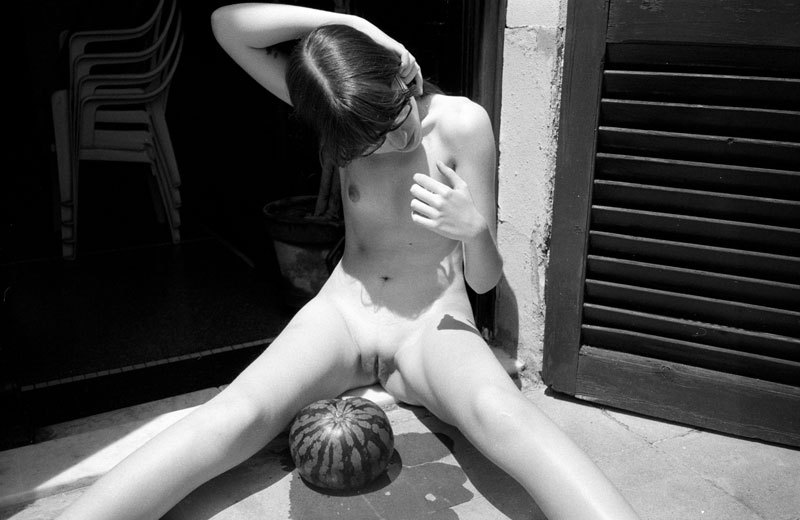
Much of this rocks my socks: it’s shot on film, contains explicit nudity and the model is my ‘type’ to a T–thin with small breasts and geeky glasses; for good measure: throw in my permanent association of watermelons wjth Tsai Ming-liang’s brilliant (screw the critics) and perverse The Wayward Cloud.

There are at least two things about it that bother me, however. I don’t want to bring the body hair fetishism fire down, so let me start by saying: when it comes to body hair I believe–without equivocation– your body, your rules.

The trouble is due to the ubiquity of utterly depilated female bodies, undue cultural pressure against body hair exists and by existing it makes it more of a struggle to go your own way.

There’s the matter of her amputated legs, too. (Such is never justified–especially in the context of images featuring full-frontal nudity–but at least there is a compositional sense to it–her navel marks the center of the frame, the upper frame edge just misses her raised forearm and the concrete door jamb running along the second vertical third.)

I feel compelled to compare/contrast Pepe’s work Lina Scheynius, Igor Mukhin and Ren Hang. Yes, there’s extensive variations in styles, themes and tone: Scheynius is playful, Mukhin, insular and unflinching and Hang walks a fine line between confronting taboos and centering them on his audience.

In a similar vein, Pepe leads with his fetishizing of the female body.

The feels such fetishizing gives me are a complicated knot I’ve been wrestling to unravel for more than half a decade.

(PART II)

boudoirboudoir:

42112 (by brittanymarkert)

I like this image—perhaps for the wrong reasons.

To my eye, it represents a discontinuity with the rest of Ms. Market’s work because I am not inclined to associate it with an obvious photo-historical reference (i.e. Untitled is an obvious homage mashup of Francesca Woodman’s Untitled Providence, Rhode Island, 1975-76 and Untitled Providence, Rhode Island 1976; this still from the hotel haunting screams Diane Arbus via Kubrick, while room 109 invokes David Lynch with the subtlety of a thunderstorm.

Influence is crucial—sheer force of will and work ethic only goes so far. Hell, without inspiration, how many would have picked up a camera to begin with? Let alone kept on after all those rolls of ruined film, struggling through plateau after plateau in the work, etc.

So called fine art photography operates off the principle that imitation of your influences forms the most effective framework for becoming a photographer. Although seen through rose colored glasses, Arno Rafael Minkkinen presents the essential premise behind fine art photography with insight and aplomb in his renowned Helsinki Bus Station Theory.

While I disagree with the notion that gallery owners would so much give you the time of day let alone inquire as to your familiarity with X or Y artist and object to prejudicing the destination over the journey, Minkkinen’s theory does have special resonance for photographers with a vested interest in visual narrative or those—like Ms. Market—who count filmmakers among their foremost influences since the Helsinki bus station presents us a bit of a conundrum.

Even though I am not, let’s say—for the sake of argument— I am a enamored with Stanley Kubrick’s films. But for whatever reason, I prefer the medium of photographer so I arrive the Helsinki bus station and after looking around decide that to take a bus departing from the same platform as Diane Arbus. However, once on board I don’t even make it as far as the suburbs before realizing this isn’t for me. I go back and decide to follow the Walker Evans’ line—which departs from a platform on the opposite side of the station as the previous one. Maybe I make it a little further this time but quickly discover it’s still not for me. What then?

I go back and merely because I have no idea what else to do I wander onto the platform from whence Ansel Adams departed. This time the route choice sticks—but not due to being on a line the focuses on landscape photographer so much as finding a route pathologically preoccupied with the technical. (After all, what Kubrick lacked as a storyteller he more than compensated for with his exacting abilities as a technician and unparalleled production designer.)

Filmmaking and photography are sibling art forms and like siblings, you cannot approach them in an identical fashion. Those of us who come to photography by way of narrative/filmmaking share a frighteningly similar list of influences that, to stick with the metaphor, are dispersed all over the Finnish countryside. Most are contradictory.  Mistakes are going to be made; routes will need to be abandoned and subsequently re-chosen as the line that works for each person is almost never the first choice.

But back to this image—I like it. And I like it because it is one of the few images where I do not feel the photographer is not leaning on something that has been said well before in order to add feeling, depth or relevance to her own ideas.

Flattery is the sincerest form of flattery. Brittany Market demonstrates she handle imitation flawlessly. My interest in her work is what she will produce when she finds herself on a line long enough to leave the Helsinki suburbs behind. This image suggests a great deal of potential that will hopefully be realized in her maturing work.

Alina Senchuk (goodbyestockholm)

Normal
0

false
false
false

EN-US
X-NONE
X-NONE

/* Style Definitions */
table.MsoNormalTable
{mso-style-name:”Table Normal”;
mso-tstyle-rowband-size:0;
mso-tstyle-colband-size:0;
mso-style-noshow:yes;
mso-style-priority:99;
mso-style-parent:””;
mso-padding-alt:0in 5.4pt 0in 5.4pt;
mso-para-margin-top:0in;
mso-para-margin-right:0in;
mso-para-margin-bottom:10.0pt;
mso-para-margin-left:0in;
line-height:115%;
mso-pagination:widow-orphan;
font-size:12.0pt;
mso-bidi-font-size:11.0pt;
font-family:”Garamond”,”serif”;}

La petit mort  2011

It is difficult to speak the truth, for although there is only one truth, it is alive and therefore has a live and changing face.

Normal
0

false
false
false

EN-US
X-NONE
X-NONE

/* Style Definitions */
table.MsoNormalTable
{mso-style-name:”Table Normal”;
mso-tstyle-rowband-size:0;
mso-tstyle-colband-size:0;
mso-style-noshow:yes;
mso-style-priority:99;
mso-style-parent:””;
mso-padding-alt:0in 5.4pt 0in 5.4pt;
mso-para-margin-top:0in;
mso-para-margin-right:0in;
mso-para-margin-bottom:10.0pt;
mso-para-margin-left:0in;
line-height:115%;
mso-pagination:widow-orphan;
font-size:12.0pt;
mso-bidi-font-size:11.0pt;
font-family:”Garamond”,”serif”;}

Franz Kafka