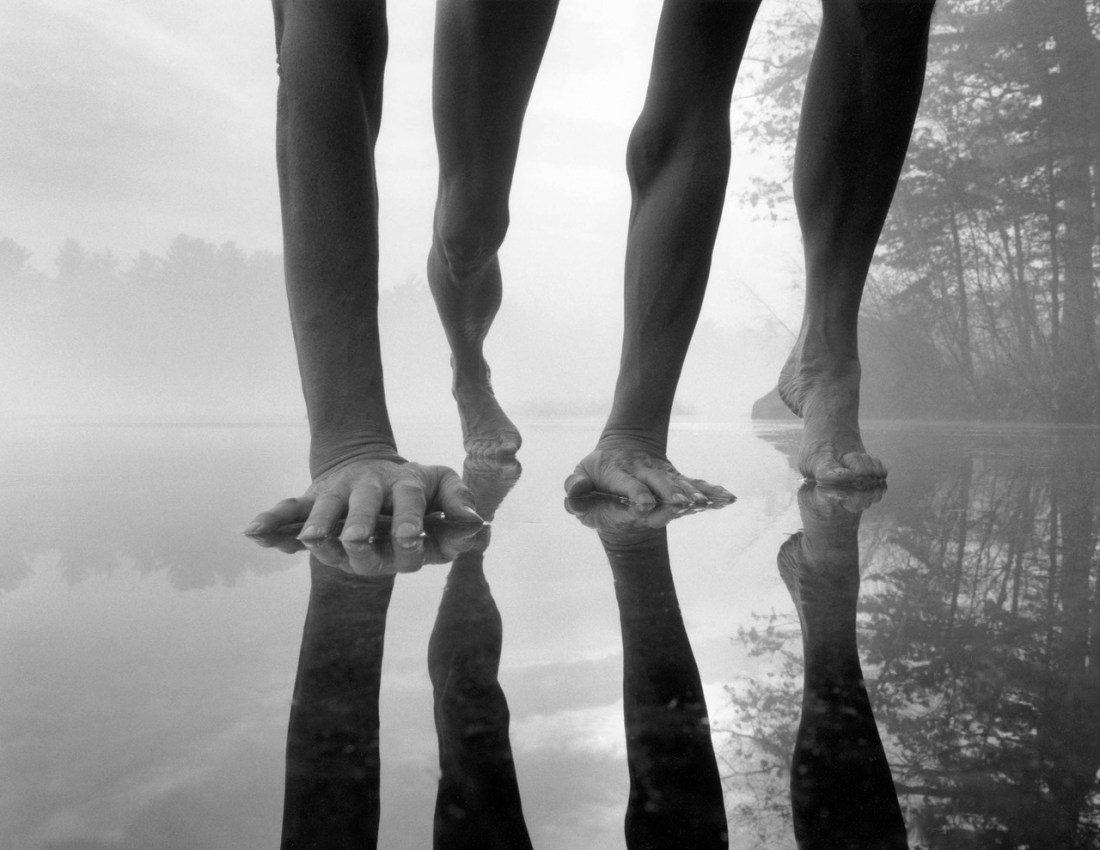
Arno Rafael Minkkinen – Self-portrait, Millennium, Foster’s Pond (2000)
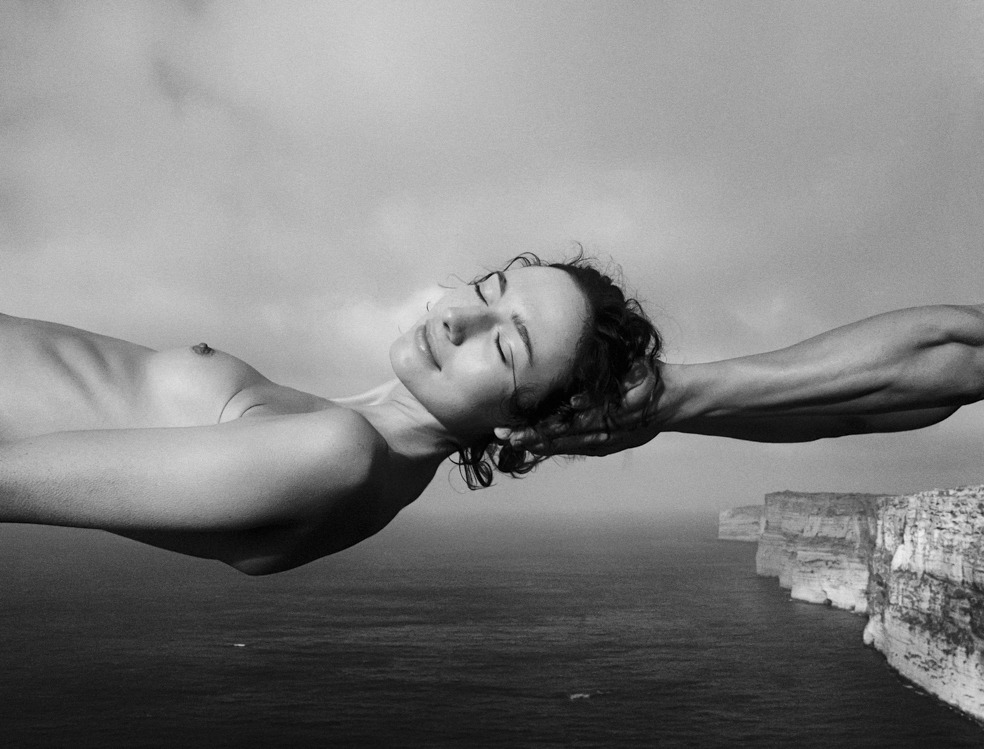
Arno Rafael Minkkinen – Laurence, ‘Ta Cenc, Gozo, Malta (2002)
Honestly, this post should be relatively uncomplicated. If I had any sense, I’d point out that Minkkinen’s strongest work seems to always be the work that is–strictly speaking–the least original.
For example: Fosters Pond (2000) is unquestionably a riff on M. C. Escher’s Drawing Hands.
I’d characterize the above as Dalí’s Persistence of Memory + Klimt’s Water Serpents I remixed by Minkkinen.
But the idea for referring to it as a remix wouldn’t be mine; in this case, I’m borrowing it whole cloth from the most recent episode of Adam Conover’s TruTV series Adam Ruins Everything in which as the title proclaims Adam Ruins Art. (<—this link hits a paywall; you can find a pirated version of the episode on YouTube with a bit of elbow grease but here’s a link to the official upload of the segment most germane to this post.)
But there’s also a way in which this relates to other things which I’ve been thinking about a lot recently. From the prosaic: I’m really into Finnish metal–especially Circle and Oranssi Pazuzu (who I saw when they played their first show stateside earlier this year and remains the most incredible live performance I’ve ever seen). Minkkinen being Finnish as well–in case that wasn’t immediately clear.
And then two days ago I watched the recent documentary Burden focused on the life of proto-performance artist Chris Burden.
I was already super familiar with Shoot, 110 or 220–and his street lamp installation at LACMA (even if I didn’t immediately know it was his).
I found myself amazed an repulsed in equal measure. His unhinged behavior when his girlfriend broke up with him and he essentially made TV commercials to narrative revenge fantasies is extremely fucked up. His TV Hijack piece is equally fucked up but definitely maintains a rigorous self-critique that points out that the problematics are part of the point.
Still I find it interesting that he viewed himself as another historically great man of art. And frankly as much as Burden impresses me (at least in theory), I am increasingly put off by this great men of history bullshit.
There’s a great deal of current events that I didn’t/couldn’t include in the post preceding this. But whether it’s the current president using taxpayer funding to stroke his ego twice a day or an engineer at Google losing his job because he circulated a sexist as fuck and egregiously erroneous (his scientific claims about why there are fewer women in tech are bullshit, but he also implicit reifies the notion that here are only two genders) screed to his co-workers against diversity.
What we’re seeing happening in every corner of society right now is that those accustomed to privilege are having their privilege questioned/challenged and to them that feels a bit like oppression. Or, to put it even more plainly, consider James Baldwin:

Which brings me–of all places–to the current trial happening where Taylor Swift is suing a DJ who apparently groped her. I am not a TaySwif fan girl but I do have to say that her commentary and the way she is handling this situation are as scathing as they are stunning and astute.
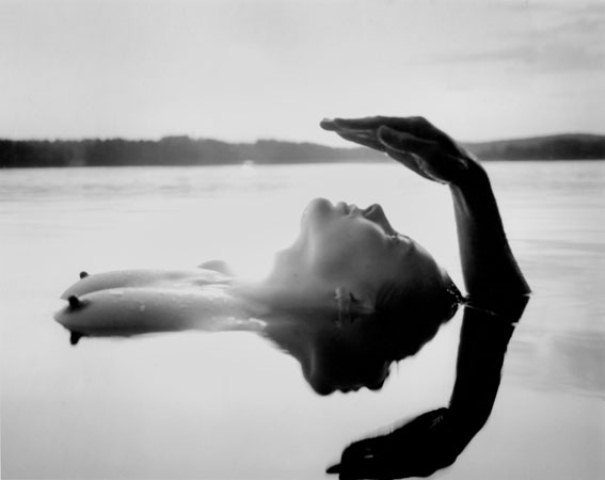
Arno Rafael Minkkinen – Self-portrait with Maija-Kaarina (1992)
Regardless of the discipline, I think anyone interested in pursuing the visual arts in an academic setting should be given a single sheet of paper printed on both sides.
The front would read:
Nobody tells this to people who are beginners, I
wish someone told me. All of us who do creative work, we get into it
because we have good taste. But there is this gap. For the first couple
years you make stuff, it’s just not that good. It’s trying to be good,
it has potential, but it’s not. But your taste, the thing that got you
into the game, is still killer. And your taste is why your work
disappoints you. A lot of people never get past this phase, they quit.
Most people I know who do interesting, creative work went through years
of this. We know our work doesn’t have this special thing that we want
it to have. We all go through this. And if you are just starting out or
you are still in this phase, you gotta know its normal and the most
important thing you can do is do a lot of work. Put yourself on a
deadline so that every week you will finish one story. It is only by
going through a volume of work that you will close that gap, and your
work will be as good as your ambitions. And I took longer to figure out
how to do this than anyone I’ve ever met. It’s gonna take awhile. It’s
normal to take awhile. You’ve just gotta fight your way through. –Ira Glass
The back would reprint the entirety of Minkkinen’s The Helsinki Bus Station Theory: Finding Your Own Vision in Photography.
Partly, I think it’s good form. Also, I feel like the assumption is made that the student wants to learn or they wouldn’t have enrolled in the course. But wanting to learn and having to learn are very different states–for example: as I approach middle-age I still want to learn to play the cello but when I was a toddler I didn’t so much want to learn to walk as I had no other choice.
Those who want to learn are a dime a dozen. The majority of them will become bored, will shirk the work or drop out.
But what academia does a shit job at is teaching you how to keep going when you don’t have a choice because to cease would be tantamount to death. Students are direly ill-prepared for those plateaus, brick walls and handfuls of hair pulled out frustrations that come part and parcel with practicing a craft.
I feel like leveling from the beginning–admitting it’s hard and dispirit but reminding folks that the process–no matter how wearying–is far more important than the product.
Or to put it another way: practice doesn’t make perfect. Only perfect practice makes perfect.

Arno Rafael Minkkinen – Sandy, Connecticut (1971)
My familiarity with Minkkinen pertains more to his seminal Helsinki Bus Station Theory.
Yes, I would take issues with a few of his tangents but his analogy is otherwise lethally on point.
Given that I was so moved by his words, I was put off by my ambivalence for his images. They reminded me of Jerry Uelsmann–for whom, as someone reasonable skilled in photo manipulation in a traditional darkroom, I have a great deal of respect but whose work does fuck all for me.
Mostly because I’m lazy but also due to the fact that I’m impatient, I didn’t bother to dig deeper into his work.
As it turns out, that was an appreciable mistake. If someone manages to make something that not only speaks with you but connects with you, it’s very rare in my experience that there’s not something similar animating the rest of their work.
Will I ever be into the in-camera optical illusions that typify Minkkinen’s work? Hardly. But, the man really has a knack of translating the feeling of physical intimacy into something visually manifest. That’s no small feat.
Also, I can know see a thread running from Minkkinen to Ahndraya Parlato; a thread that once observed serves to amplify the effect of both.
 Acetylene Eyes