Willy KesselsFemale nude from behind (19XX)

I’m too fuzzy on the the epoch to identify the progenitor here but this is reminiscent of both Edward Weston and Man Ray.

I’ve mentioned before that Weston’s enduring reputation is due to the brilliance of his skills as a print maker not especially as a result of his compositions.

And with Man Ray, who referred to images of himself as rayographs, there’s always a feeling I have when I look at his work that he felt the women he photographed were art only because they were fucking him at the time.

Kessels’ photo manages to skip the sentimental nostalgia for heated fumbling adolescent sexual exploration and present something unusually reserved, almost reverent.

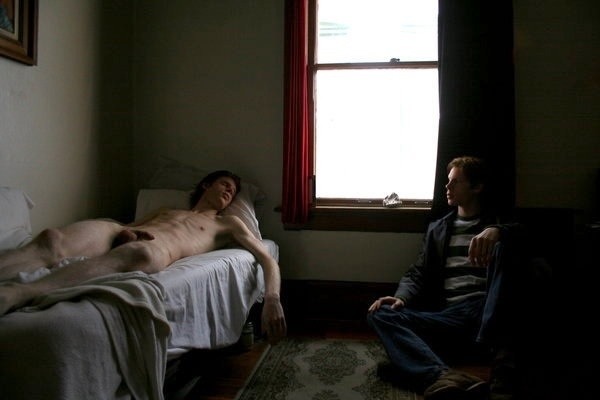
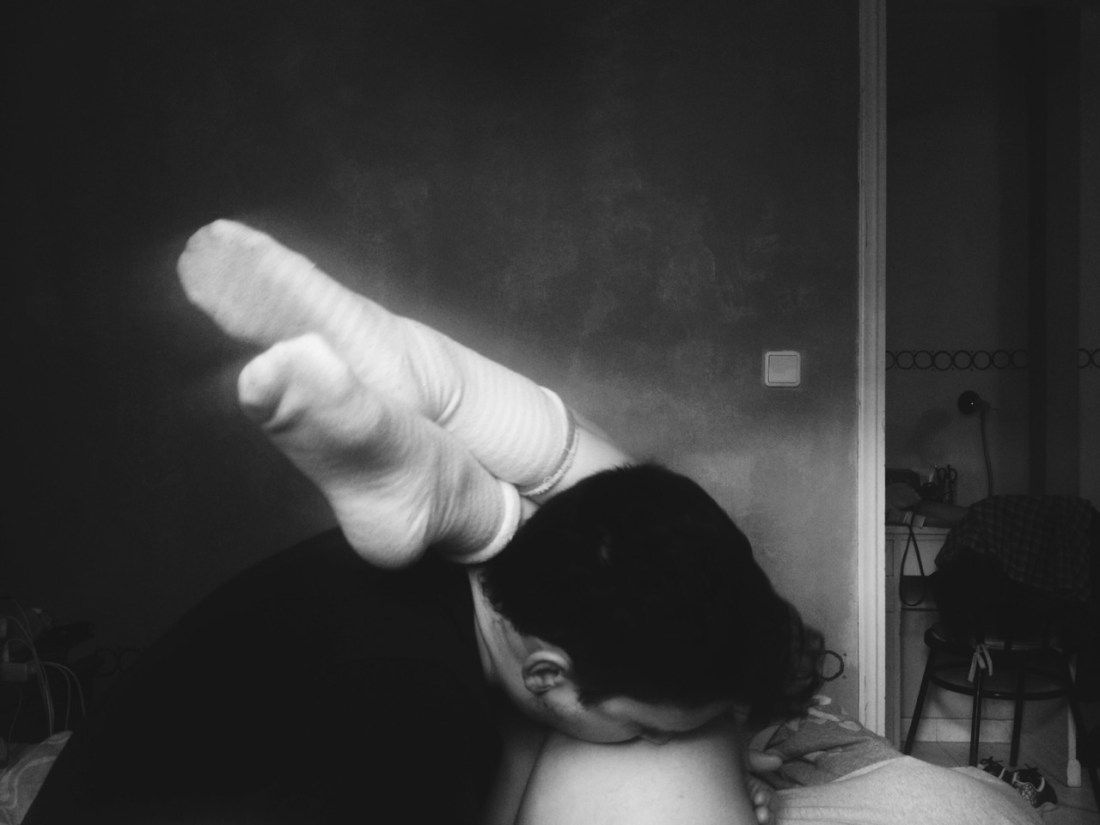
Daisuke YokotaUntitled from Taratine series (2015)

I can’t look at Yokota’s work without thinking about disintegration.

His work emphasizes imagery keen on eschewing concrete visual representation and instead offering something teetering on the brink of abstraction. The effect might best be described as a strobe used with infrared film shot in near complete darkness and the film subsequently pushed, over-developed or otherwise mangled post exposure. There’s frequently a fixation with grain enlarged to the size of golf balls, the space between grain as a sort of craquelure; fixer streaks mar the film, dust and hair become randomized, scintillating scotoma-esque focal points and the occasional hint of color reads somewhere between an opalescent oil smear on rainwet asphalt and B&W negs left to sit overnight in spent blix.

I’ll grant the use of color is masterful. But for the most part methinks the work doth seethe too much. It’s too bleak to be so entirely ambiguous about whether what it’s presenting is beautiful, a nightmare or a bit of both. (I’d wager that Yokota is probably very into Brakhage.)

That’s why the Taratine series appeals to me–unlike the rest of the work which seems clinical and detached. There’s a sense of relationship and involvement, something from which the rest of the work suffers from the abject lack of.

I object to a lot of the compositional decisions undertaken but there is something compelling about the poses in the above images. Except for the miasmatic haze hovering above the figure on the bed, the image on the right might very well be a lost Callahan of his beloved Eleanor. It’s all more painterly than that and I can’t help but think of someone like Titian or Goya.

Yet, what’s most fascinating is the image on the left. The pose is stunningly dynamic–but the visual dynamism of it is actually played away from the camera but in a way where it isn’t lost in the image.

It reminds me of Romanian auteur Cristian Mungiu’s post screening comments at the US premiere of Beyond the Hills. He spoke about working exclusively with long uninterrupted takes and how frequently at least one of the two phenomenally talented actresses wound up with their back to the camera. How does a performer convey emotion when at least half of their facilities for expressing that emotion are obscured? We in the modern world have a desire to see everything in an immediate, unmediated fashion; this urge is actually to our detriment as frequently what we don’t see is more compelling than what we do see and how an awareness of this notion permeated much of the blocking in the film.

If I had the opportunity to ask one question of Yokota, it would be: to what extent are you consciously aware of trying to formulate a new language of photographic representation of the human body exclusive to lens based visual culture?

It may not be at the forefront of his practice but it’s something that would very much be in keeping thematically with his work up to this point. Further, I think it’s actually an entirely crucial endeavor.

Take Me To Your BedroomUntitled from A Bottle of White series (201X)

From the outset, I should mention that I have way, waay too many feels about this image to approach it critically. There are a number of things that in all probability are highly problematic with this frame–but I’m not really able to go there.

Why? Well, where to even begin…

I flat out do not understand why the parameters for being ‘normal’ and ‘well-adjusted’ so frequently demand a sort of pre-dissociative state. It’s like this is the compartment where my work experiences go, so let me put on my work person-mask and get down to tit. Oh, this is the cubbyhole where my personal experiences go, let me put on my personal person-mask. We are ourselves perpetually for the time between our mothers and some maggots, why are we so damned and all fired determined to equivocate?

I know it’s not always that simple to dodge such equivocation. I mean consider our language. What percentage of our words describe visual stimulus? There’s words referencing a spectrum of light to dark, the totality of color, texture, etc. With sound we have a widely varied set of linguistic indicators–but (and I don’t know this for certain, I’m merely thinking out loud) there’s probably half the available words that describe what we hear than the total of words to name what we see. Smell and taste being a physiological response with overlap, feature much of the same language–which again is only a fraction of the total available sound describing words. When we get down to touch–what’s left: hot, cold, dry, wet, hard, soft, rough and smooth, essentially.

I know there are exceptions and that I am committing the most grievous sin of generalizing here but it feels like we use this sort of either or dichotomy when it comes to touch as a means of ordering shades and tonalities that do exist between extremes but are very difficult to fit to words.

For example: it’s very difficult to express concern, empathy and sympathy to someone who is grieving. We reach for stupid cliches–I’m sorry for your loss. How the fuck can you be–the nature of my feeling of loss is goddamn singular you fatherfucker! That’s part of what sucks so much is it’s a burden that only one person can carry.

I know there’s the whole sexist society coloring things as far as the experience of physical things go–the bullshit virgin whore dichotomy–another either/or for you. And you can’t discount that as it seeps its toxic way into everything. I’d like to think there’s another way, somehow.

It’s easy to point at monogamy and other aspects of patriarchal heteronormativity as roadblocks. And I’m aware that a counter-criticism can be leveled against me that I’m just cratchety because I am terminally unrequited. But honestly, although it’s true that I do feel terminally unrequited, I do not sit around all day bemoaning the fact that no one wants to fuck me. What frustrates me is that I almost never know the right words. I’ll frequently try to explain what I’m thinking or feeling to someone and they’ll be like, yeah, sure, I get it. And I’ll be like do you? I have no idea. With touch it’s clearer… or maybe that’s a poor way of putting it. If touch is misunderstood, the misunderstand is like a jolt of electricity–there’s no ambiguity as to whether or not things haven’t been muddled somehow.

As usual, I’m abstracting. Let me try to be concrete: during my Junior year of college was one of the three times in my life I’ve been suicidal. I was very close with my flatmates–even though I’d known not a one of them prior to moving in with them. Amadine (not her real name) had the room next to mine. I wasn’t as close with her as some the other five, but she was always staggeringly kind to me.

Everyone knew I wasn’t in a particularly good place but I think Amadine was the only one who picked up that it was actually a far worse place than I was letting on. With only maybe two exceptions, for three months, she would get up just before I was leaving for the day and stand in the hallway between me and the front door. She’s spread her arms and say sleepily: hug. And she wouldn’t budge until I complied.

The first couple of times I was furious with her. Everything about it felt manipulative. But since she always went out of her way to be so exceedingly kind, I couldn’t really justify how angry her insistence made me.

At first, she’d end up just hugging me. I refused to hug her back. She’d hold on until seconds before I felt like I might actually murder someone and then she’d step aside and let me leave.

By the end of things, I virtually lived for those morning hugs. She’d always be the last one to let go and would hold me for as long as I let her.

Her hugs weren’t passive either. She was attentive with something I can only refer to as openness and presence in the moment. Sometimes it felt as if she was trying to comfort me, other times calm me, other times still it was very clear that she felt sad and needed to feel connected to someone.

So while the polyamory/group sex implication of the image above appeals to me, what I appreciate most about it is the emphasis on touch and the ambiguity as to whether or not it’s merely intended as physical or if it’s also sexual (and if it is the latter, the openness to reciprocation absent any expectation for it.)

I’d like to be this open about myself, my body and my desires with those who matter to me. There are just for me times that words will always fail to convey what a touch (simple, sexual or otherwise) can. Sometimes you need to hug, be hugged, slap or be slapped, kiss and be kissed, come and be made to come. It doesn’t have to be about romance or love or lust, it can just be a profound need to communicate something in a way that is immediate and entirely clear.

Source unknown – Title unknown (2012?)

Google image search and Tin Eye are both dead ends trying to determine authorship with the above.

A shame because it’s exquisite. (In my experience you can have the best gear in the world, meter seventeen different points and do the math to determine the perfect exposure. But in the end what allows an image to turn out like this has more to do with trusting the unconscious instinct the demands you stop down and you don’t question you just rotate the aperture dial to the appropriate setting and trigger the shutter.)

Also, I’m certain this is riffing off Michelangelo’s The Creation of Adam.

Vlad KrumUpstairs (2013)

I’ve been staring at this image for an hour trying to find a way to express what it is about it that hits me like an anvil dropped from a skyscraper.

If I was in my apartment, I’d dig through my college notebooks–nerd alert: I still have all of them–and couch things in terms of the points of contrast between Balinese and Javanese dance.

For better or worse, I am a long way from home. And unfortunately, once my brain shifts into a particular mode–in this case compare/contrast–I keep trying to find the words to point to what is so breathtakingly radical in this not necessarily good image by subtracting this image from it and analyzing the difference.

And that difference would almost certainly get at something with which I’ve been trying to come to terms for half a decade: when and if pornography can also be Art.

But every time I try to approach that vector my brain redirects me to a recent memory; namely: last week I boarded the subway and standing across from me in the opposite door well was this young woman. She was tall, perhaps an inch shy of six feet tall. It wasn’t her height that drew my attention; it was the not yet completely unlearned, painfully self-conscious awareness that made her cross her feet at the ankles and slouch slightly.

She had that I’ll-never-be-a-cover-girl-and-I-could-be-style-myself-in-such-a-way-as-to-be-conventionally-pretty-but-I-can’t-be-arsed look that gets me everytime: black Shure studio headphones, flaxen hair with ginger root highlights, alert eyed, constantly scanning her surroundings.

I found myself achingly aroused. An odd thing during morning rush hour in NYC. I tried not to look at her–I’m sure she realized I was eying her and the last thing I wanted to do was make myself a nuisance to her.

I’ve thought about her frequently since then. I still get the same pheromonal flush but it’s not sustained. Yes, my initial response was to her body. But a body is just a body unless it’s understood as part of the totality of a discrete personal identity. It was that searching spark–like the glimmer of a starving fire–that I saw that made me look closer.

And that’s the thing that gets me about this image: it’s not staged to play towards my preconception with regard to the semiotics of desire. It declares this is what my wanting looks like.

Pornography lacking in consideration for the empathy underlying the mechanics of pleasure will be forever incapable of being Art.

Liv Carlé MortensenTitle Unknown (200X)

There isn’t much I can find about the artist; except for her sounding like my favorite kind–one who views art as an avenue for terrorism.

And as there’s even less information on this image, I’m left with nothing except my impressions to interpret.

First, of all I think knitphilia’s #thisiswhatlovelookslike tag applies.

Second, to my eye, Mortensen essentially excises the extreme detachment from subjects that features prominently in Nan Goldin’s work. With that as a starting point, Mortensen borrows heavily from fellow Dane Fred Huening adding the edgy balance between danger and dread, that I always feel his work is bereft of. (Also, while we’re on influences, the liberal dose of Ana Mendieta-esque calculated aggression should not be overlooked.)

This is exactly the sort of work I think lens based visual culture so desperately needs. It’s vital, real and alive.

Source unknown – Title unknown (20XX)

Images like this give me a feeling like maybe I’m not irrevocably broken.

I’m not sure I can explain why and I’m even less certain such feelings are a good thing…

Touch is such a goddamn minefield for me. Generally, if I don’t know someone and they touch me–something as little as their coat brushing against me as they walk by me on a subway platform can be downright unnerving. Extroverted people who throw their hands about when they laugh to collide and rest briefly on my shoulder, arm or thigh make me shudder and have brought on full blown panic attacks.

I’m split as far as how to respond to such incidents–half the time I snarl get the fuck off me, the other half I bite down hard and try to swallow the discomfort.

When it comes to acquaintances and friends, I try–and admittedly fail more than I succeed–to follow the other persons lead. Any contact will make me uncomfortable but it feels like that’s just the price of admission.

The weird thing I’ve found is that closeness isn’t prescriptive when it comes to touch. I know people who’ve insisted on hugging me upon our first introduction and I’ve been fine. Whereas, it makes me feel all squirmy inside when one of my oldest friends wraps her arms around me by way of greeting.

And here’s the rub of it: those people who can touch me with a seeming impunity to negative reaction–to a one, I would sleep with them without so much as a second thought if there was a mutual desire and clearly articulated consent.

The decision to do so would be based less on desperation (even though I have been sexually inactive for 5.5 years at this point) and more motivated by curiosity.

I don’t for a second believe I am entitled to sexual gratification from anyone simply because a random, proverbial dice throw by the universe reconciled my instinctive response their body. But I do feel–and much more often than I am willing to openly admit–that there is a disconnect between the frequency with which I experience attraction and the infrequency with which I express to those for whom I feel it.

People just don’t respond well to such admissions (from me). I just wish things in my life could be more like two of my close friends in college–both female and straight–who after a wild night woke up in bed together and although hungover one admitted to being extremely horny and the other admitted to always wanting to go down on her.

After neither was embarrassed or ashamed and they are still dear friends to this day.

To me this image not only conveys an intoxicating post-coital afterglow, it also resonates with the calmness of knowing how to ask a question so that it is not only heard but in no way presupposes any sort of response. (And I believe the entirety of my sexuality is encapsulated within that sentiment.)

Lastly, it must be noted that no matter how much this image resonates with me, it is textbook #skinnyframebullshit.

Masha DemianovaUntitled from Badlands series (201X)

By her own admission, Demianova is preoccupied with establishing a female gaze countering Berger vis-a-vis Benjamin’s art historical male gaze.

I won’t argue that her assertion is unfounded–the work does supports it. I just think that perhaps the notion might be more effective applied in analysis of Rita Lino’s work. Further, when she’s asked about the female gaze she trots out flippant non-answers a la I am a female so is my gaze.

In fairness, that half-assed quip comes from a painfully bad interview with DAZED in which they compare Demianova’s images to Petra Collins’. (As an aside: it seems if you want to talk about Collins you’d really be better suited using Arvida Byström or laurencephilomene-photo.)

Demianova’s work–preoccupation with the female gaze, notwithstanding–has far more in common with Igor Mukhin (a fellow Russian who also shoots both B&W and color) or, in an inversion of style, Noah Kalina (who is similarly caught up in fashion/editorial work and who favors skin tone just beyond the edge of overexposure, an equal but opposite effect to the way Demianova often lets her backgrounds edge dark and muddled to render a somewhat sinister Floria Sigismondi/Kubuki effect.)

But I’m not really especially critical of Demianova’s work. It doesn’t all appeal to me but like so many other artists of Russian and/or Eastern European extraction, there is an edge that draws me like a moth to a flame.

I think it has something to do with–and I may be off base her because I know little about Catholicism and even less about Eastern Orthodoxy–but there seems to be a different perspective on physicality. In the West, the body must by brought under rigid control, but I always feel very much as if in Russian and Eastern European work (at least modern work) there is a way in which physical sensuality is a spiritual realm.

So that is the bias which makes me without hesitation think the boy above is posed to recall the Blessed Virgin. The genderfucking undertone is satisfying. But what sells the photo–and (at least in my mind) suggests that even if Demianova hasn’t quite learned how to express it in interviews, she is not being even slightly pretentious when she mentions her aesthetic of a female gaze–is the fact that the way it’s shot with the photographer ostensibly standing over the subject and using a strobe, this feels like it’s also trying to re-appropriate an aesthetic now very nearly ruined by its association with predatory scum bags like Terry Richardson.