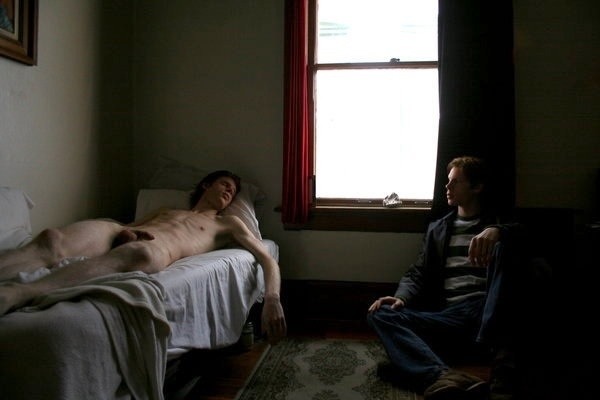
Source unknown – Title unknown (2012?)

Google image search and Tin Eye are both dead ends trying to determine authorship with the above.

A shame because it’s exquisite. (In my experience you can have the best gear in the world, meter seventeen different points and do the math to determine the perfect exposure. But in the end what allows an image to turn out like this has more to do with trusting the unconscious instinct the demands you stop down and you don’t question you just rotate the aperture dial to the appropriate setting and trigger the shutter.)

Also, I’m certain this is riffing off Michelangelo’s The Creation of Adam.

k.flightbrobdingnagian penumbra (2009)

As much as I have a preference for work where the craft is beyond on fleek, I will ALWAYS have a bias for outsider art.

Of course, it’s a very real question as to what that word even means when it pertains to image making–with all the rampant pretense, ego and misdirection that entails.

For the sake of the point I’m trying to make here: I’ll take Lynn Kasztanovics over Stephen Shore any day of the week and twice on Sunday.

The thing that makes k.flight’s images so haunting and yes, wonderful, is that any ambiguities or equivocations/quibbles are removed from the proceedings. It’s clear to the viewer what the images concern–more often than not a sort of sultry sexuality as ontology of existence.

The image maker and I have spoken on several occasions and what I feel is relevant to communicate to you is that for all her seeming assurance in the work, she admits to rarely being certain what to make of any of it.

As lame and knee jerk of a connection as it is to suggest: k.flight’s work reminds me of this commercial I saw back in the late 80s. I think it was for Chevy and it was this skater looking kid walking along a beach maybe talking to the camera about how punk rock functioned as a wake up call to rock and roll, reminded it what had original made it so vital and important.

Not all her work is great, but it is all good–even when it falls flat. I can name hundreds of image makers whose work I rabidly support, but there’s only a few that excites me to the marrow of my bones–k.flight is very near the top of that list. And I sincerely hope that I’m able to collaborate with her at some future point in time.

Source unknown – Title Unknown (20XX)

I’ve been staring at this for an hour or so trying to untangle why–despite being a shitty image–it resonates with me fucking seismically.

Yeah, I totally get the essence of it. I distinctly remember the feeling of being so aroused that it was painful and my single all-consuming thought being alleviating some of that tension.

And this nails a sort of visual distillation of that experience. But it also reminds me of that line: youth is wasted on the young. I’ve always thought of that as a sort of vampiric sentiment; you know: if only they could figure out a way to bottle that feeling of urgent adolescence, all the things I could do with what I know now!

All the while there are days I’ll not crawl out of bed all day and spend those hours wishing I had a time machine and I could go back and find myself at 19 and have just a few minutes to explain how the fear comes on its own. Don’t borrow it ahead of time, don’t wait on it. Just step out into the void and let yourself fall. Because there’s only falling. It’s not ours but it’s all we’ll ever get.

But I’m not sure I’d listen. Not sure I’d even know how to talk to the myself of so many years ago. And I think if I went back to me at 13, maybe then I’d know what to say. But what could I say: be less afraid to make mistakes because it’s not the mistakes it’s how you respond to them that will define the boundary between who you are and who you want to become.

It all comes down to the simple fact that although it does it shabbily and with less technical acumen that I prefer…this image’s raison d’etre exists in the boundary between where my work is as a photographer and where I want it to go.

The feeling underlying it has something to do with they way I always mishear that Neutral Milk Hotel line as: the miracle of their dark thing.

As has been said: Light is easy to love. Show me your darkness.

And the angles sing: How? What is the appropriate way? I’m trying. I’m trying and failing and falling, always falling.

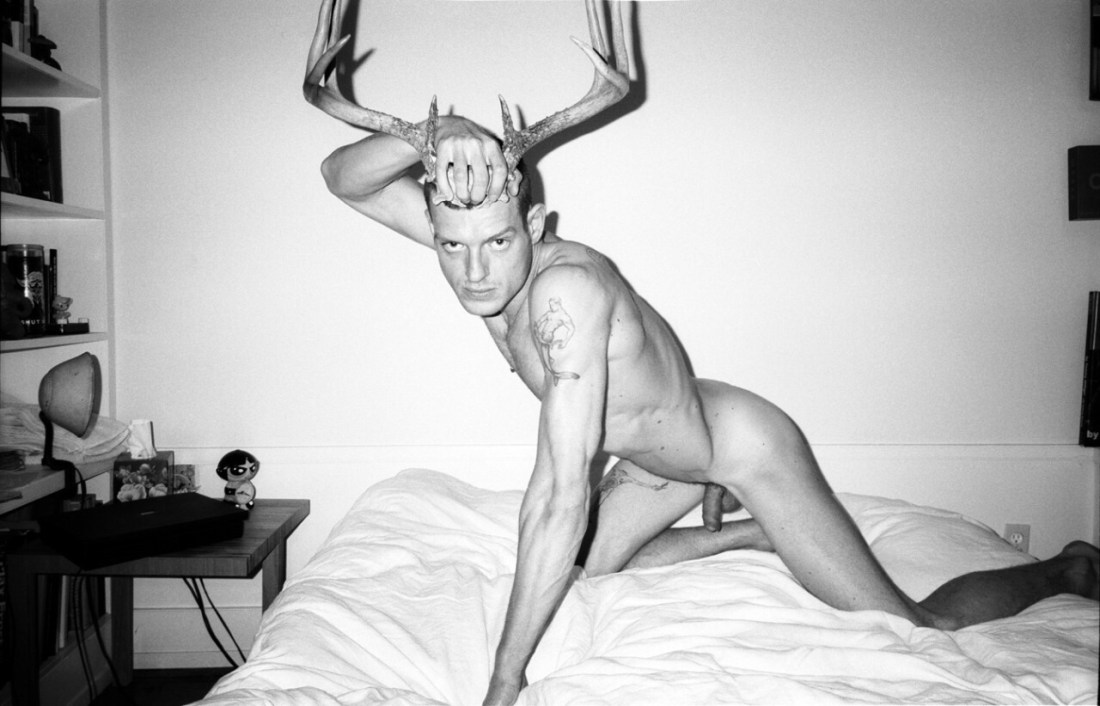
Miguel VillalobosDeer Slava (2008)

Like anything else photography has loosely defined genres, i.e. street photography, fashion photography, landscape photography, etc., etc.

There’s Ansel Adams–a stollid landscape photographer; your street photographers–Cartier-Bresson or Winogrand; and portraitists a la Arbus.

Additionally there are those artists who migrate between genres over the course of their career–probably the best example being Emmet Gowin, who started out as a portraitist who subsequently took up aerial landscapes of the American west as area of focus. Similarly–and ultimately unsurprisingly given her noted affinity for Gowin, Sally Mann has sort of been all over the place.

What’s interesting about these authors whose work shifts over time is that although the approach and overall aesthetic remain more or less constant, there’s always a lot going on between how they see and how they represent what the see. In other words, we recognize them by their creative trajectory rather than their constancy of vision.

What I find stunning about Villalobos–besides his bold use of dynamic black and white with a downright confrontational use of flash, is that although he favors edgy portraiture… there’s a consistency of seeing across his work regardless of genre.

His work seems to exist as if perpetually experiencing the trough between crests on a slightly sinister acid trip.

The Eye of Lamar – Beneath It All (2015)

As far as focal length goes, this is hell of wide–I mean the door way is bulging due to barrel distortion meaning were probably (given a 35mm equivalency) at around 16mm.

Normally, I’m a detractor from ultra-wide angle but here I’m rethinking my objection–at least in the case of this image. I mean the warping grows more noticeable toward the outside edges but since the illumination falls off, the vaguely parenthetical bulging of the door frame diminishes the effect of a frame within a frame.

I’m not sure that the two objects (it looks like a counter and a wall decoration of some sort) were meant to show up. That they do is kind of providential as it serves to balance the frame left-to-right in a way that probably wouldn’t have been as compelling with them.

Timur SuponovUntitled (2013)

As someone who has–in fairness–done more than my fair share of drugs, I’m fascinated by synesthesia.

As someone who–and this is true–shops for clothing by going shelf to rack to shelf feeling the material between my thumb and forefinger and only evaluating the style, cut and color after finding something that feels nice against my skin, I think photography has crazy untapped potential to convey a synesthetic sense of texture.

I can’t say this is a good image. It does have a nice tonal range and I appreciate that the image maker has included her entire body without chopping off limbs. The angle of the headboard(?) and foot of the cushions is distracting and although it’s supposed to be counterbalanced by the suffused lights coming through the diaphanous curtains, that strategy is a failure.

But dat texture, tho. The warn nearly threadbare cushions, the knit skirt–look at the way it stretches against her outer left thigh and even the curtains. In fact, if this were film and printed on nice rag based stock, her skin would take on a sense of taut sheen that it only hints at here.

Mercedes EsquivelSarah Vōx (201X)

At first glance, there was some thing about this image that flustered me–not flustered as in frustrated, more unconventional; as in the way the profound is often masked by it’s commonplace-ness.

It’s been saved as a draft for several months now. I keep  traipsing back to it, spending an hour hear and there trying (and ultimately failing) to give expression to an inarticulate gut reaction.

As with so much of my intellectual life, I have this tendency to believe only that which is so difficult as to be functionally impossible has merit. It’s a mentality that in the absence of intellectual heavy lifting, creates unnecessary work.

But that’s super abstract. Let’s keep it concrete and focus on this image: from square fucking one this image has been about the effortless, lack of contrivance to the pose. It is as if posing for an image were to be separated into a continuum of 1. ) preparing to pose, 2.) the mindful tension of holding the pose and 3.) the subsequent dissolution of mindful tension, then this image would represent the moment after 3 but also before 1.

This fit with my limited familiarity with Esquivel’s work; thus, most of my initial efforts to explain my reaction centered on the notion of pose. The trouble is that when you’re looking for something so specific, there is a tendency to miss the forest for the trees. By focusing on pose, I drunkenly lopped down long dark alleys of considering odd framing decisions; and instead of taking a step back, trying to justify my initial theory by suggest that kind of like counterpoint in musical compositions, the frame was an effort to highlight poses intended to exemplify the Golden Ratio.

However, after spending some time with Esquivel’s work, I’m realizing that there just isn’t that consistency in her use of pose. For as natural as the above is, her work is also rich with unnatural, highly stylized poses. In fact, her use of scale and angle of view differ enormously over her body of work. That which remains consistent is how she frames things.

And the framing is extremely interesting; it features an internal logic–while not immune to #skinnyframebullshit, she mostly avoids it–as well as an external consistency across her work. Moreover, there is a sense less of an image maker creating an image and more that the work exists as an exercise in assisted self-portraiture.If you spend any time with the images, there is a feeling that the impetus for the frame being what it is has more to do with it being something the image maker might have set up a tripod and posed for the picture herself without access to willing models.

Harry CallahanEleanor and Barbara (1954)

onlyoldphotography:

Muses throughout his career, Callahan’s wife and daughter played, posed, and aged before his lens. With their attention to the physicality of light, however, Callahan’s photographs transcend mere family portraiture by calling attention to the simple beauty of life’s fleeting moments. “He just liked to take the pictures of me,” Eleanor recalled in her nineties. “In every pose. Rain or shine. And whatever I was doing. If I was doing the dishes or if I was half asleep. And he knew that I never, never said no. I was always there for him. Because I knew that Harry would only do the right thing.”
Eleanor Callahan died in February 2012 at the age of ninety-five.

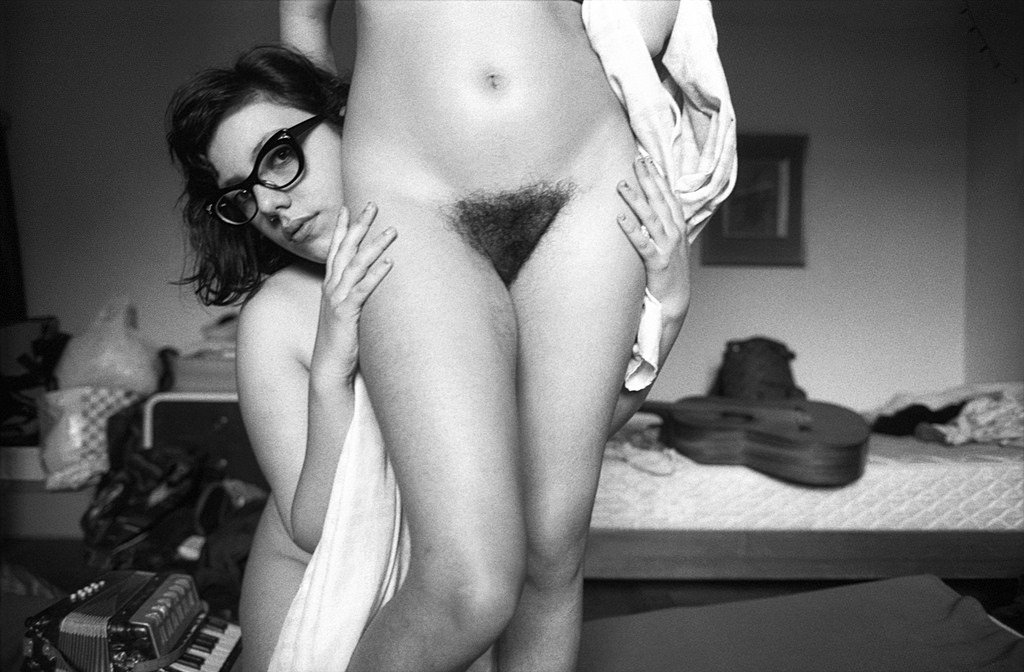
Paula AparicioUntitled (2014)

If there is a single, salient aspect to Aparicio’s work it’s likely the way her photos exude a feeling of post-coital tension between “the waning of ecstatic satiation and the waxing hunger of wanting more.

This tendency is well suited to her style; but, it’s especially noticeable in the way she photographs women.

I’ve lobbed a couple of shots over the bow of the Good Ship Female Gaze previously–namely with regard to Masha Demianova’s claim her work cultivates an equal and opposite response to Berger’s seminal male gaze as presented in Ways of Seeing.

And although I am doubtful, Aparicio would ever invoke the term female gaze to explain her own work, it would almost certainly be more functional applied to her work than anywhere else I’ve witnesses its deployment.

Upon what grounds to a base such an assertion? I am (unfortunately and much to my eternal chagrin) male bodied; therefore what the fuck can I possibly know about a female gaze?

Well, if there is such a thing as the female gaze–unlike the historical male gaze–it’s almost certainly the opposite of monolithic.

I know that growing up seen by others as ostensibly masculine, my experience of attraction, gender identity and sexual desire almost never lined up with my peers.

And I do realize it’s a dangerous assumption to take the braggadocio of hormonal male children as fact based, but I do know that while far ahead of puberty I shared an almost clinical fascination with sexual intercourse and that this fascination was age appropriate within my peer group, it remained a complete abstraction.

Let me try to unpack that a bit more–I feel a very profound need to articulate this correctly. We’d talked about sex, spent hours imagining the mechanics of it and my friends all tended to extend that imagining by connecting it to their sexual response. There was no separation in the expression of attraction and their sexual desire.

What I thought was attraction was actually a need to be understood. The people who listened to me, supported me and shared glimpses of their inner lives were always the people to whom I found myself drawn.

I remember the first time I ever experienced an attraction that linked up with my sexual desire. It was ninth grade. Her name was Michelle. She was my best friend and she’d had a growth spurt over the summer between junior high and high school. She didn’t really notice and I think her family was struggling to make ends meet with private school tuition, so she kept wearing the same clothes she had the previous year. Her favorite pair of pants were these white khakis. They’d been a bit on the tight side the previous year but now they might as well have been skin tight.

I remember walking behind her to class and noticing the visible lines caused by her underwear. I looked away, immediately. Partly because, I felt like I was violating her privacy but also because I found myself stunningly aroused. But my thoughts didn’t proceed from there to a litany of sexual things I’d like to enact with her. Instead, it orbited the notion of wandering if she felt toward me the way I felt towards her in that moment. The thought that there might be a possibility she did was the fantasy I brought myself to orgasm with again and again throughout high school. (Spoiler alert: she didn’t.)

I am hardly so daft as to suggest that what makes me think the notion of a female gaze applies to Aparicio’s work is because I experienced attraction in an unusual fashion. It’s more that the memory of the feeling resonates very strongly with something in her images.