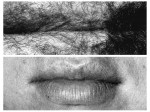
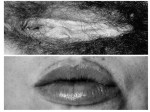
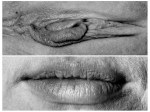
Cecilia WachterLips (2014)

Lips is a reaction to a culture in which female sexuality
and sex organs are depicted as dirty, shameful, and wrong. The slang
words for female genitalia are crude and degrading; ‘meat wallet,’ ‘fish
taco,’ ‘beef curtains,’ and ‘axe wound’ are all terms that aren’t
uncommon colloquially as well as in pop culture and mass media. Slang
words for ‘penis,’ however, carry themes of strength and domination
(e.g., ‘man muscle,’ ‘anaconda,’ ‘pocket rocket’). Whilst researching
and producing this series, I often thought of an article I once read
that printed the word ‘penis,’ but ‘vagina’ was written as a series of
asterisks. Why are the genitals of one person vilified while comparable
organs on another person are not only socially acceptable, but symbols
of power? From childhood, people with vaginas are told that their vulvas
are embarrassing, abnormal, disgusting, and smelly. As airbrushed
images of the idealized naked human body are increasingly more
accessible to young people, our perception of what is normal has become
flawed and distorted; perhaps as a result, in the past five years, the
numbers of people seeking to alter the external appearance of their
genitals has increased more than fivefold (Hogenboom 2012). Lips is
an attempt to appreciate, embrace, and encourage the divine,
unparalleled beauty of female genitals…. I sought to capture the
intimate intricacies of each of my model’s unique forms, emphasizing
their singularity and beauty.

I believe that this series will be confronting and triggering to my
audience, particularly those with vaginas, and I hope that some of them
may have the same realization that I did while viewing my negatives:
that we are more beautiful than we can imagine. Viewers may be drawn
into a reality that I have imagined, where genitalia can be body parts,
not political statements, and where what we are capable of is not
informed by our gender.


wonderlust photoworks in collaboration with @kyotocat – [↑] Vestibular; [+] Hasp; [↓] Wombs & Tombs (2016)

I’ve highlighted Emma’s intensity, poise and versatility several times already.

When I found out she was passing through NYC on her way back from overseas, I contacted her to see if she wanted to work together.

Given her work, my expectations were impossibly high and she still managed to exceed them by a factor of at least 20.

The hardest part of editing was selecting scenes where I managed to–through some fumbled bumbling miracle–make a photo that didn’t completely distract from her cultivated sense of her body in space/time, her meticulously considered poses and affinity for experimentation.

Honestly, I held back about a half dozen good images; simply due to the fact that afforded the opportunity to work with her again, I am certain we can do them better than they turned out this time ‘round…

Karin SzékessyJutta auf dem Sofa (1968)

As I’ve mentioned before I went to parochial schools from 2nd grade through high school.

In 5th grade, the school didn’t have enough money to hire a qualified Physical Education teacher. And despite the fact that every student attending already paid tuition, the school came up with the brilliant idea of charging families for extracurricular PE options.

This was how I learned to ski.

I actually did okay, at first. Managing to not fall for the first several hours I strapped fiberglass planks to my feet. Then I had my first lesson and the first thing they did during the lesson was to have everyone lift their foot–right first then left–and touch the tip of the ski to the snow and then the tail.

From that point forward I spent one day a week for the next three weeks falling often and hard. Be I pushed through the difficulty, learned and before long as tearing up green circle and blue square slopes.

Photography and image making are deceptive media. Our culture is so visual and so immersed in lens based modes of representation, that whether most folks give a second thought to it, those of us in the western world are steeped in an unthinking awareness of the basics of how to present a scene.

It’s relatively easy and takes minimal training to call one’s self an image maker. However, inherent talent only goes so far. At a certain point–if this art form means anything to them–they need to do the equivalent of lifting their ski off the snow and touching the tip and the tail to the snow; in other words, a certain dislocation or disorientation is required to truly begin to learn–one must realize that what they thought they knew they know not at all.

What does all this have to do with Székessy photograph. Well: although it’s hardly the perfect analogy–the realization that one knows little to fuck all about art history is probably the more apples-to-apples comparison with the example of learning to ski–as much as we’d like it to be (and as much as new technologies attempt to make it so–a lens does not interpret the world in the same fashion as the human eye.

And it’s not just any one thing that’s different–it’s a complex of things.

On thing is that lenses allow us to render visible subtle gradations in light we don’t normally perceive. Arguably the best example of this is covered as a part of the thoroughly excellent documentary Tim’s Vermeer–which centers on Tim Jenison’s attempt to recreate a perfect copy of The Music Lesson.

I feel like that’s in some way what Székessy image here is trying to convey–beyond a curious and dynamically presented scene.

wonderlust photoworks in collaboration with Lyndsie Alguire – [↑] The Right Light; [^] A Piece of the Sky; [+] Fever Dream; [v] Invisible Syllable; [↓] Annunciation (2016)

Nothing short of pure joy to work with @suspendedinlight and I could’ve easily included double the images here. (About half turned out really damn well.)

These were the most intriguing and distinctive to my tired eyes, though.

I am already very eagerly anticipating the opportunity of work with Lyndsie again in the future.

Sebastián GherrëBenja (2016)

I feel about Gherrë the way I’ve come to feel about Araki–namely: I don’t always get it but the work is consistently of high quality and in spite of the tendency for both artists to cover the same ground over-and-over-and-again, there remains surprising freshness and variation.

Also, I love that there’s someone out there who is still making traditional dark room prints. They just look so much better, damn it.

Otto Schmidt – Untitled (189X)

The above sampling of Schmidt’s work was posted by @vensuberg with the following note appended:

I’m posting these three pictures by Otto Schmidt to advertise another of Sparismus’ blogs, here.
The pictures there are generally of this type, about half by Schmidt
and considerable graphic material as well. Also the scans are much
better than he is able to manage on his regular Schmidt series and tend
to be about 6000×6000 (three times the resolution tumblr will post
these).

If you like your smut turn-of-the-century vintage with a dash of too-cool-for-art-school, then you’d do well to follow them.

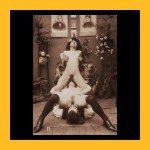
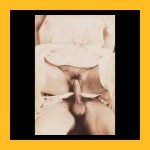
I was unfamiliar with Schmidt prior to seeing this but his work is intriguing. There’s an attention to depth of field (particularly in the top photo of what might be referred to as a cunnilingus pyramid) and control of overall tonal range which both suggest a familiarity with the photo avant-garde. Also, the blocking and positing suggests the photographer was extensively familiar with art history–particularly oil painting.

One might quibble that the commitment to fitting pornographic content to classical forms, detracts somewhat from the erotic effect of the work. I can see that and absolutely think that one of the struggles in trying to produce work that is Capital A Art with the pornographic depiction of sexuality as its subject is to carefully balance concept, form and technique with a carefully considered execution that leaves room for ruptures, disjunctions and spontaneity. (For example: although sterile and awkwardly over-posed the cunnilingus pyramid does end up reading as playful.)