The Death of Youth – Guetcha (2016)

As I’ve noted several times already: a cliche is a cliche because it allows one a reasonable handle on something that is otherwise unwieldy and fraught with complications.

The adage against cliches emerges from the fact that by using them, one is refusing to re-engage with and analyze a concept that isn’t necessarily one-size-fits-all anew. In other words, the advice against cliches isn’t that cliches are inherently bad so much as their ready made-ness presents an obstacle to independent thinking.

The elements of this image are cliche to the point of ubiquity: luminous lighting kissing the skin of a nude model standing before a milk white background.

Here though, the cliche serves as a foil–drawing attention away from the elements; instead, highlight the compositional attention to shape, line and tonal form.

I’d argue it’s too dark–and I don’t think that’s a matter of opinion given that the underexposure results in lose of shadow detail in Guetcha’s hair and along the right side of her face. But it’s easy to let that sort of teensy mistake slide when the result is this dynamically eye-catching.

Michal Buddabar – Paula Lyily (2016)

Geez Louise, what are they putting in the water in Poland? The concentration of fucking fantastic image makers active there is just effing breath-taking.

Buddabar is putting out some interesting work. You can easily pinpoint specific influences. For example: if you take any artist featured multiple times by The Quiet Front, you’re going to find traces of those folks work in Buddabar’s.

I don’t want to belabor that point by cross-referencing specific examples but I do think the it’s useful to compare and contrast with Alexander Bergström.

There’s a huge degree of overlap between their two respective bodies of work: an unapologetic voyeurism, similar form and tone, etc. Bergström‘s use of color is superior, further I think he’s arguably the better technician.

However, where Bergström seemingly tries to sublimate his more perverse (I’m employing my preferred value-neutral connotation w/r/t this term), Buddabar is more unflinching–also, although this perhaps wasn’t the case two years ago, he seems to be a much better editor than Bergström.

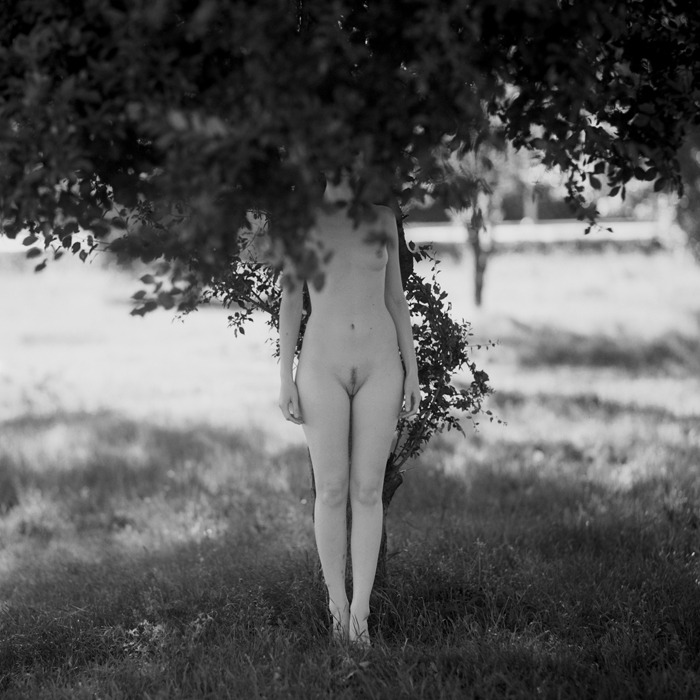
But what I also love about this image is it’s yet another wonderful example of how using the frame lines to crop out someone’s face in service of preserving anonymity is just a garbage decision. There are so many other ways to go about it and even the worst, most ill-advised face blocking device will be infinitely better than figurative decapitation.

Either way, definitely check out Buddabar’s work–it’s pretty great, especially the more recent stuff.

wonderlust photoworks in collaboration with Kathleen Truffaut – [↑] Atelier (2016); [+] Redolent (2016); [↓] Cauterwaul (2016)

My last trip out to L.A. was pretty much a cluster fuck of truly epic proportions. The highlight of the trip though was meeting and making photos with the angelic and thoroughly intriguing Kathleen Truffaut.

(An extra special shout out to @jacsfishburne–without whom the above would not have happened.)

Tono StanoGift (1999)

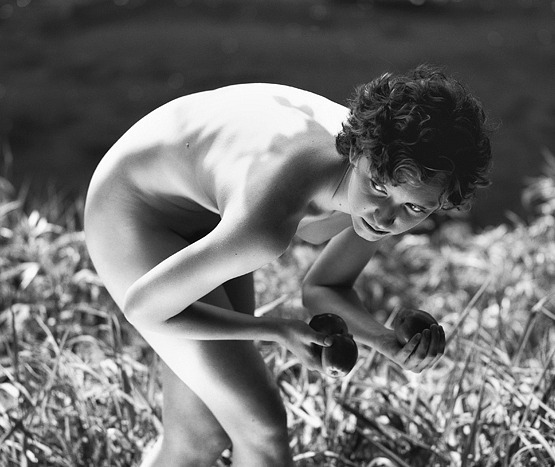
Like much of Stano’s work, I am, at first, not certain how to engage with this photograph: it’s stunning–both in the sense of the reflection of sunlight off a moving vehicle that unexpectedly blinds you as well as incurring a coup de grace.

That’s probably not such a bad starting point, actually. (First idea, best idea–and all that.) There is something impossible about the light in the above: the over exposure along the ridge of your back, the flattering dynamic range of gradients on her face. (There’s almost certainly some sort of wizard-like chicanery with bounce boards going on just beyond the frame edge.)

After the initial wow-ness of seeing it, I naturally think woman with apples and start running with the biblical Eve mythos. On the surface, I feel that’s a super hackneyed premise. I’m inclined to accuse the artist of a lack of subtlety, when I should probably equally blame myself for the ease with which I trot down that well-worn path.

However, I don’t think it’s the wrong path. Here the woman is looking at something on the ground with both gravity and curiosity. The viewer might very much be intended to make this sort of subconscious connection. The three apples (instead of the usual one associated with the trope), suggests a fascination with the potential of knowing of good and evil (and from a theological standpoint: embracing of sin).

The more I look at this the more I’ve convinced that the allusions to Eve actually serve a recursive purpose, to present the surrender to temptation with nothing more than an implicit tempter.

Everything else points to a rapturous celebration of the sensuous pleasure of being human, alive and therefore physically embodied. (Also, from the standpoint of compositional form: not how the parabola of her rounded back opposes the inverse parabola of the grass behind her and how her shape and order contrast with the blurry chaos of vegetation; and how the dark background in the upper 40% of the frame makes her stand out more–conceptually suggesting that between chaos and nothing, there is humanity and it’s potential of sensuous experience.)

Mona KuhnClaire Obscure (2001)

I do not have an entirely positive opinion of Kuhn.

Viewing this image re-contextualizes my thoughts about her work a great deal, however.

The first major difference is clearly the question of monochrome verses polychrome.

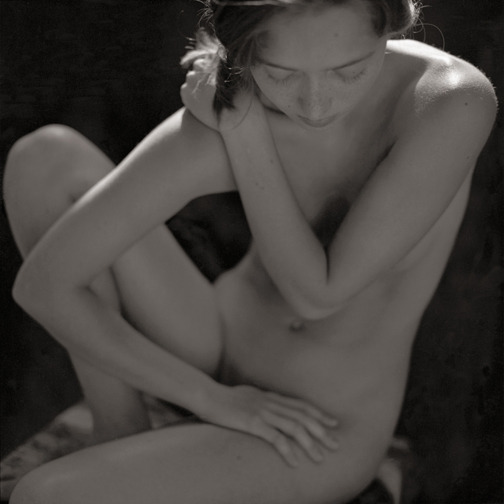
This image predates the earliest image in my previous post on Kuhn by a year. There’s the same intense intimacy and the creative deployment of depth of field  marking the later work.

Conversely, it lacks the profound sense exemplified in the later work of being anchored to a particular place and time–this is after all just a nude woman, darkness and light.

I think I’m supposed to appreciate the increased complexity and variation of the later work. Though honestly, I skew in an entirely different direction.

To me: Kuhn’s later work demonstrates an innate and unnerving sense of the interplay between colors. But there’s an almost galling lack of consistency.  For example, consider the more painterly affect of this versus the were she a painter she’d be using cadmium pigments and then leaving the finished canvas in the sun for a couple months to give it that sort of summer, sun-kissed beach bleached effect that accentuates her insanely shallow depth of field and underscores the conceptual interpenetration of her process with her material (French naturalist communities).

I reminds me of the topic du jour when I was pursuing my MFA: the role of color in fine art photography. The purists will argue that the purpose of color in fine art photography is to demonstrate something about the nature of color and lens based visual representation. In fairness: that’s already been done to perfection–see William Eggleston.

Others maintain color is just another form. Yet, the objection I always had to this is suggesting that the same–and I’m hesitant to invoke such a word here but since I can’t think of a more operable one, I’m going ahead: rules govern monochromatic work as polychromatic work.

I’m not confident enough with the clarity of my thoughts on the subject to push forward with that line of analysis at present. But, what does occur to me is that given Kuhn’s conceptual underpinnings her interest in the optics of intimacy and using naturalist communities as a sort of ersatz synecdoche, I feel the color–although contemplatively orchestrated–actually works against the stated aims of the work. With the exception of the aforementioned more painterly image, I feel like most of Kuhn’s work would actually function better with the ‘abstraction’ offered by black and white.

Dmytro GurnickiUntitled (2016)

Strictly speaking, this frame is underexposed–the darkest shadow area should retain the vaguest insinuation of textured detail; and, as can be seen, along the lower right hand edge, there is zero shadow detail to distinguish from the frame edge.

In this case it’s not the end of the world, it’s easy to make out enough of the frame edge so as to interpolate and recreate the frame edge when making a print. (Note: that this isn’t the case with the left frame edge, which is actually very nearly perfectly rendered given the dim overall illumination.)

And while the rest of the frame is objectively underexposed, the effect is extremely flattering. (Ilford Delta Pro, at least in my mind, produces optimum results when you under- or over-expose it a smidgen.)

This is a strong image. But the main reason I posted it was because it exemplifies almost exactly what I was picturing in my mind when I was addressing the shortcomings of this Karel Temny image a couple of months back.

Arseni KhamzinUntitled (2013)

…holy shit: this. is. FAN-FUCKING-TASTIC!

It’s a compositional marvel, really–the interplay between line, texture and shadow vs. light is exemplary.

The subject is slightly off-center to the right of the frame; allowing the top and right of frame to be counter-balanced by the much darker shadows cast by the subject and chimney.

There’s an intoxicating variety of sumptuous texture–poured concrete, mortar, corrugated metal, skin, hair and fabric. (It’s an especially inspired touch that the lines on the tartan print blanket reiterate the two point perspective of the composition, but in their slightly imperfect alignment, they server to further direct attention toward the subject.

Why does it all work so well? Two years ago I would’ve just offered the cop out of attention to detail regarding texture and balance but actually, the frame works off a simple 45 degree clockwise re-orientation of the rule of thirds.

And I’m not even to the best part–this is a Pietà! Yes, it’s oriented differently. Traditionally, Pietà present Jesus from head to toe starting with his head at frame left and his feet towards frame right. [Can someone with a little bit more comprehensive of an Art History background explain the relevance of such positioning? I suspect there’s something to it (sacred vs profane, which would be interesting given the fundamentally humanist trappings underlying the codification of the trope)–not unlike the direction Ganesh’s trunk curls having distinctly different meanings.]

Yes, it’s also short a figure and the genders are swapped–or so it seems to me. But there’s really some fascinating reinterpretation going on surrounding the trope. I can’t help but think the point of this variation has something to do with the loneliness of existence and a sort of embodiment of that notorious line from Donnie Darko: every living creature on earth dies alone.

Lastly, this was made on Impossible Instant Black and White Film with Hard Color Frame–which in my experience is not the easiest film to use if you want to produce a thoroughly luminous result such as the above.

Stunning and exceptional.

Will McBrideRocky & Julia (1972)

One of the most amazing teachers of my life taught Sociology 101 in community college. (She was breathtakingly brilliant and could’ve taught anywhere but as a committed Marxist, she viewed it as her duty to provide the same degree of academic rigor to students who might not necessarily have the resources to attend an Ivy League institution.)

I still refer back to notes from her class a handful of times every year. This time it was to remember the term cultural lag.

The gist of the concept is technological innovation moves at a much faster speed than cultural evolution. As a result it can take a really fucking long time for society to come to terms with advances in technology.

If you are unfamiliar with McBride, he’s notable for his collaboration with Helga Fleischhauer-Hardt, a psychiatrist, on a picture book designed as a resource to help parents educate their children about sex.

The book was called Zeig Mal! (or, Show Me!) and it included frank discussions about sex accompanying age appropriate images of nude children and graphic depictions of teens and adults engaging in sexual activity.

It was well received in Germany–and received a second printing. But it’s publication in the U.S. was more troubled. It was quickly libeled as ‘child pornography’–and despite the fact that it exonerate in court on four different occasions as not obscene.

However, there was a convoluted back and forth about whether or not distributing non-obscene depictions of nude children was protected by the first amendment. To be on the safe side, the publisher opted not to continue to publish the title in the U.S.

The notion of cultural lag doesn’t strictly apply to McBride–if anything the culture was fine until puritanical prudery arrived on the scene.

There is something potentially valuable to consider here; namely: that as long as we remain unclear on what constitutes pornography and what does not, we’re going to continue to have problems like this.

If you disagree think about teens who are getting added to sex offender registries for consensually sexting nudes to other teens.

The pervasive attitude of puritanical prudes is that education/preparation is implicit acceptance of the activity. (The reason so many idiots are against contraception is truly less out of any well-meaning desire to keep kids and teens safe and more born of the fact that “if we provide free condoms, then they’re certainly going to use them.” It’s entirely about control–no more, no less. Fear and coercion only work so long as they keep you from eating of the fruit of the tree of the knowledge of good and evil; once you’ve eaten, you want to continue to eat–you just have the associated guilt over eating in the first place to work through before you can truly enjoy the feast. (Sadly some people never make it.)

Consider another analogy: of the kids I went to a parochial high school with, only one never struggled with the sudden freedom of self-determination upon going off to college. All of them struggled with binge drinking and addiction except the class salutatorian–whose parents wisely allowed her to have a glass of wine with dinner and an occasional beer here and there from the age of twelve onward.

Similarly, the people I know with the healthiest attitudes towards sex are those whose parents refused to teach their children that some sort of shame surrounded their bodies/nudity and who modeled sexual attraction/behaviors in an open but appropriate fashion.

Or, to put it another way: in my experience if a child can formulate a question on a particular topic they are generally more than ready for an honest answer.

We–as a culture–really need to do better about this kind of thing.

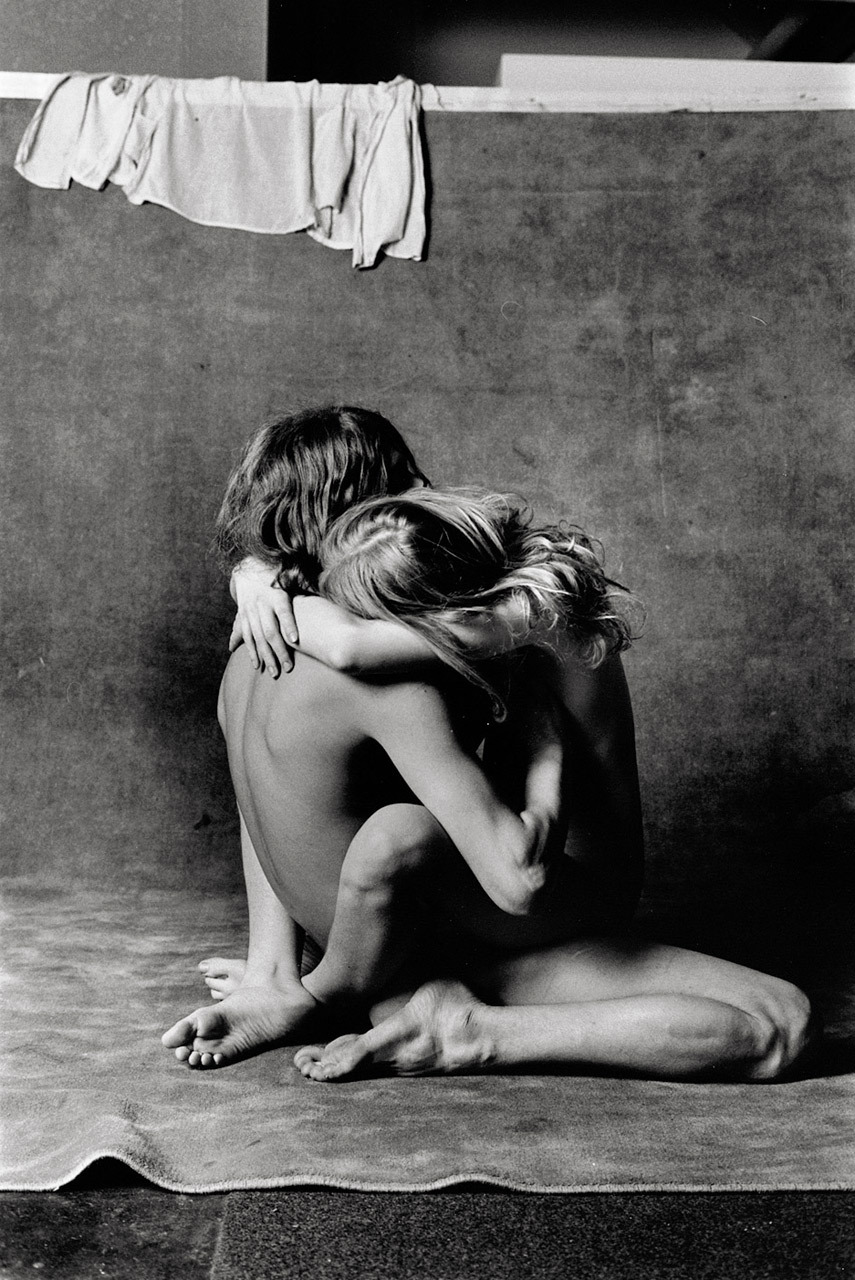
Anyway, I have no idea from what body of work the above image emerged. It would’ve preceded Show Me! by half a decade. But you do have to appreciate the seemingly post-coital intimacy that manages somehow to avoid both sentimentality and salaciousness.