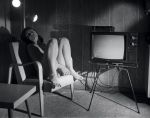
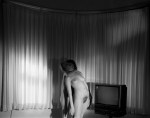
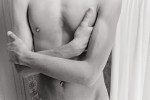
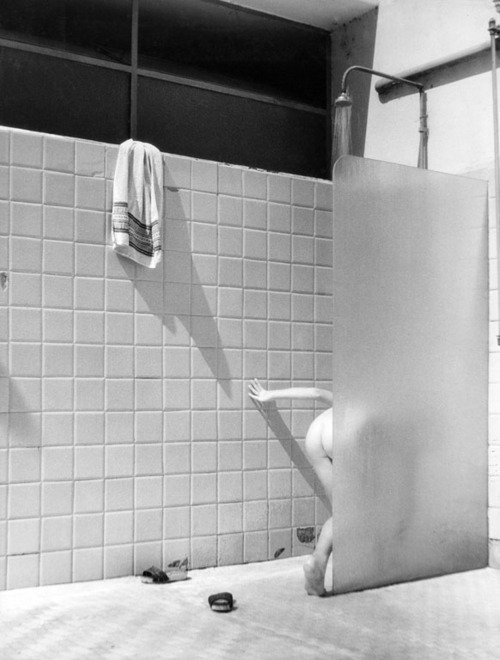
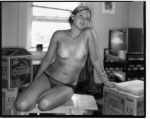
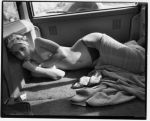
Malerie MarderUntitled from Carnal Knowledge series (1998)

When I first stumbled onto Marder’s work a little more than a year ago, I had mixed feelings about it.

As I’ve subsequently encountered the work and reengaged with it, my estimation has shifted dramatically. The work has grown and I’ve discovered nuance and sensitivities I had previously overlooked.

Yes, I would still very much like to see her make something that is simultaneously capital-A Art and pornography. However, I’m not much less inclined to believe that not making that sort of thing the focus of her work is any sort of detriment or side-step of intrinsic potential and more I suspect if she did make art porn it would immediately clarify a number of stubborn questions I have about how to approach such an endeavor.

Really though, what I’ve learned by spending more time with the work is there’s actually less in the work that relates to pornography or Art. As the title of the series from which these images emanate suggests, these are more documentations of sexual arousal. They are less concerned with any sort of fantasy or sensuality; all but completely disregard any pretense of eroticism and focus simply on the space between tension and distension in physical desire.

The images are about sex. But in being about sex they aren’t intentionally arousing or explicit, that’s merely a natural outcropping of their laser-like focus on presenting the material with honesty, immediacy and intensity of feeling.

Another way to put it might be like this: how do you describe the taste of coffee to someone who has never tasted it? It’s a trick question: you don’t/can’t. You pass them a mug and say here this is hot and strong, try it.

The corollary here is that in a similar fashion, you cannot explain to someone who hasn’t had sex with another person, what it’s like. You can say it’s different than masturbating; but as to how it’s different… yeah, good luck with that. Because there’s the way the sensation is fundamentally different.

To be crass: being so horny you need to get yourself off to alleviate the tension is not unlike hunger but desire to share a connection with someone is much closer to thirst.

I believe Marder’s work is seeking to address something of the mechanism of such thirst. And the extraordinariness of that cannot be overstated.

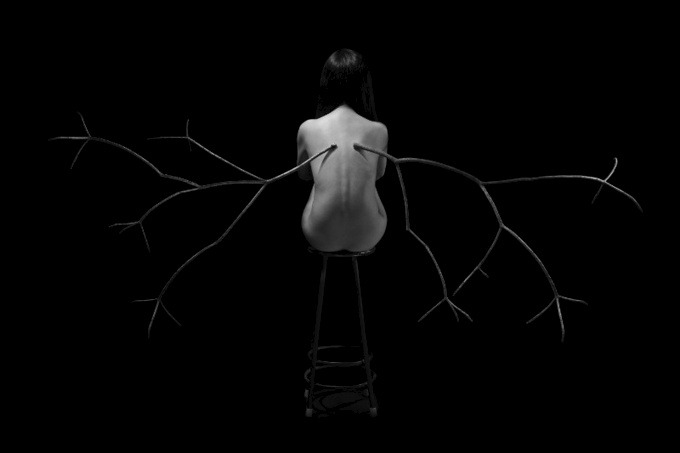
Peng Yun I also have a pair of wings (2013)

Typically, I’m not fond of excessive pitch dark negative space for the same reason I’m skeptical of close-ups–both tend to diminish context. And, if you haven’t already figured it out: I’m all about that context, ‘bout that context, ‘bout that context. No vagaries.

This though, this I like.

I think what renders it especially resonate for me is that I rarely dream anymore; or, if I do, I do not remember my dreams upon awakening. It’s probably partly that I don’t ever sleep especially well–which is almost certainly exacerbated by my dependence on self-medicated with a variety of substances.

That’s not really the point. One of two dreams I’ve remembered in the last six months or so, involved these gargoyle like creatures. They appeared more or less human–except on a slightly larger scale; like a short one would be about 7 feet tall.

What made them resemble gargoyles was they had tree branches grafted to their backs. Walking around and interacting normally, they looked like two Groot arms trailing down their backs. But when expanded, they revealed green leaved branches that could be flapped like wings and allowed for limited flight.

I wanted to do something with the idea since I had the dream but I’ve been struggling to figure out what fits. Thus, it’s unnerving to see someone a world away with a stunningly similar notion.

One other note: while I hardly dig all Yun’s work–a lot of it is a little two reminiscent of lazy liberal arts students who easily invent compelling concepts and then execute them in a half-assed, haphazard fashion to a Radiohead track. But, I do absolutely love the way there’s also an explicitly erotic tinge to her work. For example: this is an image of which I am murderously jealous I can’t claim ownership.)

Christine Godden – [↑] Light Touch #009 (197X); [←] Light Touch #008 (1970); [→] Light Touch #019 (197X); [↓] Light Touch #016 (1970)

In an interview with LENS Escuela de Artes Visuales in Madrid, Mark Steinmetz comments on the difference between B&W and color photography by saying something to the effect of if you’re shooting B&W you want to be on the blindingly bright side of the street; whereas if you’re shooting color you want to walk to the other side of the street and work in the shade.

Therefore–given the time when these images were created and given their ostensible fixation with capturing the interaction between bodies and light–it’s understandable that these were shot B&W.

Given the premise, these images were not necessarily destined for greatness. After all, ‘photography’ literally means ‘drawing with light’. And no one needs to look further than the parade of images on Instagram that serve no other purpose than to document the fall or angle of a certain precocious shaft of light.

To my mind what makes these images exquisite is their intimacy. However, instead of making that observation and then leaving it at that as I normally do–usually because I struggle so much with the unruly beast that is language and don’t know how to convey my thoughts clearly; I think it’s worthwhile to dig a bit deeper here.

Godden’s eye is unusually disciplined. The one thing that I believe holds true across her body of work is that through it’s revealings, it actually manages to conceal far more than it presents–the hiked up skirt hem, one erect nipple/the other concealed, a shift lifted to reveal allow a bare tummy to luxuriate in light and a nude body stretched out beside a pool.

Nothing is explicit; yet the photos are organized to point–seemingly incidentally–towards what remains unseen.

All of the above images are what I would term close-ups. I typically don’t like the close-up because I feel it tends to highlight a part of the whole instead of the part within the context of a whole. These images have a context–albeit a purposefully limited one.

What’s interesting is these images remind me quite a lot of glossy ads for luxury items from the late 80s/early 90s that I see beginning to bleed in around the edges in emerging ads that go over the top to commodify sexuality by aggressively conflating it with whaat ever the fuck is being sold–the pairing of several discrete elements that read as surreal juxtapositions.

In the case of such ads, it’s the product that unifies the disparate elements. But with Godden’s work, these carefully constructed images allow for the viewer to experience a sort of mirrored relationship between the photographer and her subjects. There’s very much something of seeing the world through someone elses eyes.

Source unknown – Title Unknown (19XX)

Narrative this image is not. In fact it’s pretty goddamn contrived–a cishet male photographer appropriating lesbianism for erotic effect.

But that realization serves as a narrative spark and I can’t help but think that as these two women were leaving post-session and one of them–probably the one on top (the woman on the bottom with the protruding tongue is a little too lipstick lesbian for me to believe she has any personal experience with cunnilingus) works as a prostitute but is a lesbian. She accepts these photo gigs because they pay the same as sex work and she doesn’t have to deal with men.

Yet the sessions themselves are the closest she gets to tracing the outline of her true desire and as such she frequently jokes with other woman with whom she is photographed about how ridiculous the way heterosexual men think about lesbian sex is and hoping that the other model will just once nod a little too knowingly and one thing will lead to another.

Source unknown – Title Unknown (20XX)

A couple of posts back I mentioned about how in unselfconscious moments, no one really gives a second thought to accepted notions of public decorum. We pick our noses, scratch our asses and just generally give in to the entropy of personal comfort.

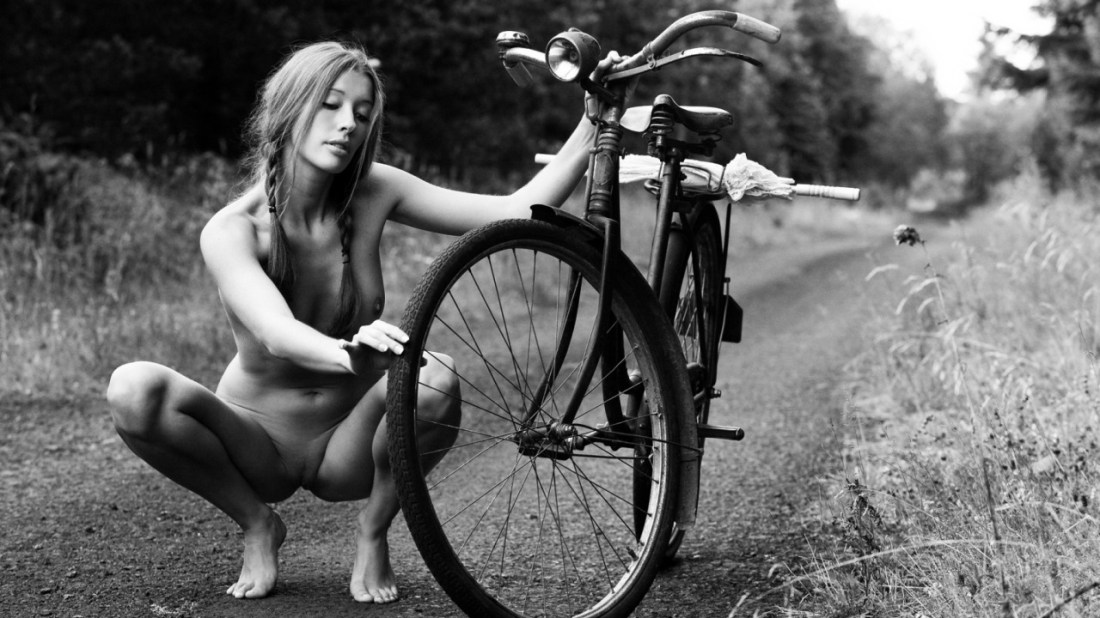
As such, this is clever insofar as the pose–although leaving little to the imagination–is actually not salacious. I mean, if a young woman riding her bike nude down a picturesque country road were to question whether or not she had a flat-tire, it might look something like this.

Yes, the camera is positioned ever so carefully to offer the audience the best view. But I do like the sense of scale, perspective and other than the dead flowering weed that just seems to float in the foreground, it’s actually a pretty damn decent composition.

(And, yes, anyone who was a seasoned bike rider would probably stop, straddle the bike and lean over the handle bars to check the tire–but that would be far less coy.)

With these type of images I always encourage people to ask: why is the subject naked? In this case, that’s not a question I think to ask. (I may not have ever had a chance to go skinny dipping in my life but I’ve damn well ridden a bike naked on dozens of occasions.)

But what I don’t understand is the damn umbrella strapped to the back of the bike? I mean, she doesn’t appear to need to wear glasses, she’s rocking the bedhead straight to braids look so it’s not like impending showers are going to muss her look and it’s warm enough for her to be riding her bike naked down a deserted country road…it seems to me an umbrella just doesn’t make a goddamn lick of sense.

Because riding a bike naked is great and all but running around without a stitch in the summer rain is bloody transcendent.

w-y-s-f:

I’m going to be out of town, but I wanted to post a reminder that today’s theme is scars! I have eight symmetrical scars on my spine from an injury I suffered in 2010. While it was one of the most traumatic things I’ve ever experienced, and I deal with pain everyday, I think about how often artists transform pain. Brooke Eva looked at my scars and saw something else. Scars are healing. They’re the place where the cut was. They’re the place where the skin is growing over the hurt. They are your Earth’s earnings. Your transaction with time. A sign that you survived something that might have killed others.

Hanna

Brooke EvaHanna Grace (2015)

I don’t–for once–have a raft of commentary about this image. It’s entirely too dark and the placement of the subject in the frame is governed less by any pervasive aesthetic logic and more presenting an overhead-ish view without including the camera operators feet.

That’s not really intended as a slight against the image. In being entirely too dark and given the prominence of the vertebral column, there’s a clear parallel with Sally Mann’s work.

However, I talk about Mann entirely too much and it’s seems especially pointless given that when you perform a Google Image Search on this image, the top result is actually a Sally Mann image. No one reads what I post in order to discover something an algorithm could teach them.

What interests me about this is the subject herself: Hanna Grace.

I noticed her work about six months ago and was so impressed with the inherent potential in one of her photosets that I featured it in a post.

Subsequently, her work as well as her commentary/writing keep commanding my attention–there’s something devastatingly insightful in the way she articulates her thoughts. And there’s a certain rawness to her presentation that applies whether she’s modeling, making self-portraits or explaining her singular perspective.

I’ve struggled in the writing of this post–deleting everything multiple times and starting over. I can’t seem to get the tone right. The laudatory aspects is easy enough. Since I legitimately enjoy her work. But there’s also something else I want to address but I’m hesitant…

In several earlier drafts, I’ve tried to suggest a correlation between Hanna and Francesca Woodman. That’s a little too easy and pat, though. What I see as relateable between the two is Woodman’s asymptotic approach to something not unlike malediction in the later work.

However, Woodman’s later work tends to toe the line separating curious exploration and experimentation from outright narcissism. In other words, the precociously astute interrogation of visual representation and gender identity grow that defined her work as a teenager growsincreasingly redundant and struggles to find a solid contextual footing.

Now I’ve read a great deal on Woodman but I’m unfamiliar with critical commentary that has taken issue with her ostensible white, cishet privilege.

That–in turn–propelled me to consider similarities between Woodman’s work and Ana Mendieta’s. Again, that’s probably to pat and easy a corollary but they were both wunderkinds, who were celebrated during their lifetime and who both died under similar circumstances–falling from tall buildings. (Although, it is worth noting that unlike Woodman, Mendieta was probably pushed.)

On top of those similarities, there’s an overlap in their respective tones–a similar maledictory thrust. (In fact, several of Mendieta’s performances invoke violence in ways I consider objectionable.)

Despite that, I find it interesting the degree to which Woodman receives adulation and Mendieta remains lesser known. I’d argue both are equally important. But Mendieta does–at the least–contextualize her work in a broader, historical sense addressing a more primal, magical sense of gender as construct. (By that account, she’s objectively more mature than Woodman.)

Grace’s work strikes me as adjoining these two women. The malediction is subverted into a means of exorcism and the context is intersectional feminist discourse. In that regard, she’s closer to Mendieta than Woodman. However, I do have to point out that in the quote with which Grace introduces the above image, I do think the final sentence is telling: A sign that you survived something that might have killed others. [Emphasis mine]

It doesn’t quite read as an explicit notion of personal exceptionalism. But it does beg the question how surviving something that might have killed others is somehow more noteworthy than surviving something that might have killed you.

Rendering death as an alterity is rather an odd maneuver given the intensity and rawness of the work. Especially given the momento mori of the above image. And I mention it not so much as criticism; more from the realizations that its often the seemingly irreconcilable contradictions between how we think of a thing and how we articulate our thinking about that thing which provide the most staggering growth in our work–creative or otherwise. 

Karel Temny**** (2015)

There is something curious about Temny’s work.

Skimming through it’s easy to latch onto an essential Russian-ness to his aesthetic; from there, to pick apart various apparent influences, & etc.

Such actions ultimately impune the images as both derivative and internally redundant.

However, there are some interesting things to be gleaned if you squint a bit and think outside the box. In other words: Temny does literally thousands of things wrong but at the very least he does them consistently–and in that consistency there is something not unlike a recalcitrant artfulness.

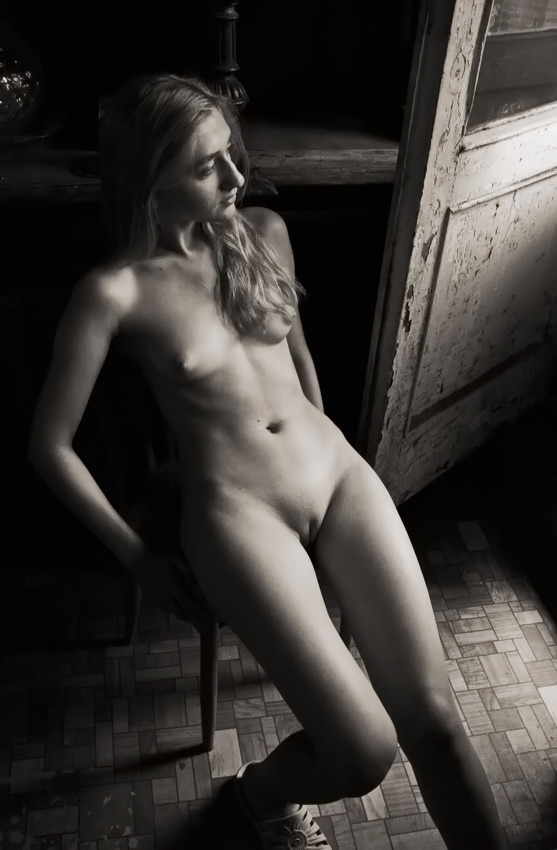
To start with: the above is a shining example of #skinnyframebullshit. The vertical orientation serves no other purpose other than to–given a tight space–include as much of the young woman’s body as possible; even though the frame runs contrary to the logic of the lines of the door and oblique angle of the light which push the eye leftward. (The way the lower frame edge amputates the bottom third of her right food and her left leg mid-calf is also unappealing. Also, a wider frame would’ve diminished the distraction of light falling from a window onto the floor that can be seen in the background between her face and the edge of the door.)

Yet, in this botching of composition, there is something instinctive that should be celebrated. Given this scene the light is hardly ideal. Given the bright spot on the door and the reflected spill onto the floor, this image was made at or very near to mid-day.

A ‘better’ image maker would’ve waited for more diffuse illumination but there is something to be said for the way the light accentuates the texture of the flaking paint on the door, the pattern of tile floor (further enhanced by the fact that the hyper focal point of the image is actually mid-way between the model and the floor), and the arabesques of her sandals.

Also, the pose doesn’t work. Her upper body seems transfixed on something playing out just beyond the edge of the frame; whereas her knees press together in a slightly demure self-consciousness. (Contrast with these MetArt images of Brionie W or this still of Laney from an Abby Winters masturbation video; both are made with a voyeur clearly in mind but although stylized they present a realistic unself-consciousness that is designed to de-emphasize the voyeuristic imperative.)

There is at least one other thing of interest to note–despite the inherent Russian-ness of the image, there’s also a way in which the muddy mid-tones invoke a Francesca Woodman-esque tone; a tone that neither exactly fits nor doesn’t fit the image but strikes me as intentional. If so, whether or not it work, it’s an audacious inclusion and I hope Temny is better able to address the extensive technical flaws with his work because I get the feeling he’s got some truly bad ass ideas he just hasn’t quite figured out how to accomplish yet.

Alexander Talyuka*** (2016)

You know how there’s a statistically relevant correlation between being a fan of Smash Mouth and being a Douche Bro?

I’m here to suggest a similar relationship between white cis men who identify as ‘fashion & nude photographers’ and shitty, quasi-exploitative imagery.

Talyuka is a sterling example.

However, much like the infinite monkey theorem suggests, even a douche-y bro can sometimes stumble upon a good picture–consider the above.

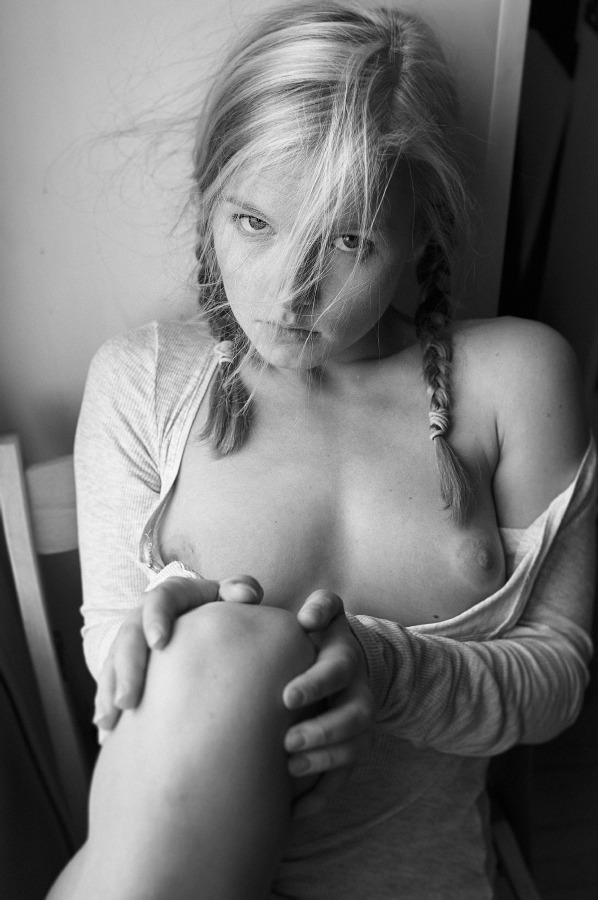
And it’s not even necessarily good. First and foremost, there is no compelling reason for this to be a vertical composition. Second, I’m going to take a wild stab and suggest that it was shot on some sort of full manual, setting. This would’ve been an image that would’ve benefited from an extremely shallow depth of field as her knees and hands contribute decidedly towards creating a foreground and the wall behind her is an obvious background. Rendering both bokehlicious, could have accentuated her expression–somewhere between coy and perhaps deflective of unwanted insinuation.

But really, I’m all about the mussed hair. It’s like she just pulled a wool jumper over her head and her hair is all wild with static electricity. It flies in the face of the prerogative for perfection in fashion moded work and her it at a cute, down-to-earthness to the image that renders it palatable.

Ted Partin – [↖] Dallas (2008); [↗] New Have I (2004); [+] Brooklyn (2004); [↙] Brooklyn (2004); [↘] Brooklyn (2004)

I’m flabbergasted at how little of Partin’s work there is floating around out there in the interwebz–almost none of it on Tumblr.

Scanning the critical exposition on it, it’s easy to understand why–sadly, there’s a roughly two decade lag between what the gatekeepers of fine art will publicly endorse and great new work that is being made in the here and now.

Part of the problem is that critics–and I’m accusing myself just as much as anyone else–tend to shout about the easy connections. Folks want to contextual Partin as the heir apparent to Goldin and Clark.

It’s not that such connections are inaccurate it’s just that placing them side by side like that you emphasize a sort of insider’s perspective into the experience of counter culture youth. And that relationship simply isn’t borne out in the work.

Two more appropriate corollaries might be Ryan McGinley and Mark Steinmetz–the later as a result of the unmediated/unrehearsed immediacy of framing and McGinley’s fascination with youth culture is more in-line with the work than Clark; although even McGinely is problematic as he tends to fixate on fetishizing youth whereas Partin seems more interested in a sort of humanistic elegy.

Or, if you’re looking for brownie points: you could argue for interpreting the work as an allergic reaction to Winograd’s Women Are Beautiful.

Any way you slice it: it’s nearly meditative work that makes up for what it lacks in maturity and breadth of scope with a precocious and raw intimacy that somehow manages to avoid both documentary sterility and voyeuristic fixation.