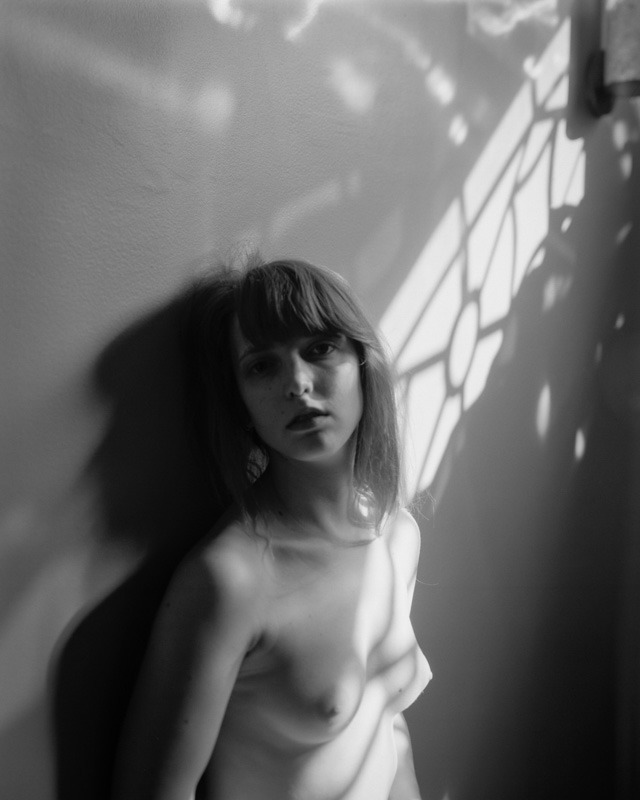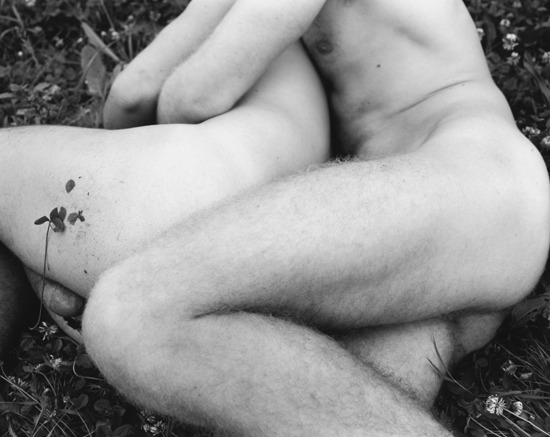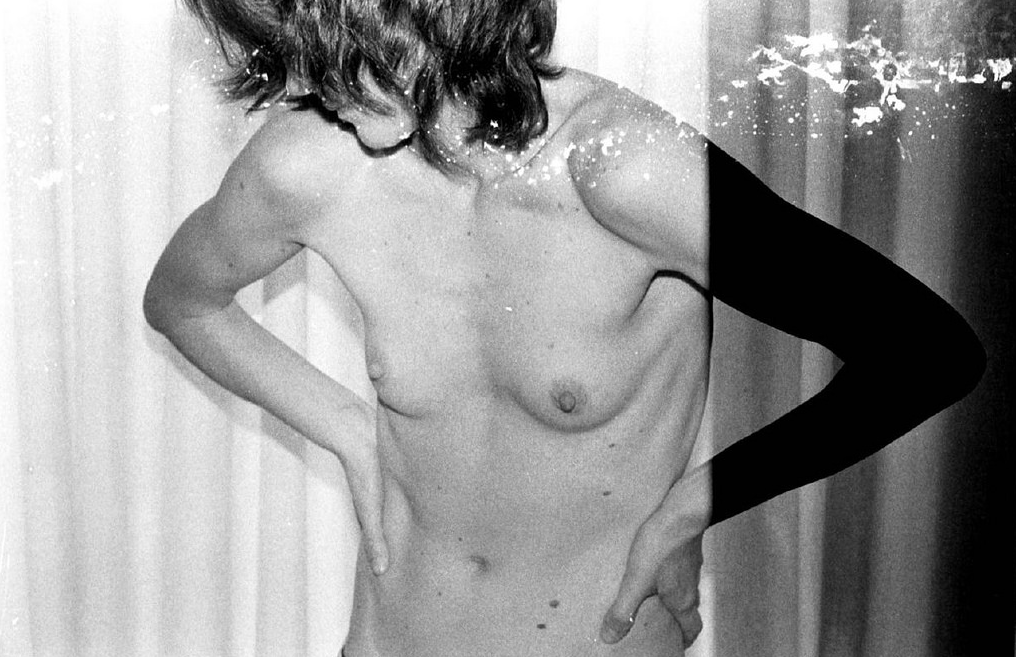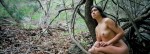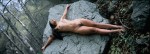
Lúa OcañaUntitled selections from Don’t break series (2011)

One of Nietzsche’s most oft quoted aphorisms comes from Beyond Good and Evil:

Wer mit Ungeheuern kämpft, mag zusehn, dass er nicht dabei zum
Ungeheuer wird. Und wenn du lange in einen Abgrund blickst, blickt der
Abgrund auch in dich hinein. [He who fights with monsters should look to it that he himself does
not become a monster. And when you gaze long into an abyss the abyss
also gazes into you.]

It’s the second bit about gazing into the abyss which seems to me to be applicable to Ocaña’s photos.

This was the first image of hers I stumbled upon.
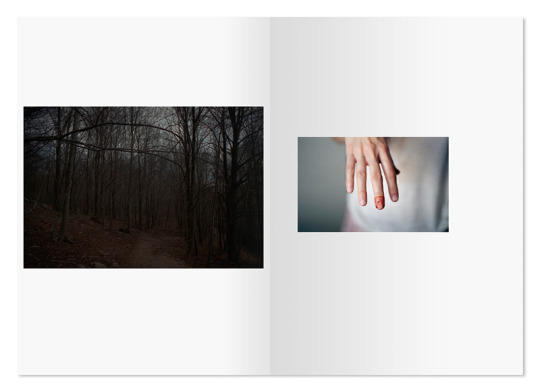
The photo on the left reminds me of the stuff Sally Mann was doing between Deep South and Proud Flesh–too dark to determine whether its twilight pastoral or turgid nightmare.

Yet paired with the second photo of a bloody finger–which might have been taken by any number of internet famous photographers–any sense of sinister menace resolves into something closer to the slow ache of an unrequited longing; as if the beauty as well as desperation of existing in a desolate space transform one into something that mirrors similar beauty entwined with desperation.

Ocaña is doing revelatory work in exploring the interplay of images. (I especially admire the way she’s employing text, mixing B&W and color–something I’ve struggled with how to pull off in my own work–and so openly demonstrating her process.

But here we should return to the images with which this post opens from the series Don’t break.

My Spanish is godawful but here’s what I’ve got as far as an ultra literal translation of the artist statement:

This project is about delicate-ness; where absence, the unattainable and loneliness form the central conceptions. Nudity is de-emphasized and employed as a means of establishing an intimate, relateable frame for the work.

Each photo/diptch presents an anonymous protagonist. The relationship between photos morphs across the series and establishes a larger context given the work taken as a whole.

Assuming I got even a fraction of that right, I would deem the work highly successful.

However, heading back now in the direction of the quote with which I opened this post: I read this article recently in the NYTimes about a newly discovered ‘music center’ in the brain. I was fascinated and appalled in equal measure.

See: I’m a disciple of Wittgenstein. And one of the most salient facets of Wittgenstein’s work is the notion that contrary to the accepted Cartesian model, meaning does not derive from internal mental processes. As W. puts it: if every time I understand how to solve a problem I experience a white flash as if a light bulb is suddenly illuminated above my own head, the white flash is not ‘understanding’. I am justified in saying I understand only when I am able to correctly solve the problem.

Thus, if we say that music activates a certain area of the brain that language and aleatoric sound do not–how much further is it to test if something is music or not by strapping someone into an MRI and playing them a sample and then judging by how they react deeming music or not?

One of the great sadnesses of my life is that I possess no talent for playing music–although I am more sensitive to music than any other form of art. (I’ve gotten higher off songs than I’ve ever managed with any illicit substance.) To me there’s something musical about walking through a snowy forest with no one around for miles and you can actually hear real silence for once or the way the calack-calack of trains always ends with a half-measure rest instead of the expected completion of the rhythmic expectation. Hell, right now I’m listening to Tim Hecker

Is what Ocaña does photography or collage. I’d argue it’s both. And to me that both is incredibly important.

Imagine I’m standing listening to you tell a story. You’re back is to the ocean and I’m facing you. We’re standing on a hill and the sun falling toward the ocean. And then something between your story and the orange-mauve color of the sky sets my brain on fire. I point and you turn and look. Either you’ll see it or you won’t. By the time I find the words to indicate that to which I am pointing, it’s spell on me will have ended. But by pointing there is a chance that you might catch the tail end of the same spell. That I might share it with you. That you might know too.

Rachel JumpUntitled from In Progress series (2014)

I like Jump’s work but I have no idea what to do with it.

She mentions her conceptualization revolves around ideas of ‘memory’, ‘belonging’ and ‘home.’

It’s not that I think she’s misjudging her own work. It’s that if those are her primary considerations–then they are not readily apparently in the work (at least not without enough mental squinting to prompt a migraine).

I’d venture that the work is about those things insofar as each of those notions involve some degree of fragmentation. Memory–I remember it like this, you remember it like that but the truth was likely somewhere between contradictory accounts. Belonging–do you accept me for who I am, who you think me to be, who you want me to become? ‘Home’–as a very wise person once told me: home is the place you can’t leave fast enough but once you’re gone all you do is count the days until you come back.

It’s as if she’s trying to produce work that matches the vision in her head but in doggedly pursuing that vision, she loses sight of subtle course corrections suggested by the ways product contradicts process.

Like she makes wonderful self-contained images that are visually dynamic (1, 2) yet convey a strong sense of temporal-spacial distension–as if the viewer is a voyeur watching a dreamer experience their dream.

But such cohesive and clear photos are placed side-by-side with the above–which is lovely, yes; but there’s something languid, informal and uncertain to it.

Interestingly, as dynamic as some of the other work is, I get caught up wondering what I’m missing with the image above. And I can’t help think that if whatever is absent was at least pointed to by the photo, I would probably prefer this to the more compelling but distant considerations.

Still, I think Jump is talented and she clearly has a solid enough foundation that if she continues to make work, I have no doubt her work will become more focused and incisive.

Source unknown – Title Unknown (19XX)

From a technical standpoint this image is garbage. There’s seemingly not logic for the composition, the way the guy in the background is decapitated, the guy being fellated’s left arm stretching awkwardly out of frame and then the bend of the elbow of the boy in the foreground could’ve been used to frame the sex act if he’d shifted his arms back and to frame right ever so slightly while sliding maybe a half inch toward frame right at the same time.

It is not, however, an uninteresting image. I really want the camera moved back and two the left about two feet; along with a shallower depth of field that instead of focusing on the boy sucking dick, the focus is instead on the way the guy in the mid-ground is looking back at the person whose hand he’s holding.

Arthur Tress – Kent on Slide, N.Y. (1979)

As much as I like Tumblr, I think spending a lot of time on here ends up being a bit of a mixed bag. Yes, it’s reasonably on-point when it comes to keeping abreast of new work and new artists making work in lens based visual arts.

Unfortunately, the volume is such that I can’t always properly follow up on various makers.  I mean I have around two dozen names of people whose work resonated with me strongly after only a glance.

Tress’ name is on one of those post-its. I remember a while back Getty released a spate of images Tress made during the 60s where he staged children’s nightmares for his camera.

I was extremely impressed with several of the photss but ultimately haven’t made time to return to his work because it didn’t seem to fit the purview of this project. I’m now seeing my mistake.

Some of his more surrealist inflected work is nothing short of stunning. He takes a Minkkinen-esque approach as far as mood and tone but his images seem more grounded in an even-handed incisively observed eroticism. In other words, the work adopts the structure and form of a glimpse from a dream but it retains the same fluidity that inspires the dreamer to remain unaware that they are dreaming.

Lastly, Tress is clearly EXTREMELY familiar with photo history. Were I a photo teacher, I’d assign an essay wherein students could pick between Ralph Eugene Meatyard, Rodchenko or Ed Ruscha and compare/contrast with Tress.

Nicholas NixonY.A., J.S., Vevey, Switzerland (2000)

Viewing Nixon’s work I am reminded of Emmet Gowin. Both share an interest in portraiture and more-or-less abstracted landscapes.

I prefer Nixon’s trajectory more–as he’s pursued both tracks over the course of his career; whereas Gowin has all but stopped making portraits.

However, even though Nixon has made more consistently engaging work–it’s never quite managed to invoke the same intense and simple clarity as Gowin’s pre-aerial photography work.

The above frame is actually emblematic of what frustrates me about Nixon. He’s using a large format camera. Awesome. I totally support that and if I could afford to, I’d only shoot large format (although I prefer 4×5 over 8×10 because beyond a point, dragging large, heavy equipment around is a turn off). And I really like the way it toes the line with regard to a degree of gender ambiguity. (It took me almost 30 seconds to note the protruding scrotum of the little spoon.)

I just don’t think that ambiguity actually balances out against the lack of broader contextual clues as far as the setting. Nixon uses standardized naming conventions when titling his work. A brief description of what is pictures, where the photo was taken and the year it was produced. With much of the rest of his work it doesn’t bother me. (The tact is–after all–endemic in fine art photography.)

Here though, it reads like an effort to activate the work in a way that the purely visual does not.

Yet, then there’s the broader context of the work within which this photograph coexists–a project documenting amorous couples. This resonates strongly with the ambiguity of gender in the presentation. And while I don’t think it has the immediacy or empathy of other images in the same series it is nice to see effort made to represent the act of love as non-hetero exclusive.

Diana Reinoso – Untitled (2015)

So-called ‘lifestyle photography’ can be a huge drag. It tends to be folks performing cool in ironically coded ways that only their fellow hipsters shits are going to ‘get’.

Reinoso doesn’t seem to give a single fuck about ‘cool’. Instead, her work seems precociously fixated on the virtue of a panoply of experiences.Another way of putting it: sex, drugs and rock and roll are less the entry fee and more the perfectly curated opening act that whets appetites for the headlining band.

Consider the juxtaposition between this more formal photograph (which could be a reference to Clare Laude) and this more grungy strobe variation.

And this one where a pants-less, high-as-fuck guy pisses on a couch.

Or this one. No description. You just need to click on it. (Also, full disclosure: have done, would do again.)

I just can’t shake the feeling that much of the work features people who sexually aroused and are either about to fuck or are thinking about fucking.

I’m not saying it’s all great. But insofar as all of it is interesting, it’s at least good and there are glimpses of simple, candid greatness both in the more erotic work as well as in the quieter, more candid portraiture.

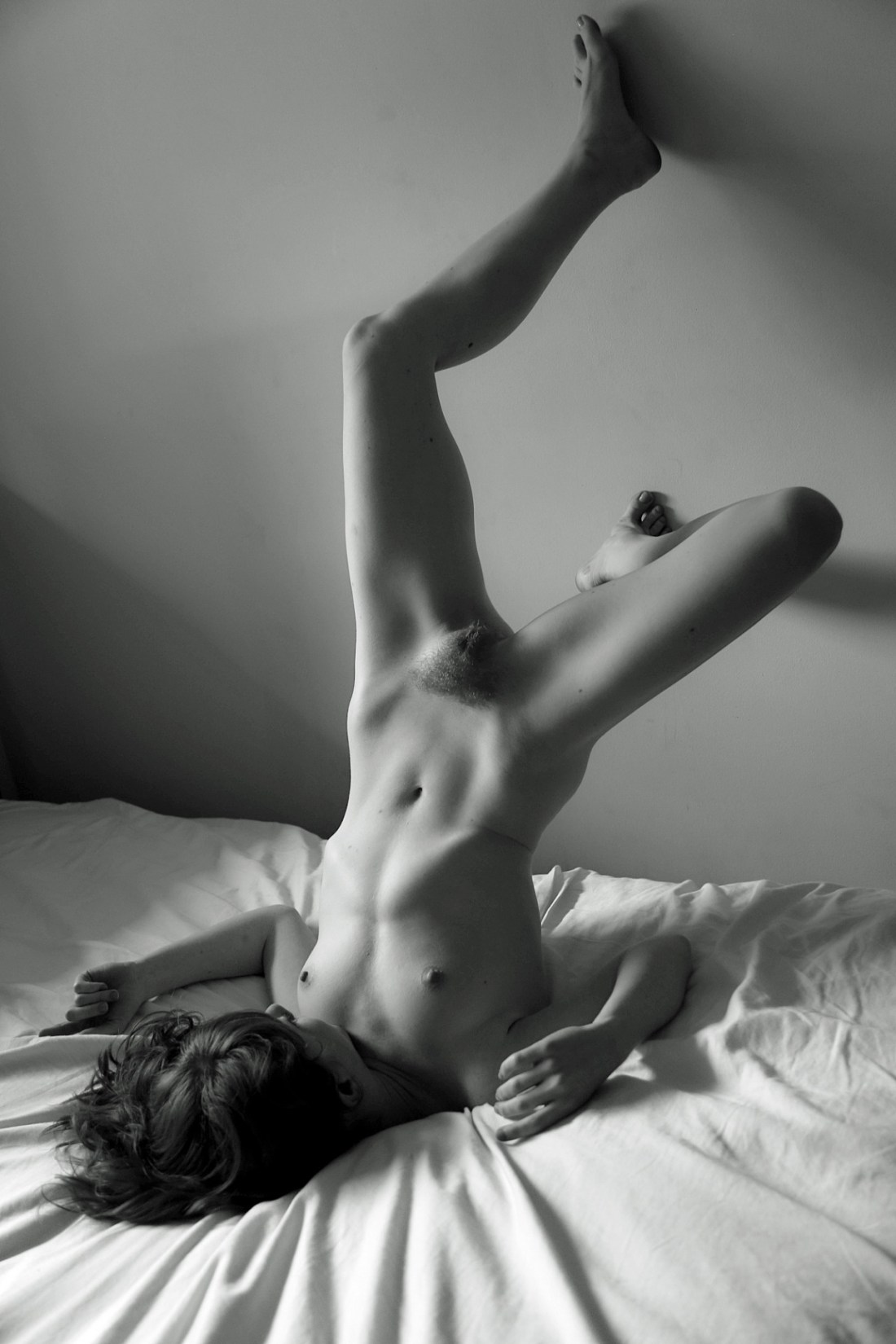
Werner LorbertLiv Sage (2013)

Liv Sage posted this image as a part of a photo set over on her Tumblr.

I’ve excised the above image from the set and re-posted instead or reblogging for several reasons.

First: Tumblr’s layout interface can place two vertically oriented frames side by side with minimal cropping. However, any time you add more than two vertical images, the default grid presentation clips the shit out of vertical frames. Sadly, the layout ends up being a huge detriment to the images.

Second: I have (admittedly insignificant) quibbles with three of the other five images.

Third: I really want to showcase this image on its own because it’s exceptional and absolutely NOT #skinnyframebullshit.

Why? You ask. Well, my eye enters the frame in the upper left third, follows the line of angled light at a downward diagonal and then I follow the left edge of her body down to the bed. The way the wrinkles in the topsheet radiate halo-like from her head and shoulders–and this is the way I think most peoples’ eyes first enter the frame–makes her head a focal point of the image; her gaze is directed back upward and the viewer naturally follows this upward.

So why isn’t it #skinnyframebullshit? Simple: it insists upon your eye moving up and down the frame–not left to right across it.

It’s a great image because it uses this compositional logic to guide the eye toward all the treasures this image holds–as I’ve mentioned the wrinkles forming a halo, the compression of highlights, mid-tones and shadows in order to expand the range between highlight and mid-tones and mid-tones and shadows, respectively.

And it may seem like a small thing but you can clearly see both her hands and both her feet, which contributes a sensuous sinuosity to her exquisite muscle town which is not only extraordinarily flattering, it also lends a naturalism to an otherwise unnaturally contorted posture.